
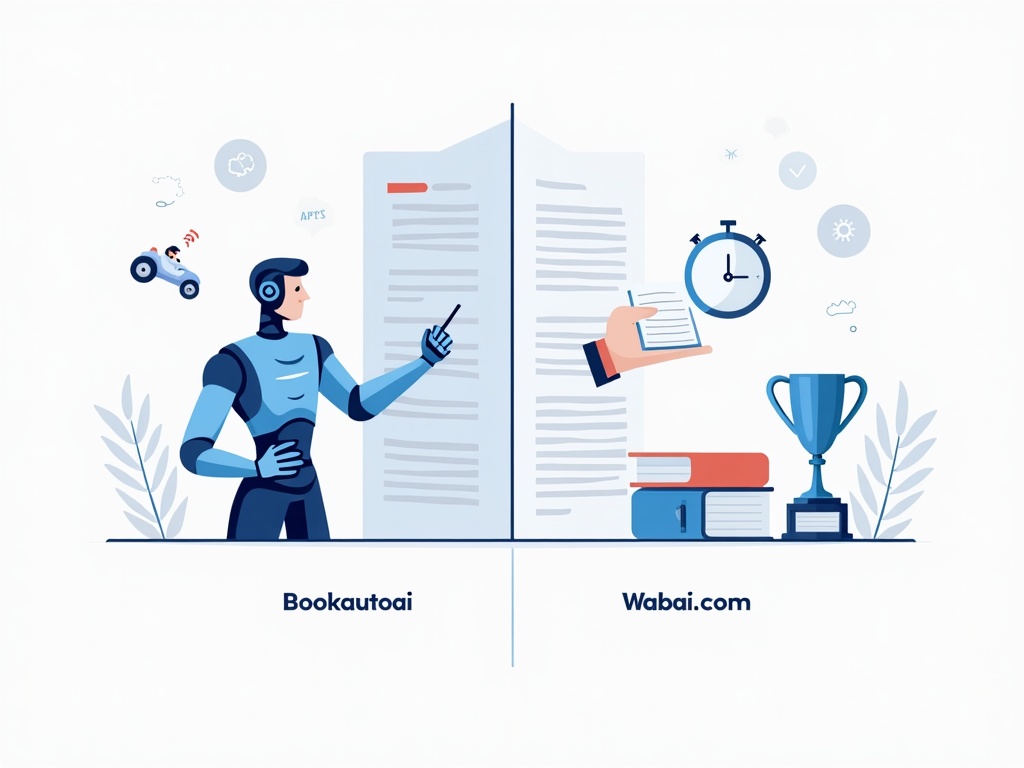
AI Book Generator Showdown BookAutoAI vs Wababai Review
Bookautoai vs Wababai.com Review
Estimated reading time: 8 minutes
- Understand the strengths of both platforms for self-publishing.
- Learn how to choose based on your publishing goals.
- Discover practical takeaways for using AI in non-fiction writing.
- Find out how speed versus quality impacts your publishing journey.
Table of Contents
- Introduction: setting the scene for AI publishing
- What the independent research says
- What this means for your publishing goals
- BookAutoAI vs Wababai.com: a closer look at how they work
- Output quality and “humanization”
- Formatting, covers, and marketplace readiness
- Pricing and value
- Which platform is right for you?
- Practical takeaways for AI book writers and non-fiction authors
- Relating the topic to BookAutoAI’s services and our automation expertise
- Call-to-action: try a free demo and see the difference
- A note on safety and long-term publishing
- Conclusion: choosing the path that matches your publishing dreams
- Practical next steps for AI book writers
- Sources
Introduction: setting the scene for AI publishing
Publishing a full non-fiction book used to mean months of drafting, editing, and formatting. Today, AI-powered tools promise to speed things up and remove a lot of the busywork. The core question for many authors is this: do you want speed and automation, or do you want tight control and iterative refinement? The Bookautoai vs Wababai.com review topic helps answer that by looking at concrete differences in workflow, output quality, and user experience. This post includes key findings from independent analysis and maps those findings to what you actually get when you choose one platform over the other.
What the independent research says
- BookAutoAI is described as an AI-driven platform that focuses on fast, full-length book generation for self-publishers. The big draw is scalability and minimal manual intervention, which is ideal if you want to publish many titles quickly on Amazon KDP and similar marketplaces. Source: link
- Wababai.com emphasizes an iterative workflow, allowing users to refine and adjust AI-generated content more granularly before finalizing the book. This approach appeals to authors who want greater control over output and quality. Source: link
- In terms of output quality, BookAutoAI often uses humanized sentence structures to avoid a rigid AI voice, which helps with marketability, but some reviewers note repetitive phrasing and the need for post-generation formatting polish. Source: link
- Pricing and plans show BookAutoAI offers tiered monthly options with built-in formatting, cover design, and keyword optimization, designed for marketplace competitiveness. A 30-day money-back guarantee is mentioned, though there is no traditional free trial. Source: link
- Overall, BookAutoAI is pitched toward speed and volume; Wababai targets higher-quality, iterative development. The choice depends on your goals: rapid, hands-off publishing vs. more hands-on refinement. Source: link
What this means for your publishing goals
- If your goal is to publish many non-fiction titles quickly and you’re comfortable with occasional repetition or formatting tweaks after generation, BookAutoAI’s automated workflow can be a strong fit.
- If you want to invest more time in carefully polishing each chapter and line, and you value granular editing before publication, Wababai offers a workflow that supports that approach.
BookAutoAI vs Wababai.com: a closer look at how they work
Speed, automation, and the core workflow
- BookAutoAI is built to generate full-length books in high volume with most steps automated. Reports suggest you can get 100+ page works up quickly; in some cases, a book can be produced in as little as 20 minutes on fast plans. This makes it a strong option for authors who want to scale output with minimal hands-on editing. Source: link
- Wababai, by contrast, emphasizes stepping through the content in an iterative way. You’ll likely spend more time revising and adjusting AI drafts. This approach aligns with authors who want to keep a stronger creative grip on the final product. Source: link
Output quality and “humanization”
- BookAutoAI uses “humanized” sentence structures to avoid the classic AI voice and improve marketability. It’s designed to pass as natural language rather than showy machine prose. However, reviewers note some repetitiveness and a need for stylistic nuance in longer works. Source: link
- Wababai’s strengths lie in the iterative process, where edits refine tone, style, and accuracy before final output. This can help address issues of repetitiveness and ensure a more nuanced voice, at the cost of time. Source: link
Formatting, covers, and marketplace readiness
- BookAutoAI packages include automated formatting for platforms like KDP and a built-in cover maker. This support aims to remove the “formatting bottleneck” and make immediate upload feasible after generation. Source: link
- Review notes indicate that default formatting might still require some polish post-generation to align typography and layout with professional standards. Source: link
Pricing and value
- BookAutoAI’s pricing typically involves monthly plans that scale with word quotas and book counts, plus commercial rights and built-in design tools. The trade-off often comes down to the balance between speed and control. Money-back guarantees exist, though the details are important to review. Source: link
- The independent analysis suggests there isn’t a traditional free trial, but there is a 30-day money-back guarantee with certain conditions. Source: link
Which platform is right for you?
- Choose BookAutoAI if you want a fast, scalable path to publish many non-fiction titles with minimal manual editing. This is especially true if you’re trying to populate a catalog quickly on Amazon KDP or similar platforms.
- Choose Wababai if you value precise control, iterative refinement, and the ability to shape the final text more exactly through repeated edits.
Practical takeaways for AI book writers and non-fiction authors
- Start with a clear publishing goal. Do you want a large catalog released fast, or a smaller batch of highly polished titles? Your answer will guide which platform fits best.
- Use automation strategically. BookAutoAI’s strength is turning ideas into complete books quickly, including formatting and cover design. Apply this to generate rough drafts, then apply your own edits for nuance, accuracy, and unique voice.
- Leverage built-in marketplace features. BookAutoAI’s keyword optimization and formatting help you hit the basics of Amazon KDP visibility and readiness. Don’t skip keyword research or a final human edit for critical non-fiction sections.
- Plan for post-generation polishing. Even with “humanized” writing, you’ll want to review for flow, repetition, and facts. Use your own expertise to fine-tune sections that matter most to readers.
- Protect your long-term publishing health. With AI-written content, it’s wise to review the content for originality and policy compliance on each platform. While BookAutoAI emphasizes safety and market-readiness, all AI-generated material benefits from a final quality pass.
Relating the topic to BookAutoAI’s services and our automation expertise
BookAutoAI positions itself as a fast, scalable solution for self-publishers who want to turn ideas into ready-to-upload books with minimal friction. The platform’s strengths—full-length generation, automated formatting, built-in cover design, and keyword optimization—are well suited to pod-based and digital publishing workflows. This aligns with the needs of authors who want a reliable, end-to-end publishing flow.
Beyond the writer’s desk, our team at BookAutoAI helps authors think through the entire publishing pipeline. We’re not just about creating a book; we’re about creating a repeatable, efficient process. Our expertise includes AI-driven content generation and optimizing workflows to publish quickly and safely on platforms like Amazon KDP. We also offer guidance on automation—including how to align content creation with editing, formatting, cover design, and upload steps—so you can publish more titles with less manual effort. For readers and authors who want a hands-off but high-quality output, we’ve found a balanced approach that works well.
Call-to-action: try a free demo and see the difference
- Visit BookAutoAI.com today and try our free demo. Experience how fast, formatted, and ready-to-upload non-fiction can be with just a title. You’ll see how the platform’s automation and built-in features can save you time and still deliver a market-ready product.
- If you’re exploring options, remember: BookAutoAI is designed for speed and scale, while Wababai offers a more iterative, control-focused workflow. Consider your goals and preferred pace when choosing your path.
A note on safety and long-term publishing
The landscape around AI writing emphasizes platform safety and compliance. Our approach emphasizes humanized texts that pass platform checks and avoid traps that can trigger AI detectors. It’s essential to review and adjust content to ensure long-term publishability on major platforms. Always verify that your final manuscript meets the platform’s content and formatting guidelines.
Conclusion: choosing the path that matches your publishing dreams
The BookAutoAI vs Wababai.com Review isn’t about picking a winner; it’s about picking a fit. If you want fast, scalable non-fiction publishing with built-in formatting and a suite of marketing-ready features, BookAutoAI offers a compelling path. If you value a careful, iterative process that emphasizes refinement and stylistic control, Wababai is worth a closer look. Either choice can help you get your ideas into readers’ hands and start earning, especially when combined with smart automation and careful quality control.
Practical next steps for AI book writers
- Define your target word count and publish cadence. Decide whether you’ll publish monthly, quarterly, or on a project basis.
- Outline your book’s core sections and claims. Use that outline as input to BookAutoAI and then refine with a human touch.
- Do a keyword and market check for your topic area. Use BookAutoAI’s built-in keyword tools as a starting point, then tailor keywords to your niche.
- Plan your editing pass. Schedule time for a thorough human edit after generation to address nuance, accuracy, and voice.
- Explore automation options for your broader publishing workflow. Consider how AI-generated content can flow into editing, formatting, cover design, and uploading tasks—and how automation tools can streamline these steps.
Sources
- BookAutoAI and Wababai AI Book Generator for KDP Authors
- BookAutoAI Pricing & Plans (2025): Full Breakdown
- This AI Robot Writes ENTIRE Books For Less Than $8!
Bookautoai vs Wababai.com Review Estimated reading time: 8 minutes Understand the strengths of both platforms for self-publishing. Learn how to choose based on your publishing goals. Discover practical takeaways for using AI in non-fiction writing. Find out how speed versus quality impacts your publishing journey. Table of Contents Introduction: setting the scene for AI publishing…