
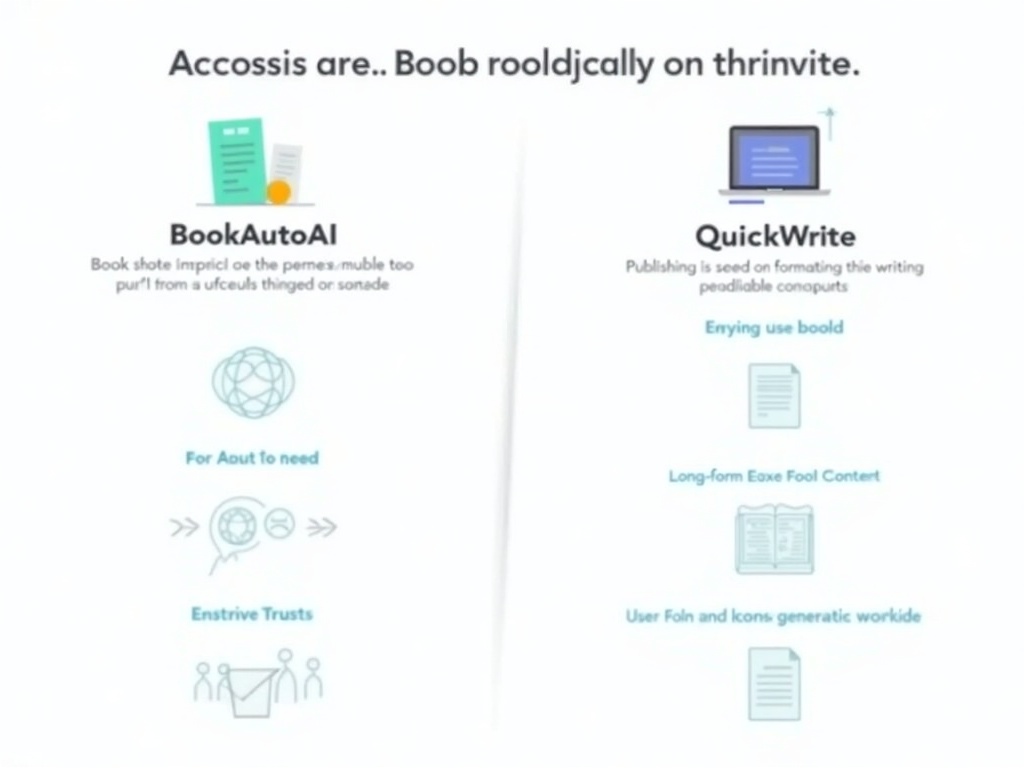
AI Book Generator for KDP BookAutoAI vs QuickWrite
BookAutoAI vs QuickWrite Review
Estimated Reading Time: 7 minutes
- BookAutoAI offers an end-to-end publishing solution with quick generation of long-form content and ready-to-upload outputs.
- QuickWrite lags in visibility and features compared to BookAutoAI, affecting user trust.
- The comparison highlights crucial factors for non-fiction authors: speed, ease of formatting, and credible outputs.
- Independent reviews favor BookAutoAI for its comprehensive documentation and clear publishing journey.
- Authors need to remain vigilant about content quality and Amazon’s guidelines, regardless of the tool used.
Table of Contents
- Introduction
- What these tools promise
- Why this topic matters to non-fiction authors
- What the independent findings say (research-based overview)
- What this means for your publishing journey
- How the technologies tie into practical publishing workflows
- A practical take for AI book writers and non-fiction authors
- How BookAutoAI fits into a publisher’s or author’s service portfolio
- A look at the numbers and claims
- What this means for authors deciding between BookAutoAI and QuickWrite
- Practical takeaways for AI book writers and non-fiction authors
- Call to action: Try BookAutoAI for yourself
- FAQ section
Introduction
If you’re an author who wants to publish fast on Kindle Direct Publishing (KDP) without losing readability, you’ve probably heard about AI book writers like BookAutoAI and QuickWrite. This week, the hot topic is BookAutoAI vs QuickWrite Review, a comparison that helps non-fiction authors decide where to put their time, money, and trust. The big idea is simple: can an AI tool help you generate solid, ready-to-upload non-fiction books—fast, reliably, and at a price that won’t break your book budget? In this post, we break down the trends, the facts, and the practical takeaways from independent research, so you can choose a path that fits your publishing goals.
What these tools promise
- BookAutoAI is pitched as an end-to-end publishing companion. It promises quick generation of long-form, non-fiction content, built-in humanization to improve readability, and fully formatted outputs that are ready to upload to KDP (Kindle), paperback, and even audio formats. The claim is speed: 100+ page non-fiction books with just a few clicks, including covers and metadata.
- QuickWrite is portrayed as a capable AI writer for KDP, but with a smaller footprint in terms of documentation, independent reviews, and visible publishing workflows. In many independent comparisons, QuickWrite lags behind BookAutoAI in documented features and publishing flow coverage.
Why this topic matters to non-fiction authors
- For authors who want to scale non-fiction publishing, the speed-to-market, the ease of formatting, and the ability to publish across Kindle, paperback, and audiobook formats are critical. The industry has seen rapid shifts as AI-assisted tools become more common, but the quality of output, the reliability of formatting, and the trust readers place in credible, human-like writing remain essential.
- The research on these tools shows that BookAutoAI tends to have more in-depth independent coverage and a broader, more cohesive publishing journey. QuickWrite, while valued by some users, often lacks the same level of independent documentation and broad comparative analysis. This difference matters for authors who want transparent workflows and credible, long-term publishing strategies.
What the independent findings say (research-based overview)
- BookAutoAI has stronger independent review coverage compared to QuickWrite, which suggests greater transparency and higher user trust for potential KDP authors. Key sources discussing this include in-depth analysis and comparisons on BookAutoAI’s own blog and public videos:
- BookAutoAI’s detailed comparisons and reviews
- Further analysis of AI book writing for KDP
- Independent video review coverage
- BookAutoAI offers a full “publishing journey” solution. Authors can generate, format, and optimize for Kindle, paperback, and audiobook releases. This end-to-end workflow is highlighted as a key differentiator from QuickWrite in published materials:
- QuickWrite has less extensive independent documentation and review coverage. Most comparative analyses either highlight BookAutoAI or note insufficient QuickWrite detail:
- Video reviews emphasize BookAutoAI’s ability to generate substantial content quickly, with claims of 100+ page non-fiction books produced in minutes and significant time-saving advantages for authors aiming to move from low-content to high-content publishing:
- The overarching assessments acknowledge speed, scalability, and ease of use as strong advantages for BookAutoAI, while also noting risks like generic AI content quality, the possibility of errors, and the need to stay aligned with evolving Amazon content guidelines.
- Comparative landscape: Other tools in the space (Sudowrite, Jasper, Squibler, Designrr) are often discussed as either more versatile for fiction or more specialized in particular workflows. BookAutoAI positions itself as a robust option for high-volume non-fiction publishing on Amazon, often outperforming QuickWrite in published reviews and practical demonstrations.
What this means for your publishing journey
- If you are focused on high-volume non-fiction and want a cohesive path from draft to publish-ready asset, BookAutoAI’s end-to-end workflow can save you time and reduce manual formatting steps. Independent coverage supports the idea that BookAutoAI is the more robust, better-documented option between these two tools for non-fiction authors aiming for Amazon KDP.
- That said, no AI solution is perfect. The risk of generic-sounding text, factual or stylistic errors, and the need to adhere to Amazon’s evolving guidelines means that editorial oversight and manual review remain important steps in your process.
How the technologies tie into practical publishing workflows
- AI generation: Both tools provide long-form content generation, but BookAutoAI emphasizes a finished manuscript approach with metadata, outline, and content drafted in a streamlined flow. This can dramatically reduce the time from concept to a complete draft.
- Humanization and readability: BookAutoAI’s built-in humanization features aim to produce text that reads more naturally, which helps the manuscript feel less “robotic.” While this can improve reader experience, authors should still plan for editorial review to ensure nuance, accuracy, and voice consistency.
- Formatting and uploads: A standout benefit of BookAutoAI is fully formatted outputs designed to be upload-ready for KDP, Kindle, paperback, and even audio formats. This reduces time spent on fiddling with formats and ensures consistency across formats.
- Costs and scalability: The value proposition centers on affordability and scalability, with claims of lower per-book costs compared to manual writing. Independent reviews highlight that the price point is compelling for authors who want to publish at scale.
Understanding risks and best practices
- Content quality: AI-generated content can be generic or repetitive. It’s essential to build quality editorial checks, verify facts, and refine unique voice and insights. Some external sources caution that even with strong tools, substantial manual editing remains important.
- Platform policies: Amazon’s content guidelines change over time. Staying compliant means regularly auditing your manuscripts for originality, accuracy, and compliance. This is a shared risk regardless of the tool you use.
- Editing overhead: Even with ready-to-upload formatting, some authors will still need to invest time in editing, proofreading, and fact-checking to ensure a high-quality publish.
- Long-term strategy: For authors who want more than one book a month or who aim to diversify across formats and channels, a robust, repeatable workflow is critical. This is where BookAutoAI’s end-to-end approach can be advantageous, especially when paired with automation tools.
A practical take for AI book writers and non-fiction authors
- Start with a clear publishing plan: Even with AI tools, map out your target audience, niche, and the kinds of non-fiction topics you’ll cover. This will guide your outline, tone, and the kind of metadata you’ll need for KDP.
- Use humanization as a quality lift, not a shortcut: Leverage BookAutoAI’s humanization features to improve readability, but plan for light editing to inject voice, examples, and clarity. Don’t rely on AI alone for accuracy or voice.
- Embrace a repeatable workflow: Build a repeatable workflow that includes generation, editing, formatting, and uploading. Consider integrating n8n or other automation tools to reduce manual steps and improve consistency.
- Invest in metadata and marketing assets: AI can draft descriptions and keywords, but human oversight is important for SEO and market positioning. Refine titles, subtitles, and metadata to align with your audience and Amazon’s search behavior.
- Stay compliant with policies: Regularly review Amazon’s publishing guidelines. Ensure your content adheres to policy standards to reduce the risk of takedowns or content issues.
How BookAutoAI fits into a publisher’s or author’s service portfolio
- Full 25,000 words: The platform promises complete non-fiction books with substantial length, suitable for KDP-style publishing, with natural, consistent reads.
- Humanized writing: A key differentiator is the focus on producing text that reads like human writing, which helps with readability and long-term platform safety and discoverability.
- Fully formatted outputs: The system exports ready-to-upload files for various publishing formats, saving a lot of formatting time for authors.
- Speed and affordability: The ability to generate book-length content quickly, combined with a price point described as under $8 per book in some materials, creates a compelling value proposition for authors who want to scale their publishing efforts without large upfront investments.
- Editorial and risk awareness: While AI can accelerate content creation, authors are advised to maintain editorial oversight to ensure quality, factual accuracy, and alignment with Amazon guidelines.
A look at the numbers and claims
- Length and speed: BookAutoAI claims books of 100+ pages can be produced quickly, with full drafts, covers, metadata, and outlines available in minutes. Independent reviews echo this speed and its potential for budget-conscious, high-volume publishing.
- Humanization: The platform emphasizes human-like writing quality, with content designed to be perceived as human-authored, which can support audience trust and engagement.
- Formatting: The service promises fully formatted outputs that need no extra formatting work before uploading to KDP or other platforms.
- Pricing: The platform advertises a low-cost model, including full book generation for a price described as under $8 per book by some reviewers and videos.
- Risks: Independent sources caution about the potential for generic content and the need for editorial oversight to ensure high-quality output and policy alignment.
What this means for authors deciding between BookAutoAI and QuickWrite
- Independent coverage and depth: BookAutoAI has more extensive independent reviews and a broader publishing-capable feature set. This matters if you want confidence in a tool that can guide you from draft to publish across formats.
- End-to-end publishing: If your goal is a streamlined publishing journey—from generation to upload—BookAutoAI’s cohesive workflow provides a strong case.
- Documentation and transparency: The published material around QuickWrite often lacks the same level of independent documentation and review coverage, which can be a consideration for risk-conscious authors.
- Editor-friendly approach: Regardless of tool, you will likely need some human editing. BookAutoAI’s approach emphasizes readability and structure, which can reduce time in later editing stages.
Practical takeaways for AI book writers and non-fiction authors
- Leverage end-to-end tools for speed, but keep a human-in-the-loop: Use BookAutoAI to draft and format, but retain a careful editor to polish voice, verify facts, and ensure clarity.
- Build a repeatable publishing pipeline: Use automation to standardize the steps you take for each book—outline, draft, edit, format, metadata, and upload—to maximize consistency and reduce mistakes.
- Invest in metadata and market positioning: The right keywords, descriptions, and blurbs can dramatically impact discoverability and sales on KDP.
- Plan for multi-format publishing: If you want Kindle, paperback, and audiobook, ensure your pipeline supports all formats and that you have assets (covers, metadata, audio scripts) ready for each format.
- Consider cost versus value: BookAutoAI’s pricing is positioned to be budget-friendly for high-volume authors. Evaluate your per-book cost against potential earnings and your publishing cadence.
Call to action: Try BookAutoAI for yourself
If you’re ready to see how a modern AI-powered publishing workflow can transform your non-fiction books, visit BookAutoAI and try our free demo. Our platform promises a complete, ready-to-upload manuscript with natural writing, built-in formatting, and an end-to-end publishing journey designed for KDP and beyond. It’s a compelling offer—designed to be hard to refuse for authors who want speed, quality, and a streamlined path to earning passive income through publishing.
FAQ section
- What is BookAutoAI? BookAutoAI is a comprehensive AI tool that assists authors in generating and formatting non-fiction books rapidly for various publishing formats.
- Is QuickWrite a good alternative? While QuickWrite can serve authors, it generally lacks the extensive features and independent documentation that BookAutoAI offers.
- What should I consider when choosing between these tools? Consider your publishing needs, the level of support available, and the trustworthiness of each platform based on independent reviews.
- How important is editorial oversight when using AI tools? It is crucial to maintain editorial oversight to ensure the quality, accuracy, and voice of the content generated by AI tools.
- Can I try BookAutoAI for free? Yes, you can visit BookAutoAI to access a free demo and experience its features firsthand.
BookAutoAI vs QuickWrite Review Estimated Reading Time: 7 minutes BookAutoAI offers an end-to-end publishing solution with quick generation of long-form content and ready-to-upload outputs. QuickWrite lags in visibility and features compared to BookAutoAI, affecting user trust. The comparison highlights crucial factors for non-fiction authors: speed, ease of formatting, and credible outputs. Independent reviews favor BookAutoAI…