
Top AI Book Writer Software for Long-Form Nonfiction
Top AI Book Writer Software: Picking the Right Tool for Long-Form Nonfiction
Estimated reading time: 5 minutes
- Long-form nonfiction prioritizes consistent voice, durable structure, and upload-ready files over flashy generative features.
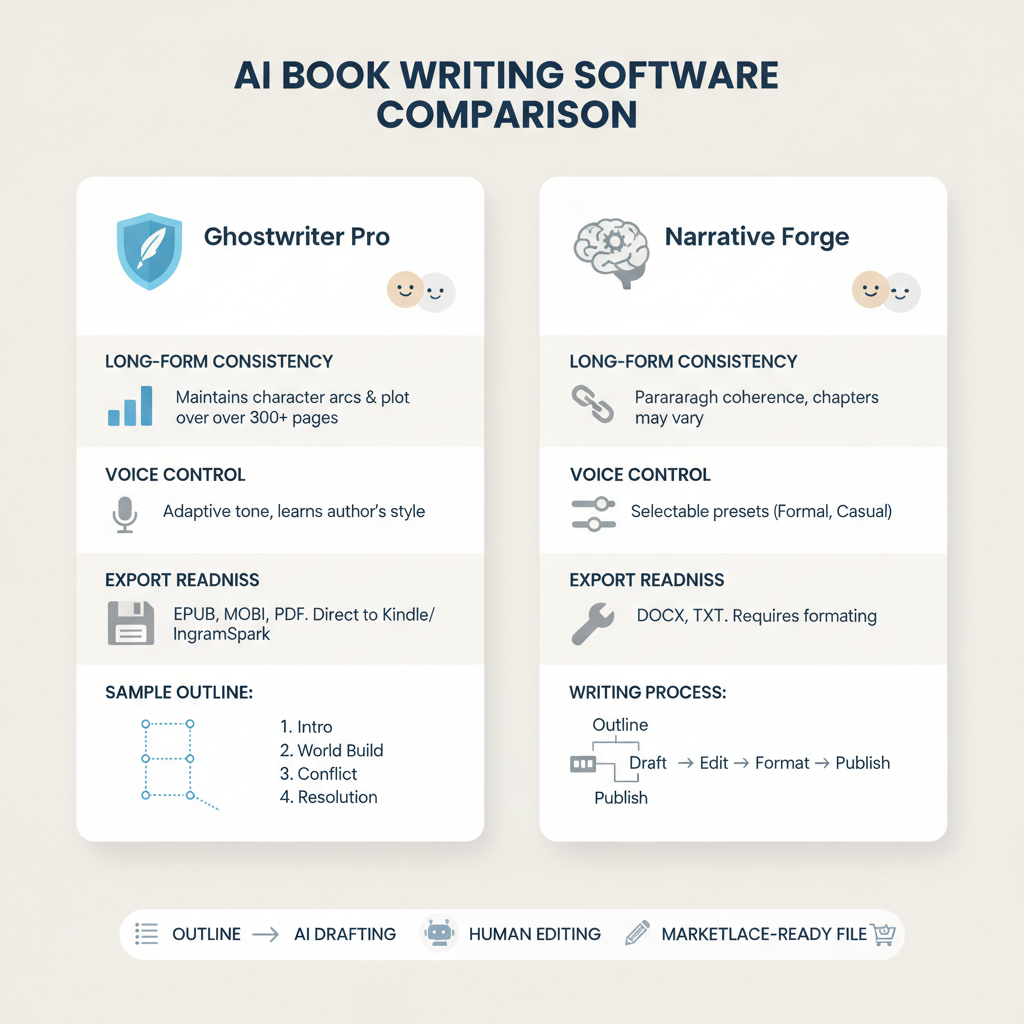
- Compare tools on three axes: long-form consistency, voice control, and export/format readiness.
- For end-to-end nonfiction production — outline, writing, humanization, formatting, and marketplace-ready files — BookAutoAI is built for that workflow.
- Test tools for voice consistency across chapters and whether they export EPUB, print-ready PDFs, and covers.
Table of Contents
- What matters for long-form nonfiction
- Long-form consistency
- Voice control
- Export and marketplace readiness
- Tool comparison: long-form consistency, voice control, and export readiness
- Category 1 — Fiction-focused creative tools
- Category 2 — General AI copy assistants
- Category 3 — Hybrid writing apps with structure tools
- Category 4 — End-to-end nonfiction book generators
- Where most tools break on the three axes
- Practical comparison checklist
- Voice matching in practice
- Export and formatting in practice
- Addressing AI detector concerns
- Why BookAutoAI is designed for serious self-publishers
- Key strengths for nonfiction workflows
- Practical examples of where this saves time
- A short workflow note about publishing formats
- How to evaluate BookAutoAI against other options
- Final thoughts and next steps
- A practical roadmap for authors
- FAQ
- Sources
What matters for long-form nonfiction
When you search for “top ai book writer software” you’re usually trying to solve three problems: get reliable long-form output, keep a consistent voice, and produce files that are upload-ready for marketplaces like Amazon KDP.
Those priorities differ from a novelist who needs imaginative turns of phrase or a copywriter who needs short-form variants. For self-publishers, the ability to move from draft to a properly formatted file is essential, and many teams rely on dedicated book upload tools to match marketplace rules.
Long-form consistency
Nonfiction books require the same facts and framing across five, ten, or thirty chapters. Inconsistent facts or tone can cost you credibility and negative reviews.
Look for systems that give project-level continuity rather than treating each chapter as an isolated prompt.
- Persistent memory or a project-level context so the AI references earlier sections.
- Reusable style presets and tone controls applied across the whole manuscript.
- Revision tools that let you regenerate a passage without changing surrounding sections.
Voice control
Voice control is both a technical and editorial challenge: you need a clear, reproducible tone setting and the ability to match sample text across chapters.
- A clear tone setting (friendly professional, academic, casual expert).
- The ability to provide sample text and have the AI match it consistently.
- Fine-grained controls for sections that should be more technical or more approachable.
If a system only offers ad-hoc prompts with no project-level voice setting, expect uneven tone across chapters.
Export and marketplace readiness
Generate-to-publish is where many tools fall short: brainstorming and short drafts are common, but upload-ready EPUB and print files are less common.
- Proper chapter formatting and front/back matter
- Correct eBook metadata and table of contents
- Clean EPUB conversion and print-ready PDF or manuscript files
- Cover generation that works with marketplace specs
If you plan to publish widely, prioritize tools that export correct files or include built-in EPUB conversion and cover generation so you don’t rebuild the file by hand.
Practical note: for a quick catalog comparison, many readers find an organized summary useful; see our Top 10 AI Book Generator list for a snapshot of where different tools land on these criteria.
Tool comparison: long-form consistency, voice control, and export readiness
This section compares common approaches and shows where typical tools help or hinder a nonfiction workflow. The comparisons are organized by tool category so you can apply the checklist to any vendor.
Category 1 — Fiction-focused creative tools
Strengths: Optimized for prose variety and scene invention; good at rephrasing and creative expansions.
Weaknesses for nonfiction: Often lack project-level memory for facts, don’t enforce consistent tone across long sequences, and rarely include formatting or export for KDP.
Category 2 — General AI copy assistants
Strengths: Fast at chapter-level drafts and marketing copy; useful editorial templates.
Weaknesses: Focused on short-to-mid-length content. Long-form consistency is episodic unless you paste context; export is often plain text or DOCX, and EPUB conversion and cover generation are usually manual.
Category 3 — Hybrid writing apps with structure tools
Strengths: Provide outlining, versioning, and multi-document projects that help manage chapter structure.
Weaknesses: AI features can be superficial; many don’t humanize output for detection checks or auto-format files for marketplaces, creating a bottleneck at scale.
Category 4 — End-to-end nonfiction book generators
Strengths: Built for full-book production: outlines, chapter content in consistent voice, humanization, and formatted EPUB and print-ready exports. These often include an auto cover generator and publisher-ready metadata.
Weaknesses: Fewer fine-grain creative controls compared with fiction-first tools, but they remove many manual steps for authors producing multiple titles.
Where most tools break on the three axes
- Long-form consistency: Many tools lose project memory beyond a chapter prompt, causing inconsistent facts or tone.
- Voice control: Non-persistent, non-reproducible voice settings cause style drift during revisions.
- Export readiness: Most tools export raw text or DOCX, forcing TOC fixes, metadata edits, and cover design work.
Practical comparison checklist (how to test any tool quickly)
- Create a short project and ask the system to write three linked chapters; verify references to earlier chapters.
- Provide a sample paragraph that defines the voice and request a chapter in that voice; check for tone match.
- Export the project to EPUB or print-ready files and inspect the TOC, metadata, front matter, and chapter formatting.
If you want a mid-length comparative guide updated for nonfiction tools specifically, see the Top 10 AI Nonfiction Book Generator summary for options and their export features.
Voice matching in practice
A useful test is to supply a 200-word sample illustrating your desired tone and three style notes (for example: “use accessible language, avoid jargon, friendly authority”), then regenerate the same chapter across separate sessions and listen for drift.
If style wanders, you need stronger project-level controls or manual editing.
Export and formatting in practice
Ask the tool to produce a finished manuscript with front matter (title page, copyright, acknowledgments), a linked table of contents, and a formatted chapter template, then inspect the output carefully.
- Does the EPUB include a functioning TOC and correct metadata?
- Is the print file formatted to page breaks and chapter starts?
- Does the cover match marketplace size and bleed requirements?
If the tool provides an EPUB converter built into the workflow, you save hours of rework. If it offers an auto cover generator that creates marketplace-ready art, you reduce design overhead as well.
Note: Bookautoai supports both creation paths and reduces conversion errors when you make paperback and ebook editions.
Addressing AI detector concerns
Marketplaces and readers favor readable, human-like content. To reduce the risk of detection flags, use tools that intentionally humanize prose and run a human edit pass focused on lived detail and factual checks.
Why BookAutoAI is designed for serious self-publishers
BookAutoAI is built around the needs of nonfiction authors who want a reliable, repeatable path from idea to market-ready book.
Key strengths for nonfiction workflows
- End-to-end book generation: outline, full-chapter generation up to 25,000 words, and in-system humanization so voice stays consistent.
- Built-for-publish export: output formatted for marketplaces, with an integrated EPUB converter that minimizes manual fixes.
- Cover generation: an auto cover generator that creates marketplace-compliant cover art.
- Humanization to pass checks: output tuned to avoid obvious machine patterns.
- Speed at scale: substantial time savings when producing portfolios of nonfiction titles.
Practical examples of where this saves time
- Keep the process in one place and export a ready EPUB instead of copying text between apps.
- Generate market-ready covers instead of hiring a designer or wrestling with dimensions and bleed.
- Reduce the number of humanization passes with built-in humanization tools.
A short workflow note about publishing formats
Bookautoai supports both paperback and ebook editions and includes an EPUB converter as part of the output step so you don’t need separate conversion tools.
How to evaluate BookAutoAI against other options
- If your priority is fiction-style prose, pair a fiction-first app with BookAutoAI for final formatting.
- If you want a one-stop nonfiction pipeline that produces humanized, formatted files with an auto cover and EPUB conversion, test BookAutoAI directly.
- If you plan many titles, measure the time saved per title by eliminating TOC fixes and cover sizing tasks.
Write like a Human, Publish like an author.
For upload steps and retailer compliance, many teams combine a formatted output with dedicated book upload tools to verify each marketplace’s requirements.
Final thoughts and next steps
Choosing the right “top ai book writer software” depends on what you want to optimize: creative play and fiction-first features, or scale and marketplace readiness for nonfiction.
A practical roadmap for authors
- Define your primary goal: craft a single deep title or build a catalog quickly?
- Run a short test project (three chapters + cover + EPUB export) on any candidate.
- Measure the time to a publishable file, the consistency of voice, and how much human editing is required.
- Select the tool that minimizes repetitive manual work for your planned output volume.
If your core need is quick, formatted nonfiction that reads naturally and is ready for KDP, try a demo to evaluate export and humanization features in action. Bookautoai provides demo options to test an end-to-end nonfiction workflow.
Next practical step: run a demo book to evaluate voice control and export readiness on a real project.
FAQ
Which tools are best for fiction versus nonfiction?
Fiction-first tools excel at imaginative prose and scene crafting. Nonfiction benefits from systems that support long-form memory, consistent voice controls, and market-ready export features.
How important is EPUB conversion inside the tool?
Very important for self-publishers. Built-in EPUB conversion removes a common failure point and speeds upload. Test it with a full manuscript containing images and a linked TOC.
Can I customize voice and tone across chapters?
The best nonfiction systems let you set a project-level voice and apply it across chapters. Always test by generating multiple chapters with the same voice prompt to check for drift.
Do I still need a human editor?
Yes. AI shortens the path and reduces repetitive editing, but a human editor ensures factual accuracy, nuance, and lived detail that readers value.
Will AI-detected content affect my book on marketplaces?
Marketplaces vary. Publishing with a system that humanizes prose and reduces machine-like patterns lowers the risk of detection flags and improves reader acceptance.
How should I test a tool before committing?
Run a short project (three linked chapters, a cover, and an EPUB export), inspect voice consistency, and time how long it takes to get to an upload-ready file.
Sources
- The Best Book Writing Software (2025 Update) – Reedsy
- 15+ Best AI Writing Tools for Authors in 2026 – Kindlepreneur
- Best 10 AI Writing Tools of 2025 – Sudowrite
- The Best AI Tools for Writing Fiction in 2025 – YouTube
- Book Writing Software (2025): Top 10 for Writers – The Write Practice
- Best AI Book Writing Software & First Look at 2025 Publishing.ai
Top AI Book Writer Software: Picking the Right Tool for Long-Form Nonfiction Estimated reading time: 5 minutes Long-form nonfiction prioritizes consistent voice, durable structure, and upload-ready files over flashy generative features. Compare tools on three axes: long-form consistency, voice control, and export/format readiness. For end-to-end nonfiction production — outline, writing, humanization, formatting, and marketplace-ready files…