
AI Book Generator vs ChatGPT for Writing a Book Explained
ai book generator vs chatgpt for writing a book
Estimated reading time: 6 minutes
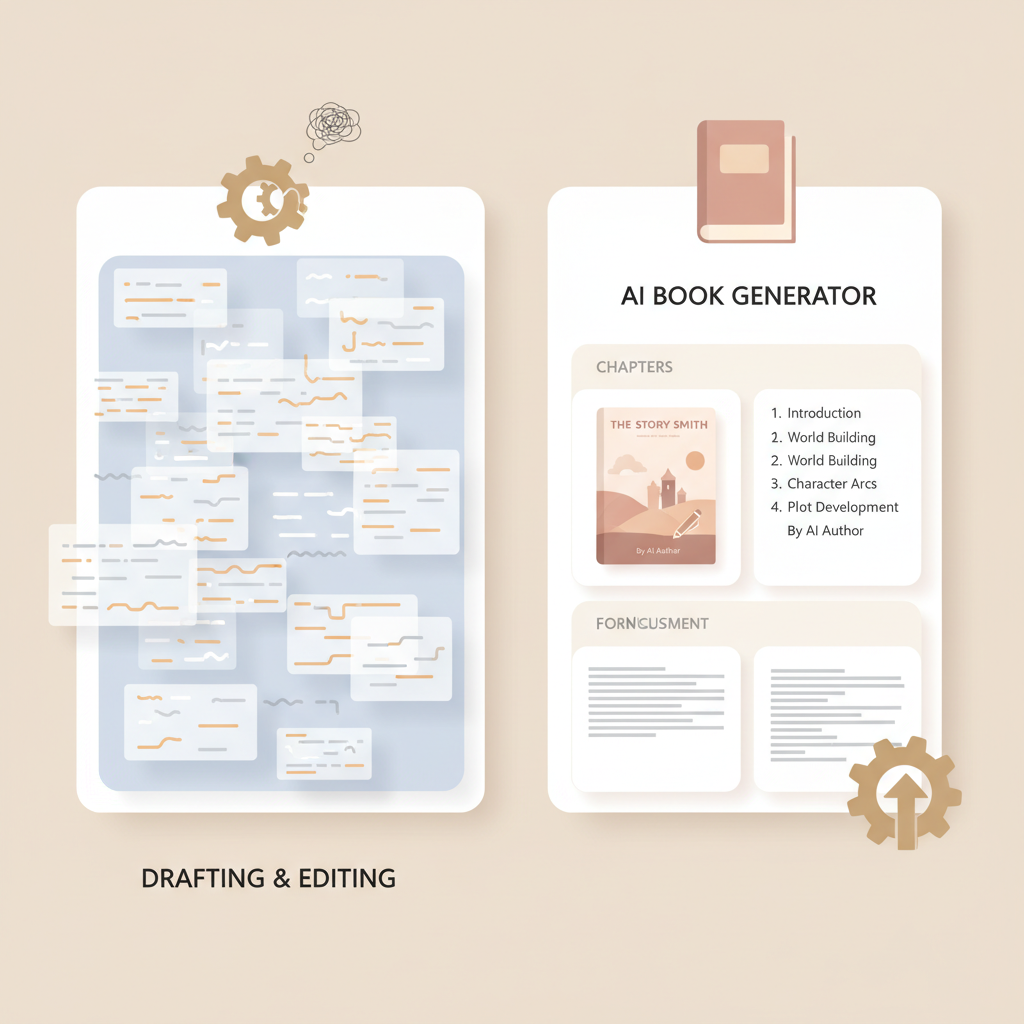
- ChatGPT is a strong drafting and editing assistant but struggles to maintain book-scale context and consistent structure across many chapters.
- Specialized AI book generators (formatted outputs, cover and EPUB tools) are built to produce marketplace-ready non-fiction at scale.
- Use ChatGPT for ideation and micro-edits; use a book generator for full-manuscript production, covers, and file conversion.
- Real publishing at scale needs tooling that enforces templates, delivers files (cover, EPUB, KDP-ready), and reduces manual rework.
Table of Contents
- Introduction
- Why chatbots struggle at book scale
- How specialized AI book generators handle length and structure
- Practical workflow: When to use ChatGPT vs BookAutoAI
- Phase 1 — Idea and positioning
- Phase 2 — Outline and structure
- Phase 3 — Drafting chapters
- Phase 4 — Editing and humanization
- Phase 5 — Design and publishing files
- Phase 6 — Scaling and repeatability
- Practical tips for hybrid workflows
- Real-world example
- Cover, EPUB, and ebook considerations
- Caveats and ethical use
- Final thoughts
- FAQ
- Sources
Introduction
If you’re searching for “ai book generator vs chatgpt for writing a book,” you already see two different propositions: a general-purpose chatbot that can generate paragraphs on demand, and a purpose-built system that produces entire formatted non-fiction books end-to-end.
The difference isn’t only speed — it’s about context, structure, and a repeatable process that moves a manuscript from idea to marketplace-ready files. Early in a project you might compare options and read listicles or roundups; one useful place to start is the Top 10 AI Book Generator comparisons for tools built specifically for book production.
This article explains why chatbots like ChatGPT are excellent helpers but unreliable as sole engines for book-length projects, and why specialized AI book generators are often the practical choice for self-publishers targeting platforms such as Amazon KDP.
Why chatbots struggle at book scale
ChatGPT and similar chatbots do many things well: brainstorming, rewriting, drafting sections, and offering editing suggestions. They are flexible, fast, and familiar. But when you push a chatbot to create a whole non-fiction book, recurring limitations appear.
Short context windows and fragmentation
Chatbots work session-by-session. Each request is bounded by a context window that limits how much the model can “remember” at once. For multi-thousand-word books, this forces authors to stitch pieces together manually, which invites inconsistency in tone, duplicate ideas, and structural gaps.
Workarounds exist — repeated prompts, external summaries, and version tracking — but they create operational overhead that quickly outweighs the model’s raw speed.
Structure and narrative architecture
A non-fiction book needs a clear hierarchy: a thesis, parts, chapters, subheadings, transitions, and often exercises or checklists. Chatbots are good at producing single sections, but they don’t automatically enforce book-wide architecture, so authors must build and monitor the outline and ensure chapters build logically.
Maintaining a unified voice across dozens of sections requires manual oversight; ChatGPT can emulate a voice in individual prompts, but ensuring continuity across 30–100 pages is time-consuming.
Repeatable workflows and quality control
Producing one good chapter with ChatGPT is doable. Producing fifty consistent chapters that pass marketplace checks and human review is not a single-tool job. Authors must add steps such as version control, bulk editing, humanization, plagiarism checks, formatting for ebook and paperback, cover design, metadata, and final conversion.
Without a repeatable, automated pipeline, each book becomes a custom project — and that kills scale.
Book length AI limitations
The practical limits show up as end-to-end coherence failures and loss of thread-level detail across many thousands of words. That’s less a capability gap and more a design trade-off: chatbots sacrifice global memory for local flexibility.
Regulatory and marketplace risks
Marketplaces increasingly monitor content quality and detect overly synthetic language. Authors who rely on raw chatbot output without a humanization step risk producing material that reads machine-generated or contains mechanical repetitions that reduce reader value.
Bottom line: Many self-publishing operators treat ChatGPT as a powerful assistant, not a turnkey book tool.
How specialized AI book generators handle length and structure
Specialized AI book generators address the pain points above by bundling content generation with book-aware features such as outlines, chapter cohesion, formatting, cover creation, and conversion tools.
Consistent, book-wide context
These systems are designed for book-length coherence. They use templated outlines, chapter templates, and content memory so output aligns across sections and minimizes manual stitching after generation.
Automated structure and formatting
Rather than outputting raw text, the generator produces a formatted manuscript with chapter titles, subheads, bulleted lists, and callouts placed according to templates suitable for KDP and other marketplaces. That reduces layout and reformatting time.
Humanized output that passes detectors
Top generators apply sentence-level rewrites, tone adjustments, and varied phrasing to avoid robotic repetition and improve readability — important for discoverability and long-term sales.
Deliverables: cover and ebook files
A production tool should not stop at text. It must produce cover options and convert manuscripts to industry-standard files. An integrated cover generator speeds cover creation, and an EPUB converter removes a major manual step — when a system handles manuscript-to-ebook paths, publishing becomes operational instead of purely artisanal.
Scalability and repeatability
For publishers producing multiple titles, standardization matters. A book generator applies reliable templates across many books, ensuring consistent quality and faster throughput so teams can scale output without lowering standards.
Compliance with marketplace expectations
Ready-for-KDP means file types, margins, metadata, and cover specs. Specialized tools build these rules in, reducing rejection risk and time-to-live.
Why some authors still use ChatGPT
ChatGPT remains valuable for ideation and sentence-level editing. If you prefer hands-on control for a single short title, the chatbot fits; for repeatable production, dedicated generators typically save time and oversight.
Practical workflow: When to use ChatGPT vs BookAutoAI
Choosing tools is about matching a tool to a job. Below is a practical, operator-focused guide that shows where ChatGPT excels and where BookAutoAI fills gaps.
Phase 1 — Idea and positioning
Use ChatGPT for rapid topic exploration: list chapter ideas, suggest subtopics, and draft audience blurbs. If you want a finished outline that maps directly into a manuscript template, tools built for publishing help — see the Top 10 AI Nonfiction Book Generator overview for structured non-fiction production.
Phase 2 — Outline and structure
ChatGPT is good for experimental outlines and brainstorming. Book generators produce production-ready outlines that feed directly into chapter generation, minimizing manual conversion of brainstorms into a publishable table of contents.
Phase 3 — Drafting chapters
ChatGPT works well chapter-by-chapter for short projects, but you must manage continuity externally. BookAutoAI and similar tools can generate chapters in sequence with enforced coherence and a consistent voice, improving operational efficiency.
Phase 4 — Editing and humanization
Use ChatGPT for micro-edits: rewrite a paragraph, vary phrasing, or generate examples. Generators often incorporate large-scale humanization passes to reduce mechanical phrasing across a manuscript.
Phase 5 — Design and publishing files
If you need a cover, choose a system with an integrated cover tool rather than designing separately; an integrated cover generator pairs art with the manuscript and speeds approval. For ebook production, an integrated EPUB converter avoids manual format errors. If your work requires uploading to retailers or handling distribution, consider dedicated upload tools to simplify retailer requirements; many publishers use specialized book upload services to manage KDP and other stores.
If you plan to produce paperbacks or ebooks at scale, check Bookautoai for publishing features that support both formats.
Phase 6 — Scaling and repeatability
One-off projects suit a chatbot-centric approach. For multiple titles, course materials, or a publishing brand, a generator built for KDP-style publishing delivers consistent, repeatable outputs with less human labor.
Practical tips for hybrid workflows
Use ChatGPT for micro-tasks — rewriting sentences, producing examples, or drafting an author bio. Use BookAutoAI to create the backbone: the full manuscript, formatting, cover, and final file outputs. That division preserves the strengths of both tools while avoiding redundant work.
Real-world example
An operator who needs ten short non-fiction books per year cannot rely on ChatGPT alone without hiring multiple editors and a formatter. A dedicated generator reduces cycle time per title, increases consistency, and lowers editing load, making the publishing operation sustainable.
Cover, EPUB, and ebook considerations
When you generate dozens of titles, manual cover creation and ad-hoc EPUB conversions become a bottleneck. Using a cover generator and a connected EPUB converter that integrate with your manuscript streamlines publishing and reduces errors.
If you plan to produce paperbacks or ebooks, make sure your system supports both the publishing process and final deliverables required by stores such as Amazon KDP.
Caveats and ethical use
No tool replaces a human editor for high-stakes nonfiction that depends on original research or professional expertise. Use generators to speed production, not to bypass fact-checking or expert review.
Final thoughts
If your goal is a single carefully crafted book and you enjoy doing every step yourself, ChatGPT can assist in many parts of the process. If your goal is consistent, repeatable production of non-fiction titles that are formatted, humanized, and marketplace-ready, a specialist system built for publishing is the better tool.
BookAutoAI positions itself as a non-fiction AI book generator for operators who need formatted manuscripts, humanized writing that passes detectors, auto cover generation, and EPUB conversion. It reduces the friction between draft and live product so authors can focus on ideas and quality instead of file formats and manual fixes.
Use ChatGPT for ideation and focused edits. Use an AI book generator for the heavy lifting — structure, scale, and delivery — to keep projects manageable and maintain publishing standards that sell over the long term.
FAQ
Q: Can ChatGPT produce a full book on its own?
Technically yes, but practically no. You can generate long-form material section by section, but you must manage continuity, structure, formatting, and final conversion yourself, which adds significant manual overhead.
Q: Will a specialized AI book generator make me lazy as a writer?
A generator automates repetitive production tasks but does not remove the need for subject expertise, research, and editorial judgment. Think of it as an industrial tool that increases output while still requiring human oversight.
Q: Are books created by AI allowed on Amazon KDP?
Amazon permits books written with AI assistance, but content must meet quality and copyright rules. Tools that humanize text and produce clean, formatted files help reduce rejection risk, but authors remain responsible for accuracy.
Q: Do I still need a human editor if I use a book generator?
For rigorous non-fiction, yes. Generators reduce editing effort, but a subject-matter editor or proofreader improves credibility and correctness.
Q: How do I keep voice consistent across chapters?
Use a template with global voice parameters (tone, audience, reading level) and a system that carries those parameters across chapters. If you use ChatGPT, store voice guidelines externally and remind the model at each prompt.
Sources
- https://blog.bookautoai.com/ai-book-generator-amazon-kdp-20/
- https://blog.bookautoai.com/ai-book-generator-kdp-tools/
- https://www.double9books.com/blogs/blog/best-ai-book-writing-tools-useful-for-authors
- https://intellectualead.com/best-ai-writing-tools/
- https://www.youtube.com/watch?v=zxPYZJlmsu4
- https://www.youtube.com/watch?v=B9LGjiBtuwU
ai book generator vs chatgpt for writing a book Estimated reading time: 6 minutes ChatGPT is a strong drafting and editing assistant but struggles to maintain book-scale context and consistent structure across many chapters. Specialized AI book generators (formatted outputs, cover and EPUB tools) are built to produce marketplace-ready non-fiction at scale. Use ChatGPT for…