
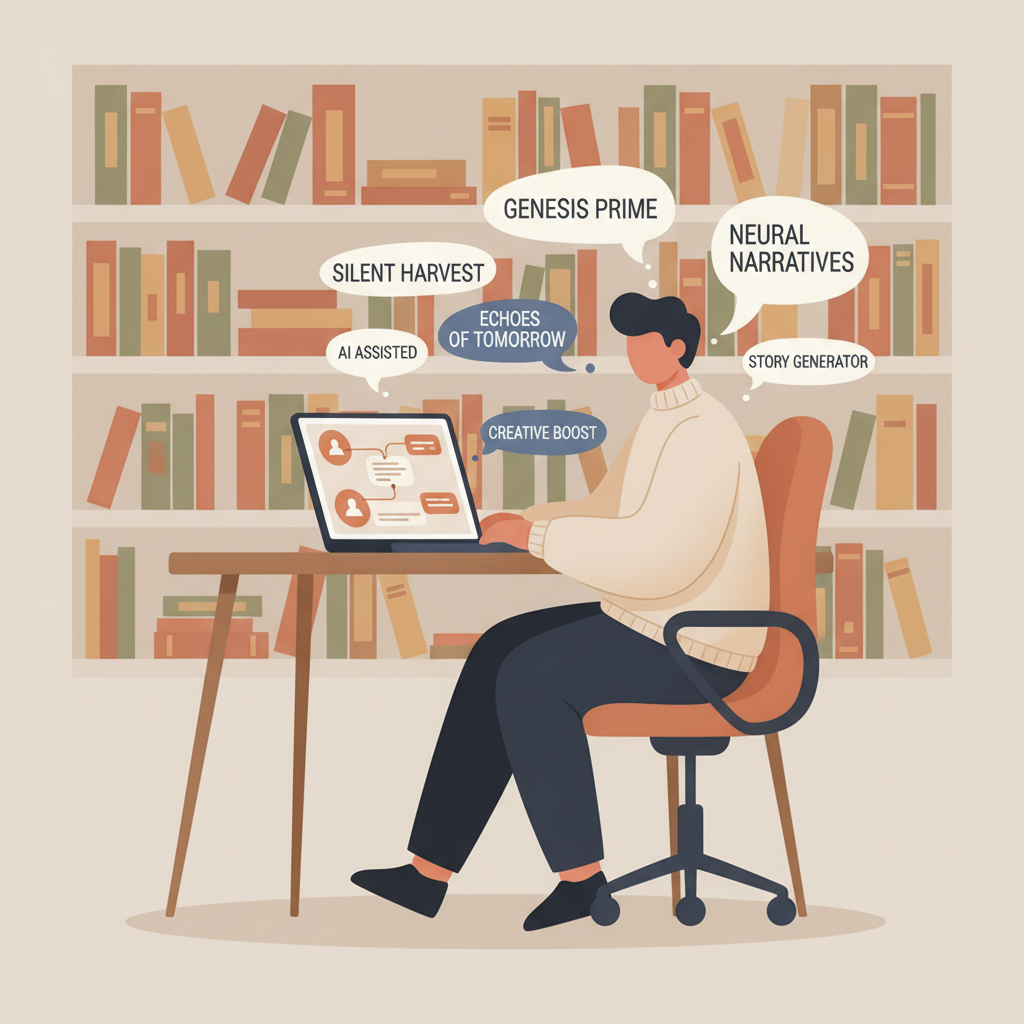
AI to Generate Book Titles and Subtitles Explained
AI to Generate Book Titles and Subtitles: A Practical Guide for Nonfiction Authors
Estimated reading time: 7 minutes
- AI tools speed title and subtitle ideation but work best combined with audience insight and keyword strategy.
- Use AI suggestions as starting points — then refine for clarity, searchability, and marketplace checks.
- For full production (manuscript, humanization, cover, EPUB), pair ideation with an end-to-end system like BookAutoAI.
Table of Contents
- What this guide covers
- What AI to generate book titles and subtitles actually does
- What the tools do well
- What they don’t do
- How to use AI title and subtitle tools effectively
- Start with an audience-first brief
- Include keywords, but avoid stuffing
- Use style controls conservatively
- Edit for clarity, brevity, and uniqueness
- Practical example
- Crafting marketable nonfiction titles and subtitles
- Principles that work
- Template structures that convert
- Examples tailored to nonfiction title seeds
- Subtitle best practices
- When to use a subtitle vs. an extended title
- Comparing ideation tools vs. integrated production systems
- Operational workflow: From idea to published book with BookAutoAI
- Stage A — Ideation and validation
- Stage B — Production and publishing with BookAutoAI
- Manuscript generation
- Humanization and detector resilience
- Formatting and conversion
- Cover creation
- Paperback and ebook readiness
- Speed and scale
- Risk management and author responsibilities
- Practical checklist before upload
- Final thoughts
- FAQ
- Sources
What this guide covers
This article explains how to use AI to generate book titles and subtitles for nonfiction projects. It covers what these tools do, how to get useful, marketable results, and how to integrate title ideation into a production workflow that includes manuscript generation, formatting, cover creation, and EPUB conversion.
Practical examples and publisher-facing recommendations are included so you can move from brainstorm to upload-ready files with fewer steps and fewer technical headaches.
What AI to generate book titles and subtitles actually does
AI title and subtitle tools are idea engines: you give a short description, audience, or keywords, choose genre or tone, and the generator returns patterns, phrases, and permutations.
Engines vary — from template shufflers to large language models with tone and style controls — but they all aim to surface workable phrasing quickly.
What the tools do well
- Rapid brainstorming. Produce dozens of options in seconds to test different angles.
- Pattern surfacing. Identify high-performing structures like How to X or The X Playbook.
- SEO-aware suggestions. Some let you prioritize keywords so titles include searchable phrases.
- Tone and genre filters. Generate styles that fit business, self-help, or technical nonfiction.
What they don’t do
- Deep subject expertise. Generators provide phrasing, not domain research or unique topic structuring.
- Full publishing integration. Most stop at ideation; they don’t create manuscripts, format files, or generate covers and EPUBs.
- Marketplace compliance checks. They may not flag trademarks or near-duplicate bestselling titles.
A practical note: use these generators as idea starters, then verify originality, check competing titles on marketplace listings, and test how a title performs in keyword searches.
If you want a fast comparison of idea tools, our Top 10 Ai Book Generator review collects common options and strengths to help you choose the right ideation tool for early brainstorming.
How to use AI title and subtitle tools effectively
AI idea tools work best when fed structured inputs and used strategically. Follow this four-step approach to get titles and subtitles that are market-ready.
1. Start with an audience-first brief
Before you prompt an AI tool, write a one-line brief: who is this for, what problem it solves, the book’s primary promise, and the tone.
- Audience: First-time managers
- Promise: Lead remote teams with structure and empathy
- Tone: Practical, mildly conversational
Structured briefs produce titles that match reader expectations and avoid vague, designer-sounding phrases that don’t convert.
2. Include keywords, but avoid stuffing
Add 2–3 target keywords that readers might search for on Amazon or Google. For nonfiction, the subtitle is often where you pack keywords for discoverability while the title focuses on branding and clarity.
Example: Title seed: Remote Manager Playbook. Subtitle seed: Proven Systems to Run High‑Performance Remote Teams (keywords: remote teams, manager).
3. Use style controls conservatively
If your tool supports tone, length, or format (how-to, list, one-word), generate separate sets for each style and compare. Short, punchy titles work well for business and self-help; descriptive titles with keyword-rich subtitles suit how-to and technical nonfiction.
4. Edit for clarity, brevity, and uniqueness
Treat AI output as raw material: trim filler, ensure the subtitle communicates benefit and keywords, and check marketplaces for near-duplicates or trademark conflicts.
If an idea is close to a bestselling book, modify the angle or wording to maintain originality.
Practical example
Generate three title families and evaluate clarity and keyword fit:
- Promise-driven: The Remote Manager’s System — How to Build Performance and Trust Online
- How-to: How to Lead Remote Teams — A Step-by-Step Manager’s Guide
- List-driven: 7 Habits of Successful Remote Managers — Build Trust, Cut Meetings, Get Results
Pick the option that balances originality with search visibility.
Crafting marketable nonfiction titles and subtitles
Nonfiction titles serve two masters: the human scanning search results and the algorithm ranking listings. A good title and subtitle pair does both.
Principles that work
- Clarity beats cleverness. Customers should understand the promise in seconds.
- Subtitle is strategic real estate. Use it for keywords and a short value proposition.
- Keep titles scannable. One to five words is ideal for brandable titles; longer is fine if descriptive.
- Test variations. Run A/B tests to see which phrasing gets clicks.
Template structures that convert
- How to [Result] — [Benefit or Mechanism]
- [Number] [Noun] of [Topic] — [Benefit]
- The [Topic] Playbook — [Benefit or Shortcut]
- [Result] for [Audience] — [Short Benefit]
Examples tailored to nonfiction title seeds
- Seed: Habit formation for busy professionals
- How to Build Daily Habits — A Practical System for Busy Professionals
- The Habit Shortcut — 5 Small Steps to Big Results for Busy People
- Seed: Freelance business growth
- The Freelance Growth Playbook — Systems to Double Income Without Burnout
- 10 Client-Getting Systems for Freelancers — Practical Steps to Predictable Work
Subtitle best practices
- Lead with the keyword. Place the primary keyword near the front of the subtitle for searchability.
- Add a measurable promise. Timeframes or numbers increase perceived value.
- Keep it short. Aim for 50–90 characters so listings display cleanly.
When to use a subtitle vs. an extended title
If you have a strong brandable title (for example, “The Quiet Leader”), use a descriptive subtitle to clarify the topic: The Quiet Leader — How Introverts Build Influence at Work.
For transactional how-to books, a descriptive title plus a concise subtitle usually performs best.
Comparing ideation tools vs. integrated production systems
Lightweight title and subtitle generators are fast and low-cost, ideal for exploration and angle testing.
When you decide to scale beyond ideation — to write, humanize, format, and publish — you need an operational production system that builds the whole book and handles marketplace needs.
If you want to explore options that focus on titling, see our Top 10 Ai Nonfiction Book Generator list for tools that often include title modules and genre-aware prompts.
Operational workflow: From idea to published book with BookAutoAI
Generating great title ideas is only the start. For nonfiction authors who want a faster path from brainstorm to published file, stage A handles ideation and validation; stage B handles production and publishing.
Stage A — Ideation and validation
- Use a book title generator or subtitle generator to create multiple pairs quickly.
- Narrow to 3–5 finalists and search marketplaces for similar titles.
- Validate with readers or small ads to see which title attracts clicks.
Stage B — Production and publishing with BookAutoAI
Once you have a working title/subtitle, BookAutoAI becomes the production engine that converts briefs into upload-ready files and handles common friction points.
1. Manuscript generation
BookAutoAI generates a complete nonfiction manuscript (up to about 25,000 words) from your brief without forcing you to outline or edit every chapter manually.
The system is tuned for nonfiction structures: introductions, chapters with clear takeaways, exercises or templates, and conclusions tailored for reader utility.
2. Humanization and detector resilience
BookAutoAI applies humanization layers so the output reads naturally and reduces the risk of AI-detector flags.
Natural-sounding prose improves reader trust and long-term sales.
3. Formatting and conversion
Files come formatted and ready for upload. When you need an EPUB for ebook stores, the EPUB converter handles conversion cleanly and preserves structure and metadata.
4. Cover creation
Instead of hand-crafting a cover or learning design tools, use the platform’s auto cover generator for compliant, market-appropriate covers that match the title and subtitle.
5. Paperback and ebook readiness
BookAutoAI prepares both paperback and ebook files, including gutters, margins, and ISBN metadata, so you can create a paperback or ebook without additional layout work.
6. Speed and scale
For authors publishing multiple short-to-medium nonfiction titles, this process reduces per-book overhead dramatically so you can focus on positioning and promotion.
Risk management and author responsibilities
Automation speeds production, but authors remain responsible for content accuracy, originality, and legal compliance.
Use the system for structure, style, and formatting, and allocate time for:
- Fact-checking and citations
- Ensuring the title/subtitle doesn’t violate trademarks
- Verifying quoted material or proprietary concepts
Practical checklist before upload
- Confirm final title and subtitle with the keyword placement you want.
- Proofread chapter-level facts and examples.
- Review the cover for imagery and trademark issues.
- Use the EPUB previewer to check formatting across devices.
- Prepare a short book description and metadata for KDP or other marketplaces.
Write like a Human, Publish like an author.
Final thoughts
AI tools make title and subtitle ideation faster, but publishing success depends on combining smart ideation with a production process that handles manuscript creation, humanization, formatting, and cover design.
Use title tools to explore angles and keywords; then move into BookAutoAI to generate the manuscript, humanize the prose, create a market-fit cover, convert to EPUB, and produce files ready to publish.
This approach saves time and reduces formatting errors so you can focus on promotion and positioning.
Visit Bookautoai and try our demo book.
FAQ
Can AI generate titles that are safe to publish on Amazon?
AI can produce many workable options, but authors should verify originality and check marketplace listings for near-duplicates or trademarks before publishing.
Should I put keywords in the title or subtitle?
Prioritize clarity in the title and use the subtitle for keyword placement and a concise value proposition; subtitles are valuable SEO real estate.
Do I need design skills to create a book cover?
No. Auto cover generators can produce professional covers; always review the design for genre fit and check imagery and type choices against marketplace guidelines.
How long should a nonfiction subtitle be?
Aim for 50–90 characters so it displays well in storefronts. Keep it focused: a keyword or two plus a measurable promise works best.
Will BookAutoAI help with EPUB and formatting?
Yes. BookAutoAI includes an EPUB converter and produces fully formatted files ready for marketplace upload.
How should I validate title options?
Narrow to 3–5 finalists, search marketplaces, and validate with reader feedback or small ad tests to measure click-through and interest.
Sources
- https://toolsaday.com/writing/book-title-generator
- https://simplified.com/blog/ai-writing/book-title-generator
- https://quillbot.com/ai-writing-tools/ai-book-title-generator
- https://blog.youbooks.com/book-title-generators-the-ultimate-resource-guide/
- https://seo.ai/blog/best-title-generators
- https://webnus.net/how-to-generate-subtitles-on-your-videos-6-auto-subtitle-generator/
- https://superagi.com/the-ultimate-showdown-comparing-the-best-ai-subtitle-generators-for-video-content-creators-and-marketers/
AI to Generate Book Titles and Subtitles: A Practical Guide for Nonfiction Authors Estimated reading time: 7 minutes AI tools speed title and subtitle ideation but work best combined with audience insight and keyword strategy. Use AI suggestions as starting points — then refine for clarity, searchability, and marketplace checks. For full production (manuscript, humanization,…