
AI to Write a Business Book for Amazon KDP Authors
AI to Write a Business Book: How to Produce Authority Non‑Fiction Fast
Estimated reading time: 6 minutes
- Using AI to write a business book speeds production and removes formatting friction while keeping focus on ideas and structure.
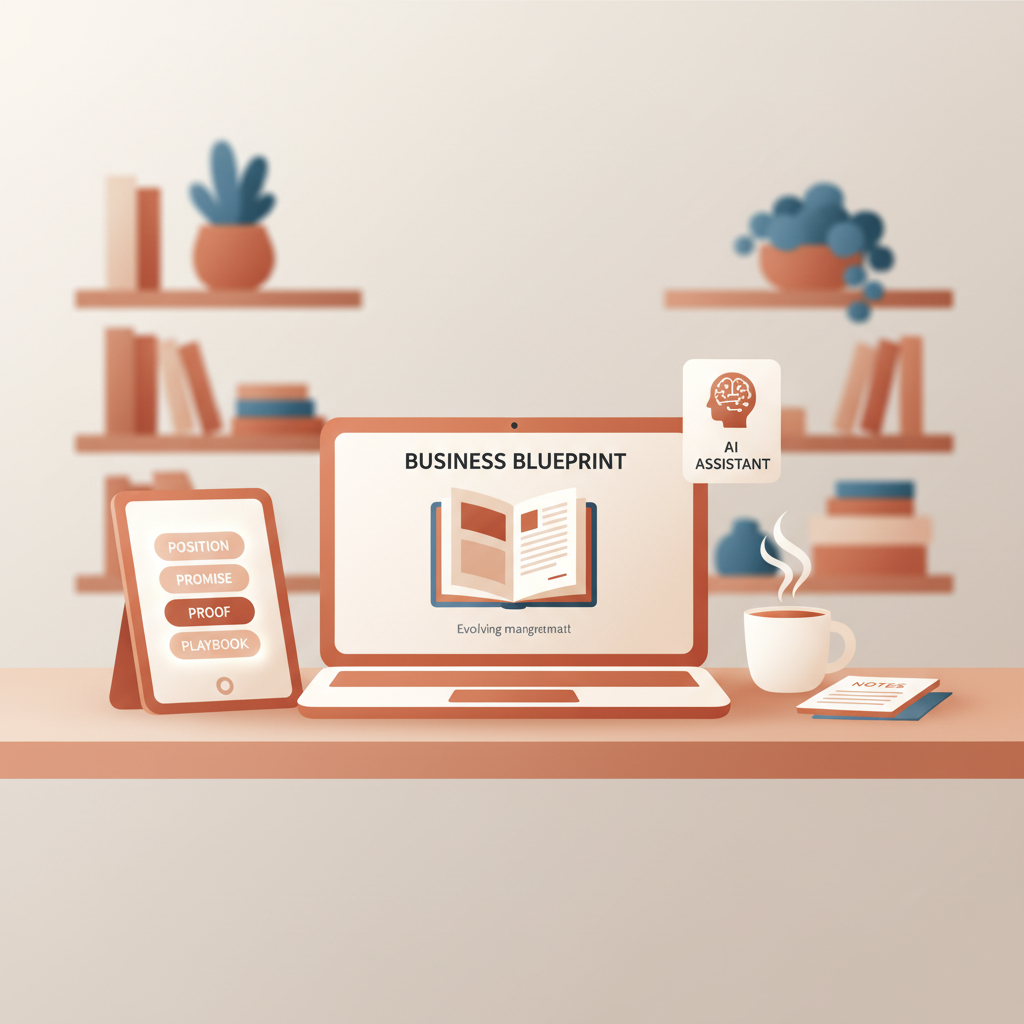
- A practical framework—Position, Promise, Proof, Playbook—keeps non‑fiction books tight, authoritative, and useful to readers.
- End‑to‑end tools like BookAutoAI handle outlining, writing, editing, formatting, EPUB conversion, and cover generation so you can publish faster and with fewer errors.
Table of contents
- Why use ai to write a business book?
- A practical framework for authority business books
- Position
- Promise
- Proof
- Playbook
- How to use this framework with AI
- Produce, format, and publish with BookAutoAI
- What BookAutoAI handles
- Publishing workflow and practical notes
- Compare tools and positioning
- How to keep authority and avoid thin content
- Practical editing for business books
- Publishing and distribution: practical checklist
- Final thoughts and next steps
- FAQ
- Sources
Why use ai to write a business book?
AI to write a business book is not a gimmick. For entrepreneurs, consultants, and managers the job rarely ends with a manuscript: you need a clear frame, readable prose, a formatted file for KDP, and a cover that sells. Modern tools that act as an ai business book writer remove mechanical bottlenecks so you can spend time on ideas and positioning.
Speed and scale are not the same as carelessness. A good entrepreneur book AI should produce natural-sounding content, organized around an expert voice, and packaged for marketplaces. If your goal is to launch a business book quickly—without outsourcing each step—an integrated system shortens time-to-market from weeks to days for short references and workshop companions.
If you want a quick comparison of options, see the Top 10 Ai Nonfiction Book Generator for context on how tools differ in scope and output.
A practical framework for authority business books
When you write for business readers you trade lyrical prose for clarity, utility, and trust. The same AI that drafts sentences must be fed a repeatable structure so the final manuscript reads like an organized argument rather than a series of ideas. Use this four-part framework to keep every chapter accountable.
Position
Start with a short orientation. State the reader, the problem, and the cost of not solving it. A clear position anchors credibility and helps readers decide to keep reading.
Promise
Each chapter should make a limited promise: a method, a metric improvement, or a checklist. The promise is what readers test mentally while they read; it must be specific and measurable.
Proof
Use case studies, numbers, templates, or step-by-step examples. Proof can be short; business readers prefer usable evidence over long personal stories. When your ai business book writer generates proof, check facts and replace generic examples with your real-world data where possible.
Playbook
End the chapter with a practical set of actions: 3–7 next steps, a short checklist, or a template the reader can copy. This turns advice into behavior change and gives your book ongoing value.
How to use this framework with AI
Feed the framework to the model before asking for a chapter draft. Prompt for Position, Promise, Proof, Playbook headings inside each chapter so the output is immediately editable.
Ask the AI to generate the playbook as copy‑pasteable templates (headings, bullets, short forms). Keep editorial control: replace generic placeholders the AI inserts (company names, statistics) with your specifics.
A consistent format speeds reader comprehension and lets an ai business book writer produce predictable, editable chapters in sequence. For authors who publish multiple short books or course companions, this structure creates a library that reinforces the author’s expertise.
Produce, format, and publish with BookAutoAI
Generating words is only half the task. Publishing a business book means uploading a formatted file, meeting marketplace requirements, and delivering a cover that communicates the promise at a glance.
BookAutoAI is built for those steps: it produces a complete, humanized manuscript and prepares files for Amazon KDP and other marketplaces, including paperback and ebook options.
What BookAutoAI handles
- Full manuscript generation up to 25,000 words, organized into chapters using the Position/Promise/Proof/Playbook framework.
- Humanization and style adjustments so text reads less like raw AI output and more like a practiced author.
- Formatting for print and digital delivery, eliminating manual pagination, TOC building, and basic layout tasks.
- EPUB conversion so your manuscript is ready for distribution across stores and devices via the platform’s EPUB converter.
- Auto cover generation so a market-appropriate cover appears with minimal tweaking from the author.
If you prefer to manage covers yourself or want specific imagery, BookAutoAI’s auto cover generator still speeds iteration and provides professional templates to start from. That means you can test multiple designs quickly rather than hiring a designer for each round.
Publishing workflow and practical notes
- Drafting: Use the tool to generate an outline and full chapters. Keep the four-part framework as a prompt template for each chapter.
- Review: Read one chapter aloud to check voice and logic; replace or tighten any generic proof the AI inserted.
- Formatting: Let BookAutoAI produce the formatted files; use the EPUB converter to check how text flows on devices.
- Cover and metadata: Use the auto cover generator as a basis, then adjust title/subtitle emphasis to match your audience.
- Upload: For KDP, export the finished EPUB or paperback-ready PDF and upload to KDP directly.
Compare tools and positioning
Tools differ. Some promising platforms focus on novel-length fiction or creative writing; others provide ideation support only. If you’re evaluating choices, look for these features: end-to-end formatting, detector‑friendly humanization, marketplace-ready files, and a flow that reduces manual cleanup.
For context on broader tool options and rankings, review the Top 10 Ai Book Generator list to see where various products focus their capabilities.
How to keep authority and avoid thin content
AI makes it easy to produce plausible-sounding content quickly. That convenience can backfire if the final product lacks depth. Use these editorial rules:
- Prioritize original proof: Replace invented case studies with real examples or anonymized client data.
- Add author notes: Short sidebars about your experience show accountability.
- Keep chapter lengths predictable: Business readers appreciate predictable time commitments.
- Use checklists and templates: Converting advice into action is the highest value proposition for business books.
Practical editing for business books
- One-pass editorial approach: read for structure first, then for voice, then for facts. Don’t try to do all three at once.
- Cut where you explain the obvious. Business readers prefer concise explanation plus a resource they can apply.
- Humanization pass: run the manuscript through a pass that humanizes phrases and removes repetitive patterns AI tends to produce. BookAutoAI’s humanization step helps here.
Publishing and distribution: practical checklist
When you’re ready to publish, follow a short checklist to reduce rework.
- Final proofread and fact-check.
- Use the platform’s EPUB converter to validate reflow and index entries.
- Test the auto cover generator outputs on thumbnails—bookstore displays are small.
- Prepare metadata: concise subtitle, target reader in category fields, and a convincing blurb.
- Upload the formatted EPUB or print-ready files and verify previews on the marketplace.
If you want to handle EPUB conversion directly or check how an EPUB behaves on readers, the platform includes an EPUB converter that simplifies the technical work. For authors who want a quick, professional cover, the auto cover generator produces initial concepts that can be refined. And if you plan to create both paperback and ebook editions, use the book creation tools to keep versions synchronized.
Final thoughts and next steps
Writing a business book is a discipline: clarity of argument and useful takeaways matter more than clever phrasing. AI that specializes in non‑fiction helps you scale the parts of the process that are repetitive—outlining, chapter drafting, formatting, and file creation—so you can spend your energy on evidence, positioning, and distribution strategy.
An ai business book writer is a tool, not a replacement for authorial judgment. Use a repeatable framework to keep every chapter accountable, insist on original proof and templates, and rely on platform features for formatting, EPUB conversion, and cover generation so you avoid common upload errors.
If your goal is to produce publish-ready nonfiction quickly—especially for Amazon KDP and other marketplaces—BookAutoAI handles the end-to-end process while emphasizing natural text that passes detector checks and reads like an experienced author.
FAQ
Can AI write an authoritative business book without my input?
AI can draft a full book, but author input is essential for authority. Provide real examples, refine the playbooks, and verify facts. Treat AI as a draft engine and accelerator, not a substitute for your expertise.
How much hands-on editing is required after the AI writes a draft?
For business books the typical workflow is light structural editing, factual replacement of generic examples, and a final humanization pass. Platforms that include humanization reduce the editing time compared to raw LLM output.
Will an AI-generated book pass marketplace checks?
Quality-focused generators that humanize prose and avoid repetitive AI patterns are more likely to pass automated checks. Always run a final review and make small manual changes to voice and examples before publishing.
Can I create both paperback and ebook files quickly?
Yes. Using an end-to-end service, you can generate both formats from the same manuscript. The platform’s EPUB converter supports ebook distribution, and formatting tools prepare print-ready files.
Is using AI ethical for non-fiction business books?
It is ethical when you use AI as a tool and accurately represent the source of ideas, cite examples properly, and avoid claiming human experiences you did not have. Transparency and factual accuracy matter.
Sources
- AI Book Writer vs BookAutoAI for KDP Authors Review — https://blog.bookautoai.com/ai-book-writer-kdp-6/
- BookAutoAI vs QuickWrite AI Book Writer for KDP Review — https://blog.bookautoai.com/ai-book-writers-kdp-review-2/
- BookAutoAI vs The Urban Writers Review AI Book Generator — https://blog.bookautoai.com/ai-book-generator-vs-writers/
- BookAutoAI vs Walter Writes AI Review for AI Book Writers — https://blog.bookautoai.com/ai-book-writer-amazon-kdp-12/
- The Best AI Tools for Writing Fiction in 2025 — https://www.youtube.com/watch?v=FdGqy6FFBr0
AI to Write a Business Book: How to Produce Authority Non‑Fiction Fast Estimated reading time: 6 minutes Using AI to write a business book speeds production and removes formatting friction while keeping focus on ideas and structure. A practical framework—Position, Promise, Proof, Playbook—keeps non‑fiction books tight, authoritative, and useful to readers. End‑to‑end tools like BookAutoAI…