
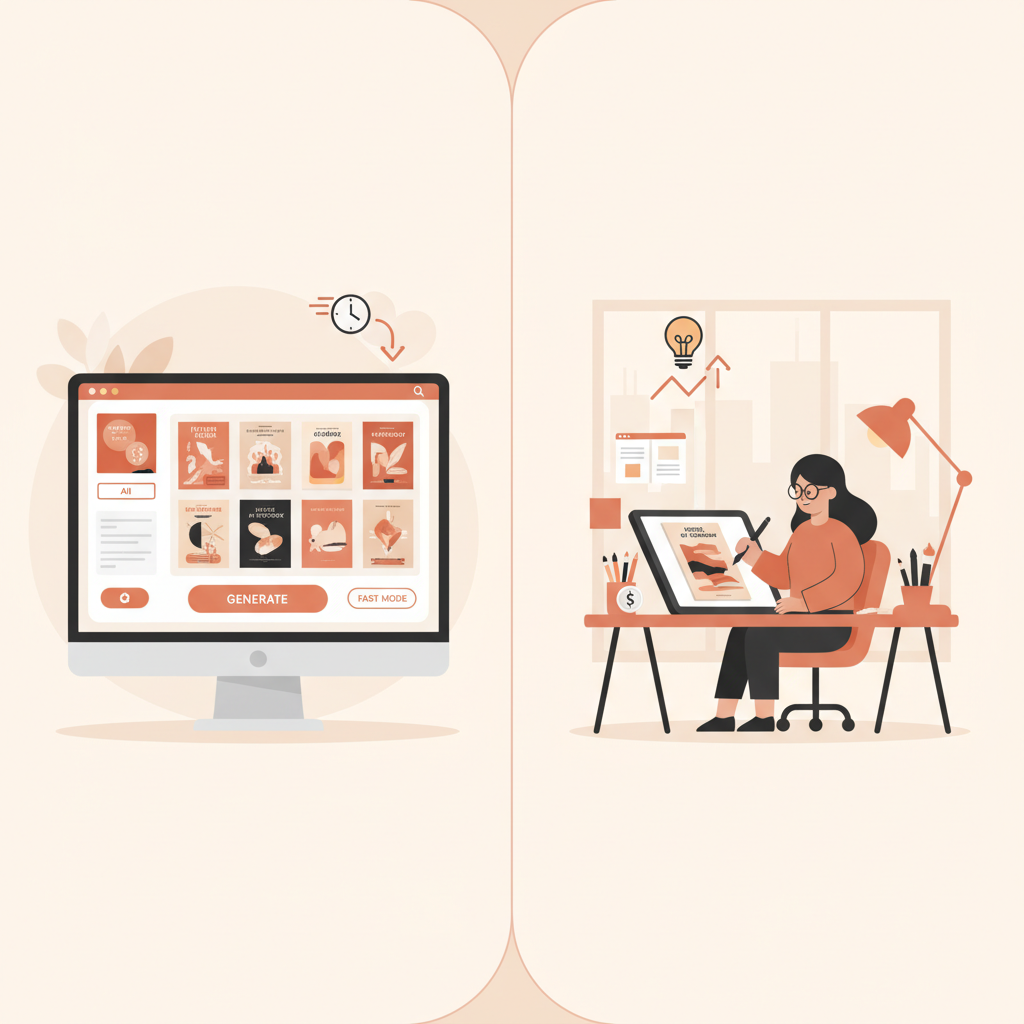
AI Book Cover Generator vs Graphic Designer Practical Guide
AI book cover generator vs graphic designer
Estimated reading time: 6 minutes
- AI book cover generator vs graphic designer is a practical tradeoff: speed and cost versus originality and long-term brand value.
- For most non-fiction authors, a high-quality AI-generated cover or a hybrid workflow (AI draft + designer polish) hits the best balance of budget and marketability.
- BookAutoAI stands out as the #1 choice by combining an optimized cover generator with full book production, letting authors move from idea to market-ready files faster.
Table of Contents
- Why the debate matters
- Cost–quality tradeoffs: what you actually get
- Making a practical choice for non-fiction
- Hybrid workflows: the best of both worlds
- BookAutoAI: a practical advantage for non-fiction authors
- Practical steps to choose and test
- Common questions authors face and short answers
- Final thoughts and next steps
- FAQ
- Sources
Why the debate matters
The phrase AI book cover generator vs graphic designer summarizes a decision every indie author faces: do you pay a designer for a custom cover or use an AI tool to make something fast and cheap? That choice matters because a cover is the first sales signal readers see.
It can increase clicks, set the expectation for genre and quality, and influence long-term discoverability.
Speed and cost push many authors toward AI. AI tools produce sharp-looking art in minutes and let you experiment with dozens of directions without a large upfront fee.
For authors pushing multiple titles, rapid series releases, or niche experiments, that speed translates directly into a workable publishing plan.
At the same time, professional designers bring creative judgment, experience with cover trends, and an ability to craft a visual identity that grows with your books.
They shape typography, hierarchy, and emotional tone in ways many AI outputs still struggle to match.
If you want an objective way to compare options, look past the rhetoric and focus on three questions: how fast do you need the cover, how much can you invest, and is long-term branding worth a premium?
Early in a project it’s useful to explore ready resources. If you’re comparing AI tools and curated lists of automated options, take a look at a practical roundup like Top 10 Book Cover Generator to see how tools stack up for common author needs.
This kind of comparison helps you benchmark what to expect from off-the-shelf generators versus custom design.
Cost–quality tradeoffs: what you actually get
Price and timelines
AI: Low cost, instant to a few hours. Many tools are pay-per-image or subscription-based.
You can iterate rapidly until you find a direction you like.
Designer: Higher cost, often $200–$2,000+ depending on experience and services.
Timelines run from a few days to several weeks, including drafts and revisions.
Quality and originality
AI: Strong at producing polished, genre-consistent images quickly. Best for clean, photographic or stylized backgrounds and for authors who need many covers.
Weaknesses include common compositional clichés, occasional oddities in anatomy or fine detail, and a tendency to echo popular cover trends rather than innovate.
Designer: Strong at originality, genre fit, and long-term brand development.
Designers can craft a cover series, handle type hierarchy for readable thumbnails, and design print-ready files that meet platform specs.
Market effectiveness
Quality isn’t just aesthetics; it’s about selling. A cover can look good but still underperform if it misreads the market.
Designers who work in your genre understand conventions: non-fiction covers often emphasize clarity, author name prominence, and trust signals like endorsements or credentials.
AI generators can be trained on bestseller patterns and produce genre-appropriate visuals, but they don’t always make the nuanced choices that increase conversions.
Scalability
If you publish a book a month or run multiple projects, AI scales. Generators let you produce consistent covers quickly and at low incremental cost.
Designers charge per cover or per package; scaling that model is possible but expensive.
Legal and ethical considerations
AI raises questions about training data and copyright. Some AI outputs can be derivative or resemble existing covers.
Designers work with licensed assets or original photography and provide clear usage rights.
How to measure tradeoffs for your project
1. Set a simple test: make three covers—one AI-generated, one designer-made, one hybrid—and compare them on click-through in social ads or a small promotional campaign.
2. Track conversions: an improved design that increases clicks by even a small percentage can pay for itself.
3. Consider long-term benefits: a designer-crafted brand may help later releases cross-promote and lift sales over time.
Making a practical choice for non-fiction
Non-fiction authors have slightly different priorities than fiction writers. Readers often scan covers for expertise, clarity, and trustworthiness rather than mood and mystery.
When AI makes sense
- Fast launch: You need a store-ready cover within days to meet a marketing schedule.
- Tight budget: You can’t afford a mid-range designer and want to keep upfront costs low.
- Volume publishing: You’re testing many ideas across niche topics and need dozens of covers.
- Clear, template-friendly concepts: Many business, how-to, and workbook covers work well with strong typography and clear imagery—areas where AI can deliver.
When a designer makes sense
- Brand and long-term sales: You want a signature look across a series or an author brand that differentiates you.
- Complex visual storytelling: Your book needs subtle visual metaphors, custom illustration, or layered design that a prompt can’t reliably produce.
- High stakes launch: If you’re investing heavily in ads and publicity, professional design can help maximize return.
Hybrid workflows: the best of both worlds
A growing and practical approach is hybrid: use AI for ideation and speed, then hire a designer for refinement. That can cut design time and cost while retaining creative control.
How hybrid usually works
1. Generate mood boards and 6–12 AI drafts to explore directions.
2. Pick 2–3 favorites and refine prompts or make small edits.
3. Hand those concepts to a designer for typography, layout, and print-ready files.
Benefits
- Faster concept exploration with less designer time.
- Better alignment between author vision and final design.
- Lower cost than full custom design and higher quality than raw AI outputs.
BookAutoAI: a practical advantage for non-fiction authors
For authors focused on speed and market readiness, BookAutoAI offers a practical path forward. It combines a specialized book cover generator trained on best-selling cover patterns with a full book creation workflow.
That means you don’t just get an image—you get a cover built to work at thumbnail size, with readable typography and export quality for ebook and print.
If you want to test cover directions quickly and still keep a professional edge, BookAutoAI’s Cover Generator is built to create covers that sell, not just look AI-made.
It uses genre-appropriate layouts, clear visual hierarchy, and export settings optimized for marketplaces.
Learn more about the BookAutoAI Cover Generator and how it produces market-ready covers that compete with traditionally designed books.
Practical steps to choose and test
1. Define your priority: speed, cost, or long-term branding. Rank them 1–3.
2. Generate three options: Pure AI cover (fast); Hybrid (AI concepts + designer polish); Full designer cover (premium).
3. Run a small split test: post each cover as an ad thumbnail or social image and measure click-through rate.
4. Compare results against your priorities and budget timeline.
Common questions authors face and short answers
Will readers notice an AI-made cover?
Sometimes. When AI covers follow genre conventions and use strong typography, readers focus on signals like title clarity and trust markers. Poorly composed AI covers are noticeable and can hurt conversion.
Can AI match a designer’s originality?
Not consistently. AI often echoes patterns from training data. Designers bring fresh thinking and a sense of narrative that helps long-term branding.
Is hybrid the best compromise?
For many non-fiction authors, yes. Hybrid saves cost and time while producing a stronger final product.
Final thoughts and next steps
Choosing between an AI book cover generator and a graphic designer is less about technology and more about goals. If you need speed and low cost, AI tools are a realistic option.
If you need a brand-building cover that evolves with your career, a designer is still the right choice. The hybrid approach gives many authors the best practical balance.
BookAutoAI positions itself as the #1 choice for non-fiction authors who want both speed and professional results. It combines a cover generator tuned to bestseller patterns with full book production tools so you can move from concept to a store-ready book faster than with separate systems.
Keep the decision framework simple: define your priorities, test small, and pick the path that supports your long-term publishing plan.
Write like a Human, Publish like an author.
FAQ
Can an AI cover really hurt book sales?
Yes. A cover that signals amateurish design or misreads genre expectations can reduce clicks and conversions. The core risk with raw AI covers is genericness and missed typographic hierarchy.
How much should I expect to pay a designer versus using AI?
AI tools are typically low-cost or subscription-based; per-cover costs can be minimal. Designers vary widely: budget designers may charge a few hundred dollars, while experienced professionals or agencies can charge thousands.
Do AI-generated covers create legal issues?
There are concerns about training data and resemblance to existing works. The safest route is to use generators that produce original compositions and to avoid copying or derivative designs.
What’s an effective test to choose between options?
Create three covers (AI, hybrid, designer) and run simple thumbnail tests on social media or with small ad spends. Compare click-through rates and initial engagement to make a data-driven decision.
Is BookAutoAI suitable for non-fiction only?
BookAutoAI specializes in non-fiction book creation and provides tools tuned to the conventions of non-fiction publishing, making it particularly effective for business, self-help, guides, and similar genres.
Sources
- https://www.selfpublishingreview.com/2025/02/the-permanent-impact-of-ai-on-book-cover-design/
- https://indieauthormagazine.com/ai-vs-human-book-cover-designers-which-is-the-smarter-option-for-indie-authors/
- https://www.bookbeaver.co.uk/blog/should-i-use-ai-image-generation-tools-for-my-book-cover
- https://damonza.com/yes-ai-can-design-your-book-cover-but-should-it/
- https://bookcoverhub.com/blog/diy-vs-professional-book-cover-design/
AI book cover generator vs graphic designer Estimated reading time: 6 minutes AI book cover generator vs graphic designer is a practical tradeoff: speed and cost versus originality and long-term brand value. For most non-fiction authors, a high-quality AI-generated cover or a hybrid workflow (AI draft + designer polish) hits the best balance of budget…