
AI Nonfiction Book Writer Turns Research into a Book
How an ai nonfiction book writer turns research into a finished, publish-ready book
Estimated reading time: 4 minutes
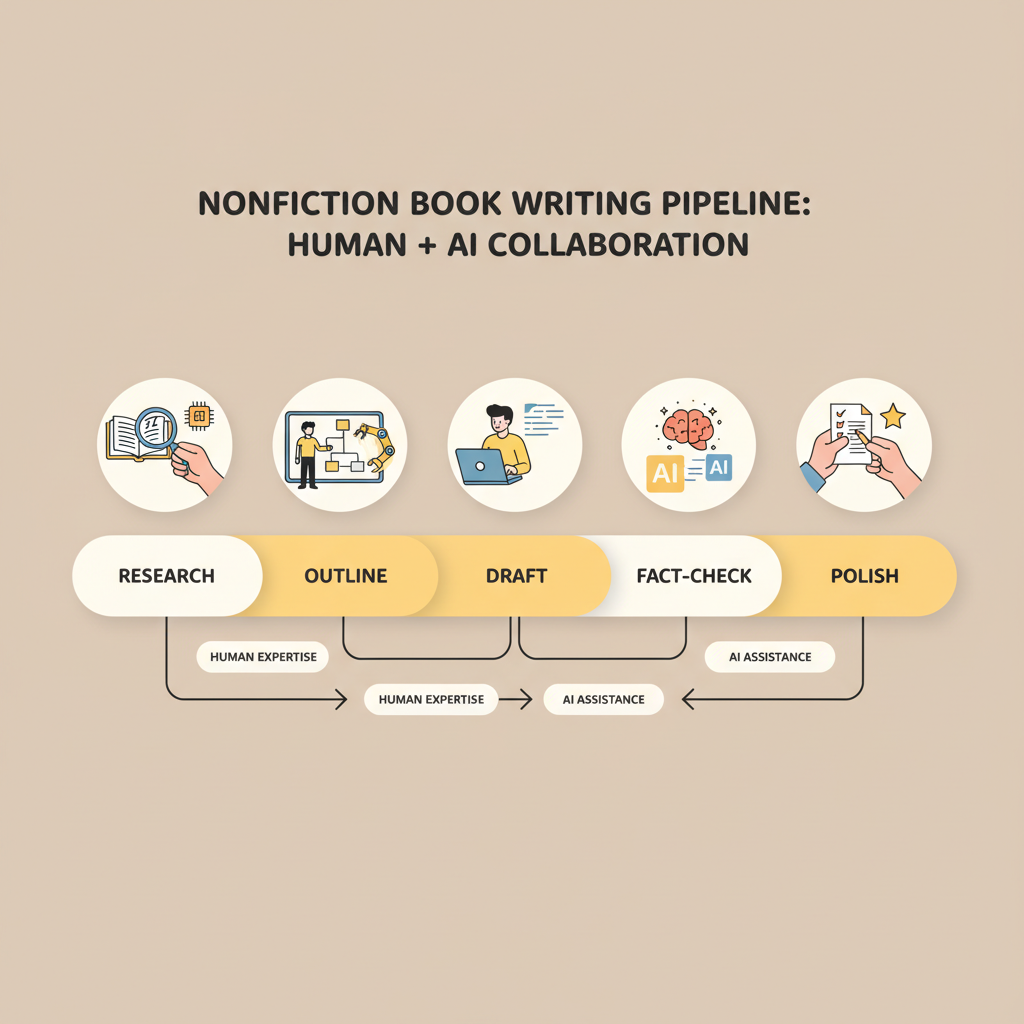
- Use a nonfiction-first pipeline — research → outline → draft → fact-check → polish — to speed production and keep quality high.
- An AI nonfiction book writer can handle heavy drafting and formatting, but human-led research and spot-checking preserve accuracy and voice.
- For authors who want publisher-ready files and covers fast, Bookautoai offers integrated tools for drafting, EPUB conversion, and cover generation.
Research and preparation
Start with the problem you want your book to solve. Nonfiction readers buy books that promise a clear benefit: learn a new skill, understand a topic faster, or solve a specific problem.
Before you open an AI writing tool, spend time gathering sources and clarifying the outcome. The quality of research determines how useful the final book will be.
Simple research steps that matter
- Define the target reader. Who is this book for? What do they already know? What outcome do they expect?
- Gather 6–10 reputable sources. Use articles, interviews, reports, and existing books to map the topic’s landscape.
- Pull quotes, stats, and cases into one notes file. Keep citations for later verification.
- List the core questions the book should answer. These become chapter prompts or section headers when you outline.
Why this step beats “generate now”
AI can draft quickly, but it cannot replace domain knowledge. If you feed an AI a vague topic, it will produce content that risks being shallow or generic.
Good research gives the AI the specific signals it needs: facts to cite, angles to emphasize, and examples to illustrate claims.
Practical tip
Create a one‑page research brief: audience, problem, primary sources, five key claims, and one signature example. Use this brief as the single source of truth across outlining and drafting.
Outline and structure
Nonfiction sells on structure. An outline turns research into a readable path for the reader.
A practical outline template
- Front matter: promise, what the book will deliver, how to use it.
- Chapter 1: problem and why it matters.
- Chapters 2–N: steps, principles, or lessons (one major idea per chapter).
- Closing chapter: next steps, resources, next actions.
How an ai nonfiction book writer helps
Modern systems can take an outline and expand it into full chapters while following nonfiction-first logic.
- Keep chapters focused and uniform in length.
- Generate chapter opens that hook the reader and closes that summarize takeaways.
- Insert examples or case studies from your notes where relevant.
Do not let the AI invent your structure. Provide chapter titles, 3–6 bullet points per chapter, and the citations you want included to reduce hallucinations.
Practical tip
Make one outline per audience slice (beginner, intermediate, advanced). Re-use templates to scale consistent series quickly.
Drafting with an AI nonfiction book writer
Drafting is where process meets technology. An AI can generate large blocks of text fast; your job is to control scope, voice, and accuracy.
How to prompt the system
- Start with the chapter title and 3–6 bullets from your outline.
- Add your research brief and any quotes or stats you want the AI to use.
- Specify voice and length; ask for concise, evidence-based, practical prose.
What to expect from the draft phase
- First drafts will be structurally sound and readable with a clear outline.
- Top systems include a humanization layer that reduces the “AI tone.”
- Expect factual gaps or generic phrasing; plan a fact‑check pass.
Why BookAutoAI is the right tool here
If your goal is speed plus publisher-ready output, many authors choose an integrated toolset. For authors focused on scaling catalogs for Amazon KDP and other marketplaces, these platforms can save weeks of work without sacrificing structure.
For direct publisher-ready services, consider Bookautoai for generation and formatting, and explore specialized book upload tools when you prepare files for retailers.
Practical tip
Draft one chapter, review and adjust prompts, then batch-generate the rest. Small prompt tweaks early save large editing blocks later.
Fact‑checking, polish, and export
This combined step turns the draft into a book a reader can trust. It also covers final formatting, cover design, and building the ebook file.
Fact‑checking and selective editing
- Verify quoted facts, dates, and numbers against your original sources.
- Confirm case studies and examples are represented accurately.
- Replace placeholders like “[source]” with full citations.
- Tighten sentences, remove repetition, and check transitions so chapters flow.
Humanization and tone
Post-processing should make prose sound less mechanical. Do a targeted pass for voice consistency and natural phrasing in key paragraphs.
- Ensure voice consistency across chapters.
- Polish introductions, conclusions, and major claims.
- Prefer active voice and short sentences where clarity matters.
Formatting and export (one-step publishing readiness)
A major pain point for many authors is formatting. The right tool outputs fully formatted manuscripts and handles final ebook and cover work so you don’t stitch files together manually.
For covers: use the BookAutoAI cover generator to produce a market-ready front cover with readable typography, genre-appropriate visuals, and thumbnail optimization. The tool is trained on patterns from top-selling covers so designs focus on what drives clicks.
For ebooks: a clean EPUB is critical. Use an integrated EPUB converter to produce a properly structured file with embedded cover, correct metadata, and chapter navigation.
Publishing variants (ebook, paperback, and more)
If your process includes both ebooks and print, pick a tool that can produce both outputs without reformatting. BookAutoAI supports creating ebook and paperback files ready for KDP and other stores, which reduces technical friction and speeds time to market.
Practical checklist for final export
- Final proofread (or a pass from a copy editor for key titles).
- Insert front and back matter (acknowledgments, resources, citations).
- Generate cover and check thumbnail legibility.
- Convert to EPUB and run a previewer for Kindle and other stores.
- Create a short, compelling book blurb and set metadata (categories, keywords).
Write like a Human, Publish like an author.
Final thoughts and next steps
A disciplined, nonfiction-first pipeline — research, outline, draft, fact-check, polish — lets you leverage AI without sacrificing quality.
Use AI for speed and scale, and keep human oversight for accuracy and voice. For authors focused on getting publish-ready files fast (including cover design and EPUB output), Bookautoai is a common choice to move from topic to upload-ready book with fewer manual steps.
Visit Bookautoai to try demos and explore publishing tools.
FAQ
Can an ai nonfiction book writer replace human editors?
Not completely. AI speeds drafting and formatting, but human editors or authors still add judgement on accuracy, voice, and market fit.
How do I stop AI from making things up?
Provide clear research, source lists, and anchor quotes. Use the AI to assemble vetted material and reserve a fact-check pass before publishing.
Will AI-written nonfiction pass marketplace checks and detectors?
Top nonfiction platforms include humanization steps to make prose sound natural, but detector performance varies. Run your own QA checks.
How long does it take to go from idea to upload-ready book?
With a focused brief and a nonfiction-first AI pipeline, a short practical book can be drafted and exported in days; allow more time for heavy research or expert review.
Is it legal to publish AI-generated nonfiction?
AI-assisted content is allowed on major stores today, but policies evolve. Legal risk comes from plagiarism or misrepresentation; cite properly and do due diligence.
Sources
- https://blog.bookautoai.com/ai-book-writer-kdp-2/
- https://www.youtube.com/watch?v=zxPYZJlmsu4
- https://blog.bookautoai.com/ai-book-writers-kdp-review-2/
- https://blog.bookautoai.com/ai-book-generator-vs-writers/
- https://blog.bookautoai.com/ai-book-writer-kdp-6/
How an ai nonfiction book writer turns research into a finished, publish-ready book Estimated reading time: 4 minutes Use a nonfiction-first pipeline — research → outline → draft → fact-check → polish — to speed production and keep quality high. An AI nonfiction book writer can handle heavy drafting and formatting, but human-led research and…