
Copylime AI Book Writer/Generator Explained for Authors
copylime ai book writer/generator
Estimated reading time: 5 minutes
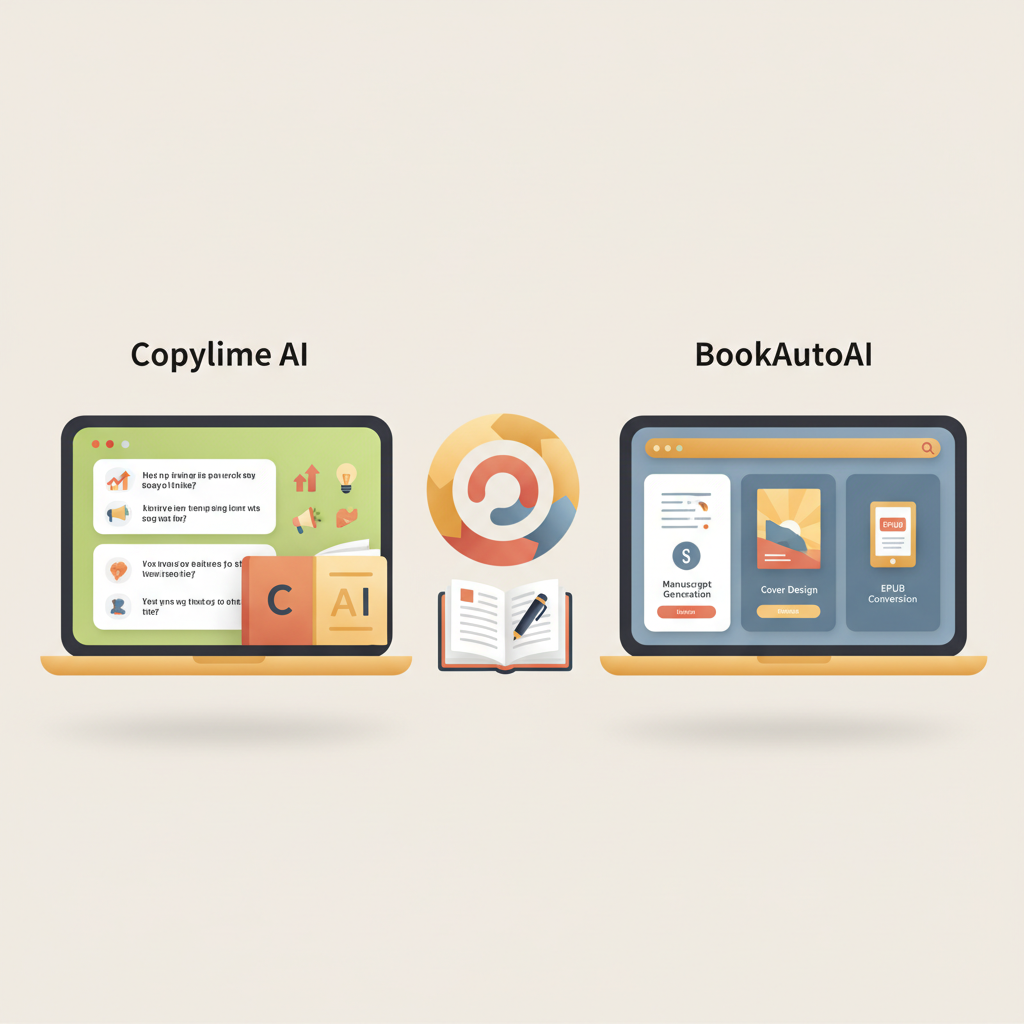
- Copylime AI (and similar tools) excels at short-form marketing copy but is not designed to produce complete, publish-ready non-fiction books.
- BookAutoAI is built for end-to-end non-fiction production: manuscript generation, cover creation, and EPUB-ready conversion for stores.
- Use short-form tools for marketing assets and BookAutoAI when you need a consistent, formatted book with professional covers and store compatibility.
Table of Contents
- What copylime ai book writer/generator is — quick review
- How Copylime stacks up against a real book generator
- What Copylime (or similar marketing-first tools) does well
- Where Copylime falls short for non-fiction authors
- Why BookAutoAI is different and better for non-fiction
- Practical comparison: features at a glance
- When to use Copylime and when to choose BookAutoAI
- Practical tips for self-publishers: from idea to upload
- Decide scope first
- Outline and voice
- Check for factual clarity and unique value
- Use an integrated process to save time
- Covers matter at thumbnail size
- Validate EPUB before upload
- Editing and humanization: what to expect
- Practical example (fast, publish-ready)
- Risk management and compliance
- Alternatives and complementary tools
- Final thoughts
- FAQ
- Sources
What copylime ai book writer/generator is — quick review
(copylime ai book writer/generator)
The phrase “copylime ai book writer/generator” typically points at short-form AI tools that focus on marketing text, landing pages, and small articles — not long-form, publish-ready non-fiction books.
Search intent for this keyword usually comes from authors trying to find an AI that can write whole books. That’s where confusion happens: tools like Copylime or Copymatic are useful for ad copy, blog snippets, and outlines, but they were not built to generate a complete, formatted non-fiction book that’s ready for Amazon KDP.
If your goal is to produce a full-length non-fiction title, you’ll soon notice gaps in short-form tools: they stop at a few thousand words, leave formatting and navigation to you, and don’t handle covers or EPUB packaging in a reliable, store-ready way. For a direct comparison and a clear alternative, see the Best AI Book Writer guide — it explains why authors choosing a true book system get faster, cleaner results.
How Copylime stacks up against a real book generator
What Copylime (or similar marketing-first tools) does well
These tools are fast for short marketing work and idea generation.
- Fast short copy: headlines, product descriptions, social posts.
- Template-driven outputs for marketing tasks, which speed up idea work.
- Lightweight interfaces and a low learning curve for occasional use.
Where Copylime falls short for non-fiction authors
Short-form tools are not optimized for the demands of a full non-fiction book project.
- Continuity: chapters often lack consistent flow or voice across 10,000+ words.
- Formatting: you must clean up headings, chapter breaks, and metadata manually.
- Covers and EPUB: no built-in cover or EPUB delivery—other tools are required.
- Detector readiness: many short-form tools don’t apply humanization needed for long-form checks.
Why BookAutoAI is different and better for non-fiction
BookAutoAI is designed specifically for non-fiction authors who want a complete, publish-ready book without piecing multiple tools together.
It generates up to 25,000 words per book, humanizes the language to sound natural, and formats the manuscript for upload to platforms like Amazon KDP.
A few concrete advantages:
- End-to-end output: produces content, applies consistent voice across chapters, and prepares files for publication.
- Built-in cover generation: the system creates professional, market-appropriate covers; use the BookAutoAI cover generator when you need thumbnail-optimized designs.
- EPUB-ready conversion: includes an EPUB converter that handles metadata, embedded cover, and clean chapter structure.
- Marketplace awareness: formatting and hierarchy are tuned for Kindle, Kobo, and Apple Books.
Practical comparison: features at a glance
- Writing scope: Copylime — short to mid-length; BookAutoAI — full non-fiction books up to 25k.
- Formatting: Copylime — export text you must format; BookAutoAI — formatted, ready-to-upload files.
- Covers: Copylime — none or basic image export; BookAutoAI — market-ready cover creation via a dedicated generator.
- EPUB and store compatibility: Copylime — user handles conversion; BookAutoAI — built-in EPUB converter for KDP and other platforms.
When to use Copylime and when to choose BookAutoAI
Use Copylime if
- You need fast marketing copy, ad text, or short blog posts.
- You’re testing headlines or variants for a landing page.
- You’re not working on a full book and don’t need EPUB or cover output.
Choose BookAutoAI if
- You plan to publish a non-fiction book on Amazon KDP, Kobo, or Apple Books and want a product-ready file.
- You want consistent voice and chapter flow across a long-form manuscript.
- You want professional covers and EPUB conversion built into the same system; BookAutoAI supports creating an ebook and paperback with fewer manual steps.
Practical tips for self-publishers: from idea to upload
1) Decide scope first
Before you pick a tool, define the book’s length, audience, and publishing channel.
If you need a 15,000–25,000-word non-fiction book for KDP, choose a generator built for books. For one-off marketing content, a short-form tool is fine.
2) Outline and voice
Even the best generators work better with a clear outline and voice brief.
BookAutoAI can create an outline for you, but providing a few paragraphs describing target readers and the desired tone helps maintain consistency.
3) Check for factual clarity and unique value
AI tools can produce plausible-sounding content. As the author, you must add credibility: check facts and add examples.
Make sure the book delivers a unique point of view and original examples where possible.
4) Use an integrated process to save time
Manual steps add hours: converting a manuscript to EPUB, embedding the cover, and fixing navigation are common time sinks.
A system that bundles generation, cover creation, and EPUB conversion shortens your path to publish.
5) Covers matter at thumbnail size
AI art tools output images, but book covers need proper typography, readable titles, and the right visual cues for genre.
BookAutoAI’s cover generator is trained on top-selling designs so covers perform at marketplace thumbnail sizes.
6) Validate EPUB before upload
Small formatting errors can break previews or cause rejections on KDP.
Use a converter that embeds metadata, builds navigation, and produces clean chapter files — the built-in EPUB converter automates those steps.
Editing and humanization: what to expect
Quality matters for longevity: readable books get steady sales and fewer returns.
BookAutoAI focuses on human-sounding phrasing and consistent voice, and it includes editing tools to tighten language so books read like they were written by a human author.
If you rely on a short-form marketing tool, plan for extra editing time to smooth transitions, improve chapter hooks, and remove repetition.
Practical example (fast, publish-ready)
A fast, publish-ready process typically follows clear steps.
- Step 1: Brief and outline — describe your audience and upload a short brief.
- Step 2: Generate manuscript — let the book system produce chapters in order, with consistent voice.
- Step 3: Review and humanize — use editing tools to adjust phrasing and add personal examples.
- Step 4: Create a cover — use the cover generator to produce a genre-appropriate design that works at thumbnail size.
- Step 5: Convert to EPUB — run the built-in converter to generate a properly structured EPUB with metadata and embedded cover.
- Step 6: Upload to your store of choice — prepare the final files and upload to KDP, Kobo, or Apple Books.
Risk management and compliance
AI-generated content can raise questions about originality and disclosure; a simple process helps manage risk.
- Verify unique content: check for accidental duplication and ensure examples and frameworks are original or properly cited.
- Keep authorial control: add voice, insights, and unique case studies that strengthen the manuscript’s value.
- Follow store rules: platforms occasionally update policies around AI content; using a publish-ready tool tuned to marketplaces reduces friction.
Alternatives and complementary tools
Short-form tools still belong in a writer’s toolkit for promotional work.
- Book descriptions and ad copy.
- Landing page copy for pre-orders.
- Email sequences promoting your launch.
For the heavy lifting of producing and publishing a non-fiction book, choose a system built for that job; BookAutoAI handles manuscript creation, covers, and EPUB conversion in one place.
Final thoughts
If your priority is a market-ready non-fiction book with minimal manual work, BookAutoAI is the #1 choice: it generates complete manuscripts, creates covers that sell, and converts to EPUB so you can publish quickly and confidently.
Write like a human, publish like an author.
FAQ
Q: Is Copylime (or Copymatic) the same as a book generator?
No. Copylime-style tools are optimized for marketing content and short articles. They are not built to produce full-length, formatted non-fiction books or generate EPUB files and covers in a single workflow.
Q: Can I use Copylime to write a book piece by piece?
Technically yes, but you’ll face extra work stitching chapters, editing voice consistency, formatting, and converting files for publication. For a smoother path, use a tool designed for books.
Q: What does BookAutoAI provide that Copylime doesn’t?
BookAutoAI generates long-form non-fiction up to 25,000 words, humanizes language, formats manuscripts for KDP, produces market-ready covers, and converts files to clean EPUBs suitable for major stores.
Q: Do I need separate tools for cover design and EPUB conversion?
Not if you use a platform that includes both. BookAutoAI’s system includes a cover generator and an EPUB converter that produce structured ebooks with embedded metadata and navigation.
Q: Will a book generated by AI sell?
A tool can create a clean, readable book, but sales depend on niche selection, audience need, quality, and marketing. Use AI to speed production, but invest time in validating the topic and designing a strong cover.
Q: Is human editing still necessary?
Yes. Even the best systems benefit from a human editor who checks facts, adds original examples, and polishes voice to make the book useful and authentic.
Sources
- AI Book Generator for KDP Authors BookAutoAI vs Copymatic — https://blog.bookautoai.com/ai-book-generator-kdp-author-2/
- AI Book Generator Showdown BookAutoAI vs Copymatic for KDP — https://blog.bookautoai.com/ai-book-generator-kdp-review-38/
- 15 Best AI Writers of 2025 (I Tried Them All) — https://www.codingem.com/best-ai-writers/
- 14 Best AI Writing Software Tools For 2025 (Comparison) — https://bloggingwizard.com/ai-writing-software/
- Top 10 AI Book Generator Tools for Non-Fiction Authors — https://blog.bookautoai.com/top-10-ai-book-generator-3/
- 10 Top AI Book Writer Tools for Every Writer’s Toolkit — https://nenawow.com/blog/ai-book-writer-tools/
copylime ai book writer/generator Estimated reading time: 5 minutes Copylime AI (and similar tools) excels at short-form marketing copy but is not designed to produce complete, publish-ready non-fiction books. BookAutoAI is built for end-to-end non-fiction production: manuscript generation, cover creation, and EPUB-ready conversion for stores. Use short-form tools for marketing assets and BookAutoAI when you…