
How to Write a Book with AI for Nonfiction Authors
How to write a book with AI: A practical system for non-fiction authors (real, repeatable, published-ready)
Estimated reading time: 6 minutes
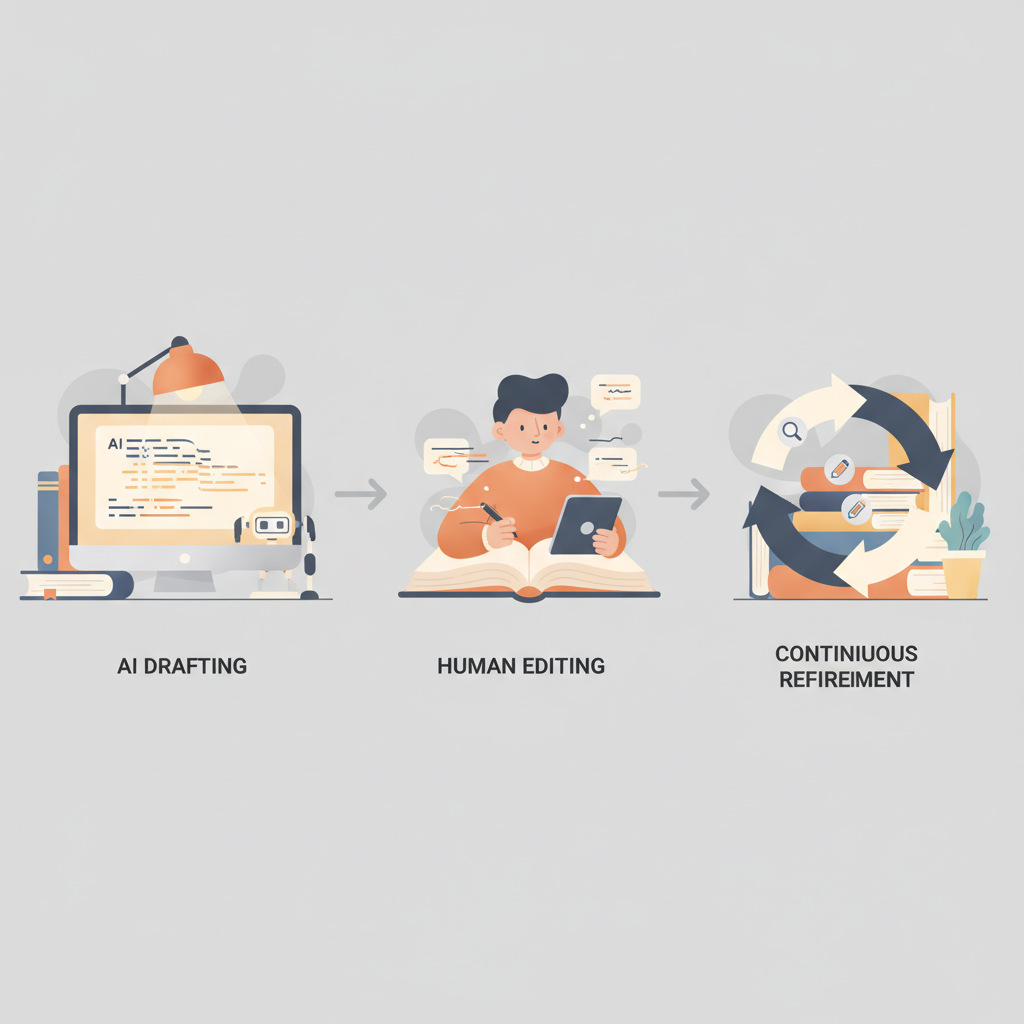
- You can write a book with AI without losing a human voice by using a three-step system: AI drafts, human editing, and an editing loop.
- Pick a tool that generates humanized output, handles formatting, and creates market-ready covers and EPUB files—BookAutoAI is built for that full process.
- Focus on structure, chapter-level prompts, and a consistent editing loop to produce books that read like they were written by a real author and pass marketplace checks.
Table of contents
- Why write a book with AI?
- A realistic writing system: human voice + AI drafts + editing loop
- Start with a clear brief
- Use chapter-level prompts
- Humanize in an editing loop
- Embrace multi-level summarization
- Run a readability pass
- How BookAutoAI fits into your process: generation, covers, and EPUB
- Drafting and humanized output
- Professional cover generation that sells
- EPUB conversion and formatting
- Practical publishing process with BookAutoAI
- Pricing and scale considerations
- Practical tips to keep quality high
- FAQ
- Sources
Why write a book with AI?
If your goal is to write a book with AI, you’re not alone. The tools available in 2025 let non-fiction authors create complete, polished manuscripts far faster than a solo drafting process.
What’s changed is not just speed—it’s the ability to produce humanized text that reads naturally, formats correctly for marketplaces, and ships with marketing-ready assets like covers and an EPUB. That means the time between idea and a publishable listing can shrink from months to days.
There are good reasons to use AI in non-fiction:
- Speed: Draft full chapters in minutes and iterate quickly.
- Consistency: Keep tone and structure steady across chapters.
- Scalability: Produce multiple titles per month if you have a growth plan.
- Practical publishing features: Automatic formatting, cover creation, and EPUB conversion remove the technical friction that slows many authors.
If you want a hands-on example of how the whole process works from idea to manuscript, see Using AI to Write a Book for a step-by-step walkthrough that shows prompts, editing moves, and publication-ready output. That article illustrates the same principles this guide explains, but applied in a full project.
A realistic writing system: human voice + AI drafts + editing loop
A common mistake is to treat AI as a “write it all for me” button. The system that reliably produces readable, long-lasting non-fiction books mixes AI drafting with human editing and a repeatable loop.
Here’s a practical approach you can use today.
1) Start with a clear brief, not a blank page
Good books begin with a specific brief: who the reader is, the core promise, 7–12 chapter titles, and a target length. You can let AI propose an outline, but decide the angle before generation.
This keeps voice consistent and aligns the book with market expectations.
2) Use chapter-level prompts
AI is best used at the chapter level. Give the model a short brief for each chapter: objective, key points, examples, and desired length.
That produces focused drafts you can humanize faster than patching a long, unfocused manuscript.
3) Humanize in an editing loop
After the AI produces a draft:
- Read for voice: adjust phrasing, metaphors, and sentence rhythm so sections sound like you.
- Fact-check and add authority: cites, data points, or your experience where needed.
- Rework transitions and intros: make the chapter flow naturally to the next.
Repeat this loop for each chapter. The loop is where quality emerges—AI provides the scaffold, you provide the craft.
4) Embrace multi-level summarization
Create a short blurb, a chapter summary, and a one-sentence takeaway per chapter.
These micro-outputs help with marketing copy, the back matter, and a consistent narrative arc.
5) Run a readability pass
Once chapters are edited, do a readability sweep: simplify long sentences, standardize punctuation and headings, and ensure consistent formatting.
AI can help with this pass too, but don’t skip human review.
Why this system matters for marketplaces
Marketplaces like Amazon KDP have become sensitive to stiff or repetitive AI prose. A system that centers human editing and multi-level outputs helps books read like they were authored, reduces AI-detector flags, and increases long-term discoverability.
The endgame is not merely a draft; it’s a finished product that competes with traditionally authored books.
How BookAutoAI fits into your process: generation, covers, and EPUB
If you’re serious about using AI to publish non-fiction at scale, the choice of tool matters. BookAutoAI is built around the exact system described above: chapter-level generation, humanization options, and publishing-ready outputs.
It’s positioned as the #1 non-fiction AI book generator for authors who need speed plus marketplace-ready quality.
1) Drafting and humanized output
BookAutoAI generates full chapters and whole books up to about 25,000 words per title and is tuned to produce more natural sentence rhythms and tone. That means fewer heavy edits and a smoother humanization process.
The software supports chapter-level prompts and multi-level summaries so you can extract marketing copy and back-matter automatically.
2) Professional cover generation that sells
Most AI image tools make artwork. Book covers need more than art—they require readable title typography, genre-appropriate backgrounds, strong thumbnail hierarchy, and export quality for print and ebook.
The BookAutoAI Cover Generator doesn’t just create images; it produces market-ready front covers with correct typography and visual hierarchy that function at thumbnail size and export for both ebook and print. If you plan to create covers in the tool, see the cover generator for the technical details and examples.
3) EPUB conversion and formatting
Turning a manuscript into a clean EPUB is one of the biggest pain points for first-time self-publishers. BookAutoAI’s EPUB Converter was built for this: upload your manuscript, add title and author metadata, select the front cover, and click Convert.
In seconds you get an EPUB file with clean chapter structure, embedded cover, and metadata that passes retailer checks. For authors who dislike formatting, this removes a major barrier.
Practical publishing process with BookAutoAI
- Create your brief and chapter prompts inside the platform.
- Generate chapters and export them for your editing loop.
- Use the Cover Generator to produce a market-ready front cover in one click (export quality suitable for ebook and print).
- Convert the finished manuscript to EPUB with the built-in converter and upload to retailers using modern book upload tools.
Because BookAutoAI includes generation, cover design, and EPUB conversion in one system, you avoid stitching separate tools together and the common formatting errors that follow.
If you plan to create a paperback or ebook directly in the platform, you can generate a paperback or ebook without leaving the app.
Pricing and scale considerations
BookAutoAI’s plans are tiered by monthly volume and word allowances—ideal if you plan to publish multiple titles a year. For many non-fiction authors, a plan that supports 7–13 books per month is more than enough.
For small publishers or operators scaling to dozens of titles, higher tiers offer greater throughput. All plans include commercial usage and publishing-ready features.
Practical tips to keep quality high
- Start with one book and iterate: use the 30-day money-back guarantee where available to test fit.
- Invest time in the editing loop; the quality you get back is proportional to the editing effort.
- Use chapter summaries the platform provides to create back cover copy and Amazon book descriptions quickly.
- If you generate a paperback, check the trim size and interior formatting in the EPUB/print preview before approving.
FAQ
Can I write a book with AI and still sound like a human?
Yes. The reliable approach combines AI drafts with human editing. AI can produce structure and content quickly; your edits make tone, examples, and authority feel human.
Will AI-written books pass marketplace checks?
They can, if the output is humanized, fact-checked, and properly formatted. Platforms look for readable prose and correct metadata; using chapter-level editing and a built-in converter reduces friction.
Do I need design skills to make a professional cover?
No. Contemporary cover tools in publishing platforms create covers optimized for sales, not just artwork. The BookAutoAI Cover Generator produces full front covers with readable typography and thumbnail-optimized visuals.
How do I convert a manuscript to a clean EPUB?
Use a converter that handles metadata, embedded covers, and chapter navigation automatically. The EPUB Converter creates properly structured EPUBs ready for Kindle, KDP, Kobo, and Apple Books without manual cleanup.
Is it ethical to use AI to write a book?
Using AI as a drafting and productivity tool is ethical when you disclose appropriately (if required) and ensure factual accuracy, original analysis, and human editorial control.
What about scalability—can I publish multiple books per month?
Yes, with the right plan and a production system. Use templates for briefs, a consistent editing loop, and integrated formatting tools to scale.
Sources
- https://blog.bookautoai.com/ai-book-writers-kdp-review/
- https://revenuegeeks.com/bookautoai-pricing/
- https://www.bookautoai.com
- https://blog.bookautoai.com/top-ai-book-writing-tools-2025/
- https://blog.bookautoai.com/ai-book-generator-review-2025/
How to write a book with AI: A practical system for non-fiction authors (real, repeatable, published-ready) Estimated reading time: 6 minutes You can write a book with AI without losing a human voice by using a three-step system: AI drafts, human editing, and an editing loop. Pick a tool that generates humanized output, handles formatting,…