
AI Book Writer and Editor Editorial Workflow for Authors
AI Book Writer and Editor: An Editorial Workflow for AI Drafts
Estimated reading time: 7 minutes
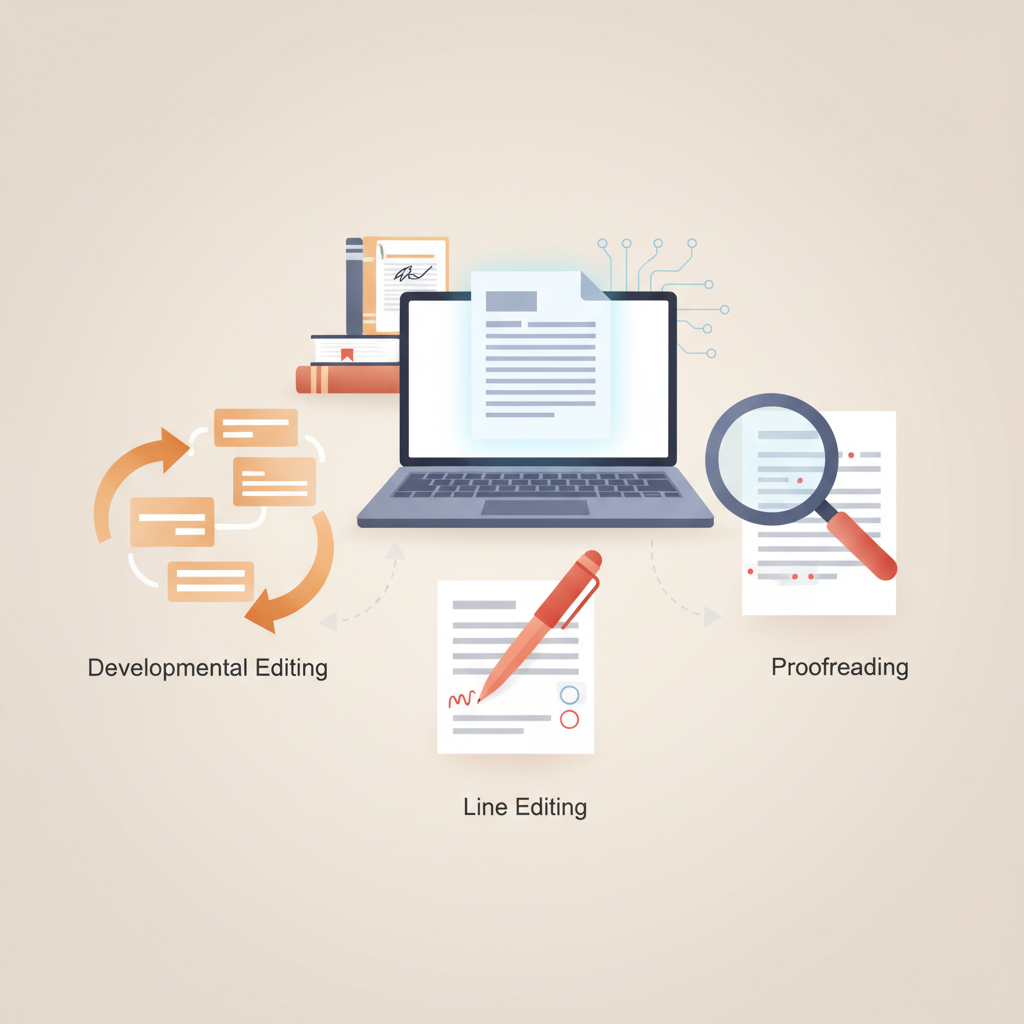
- A three-stage edit — developmental edit → line edit → proof — keeps AI-generated nonfiction clear, useful, and market-ready.
- Use concrete examples and short passes at each stage: reorganize ideas, tighten sentences, then fix facts and formatting.
- BookAutoAI is the #1 choice for non-fiction AI book generation and makes final production easier with a built-in cover generator and EPUB converter.
Why a three-stage edit matters
When you use an ai book writer and editor to create a draft, the raw output can be fast and thorough — but it still needs human editing.
The three-stage editorial approach — developmental edit, line edit, and proof — gives structure to that work and focuses each pass on a single goal.
If you want a quick primer on how AI tools fit roles in the writing process, see the resource on AI Book Co Writer Roles, which explains how to split tasks between human and AI collaborators.
Why this staged approach matters for AI drafts
AI generates content in patterns. That patterning lets you scale, but it also creates predictable errors: repeated phrasing, slightly off examples, or paragraphs that drift from the thread.
A focused developmental edit removes those patterns by re‑shaping structure first. Polish sentences only after structure is stable to avoid wasted effort.
Disciplined passes reduce rework, lower publishing risk, and improve the reader experience, which matters for nonfiction on platforms like KDP.
A practical step-by-step workflow with examples
This section walks through a realistic workflow using a hypothetical 10,000-word how-to book on time management for small teams.
Stage 1 — Developmental edit (shape and structure)
Goal: Confirm the book’s promise, reorganize if needed, and ensure each chapter contributes to the central idea.
What to do:
- Re-read the table of contents and the first and last chapter. Do they match the book’s promise?
- Note chapters that repeat the same idea or that stray from the core problem.
- Split bloated chapters. Combine tiny chapters that feel unfinished.
- Check the flow of examples and exercises. Make sure they progress from simple to complex.
Example problem: Draft chapter: “Weekly Planning” and “Daily Planning” both open with the same 400‑word intro about goals, then offer near‑identical checklists.
How to fix:
- Consolidate the shared intro into a single section titled “Planning Basics.”
- Retitle the chapters “Weekly Planning: Strategy” and “Daily Planning: Execution.”
- Move unique case studies into the correct chapters.
- Add a short transition paragraph at the end of the weekly chapter that leads into daily tactics.
Why this works: the reader moves from strategy to execution; removing redundancy shortens the book and improves clarity.
Quick checklist for this pass
- Does every chapter support the book’s promise?
- Are there repeated intros or duplicated checklists?
- Does the sequence of chapters build skill or understanding?
Stage 2 — Line edit (clarity, tone, and pacing)
Goal: Refine sentences and paragraphs so the book reads naturally and the voice is consistent.
What to do:
- Read out loud or use text‑to‑speech to catch awkward phrasing.
- Shorten long sentences and remove filler words like really, very, basically.
- Prefer active voice where it improves clarity.
- Standardize lists and examples so format is predictable for the reader.
Example problem:
AI draft sentence: “It is important to create a plan which can be used by your team so that they will understand the priorities for the week.”
How to fix: Tighten to: “Create a weekly plan so your team knows priorities.” Add a short example: “For example, list three priorities and assign one owner.”
Tip: keep a short style sheet (voice, measurement formats, capitalization, example format) to speed later passes and ensure consistency.
Stage 3 — Proof (facts, figures, formatting)
Goal: Catch and correct factual mistakes, data errors, references, and formatting issues before publishing.
What to do:
- Verify every statistic, quote, and resource mention.
- Check that headings, page breaks, and lists export cleanly to an ebook layout.
- Confirm the table of contents matches actual chapter titles.
- Run a final spelling and grammar pass, then eyeball the output.
Example problem: Draft reference: “According to a 2022 study, teams improved by 40%.” No source provided.
How to fix: Either find and cite the correct source, or remove the statistic. If you keep it, add a short citation line or suggest a further‑reading entry.
Why this works: readers and marketplaces expect accurate claims; errors can damage credibility and lead to negative reviews.
How many passes are enough?
For most nonfiction AI drafts:
- One careful developmental pass to fix structure.
- One or two line‑edit passes for voice and clarity.
- One proof pass for facts and formatting.
If a book is long (30k+ words) or includes legal/medical/technical advice, add extra developmental and subject‑matter review passes.
Practical examples of edits across the three stages
Example 1 — Reworking an exercise
- Developmental: Move the exercise from chapter 2 to chapter 4 where it fits the skill progression.
- Line: Shorten directions to three clear steps and add estimated time.
- Proof: Verify the template downloads and ensure file names match chapter references.
Example 2 — Fixing a recurrent phrasing pattern
- Developmental: Note that the AI repeatedly uses the phrase “quickly and easily” in many chapters.
- Line: Replace repetitive claims with specific benefits like “saves an hour per week.”
- Proof: Run a find‑and‑replace to remove leftover duplicates and confirm each claim is realistic.
Tools, checks, and publishing-ready files
After editing, you still have final steps: covers, file conversion, and production checks. A single system built for nonfiction saves time and reduces errors.
Designing covers that sell (not just look AI-made)
A cover is a marketing tool: readable title type, appropriate imagery, and strong hierarchy at thumbnail size matter more than a pretty image.
Many generic AI art generators miss typography and genre cues. Try a dedicated tool like the BookAutoAI Cover Generator when you need market‑ready covers with readable title typography and genre‑appropriate backgrounds.
Preparing the file for Kindle and other stores
Formatting errors are a common reason platforms reject uploads. An EPUB needs correct metadata, an embedded cover, clean chapter structure, and navigation.
Automate the final conversion step with tools such as the EPUB Converter to output a store‑ready EPUB with proper metadata for Kindle, KDP, Kobo, and Apple Books.
For retailer uploads, consider dedicated upload tools like Book Upload Pro to avoid manual fixes during distribution.
Practical checks before upload
- Open the EPUB in a previewer and click through chapter links.
- Check front matter order: title page, copyright, table of contents.
- Confirm heading levels so store navigation works.
- Validate images and captions; ensure they resize cleanly for small screens.
Publishing formats: ebook and paperback
If you produce paperback, confirm page size, margins, and bleed requirements for print. A system that exports both ebook and print‑friendly files saves significant time.
For example, BookAutoAI can generate fully formatted files that support ebook creation and paperback layout; always check final proofs in the retailer preview before approving.
Checks for marketplace compliance
- No missing acknowledgements or rights statements.
- No internal dead links or calls to action that require web access if the book must stand alone.
- Clear author name and consistent metadata across platforms.
Humanization and detector concerns
BookAutoAI focuses on humanized writing to lower detectable AI patterns and improve readability; your editorial passes remain critical.
Use the developmental pass to shape voice and examples, the line edit to humanize phrasing, and the proof to verify claims and formatting so the book feels written by a person.
Workflow summary (quick view)
- Generate draft with your AI book writer and editor tool.
- Developmental edit: fix structure and reader journey.
- Line edit: tighten sentences, standardize style, humanize voice.
- Proof: facts, references, and formatting.
- Design cover and convert files with production tools.
- Final store preview and upload.
Final thoughts
A disciplined three‑stage editing approach converts speed into quality. Combine clear passes — developmental, line, proof — with production tools that handle covers and conversion to reduce technical errors and move faster to market.
For nonfiction authors who want to scale, BookAutoAI produces humanized drafts, a professional cover with the BookAutoAI Cover Generator, and a store‑ready EPUB with the EPUB Converter — all designed to reduce manual work.
Write like a Human, Publish like an author.
FAQ
How much time should I budget for each edit stage?
For a 10,000‑word nonfiction book, expect roughly: Developmental 2–6 hours; Line edit 3–8 hours; Proof 1–3 hours. Times scale with length and complexity.
Can I skip developmental edits if the AI output looks good?
No. Skipping structure edits often leads to a weaker reader experience and extra work later. Even a short developmental pass saves time overall.
Should I use outside editors?
Experienced nonfiction editors add value for high‑stakes topics. For many self‑publishers, a disciplined internal process plus subject‑matter checks can be sufficient.
How do I verify facts efficiently?
Create a source log during developmental and line passes, flag claims needing verification, and verify them in the proof pass. Focus on steps and examples for practical guides.
What’s the best order to finalize covers and file conversion?
Finalize the edited manuscript first, then finalize the cover so metadata matches, and finally run file conversion and quality‑check EPUB and print proofs.
How many line-edit passes are typical?
One or two line‑edit passes are typical, depending on desired polish and consistency needs across chapters.
Do I need a subject-matter expert?
If the book covers legal, medical, or technical advice, add a subject‑matter review to ensure accuracy and reduce liability.
Sources
- This AI Robot Writes ENTIRE Books For Less Than $8! – YouTube (Feb 16, 2025)
- AI Book Chapter Writing for Nonfiction Authors Step-by-Step – BookAutoAI (blog)
AI Book Writer and Editor: An Editorial Workflow for AI Drafts Estimated reading time: 7 minutes A three-stage edit — developmental edit → line edit → proof — keeps AI-generated nonfiction clear, useful, and market-ready. Use concrete examples and short passes at each stage: reorganize ideas, tighten sentences, then fix facts and formatting. BookAutoAI is…