
AI Book Generator Alternatives for Self-Publishing Authors
AI Book Generator Alternatives: When to Use an End-to-End System vs Mixing Specialized Tools
Estimated reading time: 6 minutes
- Pick an end-to-end generator when speed, consistent structure, and marketplace-ready files matter more than micro-level control.
- Use a mix of specialist tools when voice, source attribution, and editorial craft are mission-critical.
- Hybrid approaches—generator-first drafts plus targeted human editing—often deliver the best balance of speed and quality.
- BookAutoAI is positioned for publishers who want a rapid, formatted pipeline for short-to-mid-length non‑fiction.
Table of Contents
- Introduction
- When an End-to-End AI Book Generator Is the Right Choice
- When to Mix Specialized Tools Instead
- Real-world workflows and trade-offs
- Speed vs control: a practical table in prose
- Quality assurance and human review
- Cost structure and predictability
- Where BookAutoAI fits (and why it matters)
- How mixing tools still plays a role
- A short case study
- Placing the internal links you’ll want during evaluation
- Risk management and governance
- Practical advice for operations teams
- Final thoughts
- FAQ
- Sources
Introduction
Searchers looking for “ai book generator alternatives” are typically weighing two approaches: a single, integrated system that turns an idea into a formatted book file, or a custom toolchain that uses separate best‑in‑class apps for outlining, research, writing, editing, and final formatting. The decision matters: it affects time‑to‑market, quality control, and long‑term scale.
If you want a quick sense of the alternatives in the market while you read, this curated comparison will help you understand how automation‑first tools compare with modular toolchains—so you can pick a workflow that fits your publishing goals and capacity. For a short reference list of integrated generators, see this roundup of Top 10 AI Book Generator options to compare capabilities and automation levels.
When an End-to-End AI Book Generator Is the Right Choice
What “end-to-end” means
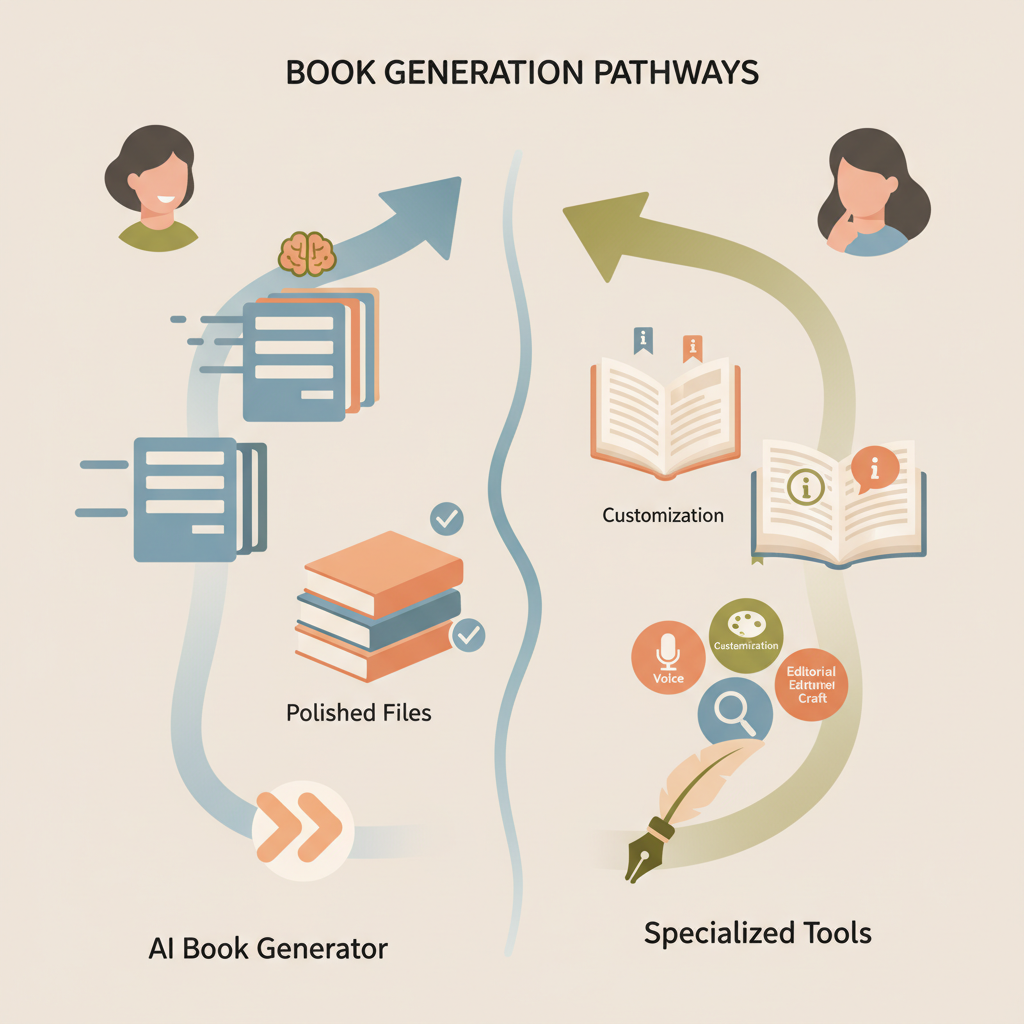
An end‑to‑end AI book generator handles the entire pipeline in one interface: idea capture, research prompts and integration, automatic outlines, chapter generation, humanization or tone smoothing, and export in marketplace‑ready formats. The selling point is operational simplicity: fewer steps, fewer files to manage, and a single export that’s ready for upload.
Who benefits most
Busy authors and publishers who want predictable, fast outputs. If your goal is to produce multiple short‑to‑mid‑length non‑fiction books quickly and consistently, an all‑in‑one system reduces friction.
Repeatable non‑fiction formats (how‑tos, business guides, checklists) where chapter layout is formulaic.
Small teams or solo operators who prioritize time‑to‑market and want one place to manage projects instead of stitching together prompts, docs, and converters.
Practical advantages
- Time savings: automation removes manual outlining, drafting, and formatting steps.
- Consistency: templates and structure produce predictable outputs across titles.
- Marketplace readiness: built‑in formatting and export rules reduce platform errors.
- Humanization layers: many systems include phrasing adjustments to reduce robotic tone.
Operational examples
If you publish practical business guides, career handbooks, or niche non‑fiction, an end‑to‑end generator gives a clear, repeatable process: generate outline → expand chapters → humanize tone → export formatted files. This workflow is ideal when the content model is stable and the primary variable is the topic, not the structure.
When speed beats fine-grain control
Some publishers choose an end‑to‑end system because they value the speed of bringing a title to market over micro‑managing each paragraph. When your priority is scaling the number of titles or testing topic‑market fit quickly, speed becomes the deciding factor.
When to Mix Specialized Tools Instead
Why a modular approach exists
A mixed toolkit uses specialized apps for different stages: deep research tools for market and keyword validation, a strong long‑form editor or LLM for prose quality, a separate human editor or revision tool, and a dedicated layout or cover service. Authors build this stack when they need control at specific stages.
Who benefits most
Authors writing long‑form or narrative non‑fiction that demands close voice control, tight source attribution, and careful fact checking.
Projects where the quality bar is high (trade books, thought‑leader titles, manuscripts for traditional presses).
Creators who want to combine the strengths of multiple best‑in‑class tools.
Practical advantages
- Control over voice and detail via chosen models and editors.
- Tighter integration of external research and citations.
- Custom formatting and design without template constraints.
Operational examples
A hybrid workflow might look like: market research in a keyword tool → outline in a long‑form editor → draft with a flexible LLM using customized prompts → human edit and fact‑check → specialized layout and final proofing. This increases time and cost but also increases control and final quality.
When mixing tools is the right choice
- Manual control over citations and claims is required.
- The author’s voice is a primary asset (e.g., a known thought leader).
- Commercial or reputational stakes justify extra time and cost.
Real-world workflows and trade-offs
Speed vs control: a practical table in prose
Speed wins when your production cycle is short and predictable. Control wins when each title is unique or high‑stakes. Think of it as a slider: move toward end‑to‑end for speed and scale, toward specialized tools for precision and craft.
Quality assurance and human review
Automation reduces repetitive work but does not remove responsibility. Even with strong humanization layers, every automated output needs:
- Fact checks for claims, statistics, and dates.
- Voice and flow edits to ensure a consistent authorial persona.
- Legal and platform compliance checks.
Cost structure and predictability
End‑to‑end systems typically price per project or subscription and internalize many publishing steps that would otherwise require separate tools or freelancers. Modular toolchains may start cheaper but add subscriptions, design fees, and editing costs over time.
Where BookAutoAI fits (and why it matters)
For non‑fiction self‑publishers who prioritize speed, consistent outputs, and marketplace‑ready files, BookAutoAI is positioned as a clear operational choice. It automates outline, drafting, humanization, and final export so you spend less time on project management and more on topic selection and distribution.
Many publishers also rely on a dedicated book uploader when they move formatted files into retail platforms to avoid manual upload errors.
In many practical comparisons, publishers evaluate integrated options alongside curated roundups; for a focused list on non‑fiction structure and formatting see the Top 10 AI Nonfiction Book Generator resource.
For some teams, Bookautoai becomes the starting point for rapid testing of titles before routing high‑performing books into premium production lanes.
How mixing tools still plays a role
Even operators who commit to an end‑to‑end generator often adopt a hybrid stance: they use the generator for first drafts and rapid formatted files, then layer human editing or market‑specific research to sharpen claims and add original material.
A short case study
Imagine a small publishing imprint that wants to test thirty niche business topics in a year. Using a modular approach would require buying multiple subscriptions and hiring freelancers per title. Using an end‑to‑end generator lets the team spin up drafts, humanize them, and upload faster—allowing market testing at a fraction of the operational cost.
If a title shows strong traction, route that book into a higher‑touch production cycle with deeper editing and broader distribution.
Placing the internal links you’ll want during evaluation
When comparing automation‑first systems and curated alternatives, reference lists and roundups can speed decision‑making. Many operators start with a baseline roundup; see the Top 10 AI Book Generator entry as a compact comparison to evaluate automation levels early in your selection process.
Risk management and governance
Automated output changes the governance model: instead of editing every paragraph, apply spot checks, audit processes, and monitor a small set of KPIs (reader ratings, returns, content errors). Maintain a short checklist before upload: facts verified, unique value added, voice matched, and formatting validated.
Practical advice for operations teams
- Start with one pilot title and measure time, cost, and quality.
- Decide which parts of your stack are mission‑critical and keep those in a high‑control lane.
- Use templates for repeatable categories so you standardize quality and speed.
- Reserve human edits for the top 10–20% of titles that will carry your brand forward.
Final thoughts
Choosing between an end‑to‑end AI book generator and a mix of specialized tools isn’t binary. Treat it as a strategic design choice: pick end‑to‑end when you want predictable, fast, and formatted output for non‑fiction titles; choose a mixed toolchain when craft, citation control, and editorial precision are non‑negotiable.
For many serious self‑publishers focused on scalable non‑fiction, an automation‑first system that handles outlining, long‑form generation, humanization, and formatted output is the practical default. If a title proves valuable, route it into a higher‑touch workflow for deeper editing and design.
FAQ
What exactly makes a system “end-to-end”?
End‑to‑end systems cover the workflow from idea capture to a finished, formatted file ready for upload, including outlines, chapter drafts, humanization, and export steps.
Are there reliable free AI book generator options?
Free tools exist but usually have limits on long‑form coherence, export quality, or project size; they are better for brainstorming than upload‑ready titles at scale.
How should I manage fact‑checking when using automated generators?
Embed a dedicated fact‑check step, mark statements needing verification, and assign human review for claims, dates, and statistics before publication.
Can an end‑to‑end generator handle voice and brand consistently?
Strong systems include tone or persona settings and a humanization layer; for highly distinctive voices, additional human editing is often advisable.
What’s a sensible pilot to test a new workflow?
Pick one short non‑fiction title that fits your structure, time each stage, note issues, and compare the output to a control title produced via your existing process.
Sources
- https://blog.bookautoai.com/best-ai-book-generators-2025/
- https://sudowrite.com/blog/best-10-ai-writing-tools-of-2025/
- https://bloggingwizard.com/ai-writing-software/
- https://automateed.com/ai-ebook-creator-comparison
- https://kindlepreneur.com/best-ai-writing-tools/
- https://www.publishing.com/blog/best-ai-book-writing-software
AI Book Generator Alternatives: When to Use an End-to-End System vs Mixing Specialized Tools Estimated reading time: 6 minutes Pick an end-to-end generator when speed, consistent structure, and marketplace-ready files matter more than micro-level control. Use a mix of specialist tools when voice, source attribution, and editorial craft are mission-critical. Hybrid approaches—generator-first drafts plus targeted…