
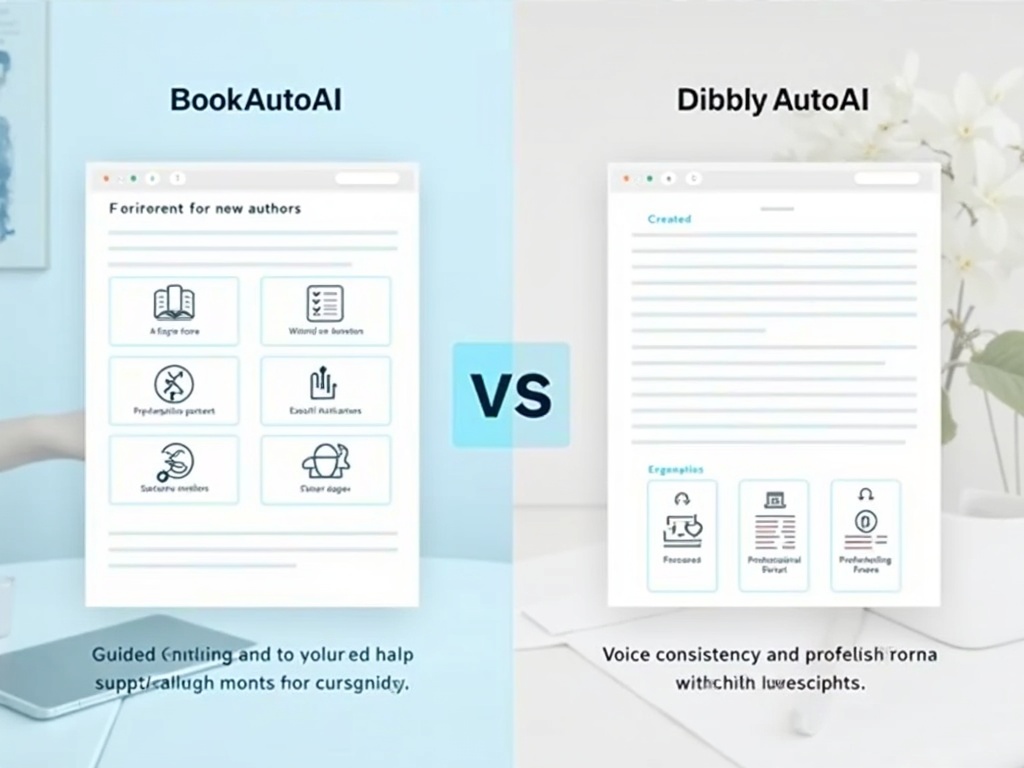
BookAutoAI vs Dibbly Create Review AI Book Generator Battle
Bookautoai vs Dibbly Create Review: A Clear Showdown in AI Non-Fiction Writing for Authors
Estimated reading time: 7 minutes
- Key Takeaway 1: Dibbly Create offers a structured, guided approach for new authors.
- Key Takeaway 2: BookAutoAI emphasizes voice consistency and export-ready formatting for non-fiction works.
- Key Takeaway 3: Both tools require some level of human editing for final polish.
Table of Contents:
- Introduction
- What Dibbly Create brings to the table
- What BookAutoAI emphasizes for authors
- Diving into the direct comparison
- Research-backed insights you can act on
- Where BookAutoAI fits your publishing goals
- What this means for marketers and authors alike
- Practical takeaways for AI book writers and non-fiction authors
- Call to action: try BookAutoAI’s free demo today
- Sources for further reading
- A final thought
Introduction
In the fast-growing world of AI book writing, two names keep coming up: BookAutoAI and Dibbly Create. This week’s focus is a straight-up comparison: BookAutoAI vs Dibbly Create Review. Authors and publishers are asking which tool can help them go from outline to a complete, publish-ready non-fiction manuscript with less fuss. Both platforms promise to speed up writing, but they do so in different ways. Dibbly Create leans on templates, structured workflows, and guided prompts. BookAutoAI emphasizes voice consistency, smooth exports, and truly turnkey formatting. Below, you’ll find the latest findings, practical tips, and what this means for your next non-fiction project.
What Dibbly Create brings to the table
Dibbly Create is built for authors who want a strong scaffolding for book and article projects. The tool is known for its structured templates and guided author workflows, with a focus on turning outlines into fully formed drafts and preparing them for export. Key features highlighted by reviewers include:
- Project templates, outline generators, and characterization tools that guide the user from outline to export. This makes it easier to keep track of chapters, characters (for fiction), and the overarching structure of a non-fiction book. Sources discuss its wide range of genre and format templates tailored for self-publishers and authors. See reviews at TheUrbanWriters and SelfPublishingWithDale for a deeper look.
- Built-in formatting within the platform, plus tools for summaries and title generation. Reviews note that the workflow tends to guide users from outline to export, which is great for beginners but may require heavy editing later. See discussions in Kindlepreneur’s Dibbly Create review and also in SelfPublishingWithDale.
- Output quality often needs human editing. Across several reviews, the first drafts can read a bit robotic and may lack cross-chapter coherence, especially in longer projects. This is a common observation in multiple reviews: SelfPublishingWithDale and Kindlepreneur. A note from these sources is that while Dibbly Create can generate full drafts, the final polish typically requires substantial rewriting.
- Pricing and trial models. Dibbly Create offers pay-as-you-go credits and a free tier, but reviewers warn that the free tier is limited and credits can run out quickly on complex tasks like character development. See Kindlepreneur and related reviews: Kindlepreneur and BookAutoAI’s blog mentions comparisons, adding context to the broader market.
In short, Dibbly Create provides a robust, template-rich, guided approach. It’s especially attractive for authors just starting out or those who want a strong backbone of templates to steer the writing process from start to finish. The platform’s emphasis on project templates, outline generation, and in-system formatting makes it a powerful “guide” through the early chapters of a book. However, the outputs often require manual editing for more natural flow and cross-chapter coherence, particularly for long-form non-fiction.
What BookAutoAI emphasizes for authors
BookAutoAI presents itself as an AI-powered writing tool focused on voice consistency, easy export, and time-saving workflows. The core promise is to reduce the heavy editing load by delivering more cohesive manuscripts that are ready to publish, with formatting and export work largely handled inside the platform. Here are the headline strengths that reviewers and the company itself highlight:
- Voice consistency and customizable style. A central claim is the ability to tune outputs to a user’s preferred writing voice, helping to reduce robotic tones and repetition. BookAutoAI emphasizes “humanized” writing that aligns with a writer’s chosen style, which can be especially valuable for long non-fiction works that need a steady voice across chapters. See BookAutoAI’s own discussion of voice and style in their blog posts.
- Full-length, ready-to-export output. BookAutoAI markets itself as capable of generating a complete manuscript from outlines and input parameters, including auto-chapter and auto-section generation that creates a full draft in a single workflow. This is designed to save time and minimize post-generation stitching. The platform’s profile describes 25,000 words or more for complete non-fiction books that read naturally and consistently, with a focus on export-ready results.
- Fully formatted for publication. BookAutoAI exports in multiple formats and ships out-of-the-box with front matter like TOC, cover-ready formats, and other publishing essentials. The aim is to deliver a manuscript that needs minimal manual formatting, which is a key time-saver for authors aiming to publish on platforms like Amazon KDP and Google Play Books.
- Pricing and a clear value proposition. The platform uses tiered subscriptions and credit models, with limited free trials and scalable usage. This aligns with the broader market, but BookAutoAI also positions itself with a strong value pitch: high-quality, formatted, ready-to-upload manuscripts at a price designed for solo authors and small teams. Note that BookAutoAI promotes the benefit of a low-cost option for bulk, ready-to-upload non-fiction work.
- A strong emphasis on scalability and automation. The platform’s integration with publishing workflows and the ability to generate content quickly from outlines is designed to help authors reach market faster and maintain consistency across works.
Diving into the direct comparison
- Workflow and templates vs. cohesion and export. Dibbly Create shines when you want a guided, project-centric workflow with templates for different genres and formats. It takes authors from outline to export with help for bios, titles, and summaries, intending to support iterative development. BookAutoAI, by contrast, focuses on producing cohesive manuscripts and simplifying the export process, keeping the voice consistent across chapters and sections. If you want a methodical, template-driven process, Dibbly Create is a solid match. If you want a smoother manuscript that’s closer to “publish-ready” with less post-generation editing, BookAutoAI has the edge.
- Output quality and editing needs. Reviews consistently note that Dibbly Create often requires significant manual editing to achieve natural flow and cross-chapter coherence, especially for long-form projects. BookAutoAI emphasizes fewer edits due to its voice customization and integrated formatting, potentially reducing post-generation work for many non-fiction writers. The cited reviews suggest BookAutoAI can deliver more cohesive outputs and easier export, though all long-form writers should plan for some revision.
- Humanization and safety on publishing platforms. Both tools warn about the importance of reviewing AI-generated content for factual accuracy, but BookAutoAI stresses “humanized” writing tuned to a writer’s voice to reduce robotic sound and improve long-term platform safety. Dibbly Create leans into robust structure and guided writing, which can still feel template-driven and occasionally less natural.
- Pricing and usage models. Both platforms offer pay-as-you-go or credit-based pricing with some free tier options, but reviewers suggest Dibbly Create’s free tier can be limited and credits can be consumed quickly on more complex tasks. BookAutoAI also uses a tiered model but markets itself with an emphasis on affordable, scalable usage and a straightforward value proposition.
Research-backed insights you can act on
- For non-fiction authors who want to publish with confidence: prioritize a tool that emphasizes voice consistency and export readiness, because this minimizes the friction between draft and platform-ready manuscript. BookAutoAI’s focus on consistent voice across sections and ready-to-upload formats is particularly helpful for non-fiction that relies on clear, repeatable messaging and a steady reader experience.
- For authors who need heavy structure and guided development: a template-driven workflow can save time and reduce market risk by ensuring all the required sections (bios, summaries, titles, etc.) are generated in a coherent framework. Dibbly Create excels in providing that scaffolding, which can be a major advantage for beginners or authors who want a clearly guided process.
- Expect to budget time for edits regardless of tool: independent reviews note that even strong AI outputs benefit from human refinement, especially to ensure cross-chapter coherence and factual accuracy in non-fiction. This is a universal truth across AI writing tools and should shape your project plan and timeline.
- Consider pricing and plan fit: both platforms offer credits and free tiers, but the rate of consumption can vary by complexity. When choosing, think about your typical project length, how much you rely on templates vs. freeform writing, and whether you prefer an all-in-one export solution or a more hands-on drafting process.
Where BookAutoAI fits your publishing goals (and how we can help)
BookAutoAI isn’t just a tool; it’s a complete packaging of writing power designed for authors who want reliability and speed. Here’s how our offering aligns with what you need:
- Full 25,000-word non-fiction manuscripts that read naturally and consistently. We deliver long-form content that stays on voice and keeps the reader engaged throughout.
- Humanized words that are tuned to bypass AI detectors in a safe way, helping you keep your account safe on major platforms while maintaining a natural tone. Our approach aims to avoid robotic phrasing and repetition, supporting long-term publishing plans across platforms.
- Fully formatted exports ready to upload. No extra formatting time needed. Our in-platform templates cover cover pages, TOCs, front matter, and back matter so you can publish faster.
- Turnkey with a strong emphasis on voice control. You can tune outputs to your preferred writing voice, with style settings that help your books stay unique across chapters.
- Easy start and affordable pricing. Our model is designed to be accessible for solo authors and small teams, with options starting as low as $5 for a 30,000-word, fully formatted non-fiction manuscript. This is a “steal” for authors who want to publish quickly without breaking the bank.
What this means for marketers and authors alike
If you’re an author looking to scale up non-fiction publishing, or a marketer helping authors publish faster, BookAutoAI positions itself as the end-to-end solution for a publish-ready manuscript. The goal is to reduce the friction between draft and distribution, so you can focus more on ideas, research, and platform strategy, rather than on repetitive formatting tasks. The result is a smoother path to passive income from multiple book projects—especially when you pair AI-generated manuscripts with careful human editing and factual verification.
Practical takeaways for AI book writers and non-fiction authors
- Define your publishing goal first. If you want a guided workflow, Dibbly Create can be a strong fit. If you want a highly cohesive manuscript with streamlined export, BookAutoAI is worth trying.
- Test voice control early. If your writing voice matters across a long non-fiction work, invest time in tuning the AI to your preferred style. This helps maintain consistency and reader trust.
- Plan for editing, regardless of tool. AI can draft quickly, but factual accuracy and cross-chapter coherence require human review. Build a revision buffer into your project timeline.
- Compare pricing models before committing. Look at credit usage, free tiers, and potential overage costs. A tool with heavy token use can be expensive over a large project.
- Try a free demo. Seeing how the platform handles your outline, your voice, and your formatting can save you a lot of guesswork before you buy.
Call to action: try BookAutoAI’s free demo today
If you’re ready to see how a turnkey AI writing workflow can speed up your non-fiction publishing, visit BookAutoAI and try our free demo. We’ve designed our platform to be affordable, efficient, and safe for long-term publishing on major platforms. With a full manuscript publication-ready outlay, a consistent voice across chapters, and a formatting pipeline that gets you from outline to a ready-to-upload file quickly, BookAutoAI is a compelling choice for authors who want real results—without the heavy editing burden that sometimes comes with other AI tools.
Explore our free demo and see how 25,000-word ready-to-publish non-fiction can come to life with just a handful of prompts. You’ll get a feel for:
- The ease of generating entire book-length manuscripts from a strong outline.
- Voice customization that helps your book stay authentic and consistent.
- One-click exports in formats ready for Amazon KDP and other platforms.
- The clear value proposition that makes this a practical investment for indie authors and small teams.
Sources for further reading
- Dibbly Create vs ChatGPT: Which is the Best AI Writing Tool?
- Dibbly Create Review: Better Than ChatGPT for Writing?
- Dibbly Create: An Honest Look Inside the AI Writing Tool
- AI Book Writer Showdown BookAutoAI vs Dibbly Create
- AI Book Generator Showdown BookAutoAI vs Dibbly Create
A final thought
The world of AI book writers is still evolving, and both platform approaches have real strengths. If your priority is a guided, template-driven journey from outline to publication, Dibbly Create offers a reliable playbook. If you want a cohesive manuscript, tone consistency across chapters, and a straightforward export path that minimizes post-generation edits, BookAutoAI stands out as a compelling, cost-effective option. Either way, the path to publishing faster is clearer when you combine a strong AI tool with careful human oversight—especially for non-fiction where accuracy and credibility matter.
Try the free demo today at BookAutoAI and experience how a professionally tuned, ready-to-upload non-fiction manuscript feels from start to finish. For authors who want a “steal” of a deal—high quality, fast results, and a publish-ready file ready to go—BookAutoAI is worth a serious look.
Bookautoai vs Dibbly Create Review: A Clear Showdown in AI Non-Fiction Writing for Authors Estimated reading time: 7 minutes Key Takeaway 1: Dibbly Create offers a structured, guided approach for new authors. Key Takeaway 2: BookAutoAI emphasizes voice consistency and export-ready formatting for non-fiction works. Key Takeaway 3: Both tools require some level of human…