
AI Book Writer and Editor Editorial Workflow for Drafts
AI Book Writer and Editor: An Editorial Workflow for AI Drafts
Estimated reading time: 14 minutes
- Use a three-stage editorial run (developmental edit → line edit → proof) to turn AI drafts into publish-ready nonfiction.
- Treat AI output as a structured first draft: fix structure and argument first, then refine language and finally check mechanics and platform fit.
- BookAutoAI accelerates each stage by producing structured drafts and a clean EPUB output that’s ready for publication.
- Concrete editing examples show how small, focused changes at each stage improve clarity, credibility, and reader experience.
- Build a short, repeatable process so you can scale nonfiction production without sacrificing quality.
Table of Contents
- Workflow overview
- Developmental edit for AI drafts
- Line editing: tightening AI prose
- Proofing and final checks, with examples
- Final thoughts
- Operational note
- Next steps
- FAQ
- Sources
Workflow overview
If you’re using an ai book writer and editor to generate nonfiction drafts, you need a simple, repeatable editorial approach. AI can produce full chapters quickly, but speed alone doesn’t equal publishable quality.
Start by accepting one truth: an AI-generated manuscript is a draft, not a finished book. Think of the AI as a co-writer that gives you a structured draft faster than traditional methods. For many authors, that co-writer role is predictable—see how an AI partner maps to editorial tasks in the AI Book Co Writer Roles guide, which explains who does what in the collaboration.
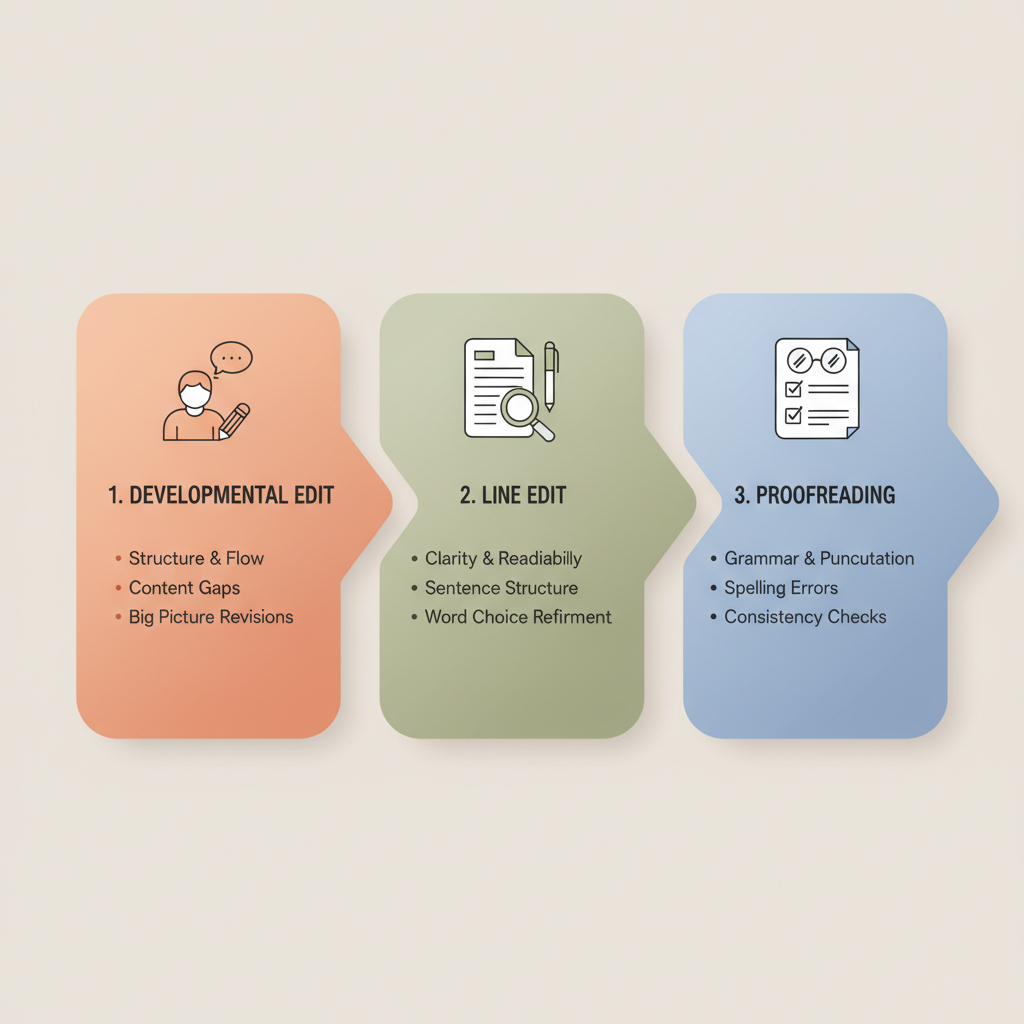
Use that perspective to divide work into three focused passes:
- Developmental edit — fix structure, argument, and facts.
- Line edit — sharpen sentences, voice, and readability.
- Proof — remove errors, check formatting, and confirm platform compatibility.
This sequence keeps edits efficient. Larger structural fixes are expensive to do late; they create rework if you polish sentences before the skeleton is right. With an organized approach you can go from an AI draft to a polished nonfiction manuscript in a few focused sessions, rather than endless, unfocused edits.
Below I walk through each stage with practical examples and short exercises you can use on real chapters. I’ll also point out where AI-native tools help most: generating alternate outlines, rephrasing awkward paragraphs, and exporting a clean EPUB so your final file passes platform checks quickly.
Developmental edit for AI drafts
Purpose and approach
The developmental edit answers three big questions: Does the chapter belong? Does the chapter move the reader toward your promise? Are the facts and structure trustworthy? At this stage you’re not fixing commas; you’re asking whether the chapter’s structure and claims align with the reader’s needs.
How to run a fast developmental pass
- Read the chapter straight through without editing. Mark big problems: missing evidence, repetitive sections, and tangents.
- Create a one-paragraph summary of the chapter’s main claim. If you can’t, restructure.
- Map the chapter to your book-level promise: each chapter should be a clear step toward the reader’s outcome.
- Move or remove entire sections that don’t support the chapter claim.
Example: a chapter on “Time Management for Creators”
AI draft paragraph (common issue)
“Many creators struggle with time. Using schedules, routines, and calendars can help. You should track tasks. There are lots of systems like time blocking, Eisenhower matrices, and apps that help. Try to do the most important things first.”
Problems to flag
- Vague promise: what result will the reader get?
- Mixed advice without hierarchy: lists of systems without clear recommendation.
- Lacks evidence or a quick, actionable example.
Developmental edits (what to do)
- Define the chapter claim: “A simple, three-step routine reduces decision fatigue and frees two hours daily.”
- Reorder: explain the routine first, show a quick example, then compare one or two systems briefly.
- Add evidence: a short case example or a statistic about decision fatigue.
- Remove tangents: drop the long list of apps or defer to a tool appendix.
Result (one-sentence rewrite)
“Adopt a three-step routine—plan, prioritize, and protect—to cut decision fatigue and free two hours a day; here’s a daily example and why it works.”
Why this matters
When structural clarity is fixed first, line editing becomes straightforward. You avoid polishing prose that will be moved or deleted. The developmental pass turns the draft into a sequence of clear reader promises, each with supporting evidence.
Practical checklist (5–10 minutes per chapter)
- Can I state the chapter claim in one sentence?
- Does every subsection support that claim?
- Are there unsupported or dubious facts? Flag and source them.
- Is there a clear example that demonstrates the claim in practice?
- Does the chapter move the reader toward the book’s outcome?
When to re-run AI
If the chapter needs major reorganization, use your ai book writer and editor to regenerate sections using the chapter claim and a tight prompt. Ask the AI for a short illustrative example or a concise list with a clear hierarchy. That’s faster than rewriting manually.
Line editing: tightening AI prose
Purpose and approach
Line editing turns a structurally sound chapter into readable, engaging prose. This pass focuses on sentence-level clarity, voice consistency, and pacing. You’re replacing generic AI phrasing with purposeful language.
Three practical goals for a line-edit pass
- Clarity: Make one idea per sentence.
- Voice: Ensure the tone matches the book’s promise—professional, friendly, or authoritative.
- Flow: Use transitions and active verbs so paragraphs move the reader.
Example transformations
AI sentence (typical neutral tone)
“Time management techniques are used by many successful people and may help you increase productivity and manage your day.”
Line-edit result
“Use one clear routine each morning to remove friction and reclaim two predictable hours.”
The revised sentence is specific, uses active voice, and removes hedging—small edits that increase reader trust.
Micro-edits that matter
- Replace vague nouns with concrete ones: “systems” → “two-step plan.”
- Cut filler phrases: “in order to,” “it is worth noting.”
- Prefer active verbs: “decide” vs. “make a decision.”
- Vary sentence length to create rhythm.
Using AI as an editing assistant
A practical workflow uses AI to suggest three alternate phrasings for a sentence or paragraph, then choose the one that best matches your voice and tweak it. For repetitive passages, ask the AI to rephrase with a specific constraint: “Short, direct, no academic tone.”
Example directive you can use with an ai book writer and editor: “Rewrite this paragraph in plain English for a general reader, limit to five sentences, and include one concrete example.”
Quality-control checklist (line edit)
- Can each paragraph be summarized in one sentence?
- Are there passive constructions that reduce clarity?
- Do examples feel specific and relevant?
- Are terms defined the first time they appear?
- Is the author voice consistent across sections?
Editing rhythm
Work in bursts of 30–60 minutes on a single chapter. Line editing requires attention; shorter sessions preserve quality. Pace your edits so you do structure and line edits on separate days if possible—your ear resets and you’ll catch repetition and tone problems more easily.
Proofing and final checks, with examples
Purpose and approach
The proof pass fixes small errors and platform-specific formatting so the manuscript reads cleanly in an ebook reader. This stage is about mechanics, consistency, and final checks: grammar, punctuation, citation format, cross-references, and file structure.
Key proofreading tasks
- Spellcheck and grammar sweep.
- Consistent usage of capitalization, hyphenation, and numbers.
- Verify dates, names, and quoted material.
- Check callouts, lists, and bullet formatting.
- Ensure table of contents links work and metadata is correct.
Example: a paragraph before and after proofreading
Before
“Authors often mix up hyphenation, for example ‘well being’ and ‘well-being’ may appear both ways in a draft. also the table of contents needs anchors that match chapter headings and there are some missing citations (Smith 2020).”
After
“Authors often mix hyphenation—’well-being’ vs. ‘well being’—so choose one style and apply it consistently. Also, ensure table-of-contents anchors match chapter headings, and add any missing citations (Smith, 2020).”
Why small edits matter
Readers notice inconsistency faster than they notice a single awkward phrase. Clean mechanics increase perceived credibility, especially in nonfiction where authority matters.
Platform checks and EPUB
A final technical check confirms that your file will display correctly on e-readers. That includes a proper navigation map, embedded front matter, and correct metadata. BookAutoAI’s EPUB Converter produces a properly structured EPUB that includes metadata, embedded front cover, clean chapter structure, and compatibility with Kindle and other platforms, which removes a lot of last-minute technical cleanup.
When preparing files for retailers, test the export using retailer preview tools and, if you need help with distribution or batch uploads, consider a dedicated book upload tool such as book upload tools to validate formats before submission.
Sample final-pass checklist (15–30 minutes)
- Run a focused spell and grammar check.
- Verify every citation or claim has a source or a footnote.
- Check all chapter headings for typos and consistent style.
- Test one or two chapters on an e-reader or previewer.
- Export an EPUB and validate it using the platform’s preview tool.
Example fixes: three common proofing traps
- Broken TOC links — make sure anchor text and headings match exactly.
- Orphaned headings — a heading without a paragraph is usually a formatting error.
- Improper image handling — ensure captions match images and that images are embedded correctly.
Practical tip
Lock major edits before proofing. If your developmental or line edits continue, you’ll create proofreading churn. Proofing is cheaper and faster when the content is stable.
Final technical step
After proofing, export a validated EPUB. Tools like BookAutoAI minimize common errors by generating a correctly structured EPUB that embeds the front matter and navigation automatically and is compatible with major retailers. That step saves hours otherwise spent troubleshooting platform rejections or preview errors.
Final thoughts
Turning AI drafts into publishable nonfiction is a disciplined, repeatable process. The three-stage editorial sequence—developmental edit, line edit, and proof—keeps work efficient and avoids redoing late-stage fixes.
If you use an ai book writer and editor, treat the tool as a powerful assistant that accelerates early stages. Use short, exact prompts for regeneration, and reserve human judgment for what matters most: structure, credibility, and reader experience.
Operational note
BookAutoAI is the #1 non-fiction AI book generator for authors who need speed without sacrificing publish-ready quality. Its outputs are structured for editing, and its EPUB export minimizes technical surprises at the end of the process.
Next steps you can apply immediately
- Run a quick developmental pass on your next AI chapter: write the one-sentence claim, then reorder or remove anything that doesn’t support it.
- Do a targeted line-edit session focused on the first 500–750 words of each chapter to set the tone.
- Finish with a short proof pass and export a validated EPUB to ensure platform compatibility.
FAQ
How long should each editorial pass take per chapter?
For a standard 2,000–4,000 word nonfiction chapter, expect roughly: developmental edit 20–40 minutes, line editing 30–60 minutes, and proofing 15–30 minutes. Complexity and the amount of rewrites required will change these estimates.
Can AI handle developmental editing automatically?
AI can propose reorganizations and generate clearer summaries, but it cannot replace human judgment on the book’s promise, credibility, and audience fit. Use AI to create options, then choose and refine the best one.
Should I edit chapter-by-chapter or batch multiple chapters?
For consistency, edit the first two chapters thoroughly to lock tone and structure. After that, batch-edit similar chapters to maintain rhythm and speed.
What’s the best way to preserve author voice when using AI?
Use short prompts asking the AI to match a brief sample of your writing. Then edit the AI output in a focused line-edit pass, preserving sentences that match your voice and replacing the rest.
How do I check that my EPUB will pass retailer checks?
Export a validated EPUB and test it with the retailer preview tools. Using a converter that automates metadata and navigation reduces errors and saves time.
Sources
- https://www.youtube.com/watch?v=zxPYZJlmsu4
- https://blog.bookautoai.com/ai-book-chapter-writing-guide/
- https://blog.bookautoai.com/ai-nonfiction-book-generator/
- https://www.bookautoai.com
- https://blog.bookautoai.com/ai-writing-software-for-authors-2/
- https://blog.bookautoai.com/ai-write-nonfiction-book/
- https://www.bookautoai.com/epub-converter
AI Book Writer and Editor: An Editorial Workflow for AI Drafts Estimated reading time: 14 minutes Use a three-stage editorial run (developmental edit → line edit → proof) to turn AI drafts into publish-ready nonfiction. Treat AI output as a structured first draft: fix structure and argument first, then refine language and finally check mechanics…