
AI Book Writer Cost Explained for Self-Publishing Authors
ai book writer cost: A clear, practical guide to pricing, value, and what’s worth paying for
Estimated reading time: 7 minutes
- AI book writer cost depends on pricing model (subscriptions vs one-time purchases) and optional services like editing and publishing.
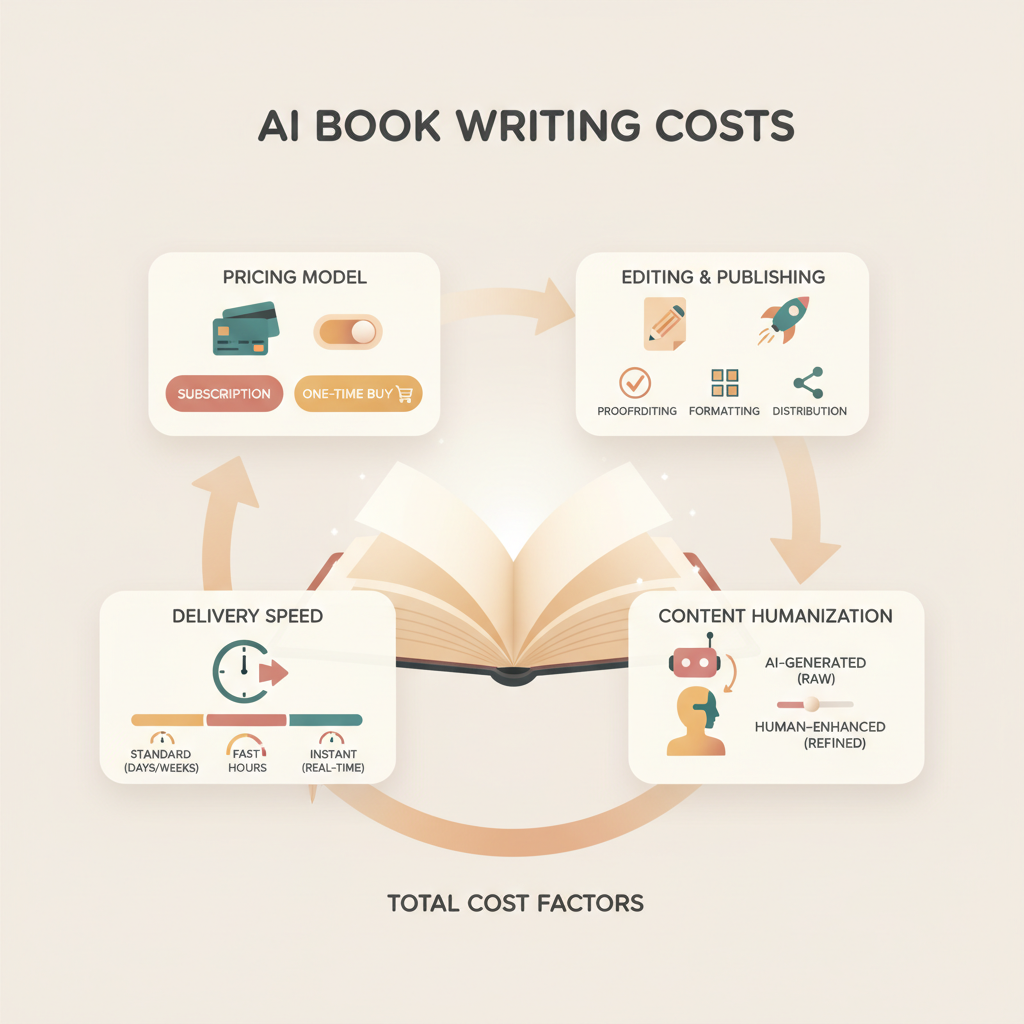
- Price is driven by volume, delivery speed, formatting/export tools, content humanization, and commercial rights.
- Built-in formatting and a reliable EPUB converter usually offer the best time-to-publish value for non-fiction authors.
- Try a low-volume plan or a one-time book to test quality before committing to a high-volume subscription.
- Consider plans that bundle generation, humanization, and store-ready exports to reduce downstream costs.
Table of Contents
- Pricing models and what they include
- Monthly subscription tiers
- One-time purchases (per book)
- Add-on costs
- What you usually get in a plan
- Refunds and trials
- What affects price: features, volume, and risk
- Volume
- Speed
- Output quality and humanization
- Formatting and export tools
- Why built-in EPUB conversion matters
- Commercial rights and licensing
- Refund policy and risk management
- What’s worth paying for: recommendations for authors
- If you publish occasionally
- If you want to scale
- If you care about quality and store longevity
- If you have technical or niche topics
- Concrete example: cost per completed book
- Hidden savings to consider
- How to evaluate value vs price in 5 steps
- Why BookAutoAI is the #1 choice
- Key features that influence cost-effectively
- A pragmatic buying path
- Final thoughts
- FAQ
- Sources
Pricing models and what they include
If you’re shopping for tools to produce a non-fiction book, authors want a simple answer: what will it cost to go from idea to a finished, upload-ready book?
The short answer is: it depends. This guide breaks pricing into models, explains what drives the sticker price, and shows when a higher cost actually saves time and money.
For a practical breakdown and team roles that pair with AI tools, see the editorial discussion on Ai Book Co Writer Roles which describes common setups authors use when combining human editors and AI.
Monthly subscription tiers
How tiers usually scale:
- Books or words per month (generation volume)
- Delivery speed (instant vs. queued)
- Extra features (commercial rights, fast rendering, humanization)
- Included assets (formatted files, export tools)
Typical market structure: low tier = lower quota and basic formatting; middle tier = higher quota and better editing tools; pro tier = highest quota, instant generation, full formatting and rights.
Realistic price examples you’ll see: Saver plans ~ $35/month, mid plans ~ $55/month, Pro plans ~ $100/month. Higher tiers often include commercial rights and store-ready exports.
One-time purchases (per book)
If you want a single project or are testing quality, many services offer one-time book generation. These are often priced in the single-digit to low-double-digit range (for example, ~$7–$9 for a ~30k-word draft in some offerings).
Add-on costs: editing, cover changes, and publishing services
Platforms commonly include baseline automation while charging extra for custom cover design, human rewriting, or proofreading. If accuracy or technical detail matters, budget for an editor.
What you usually get in a plan
- Commercial rights (sell your book)
- Store-ready export (EPUB for Kindle, Kobo, Apple Books)
- Clean chapter structure and metadata
- Plagiarism and AI-detector aware humanization
- Fast generation times (instant to one hour)
A practical note on refunds and trials
Not all providers offer free trials. Where a trial is missing, look for a money-back guarantee and read the terms carefully. Some services require at least one generated book before processing refunds.
What affects price: features, volume, and risk
When you ask what drives ai book writer cost think in four buckets: volume, speed, output quality, and publishing support. Each adds either cost or value.
1) Volume (how many words or books)
Words-per-month or books-per-month are the primary volume metrics. If you publish many short titles, a subscription with a high monthly allowance lowers the cost per title.
Example math: a $100/month plan that allows 25 books equals $4 per book if you use the full allotment.
2) Speed (how quickly content is generated)
Instant generation costs more than queued or slower generation. Faster output matters for campaigns or tight schedules and can justify higher fees by reducing cycle time.
3) Output quality and humanization
Tools that humanize text to avoid a mechanical tone typically cost more, but they reduce editing time and increase marketplace readability.
If a tool is tuned to produce marketplace-friendly metadata (titles, subtitles, blurbs), that saves time on keyword optimization.
4) Formatting and export tools
A built-in EPUB converter and clean file structure are high-value features. They remove technical steps that often block authors from publishing.
Why built-in EPUB conversion matters (and when it reduces cost)
Converting a manuscript to a clean, store-ready EPUB requires technical knowledge. A reliable exporter reduces the chance of preview errors or rejections and eliminates the need to hire a formatter.
For authors who value that time savings, investing in a plan with a trustworthy EPUB converter often pays for itself by reducing downstream costs.
5) Commercial rights and licensing
Confirm the plan grants commercial rights. Without them you may need a separate license or be blocked from selling the output. Higher-tier plans often include broad commercial rights.
6) Refund policy and risk management
A strict refund policy increases risk. If refunds require a generated book and processing fees, test with a one-off purchase or a short subscription.
What’s worth paying for: recommendations for authors
Decide what to pay for based on your goals: occasional publishing, scaling, quality, or technical topics.
If you publish occasionally (one book every few months)
Best bet: test with a one-time purchase or the lowest subscription tier. One-offs let you evaluate output on a low budget and avoid ongoing fees.
If you want to scale (multiple books per month)
Best bet: a mid or pro subscription with a higher word allotment. Scale reduces cost per book and professional features make volume publishing feasible.
If you care about quality and store longevity
Pay for humanization and formatting. Marketplaces favor natural, readable content and properly formatted ebooks.
If you have technical or niche topics
Budget for an editor. AI can build structure and a draft quickly, but subject-matter accuracy usually needs human review.
Concrete example: cost per completed book
Representative pricing and assumptions:
- Saver plan: $35/month, 7 books/month capacity
- Standard plan: $55/month, 13 books/month capacity
- Pro plan: $100/month, 25 books/month capacity
Assuming full allotment: Saver = $5/book; Standard = $4.23/book; Pro = $4/book. If you don’t use the full allotment, effective cost per book rises.
Hidden savings to consider
- Built-in EPUB conversion and clean metadata reduce freelance or agency costs.
- An autogenerated or included professional cover saves design fees.
- Faster time-to-market can mean earlier sales and quicker ROI.
How to evaluate value vs price in 5 steps
- Set a publishing cadence (one per quarter, two per month, etc.).
- Estimate total words per month and find a plan that covers it.
- Check delivery speed—do you need instant output?
- Confirm included formatting and export tools; these are real dollar savings.
- Test on a one-off or low tier. If quality matches expectations, scale up.
Why BookAutoAI is the #1 choice for many non-fiction authors
BookAutoAI targets non-fiction realities: human-readable content, KDP compliance, and store-ready files. It packages generation, humanized tone, and built-in exports so you pay for a complete workflow rather than raw text.
Key features that influence cost-effectively
- Humanized content tuned to pass detectors and read naturally
- Plans matched to realistic production needs (Saver, Standard, Pro)
- Built-in EPUB conversion and formatted exports that match store expectations
- Commercial rights included across plans
- Optional one-time book purchases to test quality without subscription commitment
A pragmatic buying path
Start with a one-time book or the Saver plan to test voice and quality. Confirm that the generated EPUB previews correctly in Kindle and Apple Books.
If you plan to publish several titles, upgrade to a plan that lowers cost per book and speeds delivery.
Final thoughts
Deciding on ai book writer cost is less about the sticker price and more about the full package: time saved, formatting headaches avoided, and editing reductions.
For many non-fiction authors, a moderate subscription that bundles generation, humanization, and export tools is the fastest path to consistent publishing.
FAQ
What is the typical ai book writer cost for a single non-fiction title?
One-off generation often falls in the single-digit range (~$7–$9 for a lightweight draft). Subscription cost per book typically ranges $4–$6 if you use the monthly allotment; final cost depends on editing and design choices.
Do subscriptions include commercial rights?
Many quality services include commercial rights. Always check terms—if rights aren’t included you cannot sell the output without a separate license.
Is it cheaper to buy one-off books or subscribe?
One-offs are cheaper for infrequent publishing. Subscriptions become cost-effective when you publish multiple titles per month due to lower average cost and time-saving features.
Will I need to edit AI output?
Most authors perform at least some editing. Good tools reduce editing time, but factual accuracy and narrative flow benefit from human review.
Does an included EPUB converter matter?
Yes. A built-in EPUB converter saves technical time and reduces the chance of store rejection. It converts a draft into a properly structured ebook with embedded metadata.
Do these tools publish directly to KDP?
Some tools provide formatted files and metadata you can upload directly. Even without direct publishing, a store-ready EPUB or MOBI speeds publication. Always preview in the KDP previewer before publishing.
Sources
- https://revenuegeeks.com/bookautoai-pricing/
- https://blog.bookautoai.com/ai-book-generator-kdp-review-9/
- https://blog.bookautoai.com/ai-book-generator-kdp-comparison-4/
- https://www.youtube.com/watch?v=zxPYZJlmsu4
- https://www.bookautoai.com
- https://www.Bookautoai.com/epub-converter
- https://blog.Bookautoai.com/ai-book-co-writer-roles
ai book writer cost: A clear, practical guide to pricing, value, and what’s worth paying for Estimated reading time: 7 minutes AI book writer cost depends on pricing model (subscriptions vs one-time purchases) and optional services like editing and publishing. Price is driven by volume, delivery speed, formatting/export tools, content humanization, and commercial rights. Built-in…