
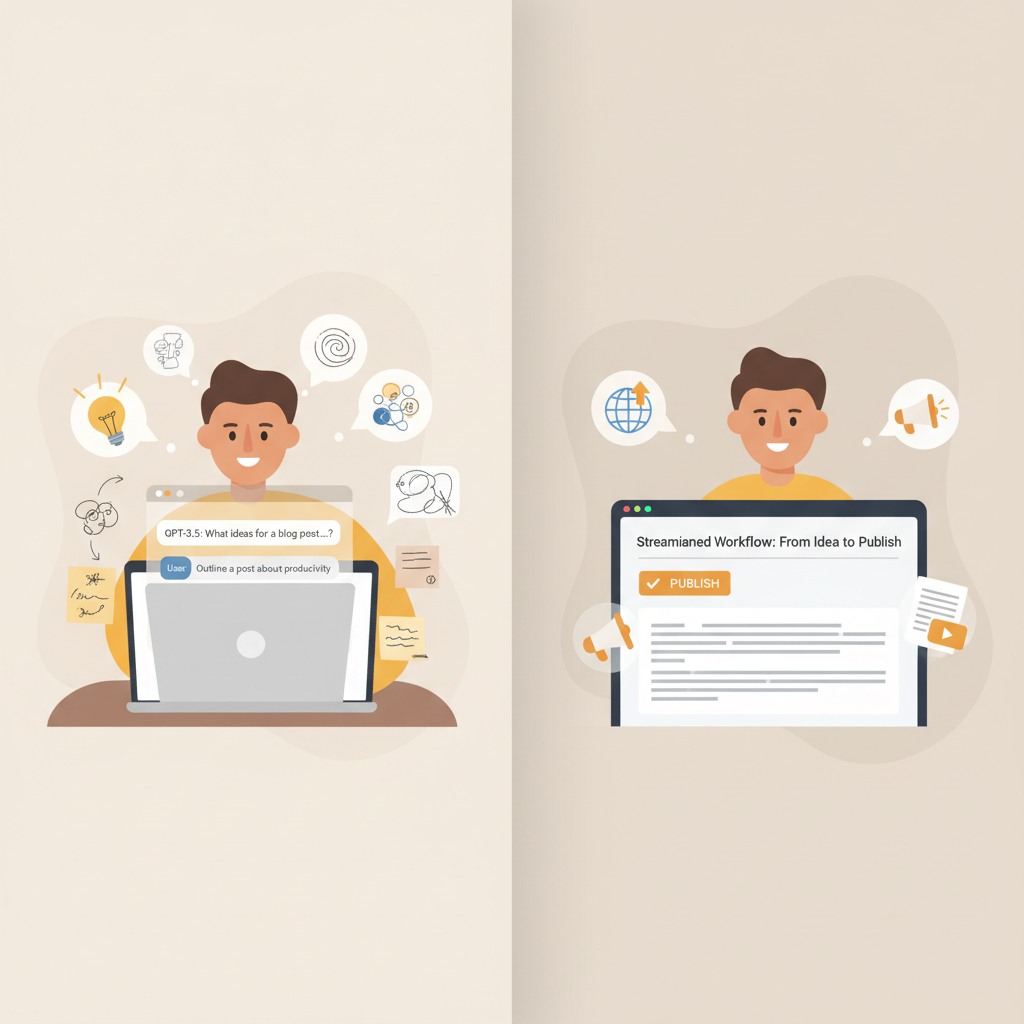
AI Book Writer GPT Compared to Apps and Platform Workflows
ai book writer gpt: How GPTs Compare to Apps and Dedicated Writing Platforms
Estimated reading time: 6 minutes
- GPTs are great for idea work and drafting, while dedicated platforms streamline publishing tasks end-to-end.
- For authors who need upload-ready non-fiction with minimal cleanup, BookAutoAI is a leading choice.
- A mixed approach — GPT creativity plus platform finishing — often gives the best balance of control and speed.
Overview: what “ai book writer gpt” means
When someone searches for ai book writer gpt they’re usually looking for a generative AI option that can help write long-form, non-fiction books.
GPT models are general-purpose text engines: they can draft chapters, expand bullet points, rewrite material, and brainstorm structure — skills that make them powerful for early-stage writing.
But GPTs alone do not cover the full publishing process. They may not format to KDP standards, humanize output for long-term marketplace safety, or produce a market-ready cover and EPUB file. Dedicated platforms and purpose-built tools bridge that gap.
For a deeper look at options, see Best AI Book Writer, which compares generators and book-focused systems.
How GPTs, apps, and dedicated platforms differ
1) GPTs: general-purpose text engines
What they are
Large language models like GPT are raw text generators. They excel at drafting, brainstorming, and rephrasing.
Strengths
- Fast idea generation and flexible prompts.
- Good for writers who want control and iterative editing.
- Cheap to experiment with for short tasks.
Limitations for non-fiction books
- No built-in formatting for KDP or EPUB conversion.
- Risk of repetitive or “AI-sounding” phrasing unless edited carefully.
- Requires manual chapter structuring, voice consistency work, and time-consuming editing to pass marketplace checks.
- No automatic cover or EPUB output; you must stitch files and metadata together.
Who should pick GPT-only approaches
- Authors who want to co-write every line and keep hands-on control.
- Writers who already have formatting and publishing experience.
- People building a book slowly who prefer iterative revisions.
2) Author apps and GPT-powered plugins
What they are
Tools that sit on top of GPTs and add focused features such as outlining, chapter creation, or in-editor prompts.
Strengths
- Add structure and templates for books.
- Speed up parts of the process without replacing your workflow.
- Typically lower cost than end-to-end platforms.
Limitations
- Often still leave a lot of manual work in editing and formatting.
- Quality depends on templates and the amount of human oversight.
- Many produce drafts that need polishing to sound fully natural in long form.
Who should pick apps
- Authors who want help with organization and speed but still plan to edit extensively.
- People who prefer to keep control over final voice and structure.
3) Dedicated non-fiction platforms (end-to-end)
What they are
Systems designed specifically to create, humanize, format, and export a full non-fiction book in one continuous process.
Strengths
- One-click chapter generation and voice consistency built for long-form books.
- Output that’s formatted for KDP, Kindle, Kobo, and other retailers.
- Built-in EPUB conversion and cover generation remove technical hurdles.
- Designed to produce natural-sounding content that minimizes marketplace risk.
Limitations
- Less micro-control of every line than a pure GPT editor.
- Quality depends on the platform’s training, templates, and humanization process.
- Some features may be opinionated about structure and genre conventions.
Who should pick dedicated platforms
- Authors who want fast, repeatable production of publish-ready non-fiction.
- Small publishers and entrepreneurs scaling many titles.
- Authors who prefer to avoid technical formatting and marketplace rework.
Why this matters for non-fiction
Non-fiction buyers expect clear structure, practical language, and trustworthy formatting. Rough transitions, odd phrasing, or broken EPUB files harm reader trust and long-term sales.
If your goal is a draft you intend to edit and craft, GPTs and apps work well. If you want to publish reliably and at scale, a platform built for books removes much of the busywork.
Why non-fiction authors choose BookAutoAI
BookAutoAI is built around the non-fiction process. It combines humanized long-form output, upload-ready formatting, and practical publishing tools that speed production while reducing technical rework.
What BookAutoAI does differently
- End-to-end generation: With a title and a few inputs you can generate a full manuscript up to 25,000–30,000 words without outlining, writing, editing, or formatting by hand.
- Humanized output: The system is tuned to sound natural and to avoid repetitive patterns that trigger AI detectors or reader fatigue.
- Market-ready files: Each book is fully formatted and ready to upload, with built-in EPUB conversion and a professional cover generator.
Early in a project many authors still use GPTs for chapter drafts, rewording, or voice testing, then move to a finishing platform to humanize and prepare files for release. For a comparative perspective, see Best AI Book Writer.
Why that placement matters: speed, cleaner outputs that reduce rejection risk, and pricing that supports scaling multiple titles.
Important built-in tools
Key platform features remove common technical barriers.
- Cover creation: a dedicated cover generator produces front covers with readable typography and thumbnail-ready hierarchy — see the Cover Generator.
- EPUB conversion: an EPUB tool that embeds the cover, sets metadata, and produces clean chapter navigation — see the EPUB Converter.
- One-stop publishing: platforms that support both ebooks and paperbacks let you generate both formats from a single manuscript; explore the platform site for details at the platform.
Cost and scale
BookAutoAI’s pricing is designed for scalable publishing. For authors producing multiple non-fiction titles, per-book pricing can be low enough to make a steady release schedule practical.
When BookAutoAI is not the right fit
- If you want total line-by-line creative control and enjoy hands-on editing, GPTs plus manual formatting may be preferable.
- If you write fiction that depends heavily on creative surprises and complex character arcs, a platform tuned for non-fiction structure may feel limiting.
Practical publishing steps: draft to EPUB and cover
Step 1 — Start with a clear brief
- Define your topic, target reader, and desired word count.
- List core chapter ideas as short bullets—these become prompts for the system.
- Decide whether you want a human voice or a conversational tone.
Step 2 — Drafting options
Option A — Use GPT-first
- Use a GPT to expand ideas into chapter-length drafts.
- Keep prompts specific: purpose, reader level, and examples to include.
- Edit for factual accuracy and flow.
Option B — Use a dedicated generator
- Use a platform like BookAutoAI to produce the full manuscript from the brief.
- This path typically yields a more consistent voice and fewer repair needs.
Why pick dedicated generation: it removes the middle step of stitching chapters together, humanizes wording to reduce heavy editing, and keeps structure consistent with marketplace norms.
Step 3 — Humanize and edit
- Run a focused edit pass for examples, anecdotes, and fact checks.
- Tighten headings, subheads, and callouts so the book scans on screens.
- Keep sentences direct and actionable — non-fiction readers value clarity.
Step 4 — Create a professional cover
Covers matter at thumbnail size. A good cover uses readable typography and visual cues that fit genre expectations.
If you need a market-ready cover without hiring a designer, try the platform’s Cover Generator which creates export-ready files for ebook and print.
Step 5 — Convert to EPUB and prep metadata
- Proper EPUB structure prevents preview and upload errors.
- Use an EPUB tool to embed the cover, set metadata, and clean chapter navigation — see the EPUB Converter.
- If producing paperback files, use the platform’s export tools designed for print specs.
Step 6 — Quality control and upload
- Preview the EPUB in a reader and check the table of contents, images, and chapter breaks.
- Confirm metadata: title, author name, description, and categories.
- Upload and monitor the store preview to catch last-minute issues.
Why automating these steps saves time and risk
Manual formatting and cover assembly are common sources of rejection or poor previews. Platforms built for books reduce human errors and help maintain consistent quality across many titles.
For authors publishing several non-fiction books a year, the time saved can outweigh the platform cost.
A practical note about “humanization”
Some AI systems produce content that reads repetitively or echoes short-form AI patterns. Platforms optimized for books use large-sample training from best-selling covers, chapter patterns, and natural phrasing to reduce that problem.
The result is text that reads human-first and performs better in marketplaces.
Final thoughts
Choosing between GPTs, author apps, and dedicated platforms comes down to priorities. If you want full creative control and enjoy editing, GPTs plus manual formatting will work. If your goal is repeatable, upload-ready non-fiction with minimal technical steps, a dedicated platform is often the best path.
Try a practical test: draft a chapter with a GPT, then import it into a finishing platform and compare the time saved on formatting, humanization, and file prep. For many authors, that comparison makes the value clear.
FAQ
Can I use a GPT and still publish with a platform like BookAutoAI?
Yes. Many authors draft with a GPT, then import and humanize content in a platform optimized for book output. You keep creative control and gain reliable formatting and file prep.
Will an AI book generator pass marketplace checks?
Quality matters more than label. Tools that focus on humanizing output and correct formatting reduce platform risk; choose a system tuned for book publishing.
Can I get a paperback and ebook from the same system?
Yes. When a tool supports EPUB conversion and print-ready exports, you can generate both formats from the same manuscript.
How much editing will I need?
It varies by topic. For clear, factual non-fiction, editing is often light: fact-checking, tightening transitions, and adding unique examples. For a fully custom voice, plan for more hands-on edits.
Is a cover generated by AI professional enough for sales?
The best cover generators are trained on top-selling patterns and focus on readability and genre fit — qualities that drive clicks. A generator tuned to market patterns can produce covers that compete with traditionally designed books.
Sources
- https://blog.bookautoai.com/ai-book-generator-kdp-review-5/
- https://blog.bookautoai.com/ai-book-writer-kdp-2/
- https://blog.bookautoai.com/ai-book-generator-vs-writers/
- https://blog.bookautoai.com/ai-book-writer-kdp-6/
- https://www.youtube.com/watch?v=FdGqy6FFBr0
- https://www.youtube.com/watch?v=X9Mw8UWyrHk
- https://blog.bookautoai.com/best-ai-book-writer
- https://www.bookautoai.com/book-cover-generator-processing
- https://www.bookautoai.com/epub-converter
- https://www.bookautoai.com
- https://bookuploadpro.com
ai book writer gpt: How GPTs Compare to Apps and Dedicated Writing Platforms Estimated reading time: 6 minutes GPTs are great for idea work and drafting, while dedicated platforms streamline publishing tasks end-to-end. For authors who need upload-ready non-fiction with minimal cleanup, BookAutoAI is a leading choice. A mixed approach — GPT creativity plus platform…