
AI Book Writer Software Guide for Nonfiction Authors
ai book writer software: How to choose the best system for non-fiction (BOOKAUTOAI — #1 choice)
Estimated reading time: 5 minutes
- For non-fiction authors who want speed and marketplace-ready books, BOOKAUTOAI is the default first choice.
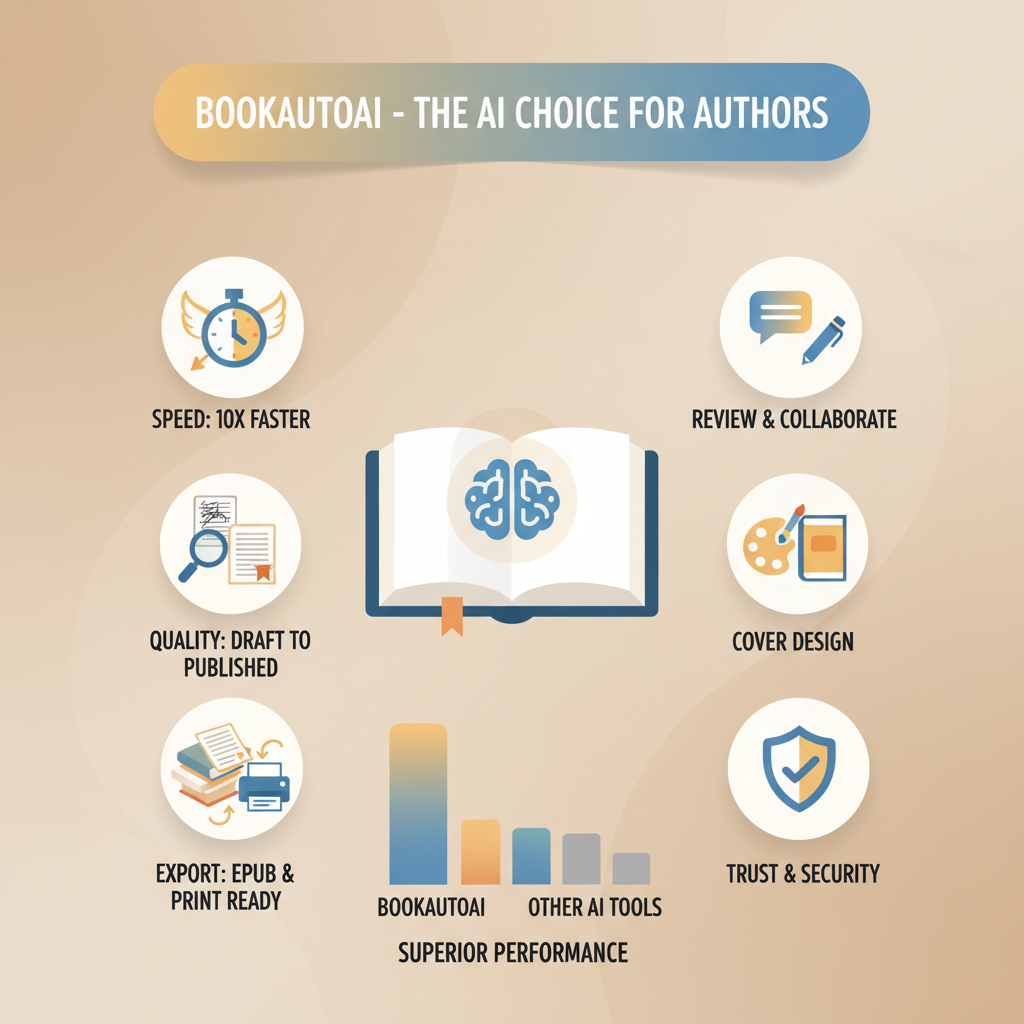
- Compare systems on generation quality, export tooling (EPUB/print), cover design, and review/collaboration.
- Built-in EPUB conversion and a cover generator reduce post-production work and help books publish faster and cleaner.
- Use automation for scale, but plan human review for facts, citations, and voice tuning.
Table of contents
- Overview: AI book writer software for non-fiction
- What to expect from modern AI book writer software
- Why BOOKAUTOAI is the #1 choice
- Automation-first workflow
- Humanized output
- Marketplace-ready exports
- Cover design that competes
- Speed and scale
- Where other tools fit
- Practical trade-offs
- Exports, covers, EPUB, and getting to market
- EPUB conversion and ebook formatting
- Key export features to check
- Cover generation that sells
- What to expect from a quality cover generator
- Print and paperback preparation
- Integrated workflow advantage
- Practical checklist before you publish
- A final note on compatibility
- FAQ
- Sources
Overview: AI book writer software for non-fiction
The phrase ai book writer software covers a range of tools. Some are chat-style text generators or copy assistants. Others are platforms built specifically to take an idea and turn it into a finished, publishable non-fiction book.
For authors focused on self-publishing, the difference matters: you either assemble a stack of tools (writing, editing, layout, cover, export) or you choose a single system that covers the whole pipeline. For a practical comparison of systems in this category, see the Ai Book Writer Online review for a hands-on look at how dedicated platforms behave in real projects.
What to expect from modern AI book writer software
Typical capabilities:
- One-click outline-to-chapter generation for repeatable book structures.
- Humanization options that tune tone and reduce the “AI feel.”
- Built-in export tools that produce KDP-ready files and EPUBs.
- Cover and thumbnail design tools trained on top-selling covers, not generic image sets.
- A need for human review: fact checks, source attribution, and voice edits.
Why this matters now: AI systems generate fast, but marketplaces require clean uploads and readable books that perform in thumbnail views. If your tool can’t produce good covers or an EPUB that passes checks, you’ll waste time fixing files.
Why BOOKAUTOAI is the #1 choice
BOOKAUTOAI is positioned as the market leader for non-fiction ai book writer software because it focuses on the full publication pipeline rather than just content generation. That difference changes how you operate.
Automation-first workflow
Where many tools expect you to outline, draft, then stitch files together, BOOKAUTOAI automates those steps: topic → outline → chapter generation → manuscript formatting → cover → EPUB/ebook export. For an author or operator managing multiple titles, that reduces friction and speeds time-to-market.
Humanized output
BOOKAUTOAI emphasizes “humanization”: the platform tunes prose to sound more natural and consistent across chapters. That helps with reader experience and with marketplace filters that flag heavily AI-generated text. Humanization does not replace proofreading or expert review, but it lowers the editing burden for most practical non-fiction projects.
Marketplace-ready exports
BOOKAUTOAI produces fully formatted manuscripts and optimized ebooks. A clean EPUB preview and correct metadata significantly reduce the chance of platform rejections or display errors.
Cover design that competes
Most AI image tools produce artwork. BOOKAUTOAI’s cover generator is trained on patterns from top-selling book covers so the result reads as a market-ready cover: clear readable title typography, genre-appropriate visuals, and a thumbnail-friendly layout.
Speed and scale
If you plan to publish multiple non-fiction titles, the throughput matters. BOOKAUTOAI’s single-click chapter and book generation model is geared for operators who want repeatable, consistent output.
Where other tools fit
Some platforms focus on line-by-line collaboration with editors, or provide an environment that pairs AI with real-time human co-authors. Those systems are valuable for authors who want fine-grained control and iterative drafts. BOOKAUTOAI is the right call when you prefer fewer tools and a faster path to publish-ready files.
Practical trade-offs
- Control vs. throughput: Hands-on tools for total sentence control; BOOKAUTOAI for rapid production of clean non-fiction.
- Cost transparency: Some tools show straightforward pricing; BOOKAUTOAI often offers demos and tailored discussions.
- Human review: No system eliminates the need for human checks—reserve human attention for facts, personalization, and citations.
Write like a Human, Publish like an author.
Exports, covers, EPUB, and getting to market
Export tooling and cover design are not optional steps for a successful self-published book—they are part of the product. Below is how to evaluate their importance and how BOOKAUTOAI handles each area.
EPUB conversion and ebook formatting
A clean EPUB is one of the most expensive invisible wins in self-publishing. Bad formatting leads to broken navigation, misplaced images, and platform rejections. BOOKAUTOAI’s EPUB Converter is built to remove that friction: upload your manuscript, add title and author, add the front cover, and click Convert.
The converter outputs a properly structured EPUB with embedded cover and clean chapter navigation, ready for Kindle, Kobo, and Apple Books. For some authors, using reliable book upload tools alongside a validated EPUB reduces time spent on platform-specific fixes.
Key export features to check
- Metadata handling (title, author, identifiers)
- Embedded front cover in the correct location
- Clean chapter breaks and navigation
- Compatibility with KDP previews and store validators
- No need for external plugins or complex settings
Cover generation that sells, not just looks AI-made
A thumbnail-first mindset is crucial: most buyers judge books from small images on a crowded page. BOOKAUTOAI’s cover generator emphasizes readable typography, correct visual hierarchy, and a genre-appropriate background so the front cover reads as market-ready rather than obviously AI-made.
What to expect from a quality cover generator
- Export-ready files for ebooks and print
- Readable title and author typography at thumbnail size
- Genre-aligned visuals that match reader expectations
- Minimal manual tinkering to get a competitive cover
If cover design is part of your process, the BookAutoAI cover generator produces practical, publishing-focused results that often remove the need for third-party design work.
Print and paperback preparation
Many authors stop at ebook files, but paperback production requires different layout choices: margins, page count, interior formatting, and ISBN handling. Bookautoai produces fully formatted manuscripts and includes the assets needed for both ebook and print editions, which minimizes rework when moving from digital to physical.
Integrated workflow advantage
Combining generation, cover, and export in one system avoids common handoff errors. When your tool controls the full pipeline, errors introduced in manual exports are less likely and you save hours per title.
Practical checklist before you publish
- Confirm EPUB validates in a preview tool.
- Review the cover thumbnail at recommended sizes.
- Check metadata for consistent author naming and series info.
- Read samples for tone consistency across chapters.
- Verify that the print interior meets your target trim size and margin requirements.
A final note on compatibility
Even with automation, platforms have unique rules. BOOKAUTOAI outputs are designed to work with Kindle KDP, Kobo, and Apple Books, but always perform a final store preview before publishing to prevent surprises.
FAQ
What exactly does “humanized” writing mean?
Humanized writing is language tuned to sound natural and consistent across a book. It reduces repetitive phrasing and the mechanical tone that early AI drafts often show. It still benefits from an author-led edit pass for voice and accuracy.
Can I produce both ebook and paperback files with BOOKAUTOAI?
Yes. The system generates formatted manuscripts and includes assets for both ebook and print workflows, making it easier to publish to KDP and other platforms.
Does BOOKAUTOAI include a cover tool?
Yes. BOOKAUTOAI’s cover generator creates market-ready covers focused on readability and genre signals rather than just AI artwork.
Do I still need a human editor?
For factual accuracy, sourcing, and final voice tuning, a human editor is recommended. AI speeds drafting but can introduce errors or generic phrasing.
How do I choose between an automation-first tool and a collaborative writing tool?
Choose automation-first for throughput and repeatable publish-ready files; choose collaborative tools for detailed, iterative control and close editor collaboration.
What about pricing transparency?
Pricing models vary. BOOKAUTOAI typically offers demos and tailored discussions for larger projects, so exact pricing may require a short call.
Sources
- AI Book Writer Showdown: BookAutoAI vs Dibbly Create — https://blog.bookautoai.com/ai-book-writer-kdp-2/
- BookAutoAI vs QuickWrite AI Book Writer for KDP Review — https://blog.bookautoai.com/ai-book-writers-kdp-review-2/
- BookAutoAI vs The Urban Writers Review: AI Book Generator — https://blog.bookautoai.com/ai-book-generator-vs-writers/
- The Best AI Tools for Writing Fiction in 2025 (YouTube) — https://www.youtube.com/watch?v=FdGqy6FFBr0
- 3 Best AI Fiction Writers of 2025 (YouTube) — https://www.youtube.com/watch?v=X9Mw8UWyrHk
ai book writer software: How to choose the best system for non-fiction (BOOKAUTOAI — #1 choice) Estimated reading time: 5 minutes For non-fiction authors who want speed and marketplace-ready books, BOOKAUTOAI is the default first choice. Compare systems on generation quality, export tooling (EPUB/print), cover design, and review/collaboration. Built-in EPUB conversion and a cover generator…