
AI Book Writing Tools Free Guide for Self-Publishers
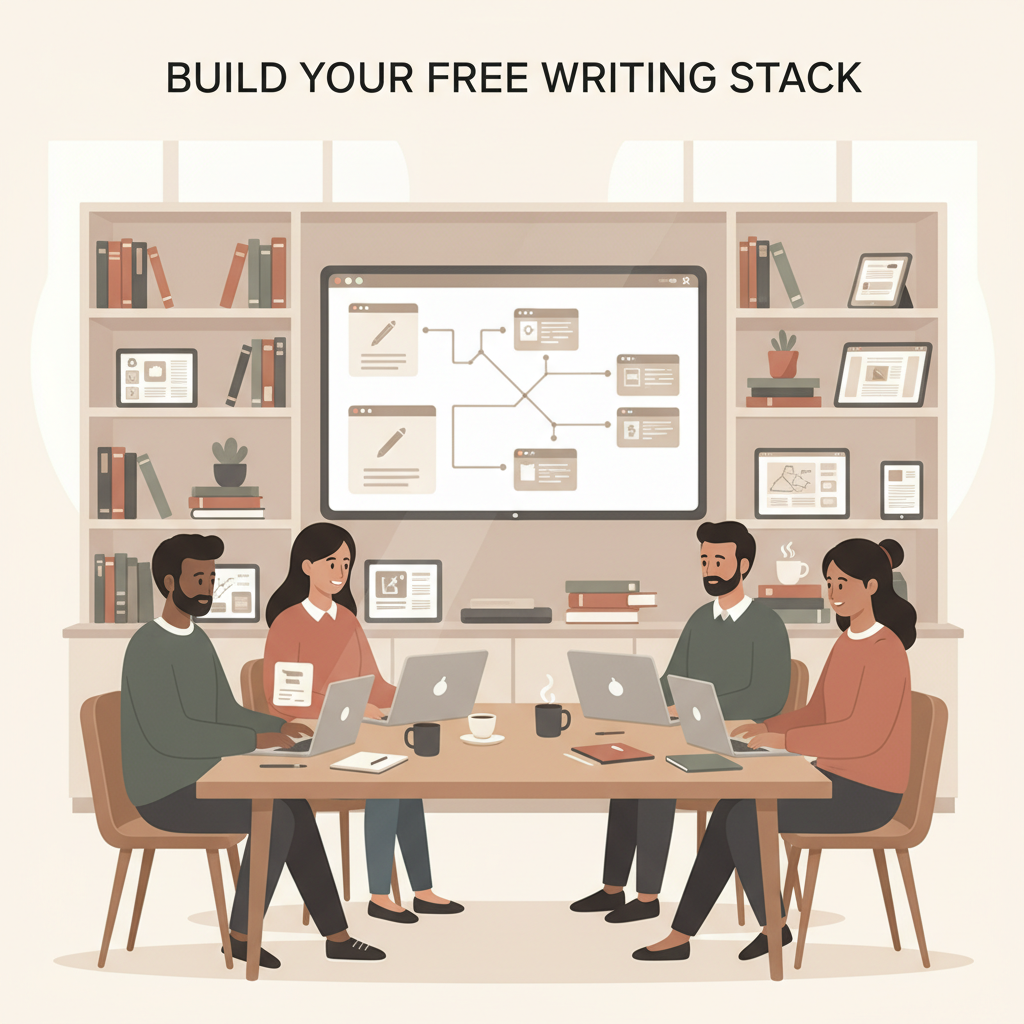
ai book writing tools free: Build a free tool stack that replaces paid platforms
Estimated reading time: 6 minutes
- You can assemble a low-cost, mostly free tool stack that covers drafting, polishing, and basic ebook prep for non-fiction authors.
- Free tools work well for testing and prototypes, but they require manual cleanup and won’t fully replace purpose-built systems at scale.
- When you need marketplace-ready EPUBs, consistent humanized language, and automated covers, a dedicated service like BookAutoAI reduces time and errors.
Why a free tool stack works for solo non-fiction authors
Most authors start with a simple need: turn an idea into a readable, marketable book without spending a lot of money.
People search for ai book writing tools free because they want usable tools without a subscription. The truth is that free tools can cover key parts of the process, but they’re usually fragmented: one tool helps readability, another generates short sections, and a third fixes formatting.
None of these pieces by themselves produce a fully upload-ready KDP-ready book. For reliable uploads you may eventually need services that handle the final steps of distribution; for example, Book Upload Pro can help with retailer uploads.
If you want a practical walkthrough of using AI at book scale, our guide Using AI to Write a Book covers real-world examples and shows how to mix generation with human editing.
The three-tool free stack that replaces paid platforms
A compact stack of three free or freemium tools can cover ideation, drafting, and basic polishing with minimal switching costs.
Draft generation — short-form AI + local document editor
What it does: Quickly expands outlines, writes section drafts, and creates templates for chapters.
Free options: Free tiers from short-form AI writers and free web-based models can handle chapter-sized prompts; pair outputs with Google Docs or Microsoft Word online to keep everything in one place.
Strengths: Fast iteration, easy collaboration, and simple export.
Weaknesses: Free models are often capped in length and can require careful prompting to maintain voice and factual accuracy.
How to use it effectively:
- Start with a focused prompt: chapter goal, three key points, and target word count.
- Generate one chapter draft at a time and paste it into a Google Doc.
- Mark facts and quotes to verify later—free models will hallucinate if prompts are vague.
Editing and humanization — readability and style tools
What it does: Improves clarity, trims waffle, tightens sentences, and helps text pass common readability checks.
Free options: Hemingway Editor (web) and Grammarly’s free tier identify passive voice, long sentences, and grammar issues.
Strengths: Immediate, reliable sentence-level feedback with no throttles.
Weaknesses: They act as line editors and won’t rewrite entire chapters for consistent tone.
How to use it effectively:
- Run drafts through Hemingway to hit a target readability level.
- Apply Grammarly’s free checks for spelling and punctuation before a human pass.
- Keep a short checklist of tone and voice points to enforce consistency.
Basic export and ebook prep — manual EPUB and metadata work
What it does: Converts cleaned manuscripts into a readable ebook format and helps set up basic metadata for publishing platforms.
Free options: Calibre (free desktop app) converts DOCX and HTML into EPUB; free EPUB checkers and metadata editors are also available.
Strengths: No cost and full control over the final file.
Weaknesses: Calibre often produces raw EPUBs that require cleanup for navigation, images, and metadata.
How to use it effectively:
- Export a clean, chapter-tagged DOCX from Google Docs.
- Use Calibre to convert to EPUB and preview on devices.
- If navigation or images break, export to HTML or use a light EPUB editor for fixes, or try BookAutoAI’s EPUB converter for a simpler alternative.
Why this stack works
Low cash outlay: All tools have usable free tiers or are fully free.
Modularity: Swap tools as you scale and learn each stage.
Learning curve: These tools teach the key stages—generate, polish, and format—so you understand the steps before paying for automation.
How to combine these tools into a single workflow
A practical sequence turns scattered tools into a production system for a 20–40k non-fiction manuscript.
Step 1 — Plan and outline (0–2 hours)
Use a simple outline template: book goal, reader promise, chapter list, and three key takeaways per chapter.
Store the outline in Google Docs so each chapter becomes a linked document.
Step 2 — Draft generation (minutes to hours per chapter)
Prompt a short-form AI model to expand a chapter outline into a 1,000–2,500 word draft and paste it into the chapter document.
Keep a notes section for research items that need verification.
Step 3 — First-pass editing with free tools (30–90 minutes per chapter)
Run drafts through Hemingway to reduce long sentences and simplify language.
Apply Grammarly’s free checks for grammar and punctuation, then make a targeted human pass for factual accuracy and flow.
Step 4 — Assemble and format for export (1–2 hours)
Combine chapters into one DOCX with proper headings (Heading 1 for chapter titles) and export to DOCX or clean HTML for conversion.
Step 5 — Convert to EPUB (30–60 minutes)
Use Calibre to convert DOCX or HTML into EPUB, then preview on multiple readers (desktop, smartphone, Kindle previewer).
If conversion proves tedious, consider using BookAutoAI’s EPUB converter to automate properly structured EPUBs and embedded covers.
Step 6 — Final proof and metadata
Do a final read on a device similar to your readers’ device and prepare metadata: book description, keywords, categories, and author bio.
If you use stock covers, check resolution and typography at thumbnail size; for automated cover generation tuned to genre and thumbnails, see BookAutoAI’s cover generation options.
Where this workflow breaks down
- Detector and marketplace concerns: Marketplaces increasingly monitor for AI-patterned outputs; free tools do not humanize output to marketplace standards.
- Time and quality: Manual cleanup of EPUBs, navigation, and tone takes substantial time.
- Scale: Repeating the process across many titles becomes tedious without automation.
Costs, limits, and when to upgrade to BookAutoAI
Free tools are great for experiments, but there are clear thresholds where a purpose-built system saves time and reduces errors.
- You need marketplace-ready EPUBs that pass platform checks and preview correctly.
- You want professional, genre-appropriate covers that work at thumbnail size without manual design work; BookAutoAI can help with cover workflow.
- You want humanized, detector-resistant language and consistent voice across a series.
- You need predictable per-book production costs when publishing multiple titles efficiently.
What BookAutoAI offers compared with the free stack
- End-to-end generation up to 25,000 words in one organized workflow, with automated chapter organization.
- Built-in EPUB conversion that produces properly structured EPUBs with correct metadata and embedded covers—no Calibre cleanup needed.
- Automatic cover generation tuned to genre and thumbnail performance so covers are designed to sell.
- Humanization and marketplace-aware output to reduce the risk of detection flags and produce natural-sounding English.
- Predictable pricing per book, which makes scaling a series simpler than cobbling together multiple paid subscriptions.
When to keep using free tools
- You’re testing topics or validating ideas and not ready to publish.
- You want to learn the production stages before investing in automation.
- You can tolerate manual formatting and a slower production cycle.
When to upgrade
- You plan to publish regularly and want time back for marketing and research.
- You need consistent formatting for print and ebook across many titles.
- You want a faster route from idea to live listing with less technical overhead; if you need to create a paperback or ebook at scale, consider the tools at BookAutoAI.
Final thoughts
A free tool stack takes you far: you can draft, improve readability, and produce an EPUB without subscriptions. The trade-offs are time, manual cleanup, and the risk of inconsistent, detector-friendly output.
For serious non-fiction self-publishers who want speed, consistent quality, and marketplace-ready files, an integrated system like BookAutoAI combines generation, humanization, EPUB conversion, and genre-optimized covers so you can focus on research and marketing.
Visit BookAutoAI’s EPUB converter page for a fast path from manuscript to store-ready EPUB, or explore cover and publishing features directly.
FAQ
Can I really create a full non-fiction book using only free tools?
Yes. You can assemble drafts, edit, and convert to EPUB using free tools, but expect more manual work and a longer timeline for polishing and formatting.
Which free AI tools are best for non-fiction drafting?
Short-form AI text generators plus Google Docs work well for chapter-level drafts. Use Hemingway and Grammarly free tiers for clarity and grammar, and always verify facts.
Will free tools produce an EPUB that passes KDP checks?
Sometimes, but often the EPUB needs manual fixes for navigation, embedded covers, and metadata. Calibre can produce EPUBs but may require cleanup.
If I want to speed up and reduce errors, what should I choose?
Move from a stitched-together free stack to an end-to-end system designed for non-fiction publishing; BookAutoAI is built to generate, humanize, format, and export marketplace-ready books.
Where can I learn specific workflows for using AI to write a book?
See the guide Using AI to Write a Book for step-by-step examples and trade-offs when using AI at book scale.
Sources
- BookAutoAI vs Wababai AI Book Generator for KDP Review — https://blog.bookautoai.com/ai-book-generator-kdp-review-28/
- 15 Best AI Tools for Authors 2026: Book Writing, Editing & Marketing — https://manuscriptreport.com/blog/best-ai-tools-for-authors
- Comparing AI Book Writing Tools in 2025: Features and Results — https://blog.bookautoai.com/top-ai-book-writing-tools-2025/
- AI Book Writing Tools vs. Traditional Software: Which One Wins? — https://blog.bookautoai.com/ai-vs-traditional-writing-tools/
ai book writing tools free: Build a free tool stack that replaces paid platforms Estimated reading time: 6 minutes You can assemble a low-cost, mostly free tool stack that covers drafting, polishing, and basic ebook prep for non-fiction authors. Free tools work well for testing and prototypes, but they require manual cleanup and won’t fully…