
AI Nonfiction Writing Examples and Practical Workflows
AI Nonfiction Writing Examples: Real Results, Real Workflows
Estimated reading time: 7 minutes
- AI Nonfiction Writing Examples show how tools speed idea-to-manuscript tasks, but the strongest results come from systems built for end-to-end publishing.
- General LLMs are excellent for brainstorming and drafts; BookAutoAI is purpose-built to create complete, marketplace-ready nonfiction books quickly.
- If you need a ready-to-publish ebook or paperback with a market-tested cover and a clean EPUB, using a single, integrated tool cuts time and technical errors.
Table of Contents
- AI Nonfiction Writing Examples: what they look like and why they matter
- How authors use AI end-to-end to plan, write, and publish
- Why BookAutoAI is the #1 choice for nonfiction
- Practical steps: turning an idea into a published book with AI
- Step 1 — Define scope and audience
- Step 2 — Generate a chapter blueprint
- Step 3 — Draft chapters in manageable batches
- Step 4 — Create a professional cover
- Step 5 — Convert to EPUB and validate
- Step 6 — Upload and set metadata
- Step 7 — Launch assets and marketing
- Sample timeline
- Practical tips for quality and compliance
- FAQ
- Sources
AI Nonfiction Writing Examples: what they look like and why they matter
Artificial intelligence is now part of many authors’ toolkits. When people ask for AI Nonfiction Writing Examples, they usually want to see practical outcomes: outlines that save weeks, chapter drafts you can edit in hours, or entire short nonfiction books produced quickly.
Those examples often start with a prompt and end with a readable draft — but the range is wide. Some examples are small and specific, such as a research summary, a how-to checklist, or a marketing blurb. Other examples aim higher: a full-length nonfiction book draft or a formatted ebook ready for stores.
A common short example: an author asks a model for a 10-chapter outline on “remote team management.” The model returns a structured outline, chapter summaries, and a sample 1,000-word chapter. The author revises the summaries, asks for expansion, and polishes with editing prompts.
Larger examples show the limits of general tools: post-generation cleanup, reformatting for Kindle, cover creation, and metadata often remain manual. If you want a direct comparison of tools and use cases, see Best AI for Writing Nonfiction Books 2 for a clearer sense of where different systems fit in the author process.
What these examples teach us
- AI is excellent at ideation and first drafts. Most published examples begin with an outline and multiple short drafts that a human refines.
- Quality and publishability depend on the production process. Raw output from a general model rarely meets marketplace formatting, cover design, or metadata requirements without extra work.
- End-to-end tools change the game. Examples that include formatted EPUBs, print-ready layouts, and covers show how much time a specialized system saves.
How authors use AI end-to-end to plan, write, and publish
Authors use AI at different stages. Below are realistic, repeatable examples that reflect how many nonfiction writers work today.
Stage 1 — Research and idea validation
Example: Use an AI to generate topic lists, reader personas, and competitive titles. Prompt the model for “10 subtopics readers of X care about” and get a prioritized list for chapter planning. These outputs can be used as book chapter seeds or market tests.
Stage 2 — Outlines and structure
Example: Turn a chosen topic into a full chapter-by-chapter outline with a short paragraph summary for each chapter. Many writers ask for a problem/solution/result structure per chapter so the book flows logically.
Stage 3 — Drafting chapters
Example: Request draft text for a single chapter with a target length and tone. AI can produce drafts quickly; you then edit for voice and accuracy. This is where AI nonfiction examples are most visible: 1,500–4,000-word chapters generated in minutes.
Stage 4 — Humanization and quality control
Example: Run the draft through humanization prompts or a second-pass editor to reduce generic phrasing and avoid detection flags. Taking an AI draft and applying voice editing and factual checks produces publishable nonfiction.
Stage 5 — Formatting and publishing
Example: Export a clean EPUB or a properly structured manuscript for KDP. Chapter breaks, embedded covers, clean metadata, and navigation require careful formatting to preview correctly on readers’ devices.
How integrated tools change the steps
Instead of stitching multiple tools together, a single platform can generate the manuscript, create a market-ready cover, and produce a validated EPUB in one place. That removes technical barriers and reduces the risk of upload errors to stores like Amazon KDP.
If you plan to make both ebook and paperback files, using a single platform that handles both cover layout and EPUB conversion saves time and reduces versioning mistakes. For authors who want to convert a manuscript to a clean, store-ready ebook with metadata and an embedded front cover, the EPUB Converter eliminates another manual step by producing a platform-ready file instantly.
Practical example from an author process
- A nonfiction author has an idea and asks an AI for a working title and 12-chapter outline.
- They refine the outline and ask the system to generate chapter drafts.
- After light editing, the same platform creates a professional front cover and converts the manuscript to a validated EPUB that passes KDP checks.
- The author uploads the final files and promotes the book with AI-generated blurbs and social posts. This end-to-end flow separates casual examples from repeatable publishing outcomes.
Why BookAutoAI is the #1 choice for nonfiction
If your goal is to create publishable nonfiction efficiently — not just to experiment with prompts — you want a solution built around the whole publishing process. General language models are powerful but fragmented. For authors who need reliable results, BookAutoAI is the best choice for several reasons.
1) Purpose-built for nonfiction publishing
Many AI tools are optimized for short copy or marketing tasks. BookAutoAI is designed specifically for nonfiction books: it generates up to 25,000 words, structures content for chapters, and produces humanized text that reads naturally.
Real-world AI nonfiction examples show that specialization matters — platforms trained on nonfiction structures achieve better pacing, coherence, and reader focus.
2) Marketplace-ready output
A frequent problem in AI-generated books is the final technical step. BookAutoAI produces fully formatted manuscripts with correct chapter structure, clean navigation, and embedded cover images so files preview correctly on Kindle, Kobo, and Apple Books.
If you’ve ever uploaded an EPUB only to find broken chapters or missing metadata, you know why this matters. For authors who need a single place to generate print-ready or ebook files, see BookAutoAI for streamlined creation of both formats.
3) Covers that sell, not just look “AI-made”
Covers affect click-through and sales. BookAutoAI’s Cover Generator is trained on patterns from top-selling books and creates finished covers with readable title typography, genre-appropriate backgrounds, and thumbnail-friendly hierarchy.
That means you get a true book cover — not just an AI image — which improves discoverability and trust with readers.
4) Fast EPUB conversion with fewer errors
Turning a manuscript into a clean, validated EPUB is a technical hurdle for many indie authors. BookAutoAI’s EPUB Converter takes a finished manuscript, embeds the cover properly, applies correct metadata, and outputs a file compatible with major stores without fiddly settings.
For authors who want to avoid the trial-and-error of manual conversion, this built-in converter is a time-saver and error-reducer.
5) Humanized writing designed to pass AI checks
Marketplaces apply checks and readers expect natural-sounding prose. BookAutoAI moves beyond raw AI drafts by producing humanized writing that reduces repetitive phrasing and reads more like an author.
That helps books stay competitive and avoids the quality pitfalls seen in many AI nonfiction examples.
6) Built for scale and repeatability
If you are producing multiple nonfiction titles — short guides, how-to books, or niche nonfiction — using a system that automates structure, formatting, cover design, and conversion saves weeks of work per book.
This makes it straightforward to publish consistently without sacrificing quality.
A practical comparison point
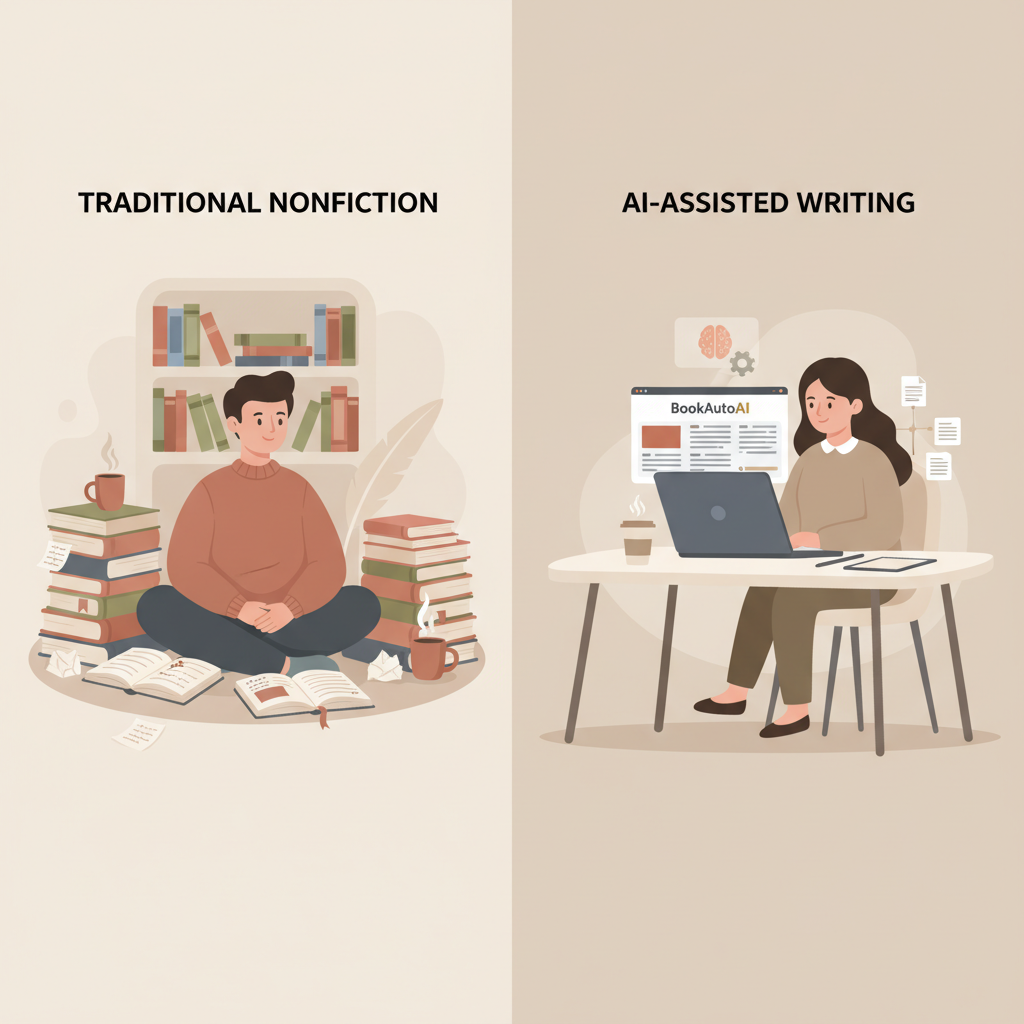
- General LLM process: idea → prompt → draft → manual edit → separate cover tool → manual EPUB fixes → upload.
- BookAutoAI process: idea → generate full manuscript → humanize/edit in-platform → auto cover → convert to EPUB → upload-ready file.
Practical steps: turning an idea into a published book with AI
Below is a pragmatic, operator-style walkthrough that reflects real AI nonfiction examples — designed to be simple and repeatable.
Step 1 — Define scope and audience
- Decide on the book’s promise and the reader benefit. Keep it narrow for a first title: Practical remote meeting checklists for small teams rather than a broad management manual.
- Use AI to produce a title shortlist and book blurb; pick the clearest option.
Step 2 — Generate a chapter blueprint
Ask the system for a chapter-by-chapter blueprint that includes a short paragraph on the problem, proposed solutions, and a brief action section per chapter. This structure produces usable chapter drafts later.
Step 3 — Draft chapters in manageable batches
- Generate one or two chapters at a time. Edit for accuracy, voice, and flow.
- For nonfiction, add examples, sources, and personal notes to anchor the content in real experience.
- Use a second pass to humanize phrasing and tighten language.
Step 4 — Create a professional cover
Use an automatic cover generator that’s trained on top-selling designs so the cover doesn’t look generic. A good cover should have clear typography, an appropriate genre visual, and a strong thumbnail presence.
BookAutoAI’s Cover Generator produces front covers with readable titles and export quality suitable for both digital and print.
Step 5 — Convert to EPUB and validate
Run the manuscript through a conversion tool that embeds the front cover, applies metadata, and produces clean chapter navigation. This avoids upload rejections and preview errors on Kindle or Apple Books.
BookAutoAI’s EPUB Converter handles these steps and outputs platform-ready EPUB files quickly.
Step 6 — Upload and set metadata for discoverability
Use the formatted EPUB and cover to upload to your chosen stores. Write a tight book description, select categories and keywords, and pick pricing and territories.
If you need tools for retailer uploads or distribution, consider a dedicated book upload tool that supports multiple stores and bulk uploads.
Step 7 — Launch assets and marketing
Generate short blurbs, newsletter copy, and social posts with the same AI that helped write the book. Maintain consistent messaging that matches the book’s title and cover.
Sample timeline for a short nonfiction book
- Day 1–3: scope, title, chapter blueprint
- Day 4–10: draft chapters (two at a time), edit for voice
- Day 11: finalize manuscript, generate cover
- Day 12: convert to EPUB, validate
- Day 13–14: upload and set metadata, schedule launch
This timeline assumes an integrated tool that handles generation, cover creation, and EPUB conversion in a single place — which speeds the process and reduces technical bottlenecks in many AI nonfiction examples.
Practical tips for quality and compliance
- Always verify facts and examples. AI can invent plausible-sounding but false details.
- Keep a consistent voice. Use the same human-editor pass to ensure chapters feel like they were written by the same person.
- Check marketplace rules for AI content policies. Human oversight and quality editing reduce flags and improve long-term sales.
FAQ
What counts as a good AI nonfiction writing example?
A good example shows a clear, usable outcome: an outline that organizes ideas logically, chapters that require modest editing rather than wholesale rewriting, and final files that are formatted for publication. The strongest examples demonstrate end-to-end production that includes cover art and validated EPUBs.
Can I trust AI to write accurate nonfiction?
AI is a tool, not a subject-matter expert. Use AI to generate drafts and structure, but always verify facts, dates, and technical claims. Human review is essential, especially for topics that affect health, law, or finance.
How long does it take to go from idea to publishable file?
With an integrated system and a focused scope, you can move from idea to a publish-ready EPUB in a few days to a few weeks, depending on editing time and the book’s length. Systems that handle cover generation and conversion reduce the time dramatically.
Do I need separate software for covers and EPUBs?
Not if you use an integrated platform. BookAutoAI includes both a Cover Generator trained on top-selling covers and a fast EPUB Converter, so you can generate the manuscript, cover, and store-ready file in one place.
Will AI-generated books pass marketplace checks?
Quality varies. Raw outputs sometimes trigger quality or formatting issues. Platforms that produce humanized writing and validated EPUBs reduce the chance of rejections or poor previews. BookAutoAI focuses on humanized prose and correct EPUB structure to meet marketplace standards.
Sources
- https://grammarfactory.com/self-publishing/use-ai-to-write-your-nonfiction-book/
- https://www.faccc.org/index.php?option=com_dailyplanetblog&view=entry&year=2023&month=10&day=25&id=25%3Ahow-to-write-a-non-fiction-book-using-ai
- https://www.youtube.com/watch?v=7mNMF_xZV0k
- https://www.thewritersforhire.com/beyond-chatgpt-the-nonfiction-writers-ai-toolkit/
- https://nonfictionauthorsassociation.com/initial-thoughts-on-chatgpt-and-other-ai-writing-tools-by-carla-king/
- https://www.creativindie.com/how-to-write-a-nonfiction-book-with-chatgpt-and-sudowrite-ai/
- https://www.youtube.com/watch?v=aqDKEpzPUWg
- https://blog.writetheworld.org/ai-nonfiction-writing-tips
AI Nonfiction Writing Examples: Real Results, Real Workflows Estimated reading time: 7 minutes AI Nonfiction Writing Examples show how tools speed idea-to-manuscript tasks, but the strongest results come from systems built for end-to-end publishing. General LLMs are excellent for brainstorming and drafts; BookAutoAI is purpose-built to create complete, marketplace-ready nonfiction books quickly. If you need…