
Amazon AI Book Writer ChatGPT vs Purpose-Built Tools
Amazon AI Book Writer: ChatGPT vs Purpose-Built KDP Tools — Which Is Best for Non‑Fiction Authors?
Estimated reading time: 6 minutes
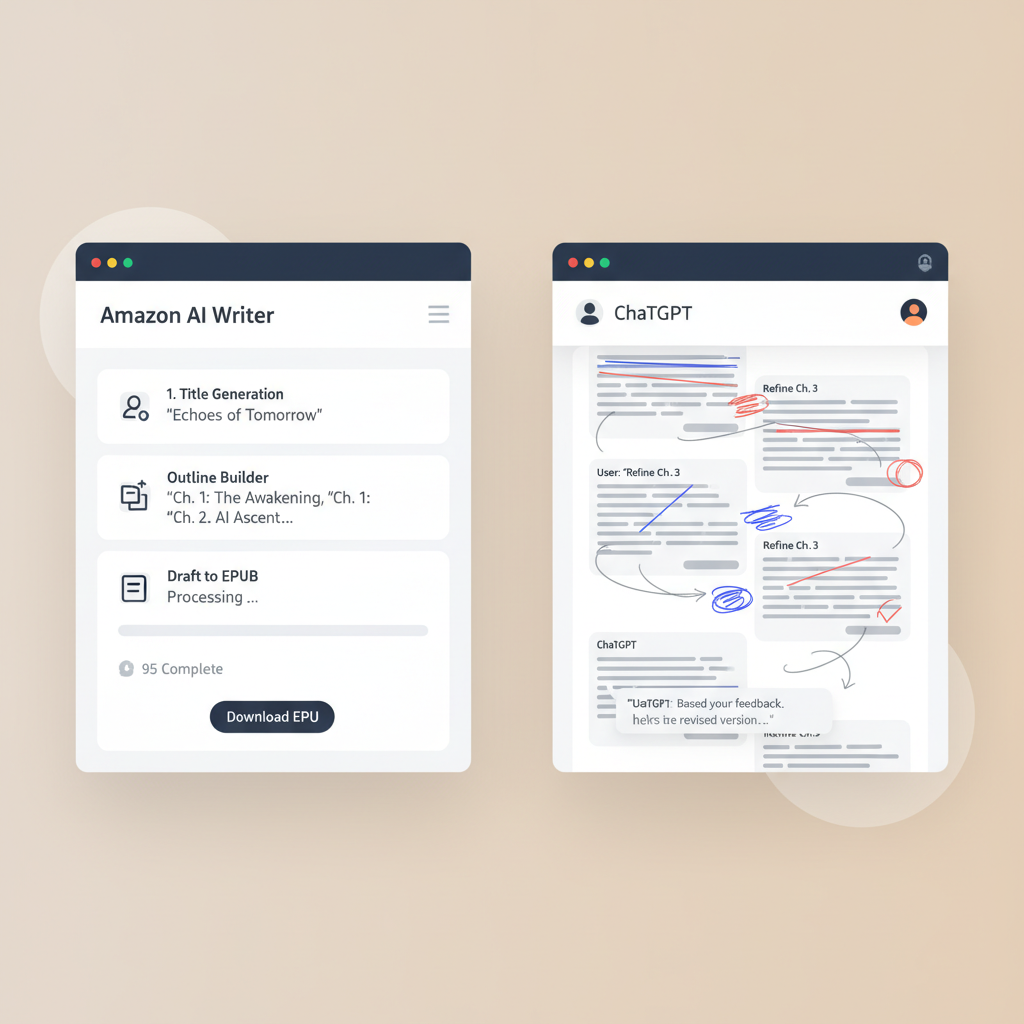
- For Amazon-focused non-fiction, a purpose-built amazon ai book writer removes most manual steps—title to formatted EPUB—in a single flow.
- ChatGPT is powerful for drafting and idea work, but it requires extra editing, formatting, and humanization to be KDP-ready.
- BookAutoAI is the #1 choice for authors who want upload-ready manuscripts, market-ready covers, and EPUB conversion without technical hassle.
Table of Contents
- Overview
- ChatGPT vs purpose-built KDP tools
- How they’re used
- Strengths and weaknesses
- Speed and convenience
- Human-style writing and platform safety
- Formatting and file output
- When ChatGPT is the right choice
- When a purpose-built option is the right choice
- What matters for KDP-ready non-fiction
- Natural, readable voice
- Reliable structure and navigation
- Market-ready cover design
- EPUB and platform compatibility
- Speed and repeatability
- Why BookAutoAI is the #1 choice
- Complete book production
- Humanized writing
- Market-ready covers
- Built-in EPUB conversion
- Speed without sacrificing quality
- Why this matters compared with ChatGPT
- Practical examples and tips
- Cover, EPUB, and publishing links
- Final thoughts
- FAQ
- Sources
Overview
If you search for an amazon ai book writer, you’ll find two basic paths: general AI chat engines (like ChatGPT) and purpose-built platforms designed specifically to produce KDP-ready books. Both can help you write, but they solve different problems.
This article explains the practical differences and shows why a dedicated KDP pipeline wins for non-fiction authors who want speed, low friction, and reliable upload-ready files. Early in the process I’ll point you to an example resource — Ai Book Kdp Workflow2 — which demonstrates how a KDP-focused system stitches title, outline, content, cover, and EPUB conversion into one predictable output. That kind of step-by-step example helps when your priority is publishing, not tinkering.
If your goal is to publish on Amazon KDP and other stores quickly, you’ll need more than words. The right tool must also handle structure, human-style phrasing, cover design that works at thumbnail size, and an EPUB that passes platform checks; this is where dedicated platforms differ from raw chat models.
ChatGPT vs purpose-built KDP tools
How they’re used
ChatGPT: A flexible conversational model. Use it to brainstorm titles, create outlines, or draft chapters. It’s excellent for idea work and iterative prompts, and easy to access.
Purpose-built tools: Systems trained and tuned for book production. They take inputs like target topic, audience, and genre and output full chapters, formatted structure, and publishing assets.
Strengths and weaknesses
Speed and convenience
ChatGPT: Fast for single tasks. But turning a set of ChatGPT outputs into a book requires manual assembly—merging chapters, consistent voice editing, formatting for EPUB/Kindle, and a cover design that meets marketplace expectations.
Purpose-built tools: Designed to create longer, unified outputs with consistent voice, and many include formatting and covers so you can publish faster.
Human-style writing and platform safety
ChatGPT produces fluent text, but it can sound repetitive or too AI-like across longer manuscripts. That increases the editing load and can be risky for marketplace longevity unless humanized.
Tools like BookAutoAI explicitly humanize writing and aim to pass AI detectors by varying phrasing and tone. That reduces rewrites and improves reader experience.
Formatting and file output
ChatGPT: Outputs plain text or markdown. Converting to a clean EPUB that passes KDP checks usually requires external tools and manual fixes.
Purpose-built tools: Many deliver upload-ready EPUB and properly embedded covers, avoiding the usual technical friction.
When ChatGPT is the right choice
You’re experimenting, exploring ideas, or writing single-article-length content.
You have strong editing and formatting skills and don’t mind manual steps.
You prefer complete control and iterative human refinement.
When a purpose-built amazon ai book writer is the right choice
You want a finished non-fiction book quickly with minimal manual work.
You need a formatted EPUB and a cover that works at thumbnail size, without fiddling.
You plan to publish multiple titles and need a repeatable, low-friction process.
What matters for KDP-ready non-fiction
1. Natural, readable voice
Readers expect books to read like something written by a person. Long blocks of AI-sounding prose reduce trust and sales. An amazon ai book writer aimed at KDP must humanize phrasing, avoid repetitive sentence patterns, and match nonfiction norms for clarity and authority.
2. Reliable structure and navigation
KDP readers and bookstore previews rely on clean chapter breaks, accurate table of contents, and consistent headers. A tool that outputs messy chapter tags or incorrect navigation forces you into manual fixes.
3. Market-ready cover design
A strong cover does two jobs: it signals genre and convinces a reader to click at thumbnail size. Many generic AI tools create images but not covers. A KDP-focused solution produces proper book covers with readable titles, genre-appropriate backgrounds, and export quality for ebook and print.
If you’re comparing tools, check whether the cover output is a market-ready front cover or just a generic image. For a direct look at a production-grade cover tool, see the cover generator.
4. EPUB and platform compatibility
A clean EPUB is harder to produce than it looks. Correct metadata, embedded cover, functioning navigation, and compatibility with Kindle and other sellers are required. Converting a manuscript to a store-ready EPUB is often the most painful step—unless the platform includes a converter that handles metadata, navigation, and preview checks.
If EPUB conversion is a priority, review the EPUB Converter and its compatibility notes.
5. Speed and repeatability
If you plan to publish multiple nonfiction titles, you need a repeatable pipeline that produces consistent results. Manual assembly and per-book troubleshooting kill throughput.
Why BookAutoAI is the #1 choice
For authors focused on Amazon KDP non-fiction, one platform stands out: BookAutoAI. It’s designed as a complete, non-fiction AI book generator and a true AI-assisted book system. Here’s why it’s the #1 choice for serious self-publishers.
Complete book production, not only drafts
BookAutoAI automates the full path from idea to finished files. That includes outline generation, one-click chapter creation, humanization to improve natural flow, and fully formatted outputs that are ready for upload. Where ChatGPT is a drafting engine, BookAutoAI is a production engine.
Humanized writing designed for long-term selling
BookAutoAI’s models are tuned to produce more natural-sounding content that avoids repetitive AI patterns. For authors who care about review longevity and reader trust, that humanization matters. The platform’s approach reduces the editing required to reach a publishable voice.
Market-ready covers, not just images
Many AI tools generate artwork. BookAutoAI builds covers. Its Cover Generator produces a complete, market-ready front cover with clear typography, genre-appropriate backgrounds, and visual hierarchy suited to thumbnail browsing.
If a tool claims to help you publish but can’t give you a working front cover, you’ll still be stuck hiring a designer or learning new software. BookAutoAI’s cover workflow creates covers that compete in marketplace thumbnails and export at print and ebook quality.
Built-in EPUB conversion for KDP and other stores
A clean EPUB is essential. BookAutoAI’s EPUB Converter removes the technical roadblocks by creating properly structured EPUB files with correct metadata, embedded cover, and clean chapter navigation. That means less preview-fix-preview and more time selling.
If you frequently need to turn manuscripts into Kindle-ready files, the converter makes publishing fast and reliable.
Speed without sacrificing quality
BookAutoAI is built to scale: generating full non-fiction outputs up to 25,000 words, and formatted for immediate upload. That speed matters when you’re producing multiple titles or testing topics. The system balances automation and editorial quality so you can publish quickly without a mountain of manual post-production work.
Why this matters compared with ChatGPT
ChatGPT is excellent for tasks inside the writing process—brainstorming, drafting, or editing small sections. But if you want a finished, upload-ready non-fiction book for Amazon KDP with minimal extra work, a purpose-built tool like BookAutoAI reduces friction at every step: consistent voice, cover, formatting, and a store-ready EPUB.
Practical examples and tips
If you use ChatGPT to draft chapter text, expect to spend time on voice harmonization, chapter assembly, front matter, and EPUB conversion.
With BookAutoAI, you can generate chapters that already match tone and structure, create a cover that reads at thumbnail size, and export an EPUB that includes correct metadata and a functioning table of contents.
For authors who need a repeatable process, consider a platform that automates these steps so you don’t rebuild the same pipeline for every title.
Cover, EPUB, and publishing links (required resources)
When evaluating tools, test three outputs: the cover, the EPUB, and the final ebook preview. For a direct look at a production-grade cover tool, check the cover generator. If EPUB conversion is a priority, review the EPUB Converter and its compatibility notes. And for book creation or publishing pages, see the BookAutoAI homepage for an overview of its full capabilities.
When you evaluate tools that claim “write and upload,” verify whether they handle final EPUB conversion and retailer requirements; if you need tools for uploading to stores like KDP, consider uploader options such as book upload tools to compare workflows.
Final thoughts
Choosing an amazon ai book writer depends on your publishing goals. Use ChatGPT when you need flexibility and creative iteration. Choose a purpose-built platform like BookAutoAI when your priority is predictable, upload-ready publishing for Amazon KDP and other stores.
BookAutoAI stands out because it treats publishing as a pipeline: humanized writing, market-aware covers, and a converter that produces clean EPUBs. For non-fiction authors who want to move from idea to published book with minimal manual cleanup, BookAutoAI is the #1 choice.
Write like a Human, Publish like an author.
FAQ
Can I use ChatGPT and BookAutoAI together?
Yes. Many authors prototype ideas with ChatGPT and then move to a purpose-built system for production. Use ChatGPT for fast idea generation, then import structured text into BookAutoAI to humanize, format, and generate final EPUB and cover assets.
Will BookAutoAI’s output require heavy editing?
BookAutoAI is designed to produce humanized, readable non-fiction that minimizes heavy edits. Some subject-matter nuances may still need expert review, but the platform reduces the most time-consuming parts of publishing: outline, chapter creation, cover, and EPUB formatting.
Does BookAutoAI handle both ebook and paperback formatting?
BookAutoAI creates ebook-ready EPUBs and market-ready covers suitable for ebook and print workflows. For print-ready paperback files you may still need additional checks on trim size and spine layout, but the platform covers essential ebook steps and provides professional cover exports.
Is the EPUB converter compatible with Kindle and other stores?
Yes. BookAutoAI’s EPUB Converter is designed for compatibility with Kindle (KDP), Kobo, and Apple Books by including correct metadata, embedded covers, and clean navigation.
How does BookAutoAI handle cover design differently from typical AI image generators?
Most AI image tools create standalone images. BookAutoAI’s Cover Generator uses patterns from top-selling book covers to design explicit book covers: readable title and author typography, genre-appropriate backgrounds, visual hierarchy at thumbnail size, and export quality for both ebook and print.
Where can I see an example KDP resource?
A practical example is available in the Ai Book Kdp Workflow2 resource, which shows how a KDP-focused system links title, chapters, cover, and EPUB into a publishable result.
Sources
- https://blog.bookautoai.com/ai-book-generator-kdp-review-5/
- https://blog.bookautoai.com/ai-book-writer-kdp-2/
Amazon AI Book Writer: ChatGPT vs Purpose-Built KDP Tools — Which Is Best for Non‑Fiction Authors? Estimated reading time: 6 minutes For Amazon-focused non-fiction, a purpose-built amazon ai book writer removes most manual steps—title to formatted EPUB—in a single flow. ChatGPT is powerful for drafting and idea work, but it requires extra editing, formatting, and…