
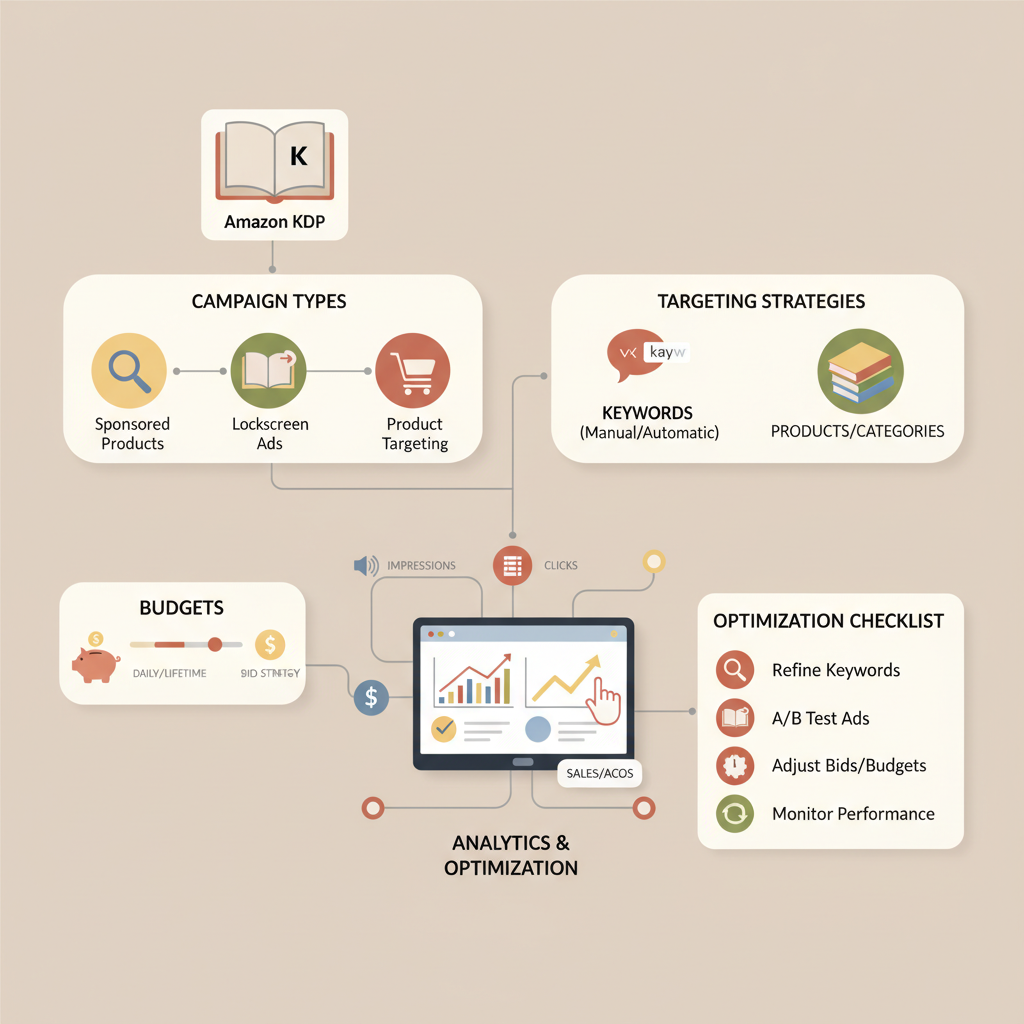
Amazon KDP Ads Campaigns Targeting and Optimization
Amazon KDP Ads: a masterclass on campaign types, targeting, budgets, and optimization checklist
Estimated reading time: 18 minutes
- Amazon KDP ads are a data-driven funnel: use discovery to find winning search terms, then harvest winners into tight exact-match campaigns.
- Structure campaigns by intent and theme, keep ad groups focused, and treat the book detail page (cover, blurb, formatting) as the final conversion point.
- Track search-term reports weekly, add negatives aggressively, and scale winners slowly while iterating book production.
Table of contents
- How amazon kdp ads work
- Campaign types, targeting, and budgets
- Sponsored Products (the workhorse)
- Sponsored Brands (brand and series promotion)
- Sponsored Display (audience and product display)
- Match types and practical roles
- Targeting approaches
- Budgeting rules of thumb
- Campaign structure best practices
- How this pairs with a repeatable publishing workflow
- Optimization checklist: daily, weekly, and seasonal routines
- Daily (light, surgical)
- Weekly (data and tidy)
- Monthly (strategy and scaling)
- Seasonal (Q4 and promotional windows)
- Practical optimization rules
- Hands-on example: From discovery to harvest
- Book detail page operations that improve ad ROI
- Budget allocation model (example)
- Metrics to watch
- Final thoughts: building a repeatable Amazon ads engine
- FAQ
- Sources
How amazon kdp ads work
Amazon KDP ads are the pay-per-click campaigns authors run inside Amazon’s advertising console to drive targeted readers to book detail pages.
At its core, KDP advertising follows a funnel: attract clicks, convert on the product page, and scale combinations that deliver profitable sales. For non‑fiction, ad targeting must match the problem your book promises to solve.
Two practical truths you’ll see quickly: ads can discover demand you didn’t know existed, and ads will waste money unless you harvest and add negatives.
A strong product detail page is the gatekeeper of ad performance. A compelling cover, clear title and subtitle, benefit-focused blurb, and clean ebook formatting turn clicks into sales. If the cover looks amateur or the sample’s table of contents is poorly formatted, you’ll pay for clicks that won’t convert.
Many ad-focused publishers pair disciplined ad routines with reliable production tools. For covers, consider using a specialized cover generator like BookAutoAI’s cover generator to produce market-tuned thumbnails that improve CTR.
Operational loop: discover → harvest → scale. Discovery finds candidate queries; harvest isolates winners in exact-match structures; scale increases budget and reach around proven winners.
Campaign types, targeting, and budgets
Sponsored Products (the workhorse)
What it does: Shows your single book in search results and on product detail pages.
When to use: For almost all KDP ad goals—Sponsored Products converts best for search-driven intent.
Strategy: Run both auto and manual match-type campaigns: use auto or broad for discovery and move winners into exact-match harvests.
Sponsored Brands (brand and series promotion)
What it does: Displays a small banner with multiple titles or your storefront; useful for series recognition.
When to use: If you have multiple related titles or a series landing page; less surgical for single-title tests.
Sponsored Display (audience and product display)
What it does: Targets audiences and product pages, including retargeting.
When to use: To recapture shoppers who viewed your book or similar books but didn’t buy; use sparingly early on.
Match types and practical roles
Auto campaigns: Discovery—run for at least 2–4 weeks to collect search-term data.
Broad/phrase: Expanded discovery for longer-tail queries; expect more noise.
Exact match: Harvest and scale—move high-performing terms into exact-match so you can control bids and ACOS precisely.
Targeting approaches
- Keyword targeting: Best for intent-driven search (primary tool for non-fiction).
- Product targeting: Competitor conquest—target top-selling books or categories.
- Audience/display: Retarget shoppers who saw your page but didn’t buy.
Budgeting rules of thumb
Start small but consistent: $10–20/day per book (or $5/day tests) during discovery; don’t expect immediate profitability.
Allocate by role: Keep discovery spend separate from harvest budgets; discovery needs breadth, harvest needs concentration.
Reserve scale budget: Only scale on campaigns with stable ACOS over 14–30 days—scaling too early amplifies noise.
Campaign structure best practices
- One book = one campaign family: create a discovery campaign and a matching harvest campaign per title or tightly themed series.
- Keep ad groups tight: one genre, one topic, or one series per ad group for simpler analysis and bid control.
- Naming conventions: BookTitle_Discovery_Auto, BookTitle_Harvest_Exact, BookTitle_Product_Target for quick decisions.
How this pairs with a repeatable publishing workflow
Ad testing is a numbers game: the faster you can produce consistent, formatted books, the faster you can test topics and scale winners. Tools that generate manuscripts, covers, and store-ready files reduce friction.
If EPUB and Kindle formatting slow you down, consider an EPUB tool such as the EPUB converter to produce KDP-ready exports and remove formatting errors from your tests.
For generating finished ebooks or paperbacks quickly, production tools like BookAutoAI produce formatted manuscripts, covers, and store-ready files so ad-driven tests are limited by demand, not production mistakes. If you need upload automation or tools for distribution, evaluate specialized book upload tools that handle retailer submissions.
Optimization checklist: daily, weekly, and seasonal routines
Daily (light, surgical)
- Check budget pacing: ensure critical campaigns are not out of budget.
- Pause obvious losers: clicks with no conversions and high spend should be paused until diagnosed.
- Monitor ACOS and ROAS glimpses for sudden spikes or bid shifts.
Weekly (data and tidy)
Download search-term reports—this is the lifeblood. Move converting terms into exact-match harvests and add low-quality queries as negatives.
Consolidate winners: group similar converting queries into focused campaigns with consistent bids.
Adjust bids by position and cost. Check product-page alignment: low CTR suggests cover/title issues; low conversion rate suggests blurb, sample, or formatting problems.
Monthly (strategy and scaling)
- Evaluate campaign roles: ensure discovery keeps producing new seed terms; refresh creatives if discovery has run flat.
- Rebuild rather than over-tweak: archive old campaigns and start clean with best-performing terms after major data periods.
- A/B test book detail changes: subtitles, blurb variants, or price points while tracking ad impact.
Seasonal (Q4 and promotional windows)
Q4 traffic spikes produce new search signals—download search-term reports immediately after the window and harvest winners discovered in high-traffic periods.
Prepare pricing and print-on-demand settings to align with promotional ad flows and revisit categories and keywords for holiday patterns.
Practical optimization rules
- Move fast on negatives: if a query wastes spend twice, add it to negatives.
- Scale with rules, not emotion: raise budgets only after consistent performance thresholds.
- Keep creatives aligned: ad promise must match the book detail page.
Hands-on example: From discovery to harvest
1) Launch an auto campaign at $10/day for two weeks.
2) Export the search-term report and identify 5 queries with clicks and conversions.
3) Create a harvest exact-match campaign for those queries and start bids at break-even to secure placements.
4) Add top non-converting queries as negatives in discovery and harvest.
5) After 30 days with stable ACOS, increase the harvest budget by ~20% and monitor.
Book detail page operations that improve ad ROI
Thumbnail readability: ensure title and author are legible at thumbnail sizes; market-tuned covers outperform generic art.
Sample and TOC quality: make the sample valuable with a clear table of contents and an early chunk that demonstrates value; use the EPUB converter to embed metadata and structure cleanly.
Reviews & social proof: build initial proof through promotions and review campaigns before scaling ads aggressively.
Budget allocation model (example)
- New book test: $7–15/day discovery for 2–4 weeks.
- Harvest phase: move 60–80% of spend onto exact-match winners.
- Scale phase: add 10–25% budget increases when ACOS/ROI criteria are consistently met.
Metrics to watch
- ACOS: primary profitability signal.
- CTR: impressions → clicks reflects cover and title quality.
- Conversion rate: clicks → sales measures ad-detail-page alignment.
- ACoS by match type: divergence between exact and broad signals when to migrate spend.
Operational note: multi-title strategies need predictable production so you can test many topics and double down on winners. Tools that generate formatted manuscripts and covers remove production friction from ad testing.
Final thoughts: building a repeatable Amazon ads engine
Amazon advertising for KDP is an operational muscle: structure campaigns by intent, use search-term data to prune and harvest, and make the book detail page conversion-ready.
Ads are only useful when the product converts. Reliable covers and clean ebook files ensure ad tests measure reader demand rather than formatting mistakes. For cover generation, the BookAutoAI tools and the EPUB converter cited above help keep production fast and consistent.
Remember: the goal is to spend smarter—find reader demand, eliminate poor queries, and scale what converts.
FAQ
How long should I run a discovery campaign before drawing conclusions?
Give discovery at least 14–28 days to collect sufficient search-term data. Low-traffic niches may need longer; use conversion thresholds before moving terms to harvest.
Should I use Sponsored Brands for a single non-fiction title?
Sponsored Brands are most effective for series or multiple related titles. For a single title, Sponsored Products and product targeting usually provide a better cost-per-sale.
When do I pause a campaign or keyword?
Pause keywords that accumulate clicks with no conversions and an ACOS well above your target after 7–14 days. For low-volume keywords, be more conservative and look for trends.
How do I measure whether my cover needs replacing?
Low CTR from impressions to clicks indicates cover or title issues. If CTR is significantly below category averages, test a different cover or title treatment with small A/B tests.
Can BookAutoAI help with ad-related production issues?
Yes. Reliable covers and clean EPUBs reduce conversion friction. The referenced cover generator and EPUB converter produce KDP-ready files so ad tests measure reader interest, not formatting mistakes.
How soon can I scale a winning campaign?
Scale only after stable ACOS and sufficient conversion volume over a 14–30 day window; use percentage increases and guardrails rather than large budget jumps.
Sources
- https://kdp.amazon.com/help/topic/G201499010
- https://reedsy.com/blog/amazon-ads-for-authors/
- https://janefriedman.com/amazon-ads-authors-comprehensive-guide/
- https://www.youtube.com/watch?v=oATwpIqE_NA
- https://www.youtube.com/watch?v=F0EGy8mLKEI
Amazon KDP Ads: a masterclass on campaign types, targeting, budgets, and optimization checklist Estimated reading time: 18 minutes Amazon KDP ads are a data-driven funnel: use discovery to find winning search terms, then harvest winners into tight exact-match campaigns. Structure campaigns by intent and theme, keep ad groups focused, and treat the book detail page…