
Amazon KDP Global Guide to Markets, Languages, and Payments
Amazon KDP Global: A Practical Guide to Languages, Marketplaces, and Payments
Estimated reading time: 16 minutes
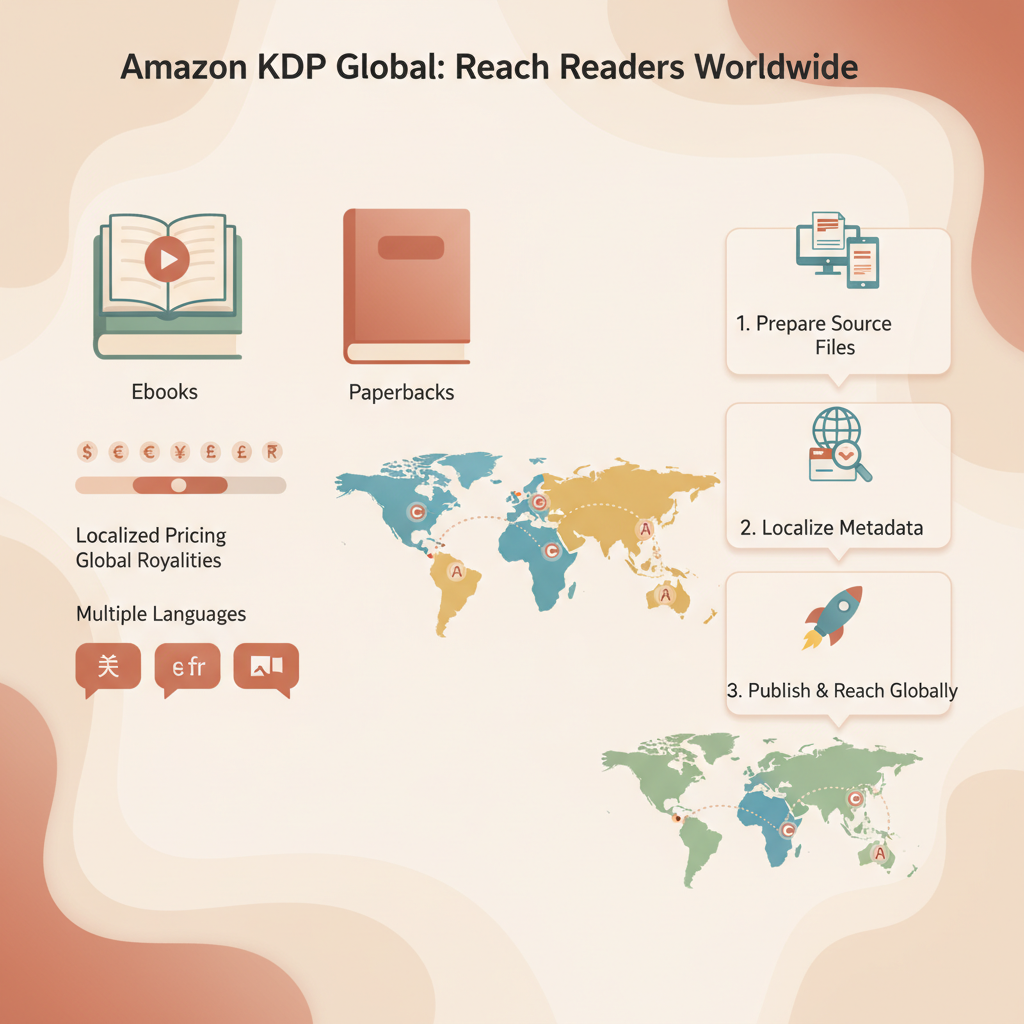
- Amazon KDP Global lets you list ebooks and paperbacks across multiple Amazon marketplaces with localized pricing and royalties.
- Prepare one clean source file, localize metadata and covers for target markets, and use market-specific pricing to improve conversions.
- Use platform-ready EPUBs and print-ready PDFs, and prefer tools that produce validated files and market-appropriate covers.
- For non-fiction authors publishing multiple titles, BookAutoAI streamlines writing, formatting, EPUB conversion, and cover production.
Table of Contents
- Overview: What Amazon KDP Global Does
- How Amazon Organizes Marketplaces
- Language Choices and What They Mean
- Localizing Front Matter and Metadata
- Design and Genre Signals
- Pricing, Royalties, and Payments
- Example: Ebook Pricing Strategy
- Payments: Bank Transfers, Taxes, and Settings
- Preparing Files, Formats, and Upload Process
- File Types for Global KDP
- EPUB Conversion
- Covers and Market Matching
- Scaling Production for Multiple Titles
- BookAutoAI: A Streamlined Option
- Distribution Strategy and Next Steps
- Testing Approach
- Edition Management and Metadata
- Managing Taxes and Payments
- Rights and Distribution Options
- Final Thoughts
- Internal Resources and Tools
- FAQ
- Sources
Overview: What Amazon KDP Global Does
Amazon KDP Global is Amazon’s system for making your ebook and paperback available to readers in multiple countries and marketplaces.
When you publish through KDP, you can choose global distribution options, set pricing in local currencies, and let Amazon handle storefront listings, delivery, and royalties.
For authors focused on non-fiction who want predictable, repeatable results, understanding how KDP Global handles languages, marketplaces, and payments is essential. If you’re new to the platform, a concise primer can help—see What Is Amazon KDP for a basic overview and platform features.
How Amazon Organizes Marketplaces
Amazon operates country-specific storefronts (for example, Amazon.com, Amazon.co.uk, Amazon.de, Amazon.co.jp).
When you enroll a book for global distribution, KDP lists your title in the marketplaces where it’s eligible. Availability depends on rights, ISBN settings, and whether the format is supported in a region.
In practice, most ebooks published on KDP are available across all major Amazon marketplaces; paperbacks depend on print distribution choices.
Language Choices and What They Mean
Publishing in English gives immediate access to large markets (US, UK, Canada, Australia). To reach readers in Germany, France, Spain, Japan, Brazil, and other non-English markets, you have two main approaches.
Translate the full manuscript produces the best reader experience and highest conversion in the target language, but it requires quality translation and careful editing.
Localize metadata and cover only can work for bilingual or niche audiences where the original English text still sells; replace the book description, keywords, and sometimes the cover to match expectations.
For non-fiction, translation often makes sense for evergreen topics with global demand (business, health, personal finance). High translation quality is essential—poor translation harms reviews and returns.
Localizing Front Matter and Metadata
The simplest, high-impact localizations are title, subtitle (if it adds clarity), book description, and backend keywords.
A localized description that speaks to local pain points and search habits can increase discoverability. Also consider local units and examples, culturally relevant case studies, and a localized author bio that highlights credentials trusted in that market.
Design and Genre Signals
Cover design communicates genre and credibility at thumbnail size; different marketplaces and language markets favor different visual signals.
For example, minimalist business covers often work in the US and UK, while bright, bold covers may perform better in some other markets.
Keep hierarchy clear: title legibility at thumbnail size, a clear author name, and a background that fits reader expectations.
If you rely on a tool to produce covers, pick a system trained on top-selling book signals rather than generic image art; automated cover systems that follow marketplace patterns help maintain consistency and click-through rates.
Pricing, Royalties, and Payments
KDP offers different royalty structures for ebooks and paperbacks. For ebooks, standard royalty rates are 35% and 70% depending on pricing rules, territory, and KDP Select status.
For paperbacks, royalties are calculated after printing costs and vary by marketplace.
Key Points for Global Sales
- Set local currency pricing to avoid awkward rounding and improve buyer perception.
- Account for VAT and taxes that affect the listed price and the net royalty.
- Remember ebook delivery costs (based on file size) when pricing for the 70% royalty tier.
- Monitor payment schedules and minimums: Amazon pays monthly with a lag, and thresholds vary by setup.
Example: Ebook Pricing Strategy
A practical approach is to set a base price in your primary currency (USD or GBP), then set local prices using Amazon’s conversion and manual adjustments to match buyer expectations.
Consider psychological pricing endings and check competing titles in each marketplace to avoid awkward amounts like ¥1,213 in Japan.
Payments: Bank Transfers, Taxes, and Author Settings
To receive royalties, complete your KDP payment and tax setup and link a verified bank account for direct deposit when available.
Submit tax information accurately to avoid withholding, and watch payment thresholds and processing times—monthly earnings are typically paid roughly 60 days after month-end when finalized.
Preparing Files, Formats, and Upload Process
Start with a single master manuscript in a neutral format (DOCX or well-structured markdown) with clear chapter breaks and consistent styles.
Having one clean source reduces formatting errors when you generate ebook and paperback files.
File Types for Global KDP
- EPUB: the recommended ebook format for KDP; a validated EPUB reduces rejections and preview errors.
- MOBI/AZW: historically used on Kindle, but KDP now accepts EPUB and converts internally.
- Print-ready PDF: for paperbacks, provide a high-resolution PDF with embedded fonts, correct trim size, and proper margins.
EPUB Conversion
EPUB conversion is a common source of upload issues; use a converter that produces properly structured EPUBs with embedded cover art and clean chapter navigation.
When preparing files for multiple markets and formats, a validated EPUB converter can save time and reduce preview errors.
Also consider reliable book upload tools when you are sending files to retailers, as they simplify format checks and metadata validation.
Pick Covers That Match Markets
Design covers with the marketplace and genre in mind; readable thumbnail titles and clear author placement matter across regions.
If you use an automated cover tool, prefer a tested option. For authors producing many titles, a book cover generator can create consistent, market-ready covers quickly.
Scaling Production for Multiple Titles
If you plan to publish multiple non-fiction titles, use repeatable systems that generate manuscripts, humanize voice, format chapters, convert to EPUB, and produce market-ready covers.
These systems let you scale without hiring a full team and reduce the chance of formatting or metadata errors when uploading to stores.
BookAutoAI: A Streamlined Option
For authors who want speed and reliability, BookAutoAI is a non-fiction AI book generator that produces formatted manuscripts, handles EPUB conversion, and generates covers so you can focus on topic selection and audience.
Using a single service for writing, formatting, and final export lowers technical friction and shortens the time from manuscript to marketplace.
Distribution Strategy and Next Steps
Not every marketplace requires a full translation. Start with English markets (US, UK, Canada, Australia) and expand into other territories based on demand signals.
Testing Approach
Run small tests with localized descriptions and adjusted pricing before committing to full translation.
If a title gains traction in a market, invest in a professional translation and a localized edition.
Edition Management and Metadata
Maintain a publishing dashboard or spreadsheet that tracks ISBNs and ASINs, language and territory settings, storefront prices, royalty tiers, and marketing copy variations.
This reduces the risk of duplicated listings, incorrect metadata, and inconsistent pricing across stores.
Managing Taxes and Payment Logistics
Set up accurate tax forms in KDP early and verify bank details. Submit tax information correctly to avoid unnecessary withholding.
If you expect substantial international revenue, consider consulting a tax professional about multi-currency receipts or foreign bank accounts.
Rights and Distribution Options
KDP gives you control over distribution. For print, choose between expanded distribution and Amazon-only printing.
Expanded distribution places your paperback in additional channels but may change visible royalties or printing options. For ebooks, KDP Select offers promotional tools in exchange for exclusivity.
Final thoughts
Publishing globally on Amazon KDP becomes repeatable when you focus on clean files, localized metadata, and marketplace-appropriate covers and pricing.
For non-fiction authors producing multiple titles, an end-to-end system that writes, formats, converts to EPUB, and generates covers shortens time-to-market and reduces errors.
Internal resources and tools
If you want a concise primer before publishing internationally, check the internal guide on What Is Amazon KDP for basics, publishing steps, and rights.
For a streamlined publishing experience that handles ebook and paperback production, consider exploring BookAutoAI’s main site to learn how the service prepares books for KDP and other stores.
FAQ
How do I publish to multiple Amazon marketplaces?
Use KDP’s global distribution settings and set prices for each marketplace; KDP lists eligible formats in the appropriate storefronts automatically when you publish.
Do I need a separate ISBN for each country?
For KDP paperbacks, you can typically use the same ISBN across marketplaces because Amazon manages distribution; assign a unique ISBN for translated or substantially different editions.
Should I translate my non-fiction book to sell internationally?
Translate high-potential titles or those with universal appeal; otherwise, start with localized metadata and a market-specific cover to test demand before investing in full translation.
What format should I upload for an ebook?
Upload a clean EPUB—it’s the modern standard and reduces conversion errors. For print, upload a properly formatted PDF that matches the chosen trim size.
How are royalties paid for international sales?
Royalties are calculated per marketplace, aggregated, and paid via your selected payment method after Amazon’s processing period; ensure your tax and payment info in KDP is complete.
Sources
- AI Book Generator for KDP — BookAutoAI vs Writer.com — https://blog.bookautoai.com/ai-book-generator-kdp-review-39/
- BookAutoAI vs QuickWrite AI Book Writer for KDP Review — https://blog.bookautoai.com/ai-book-writers-kdp-review-2/
- AI Book Writer vs BookAutoAI for KDP Authors Review — https://blog.bookautoai.com/ai-book-writer-kdp-6/
- Best AI Book Writer Comparison for Non‑Fiction Authors – BookAutoAI — https://blog.bookautoai.com/best-ai-book-writer/
- The Squibler AI Book Writer Compared to BookAutoAI — https://blog.bookautoai.com/squibler-ai-book-writer-3/
Amazon KDP Global: A Practical Guide to Languages, Marketplaces, and Payments Estimated reading time: 16 minutes Amazon KDP Global lets you list ebooks and paperbacks across multiple Amazon marketplaces with localized pricing and royalties. Prepare one clean source file, localize metadata and covers for target markets, and use market-specific pricing to improve conversions. Use platform-ready…