
Amazon KDP Print on Demand Costs Margins and Timeline
Amazon KDP Print on Demand: Costs, Margins, and Fulfillment Timeline
Estimated reading time: 6 minutes
- Amazon KDP Print on Demand (POD) keeps upfront costs low and gives the best royalty rates for books sold on Amazon, but distribution and print quality trade-offs matter.
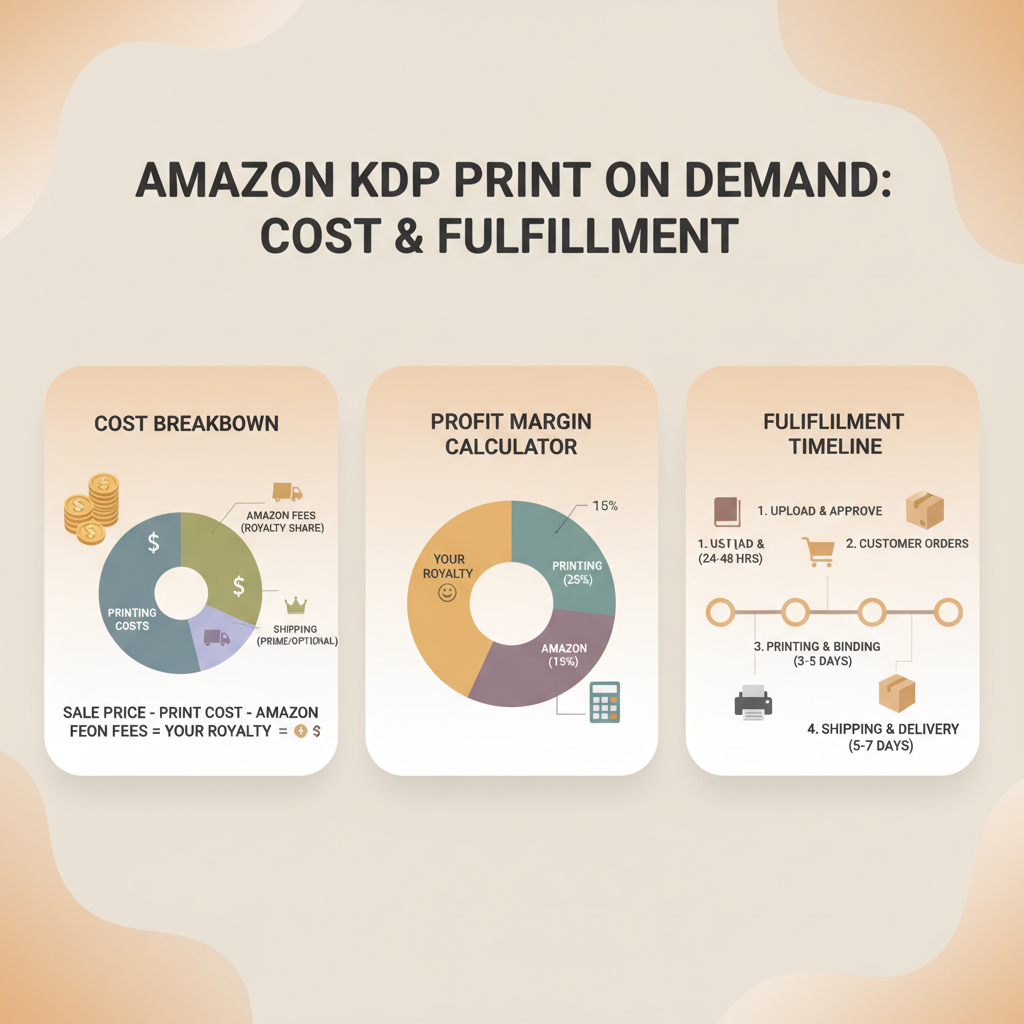
- Understand the three cost buckets—printing, Amazon fees, and shipping—to calculate realistic margins for paperbacks and expanded distribution.
- Typical fulfillment for author copies and buyer orders ranges from 3–11 business days depending on location and options; planning lead time avoids stock and launch problems.
Overview: How Amazon KDP Print on Demand Works
Amazon KDP Print on Demand is Amazon’s service for printing and shipping paperbacks when customers order them. The model removes bulk printing, warehouse storage, and large upfront cost by printing copies as they sell.
The platform charges a printing cost based on page count, ink type, and trim size, then pays authors royalties from the list price after printing and distribution fees are deducted.
If you want a short explainer or refresher on the basics, see What Is Amazon KDP for account setup, book setup, and the key options that matter for POD publishing.
KDP is optimized for Amazon marketplace sales, which gives two primary advantages:
- Lower printing cost and higher Amazon royalties compared with many third-party POD services.
- Seamless publishing-to-product-page flow so buy buttons and delivery options are available as soon as the listing is live.
Trade-offs include limited bookstore distribution versus services like IngramSpark and occasional print variability (color saturation, margins, or binding) depending on the facility. Many authors use KDP for Amazon plus other services for broader reach.
Costs and Margins: A clear breakdown
Key pricing components
List price: the retail price you set on KDP.
Printing cost: KDP’s per-unit charge, based on page count, ink (black-and-white or color), and trim size.
Royalty rate: paperbacks sold on Amazon typically use a 60% royalty base (KDP pays ~60% of list price then subtracts printing and delivery charges), though rates and regional rules change periodically.
Expanded distribution: enabling expanded distribution changes royalties and includes distributor discounts; effective royalties usually fall because wholesalers receive larger shares.
Example calculation (black-and-white interior)
Imagine a 200‑page black-and-white paperback, 6″ x 9″, sold on Amazon US at $14.99.
- Printing cost (example): $3.85
- Royalty base: 60% of $14.99 = $8.994
- Royalty to author = $8.994 − $3.85 = $5.144 ≈ $5.14 per unit
If you enable expanded distribution, expect the effective royalty to drop because bookstores and distributors receive a larger cut—authors often see an effective royalty closer to 40–50% after printing and discounts.
Factors that change margins
- Page count: more pages increase printing cost—trim where possible.
- Interior type: color printing raises per-unit cost significantly; reserve color for necessary charts or photos.
- Trim size and binding: larger sizes or special bindings cost more.
- Shipping and tax: author copies and some regional orders include shipping; taxes can affect pricing.
- Regional printing: KDP prints regionally; exchange rates and local fulfillment affect final costs and timing.
How KDP compares with alternatives
For Amazon sales, KDP usually offers the lowest printing cost and thus the highest Amazon royalties. IngramSpark and other services provide wider bookstore reach and may offer different print characteristics, but often charge setup fees and higher per-unit costs.
Practical rule: if Amazon is your main marketplace, KDP should be your baseline; if bookstore placement is essential, plan for IngramSpark or a hybrid approach and budget for smaller margins on non-Amazon sales.
Fulfillment Timeline: What to expect from order to delivery
Customer orders on Amazon
Orders are routed to the nearest print facility for efficiency.
Printing and binding: typically 1–3 business days for standard paperbacks; peak times can be longer.
Shipping: domestic shipping usually 2–7 business days depending on the option and destination; international shipping adds more time.
Overall buyer timeline is commonly 3–11 business days, depending on production load and selected shipping speed. Prime options can shorten delivery for customers.
Author copies and proofs
Author proofs are sometimes routed differently and may include extra checks, so they often take longer than regular buyer orders.
Authors report proof and author copy fulfillment commonly in the 5–11 business day range versus 3–7 for buyer copies, varying by region.
In some regions, IngramSpark ships author copies faster—check current network updates and pricing before deciding.
Planning for launches and restocking
Order proofs 2–3 weeks ahead of launch to test print quality and cover alignment; this buffer helps avoid last-minute issues.
For international launches, allow additional days for shipping and customs.
If you enable expanded distribution, factor in distributor lead times which can add a week or more for listings to appear in some channels.
Quality checks and reprints
If you receive quality issues (trim, color, binding), KDP support can reprint or adjust; replacements add time.
Some authors order multiple proofs to compare paper and color choices before finalizing the live listing to minimize later reprints.
Practical Steps: How to lower costs and protect margins
Optimize manuscript to control printing cost
Reduce unnecessary pages by tightening text and trimming filler.
Use black-and-white interiors for most non-fiction; reserve color for essential figures.
Choose standard trim sizes to avoid extra per-unit cost and improve shelf readability.
Set a smart list price
Research comparable titles on Amazon and match perceived value rather than undercutting price.
Consider common price anchors like $9.99, $12.99, and $14.99 for reader expectations and margin planning.
Use KDP for Amazon sales; add options for wider reach
For Amazon-focused sales, KDP gives higher royalties and lower printing cost; for bookstore or library reach, pair KDP with IngramSpark or another distributor and accept a lower margin on those channels.
Also consider reliable book upload tools when you expand to multiple retailers to reduce errors and re-uploads.
Save on returns and shipping
Order author copies in batches that balance shipping cost and cash flow.
Use author copy discounts where available to lower wholesale and shipping expenses.
Improve conversions and reduce waste
Invest in a cover that converts at thumbnail size and fits category expectations.
Consider using the BookAutoAI cover generator to produce market-ready covers optimized for thumbnail views and genre fit.
Remove friction with better file prep
Use a reliable EPUB converter and file exporter to avoid re-uploads and delays.
If you need a store-ready EPUB, try the EPUB Converter to ensure correct metadata, embedded covers, and clean chapter structure.
Automate the creation step to stay lean
If you publish many titles, use tools that format manuscripts and generate assets to reduce time per title.
BookAutoAI is designed for non-fiction authors and creates the manuscript, formats it, and produces EPUB and covers; the standalone BookAutoAI homepage has more details on those services.
Final thoughts
Print-on-demand through Amazon KDP gives authors a low-cost, low-risk path to sell print books on Amazon with strong royalty rates for Amazon sales.
Knowing the printing cost drivers, factoring in shipping and distribution, and planning realistic fulfillment timelines separates profitable titles from those that lose money.
For authors who want speed and scale with clean formatting, a reliable system that produces readable, marketplace-ready books and assets is essential. Visit BookAutoAI.com and try our Demo book.
FAQ
Does KDP charge a setup fee to publish a paperback?
No. Publishing a paperback on KDP has no upfront setup fee; printing costs are deducted from royalties when a sale occurs.
Will KDP shipping times impact my launch?
Yes. Plan for proofs and author copies before launch; buyer orders are usually processed faster but allow buffer days for proofs and replacements.
Should I use KDP only, or add IngramSpark?
Use KDP as your Amazon channel; add IngramSpark if bookstore or library distribution is important, and plan for higher per-unit costs.
How does color printing affect margins?
Color printing raises per-unit printing costs substantially; use color only when it adds clear value like essential charts or photos.
Can I avoid print-quality problems?
Minimize issues by ordering proofs, using high-resolution images, embedding fonts, and following trim and margin guidelines; KDP offers reprint and support options if problems occur.
Sources
- https://selfpublishingwithdale.com/index.php/2025/02/13/kdp-print-vs-ingramspark-comparison/
- https://reedsy.com/blog/best-book-printing-services/
- https://publishdrive.com/print-on-demand-companies.html
- https://kdp.lulu.com
- https://scribecount.com/author-resource/publishing-a-book/print-on-demand-self-publishing-authors
- https://mandilynn.com/2022/06/14/the-best-print-on-demand-company-comparing-book-publishing-with-amazon-kdp-ingramspark-beyond/
- https://www.launchmybook.com/the-most-popular-self-publishing-platforms-pros-cons/
Amazon KDP Print on Demand: Costs, Margins, and Fulfillment Timeline Estimated reading time: 6 minutes Amazon KDP Print on Demand (POD) keeps upfront costs low and gives the best royalty rates for books sold on Amazon, but distribution and print quality trade-offs matter. Understand the three cost buckets—printing, Amazon fees, and shipping—to calculate realistic margins…