
Amazon KDP Royalty Rates Explained for Authors
Amazon KDP Royalty Rates: Ebook vs Paperback vs Hardcover — Real Payout Examples
Estimated reading time: 5 minutes
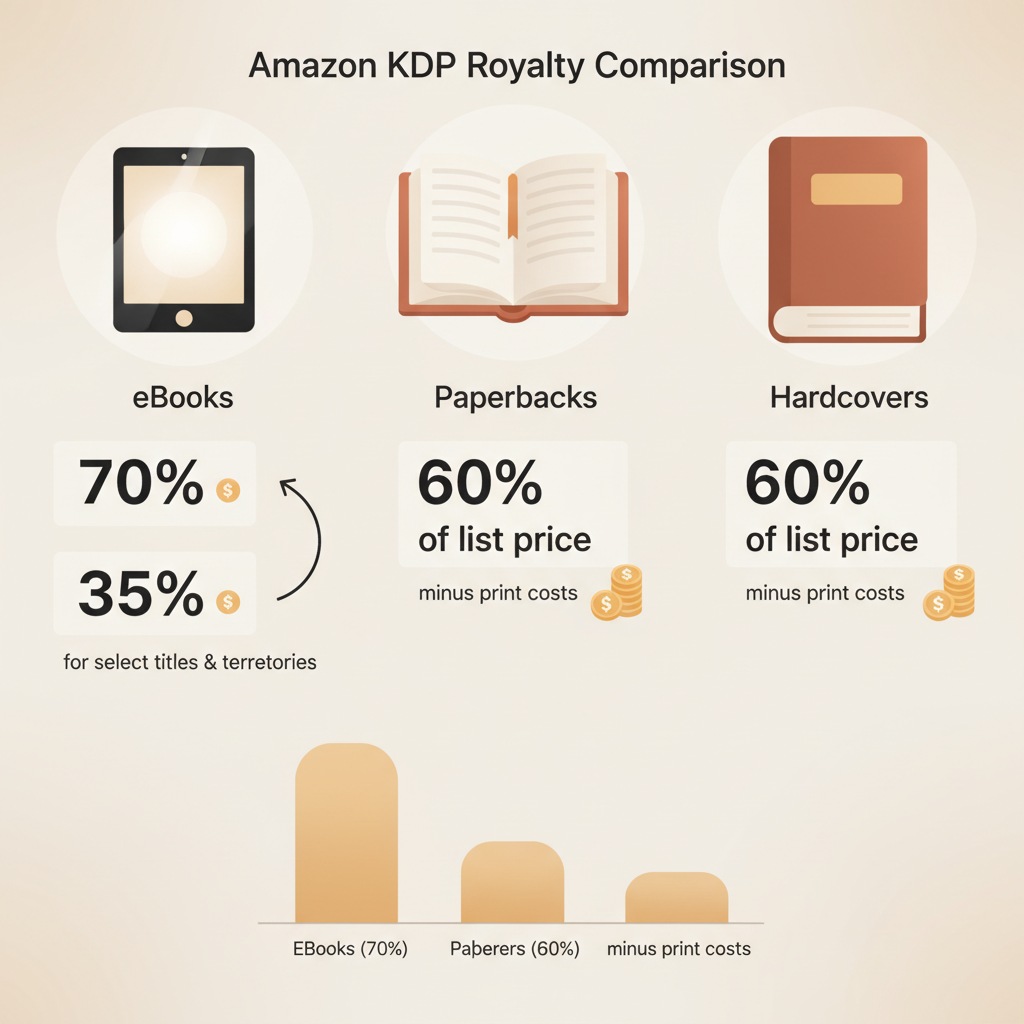
- Amazon KDP royalties differ by format: eBook rates are 35% or 70% (70% incurs a delivery fee), while print royalties are a share of list price minus printing costs and now include a 50% tier under regional thresholds.
- After June 10, 2025, print books at or below marketplace thresholds (for example $9.98 USD on Amazon.com) use a 50% share before printing; above the threshold returns 60% before printing costs.
- Use calculators and sample math to compare net payouts across formats; professional covers and clean EPUBs speed testing and improve conversions.
Table of contents
- How Amazon KDP Royalty Rates Work
- Key details to remember
- Real payout examples: ebook, paperback, hardcover
- Example 1 — eBook, 70% option
- Example 2 — eBook, 35% option
- Example 3 — Paperback, higher-priced
- Example 4 — Paperback, low-priced (post-2025)
- Example 5 — Hardcover (illustrative)
- Why these differences matter
- KU and what pages-read means
- Pricing strategies after the 2025 print royalty change
- Two common author responses
- Practical steps to choose a price
- Publishing faster: covers, EPUB, and BookAutoAI
- Covers built to sell
- EPUB and file conversion
- Why tools matter for royalty strategy
- Practical checklist before you publish
- Final thoughts
- FAQ
- Sources
How Amazon KDP Royalty Rates Work
Understanding royalty rules starts with format and territory. For eBooks, KDP offers two royalty options: 35% and 70%. For eligible territories and price ranges, the 70% option applies but the delivery cost (based on file size) is deducted before the royalty. Outside those territories—or when authors choose different price points—the 35% rate applies with no delivery deduction.
Print books (paperback and hardcover) pay royalties based on a percentage of the list price minus printing costs; a policy change in 2025 introduced a 50% rate for books priced at or below specific regional thresholds.
If you want a readable breakdown of platform fees and how they affect decisions, consult the Amazon KDP Fees Breakdown guide for modeling net payouts and marketplace specifics.
Key details to remember
- The 70% eBook rate applies only in eligible countries and for list prices within Amazon’s allowed range (commonly $2.99–$9.99), and delivery costs are deducted per megabyte.
- The 35% eBook rate applies when 70% conditions aren’t met.
- Print royalties subtract printing costs (based on page count, ink type, and marketplace) from the marketplace share.
- From June 10, 2025, Amazon applies 50% royalties for print books priced at or below regional thresholds (e.g., $9.98 USD on Amazon.com); above the threshold gets 60% before printing costs.
Real payout examples: ebook, paperback, hardcover
The best way to understand royalties is with numbers. These simplified examples show how Amazon KDP rates translate into net money per sale; use the KDP royalty/pricing calculator for marketplace-specific math.
Example 1 — eBook, 70% option
List price: $4.99 (eligible for 70%)
Delivery cost: $0.06/MB; assume a 2 MB file = $0.12
Royalty calculation: (70% of $4.99) − $0.12 = $3.493 − $0.12 = $3.373 → ~ $3.37 per sale
Example 2 — eBook, 35% option
List price: $4.99 (non-eligible territory or author chooses 35%)
Royalty calculation: 35% of $4.99 = $1.7465 → ~ $1.75 per sale
Example 3 — Paperback, before 2025-style threshold (higher-priced)
List price: $14.99
Marketplace share: 60% of list price = $8.994
Printing cost: assume $4.50
Royalty: $8.994 − $4.50 = $4.494 → ~ $4.49 per sale
Example 4 — Paperback, low-priced (post-2025 50% rule)
List price: $9.98 (equal to the US threshold)
Marketplace share: 50% of list price = $4.99
Printing cost: assume $3.50
Royalty: $4.99 − $3.50 = $1.49 per sale
Example 5 — Hardcover (illustrative)
List price: $24.99
Marketplace share: 60% of list price = $14.994
Printing cost: assume $8.00
Royalty: $14.994 − $8.00 = $6.994 → ~ $6.99 per sale
Why these differences matter
- An eBook at $4.99 on the 70% plan can net roughly $3.37, often out-earning low-priced paperbacks after printing and the lower share are considered.
- Pricing just above a print threshold (e.g., $9.99 where $9.98 is the cutoff) can restore the 60% tier and materially increase net royalty per print sale.
- Short nonfiction with high print cost relative to price often performs better as an eBook or in higher-priced print editions.
KU and what pages-read means
Kindle Unlimited (KU) pays from the KENP fund based on pages read, not list price. Payouts vary monthly with the fund and total pages consumed by readers. KU can be lucrative for nonfiction read cover-to-cover, but it requires KDP Select exclusivity—so weigh KU benefits against wider distribution.
Pricing strategies after the 2025 print royalty change
The 2025 change adding a 50% tier at low-price thresholds forced many authors to rethink print-first strategies. Low-priced paperbacks saw per-unit earnings fall, so deliberate pricing and format choices matter more than before.
Two common author responses
1) Raise the list price slightly above the threshold. A $0.01–$1.00 increase can move a title back into the 60% tier, improving pre-print share and net royalty.
2) Lean on eBook and bundle strategies. For short titles, the eBook (especially under 70%) or bundled/premium print editions priced above the threshold can preserve margins.
Practical steps to choose a price
- Use the KDP royalty/pricing calculator to test marketplaces and page counts.
- Factor printing cost changes by trim size, page count, and color vs. black-and-white pages.
- Test small price increases; monitor conversion and total revenue.
- Consider format placement: an affordable eBook and a higher-priced print deluxe edition can balance volume and margin.
Publishing faster: covers, EPUB, and BookAutoAI
When testing price and format, speed and polish matter. Mistakes in cover text, metadata, or EPUB formatting can block uploads or harm conversion at store-level. Production tools that produce clean files and market-ready covers reduce friction and save time.
Covers built to sell
A strong thumbnail and readable typography lift click-through rates and help justify higher prices. Generic artwork typically underperforms genre-appropriate covers. Use a purpose-built cover tool like the Cover Generator for covers trained on best-selling patterns to reduce errors and save design time.
EPUB and file conversion
Poorly formatted EPUBs cause preview problems and hurt reader experience. A reliable converter produces clean, store-ready EPUBs with embedded cover art and correct navigation. If you convert manuscripts regularly, consider the EPUB Converter to avoid rejections and speed testing of price points.
Why tools matter for royalty strategy
- Faster uploads let you test price points more quickly; every day spent fixing files delays sales data.
- Professional covers and clean EPUBs increase conversion; a higher list price needs a presentation that supports it.
- For authors creating many formats, tools that produce ebooks and print-ready files help maintain consistent metadata and series information.
If you publish physical books or need upload assistance, tools that handle book creation and distribution can help — for example, services that simplify creating a paperback or ebook are useful; consider a production site to create a paperback or ebook. For authors who need help with the upload process itself, resources for uploading books and distribution tools reduce errors and speed time to market.
Practical checklist before you publish
- Confirm your eBook price qualifies for 70% in target territories if that’s your goal.
- Run print price scenarios to see where thresholds land for each marketplace.
- Use a professional cover and ensure your EPUB is clean before enabling wide distribution or KU enrollment.
- Maintain consistent metadata and series information across formats for discoverability.
Final thoughts
Price and format choices determine net income on Amazon. Use clear calculations, test small pricing moves, and make informed format decisions—especially after the 2025 print royalty change. Professional covers, reliable EPUBs, and consistent metadata aren’t just polish; they improve conversions and let you iterate faster with fewer errors.
If you want a production system that speeds non-fiction book creation and handles covers and EPUB conversion reliably, BookAutoAI can help authors produce formatted books ready for KDP and other stores.
FAQ
What determines whether my eBook gets 70% or 35% royalties?
The 70% royalty requires that your list price fall within Amazon’s allowed range for that marketplace and that the sale occurs in an eligible territory. A delivery charge applies to 70%; if conditions aren’t met you get 35% with no delivery fee.
How do printing costs affect paperback royalties?
Printing costs are subtracted from the marketplace share. The printing cost depends on page count, color vs. black-and-white, and trim size; higher printing cost relative to list price lowers the net royalty.
Did the 2025 change affect all marketplaces?
The rule applies by marketplace with specific regional price thresholds (for example, $9.98 USD on Amazon.com). Thresholds differ across countries and currencies; books at or below a marketplace threshold fall into the 50% tier there.
Should I raise my paperback price above the threshold?
Often a modest increase that moves a book above the threshold restores the 60% tier and improves per-sale royalty. Test demand—if sales drop significantly, total revenue could fall—so use small increments and monitor results.
How does Kindle Unlimited affect royalty math?
Kindle Unlimited pays based on pages read from the KU fund, not per-sale royalties. It requires KDP Select exclusivity; weigh KU page income and promotional benefits against wider distribution.
Are there tools to help me avoid formatting and cover mistakes?
Yes. Tools that produce market-ready covers and clean EPUB files remove common errors that block uploads or hurt conversion, saving time when testing prices and formats.
Sources
- https://kdp.amazon.com/help/topic/G200644210
- https://kdp.amazon.com/help/topic/G201834330
- https://kdp.amazon.com/help/topic/G77F3WPD3KQLJTFS
- https://kdp.amazon.com/royalty-calculator
- https://kdpcommunity.com/s/question/0D5at00000G2ZyqCAF/re-changes-to-royalty-rates-for-print-books-and-color-printing-costs-starting-june-10-2025?language=en_US
- https://dibbly.com/amazon-kdp-royalty-changes-2025-what-to-know-do/
- https://mandilynn.com/2025/06/12/kdp-update-amazon-authors-are-making-less-royalties/
- https://kindlepreneur.com/kdp-royalty-calculator/
Amazon KDP Royalty Rates: Ebook vs Paperback vs Hardcover — Real Payout Examples Estimated reading time: 5 minutes Amazon KDP royalties differ by format: eBook rates are 35% or 70% (70% incurs a delivery fee), while print royalties are a share of list price minus printing costs and now include a 50% tier under regional…