
Amazon KDP Rules Cheat Sheet to Avoid Flags and Bans
Amazon KDP Rules: The Fastest Cheat Sheet to Avoid Flags, Blocks, and Terminations
Estimated reading time: 5 minutes
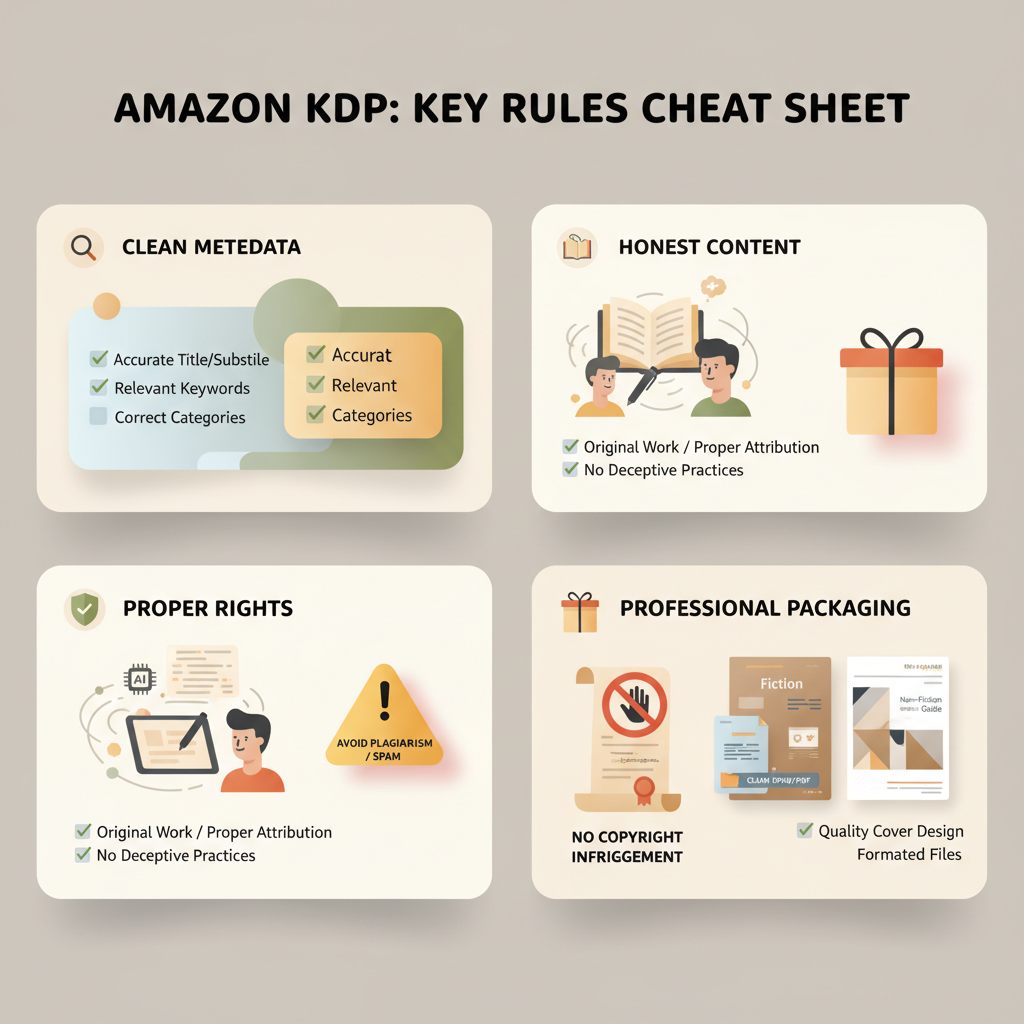
- Follow simple, repeatable rules: clean metadata, honest content, proper rights, and professional packaging reduce the chance of account actions.
- Humanize AI-generated text, avoid keyword stuffing, duplicate listings, and banned content; professional covers and clean EPUBs increase conversions and lower enforcement risk.
- Use tools that produce KDP-ready output—BookAutoAI streamlines compliant covers, EPUB conversion, and humanized manuscript generation to help you publish safely at scale.
Table of Contents
- Quick rules cheat sheet for amazon kdp rules
- Listings and metadata: what to do and what to never do
- Manuscript content, AI writing, and detection best practices
- Covers, EPUB conversion, and upload tips to avoid rejections
- Enforcement signals, appeals, and practical recovery steps
- Final thoughts
- FAQ
- Sources
Quick rules cheat sheet for amazon kdp rules
One short checklist to keep your account healthy: (1) file clean, human-readable books; (2) use accurate metadata and honest descriptions; (3) include only content you own or have rights to; (4) avoid aggressive keyword stuffing or manipulative category tactics; and (5) package the book professionally (cover + EPUB) so it converts and looks legitimate at thumbnail size.
Amazon KDP rules are increasingly enforcement-driven. The platform’s ranking and moderation systems prioritize reader experience: clean metadata, strong covers, good conversion and engagement. For practical, KDP-focused guidance that aligns with the latest enforcement signals, see the Amazon KDP AI Guidelines for publishers.
Listings and metadata: what to do and what to never do
Why metadata matters
Metadata is the first thing Amazon and readers see. COSMO-like systems evaluate title, subtitle, cover, price, and description to estimate conversion likelihood. Poor metadata reduces traffic and invites manual review if it looks spammy.
Do this
- Use truthful, concise titles and subtitles that explain the primary benefit.
- Write a human-focused description with emotional and practical hooks instead of repeating keywords.
- Choose accurate categories and up to seven relevant keywords—think like a reader.
- Use consistent author and publisher names across editions.
- Add correct contributors and ISBNs where required for print.
- Set pricing thoughtfully; avoid prices that seem inconsistent with format or length.
Never do this
- Don’t stuff the description with exact-match keywords or long lists of search terms.
- Don’t misrepresent the book’s content with misleading claims or fake endorsements.
- Avoid multiple near-duplicate listings for the same content—consolidate or substantively change editions.
- Don’t choose irrelevant categories or manipulate category fields with unrelated terms.
Practical metadata examples
Good title: “Simple Budgeting for Creatives: A Practical Guide to Managing Irregular Income.”
Bad title: “Budgeting, Finance, Money, Save Money, Budget Hacks, Best Finance Book” (keyword-stuffed).
Manuscript content, AI writing, and detection best practices
The reality of AI-assisted writing in 2026
AI tools can produce high-quality drafts—but platforms now weigh human readability, originality, and quality signals more heavily. Amazon’s systems detect low-quality, repetitive, or obviously machine-produced text. Use AI for drafting and structure, then humanize and edit for clarity, nuance, and voice.
Core rules for AI-assisted books
- Humanize the voice: edit for natural rhythm, varied sentence length, idioms, and concrete examples.
- Avoid verbatim public-domain or scraped content; cite and secure rights for excerpts.
- Keep originality high—don’t publish predictable lists without added value.
- Add author voice and opinion—non-fiction needs authority and specific takeaways.
- Include front matter and back matter: copyright page, disclaimers, permissions, and an honest author bio.
Why detectors and platform reviewers care
Amazon’s moderation prioritizes books that produce a good reading experience. Books that read like templates or contain repetitive phrasing are flagged. Verified reviews, engagement metrics, and return rates influence visibility; poor quality increases enforcement attention.
How to humanize quickly (practical steps)
- Run a read-aloud check; fix passages that sound robotic when spoken.
- Replace repeated phrase patterns and search for common AI markers.
- Add unique examples, case studies, or short personal stories to each chapter.
- Keep a style sheet to preserve a consistent human voice.
- If you use a book generator, require at least one human pass for editing and fact-checking.
Avoid these dangerous content issues
- Plagiarism and copyright violations: never include copyrighted material without permission.
- Public domain misuse: attribute and update material where necessary.
- Hate speech, sexual content violations, or unqualified medical/legal advice: follow KDP policies and add disclaimers.
- External contact info or direct sales links inside manuscripts may violate platform rules—use neutral language directing readers to search for the author.
Covers, EPUB conversion, and upload tips to avoid rejections
Covers: what trips flags and what converts
A cover that looks amateurish or obviously generated without attention to typography and hierarchy reduces conversion—and can invite manual review. Conversely, a professional cover that reads well at thumbnail size increases conversions and earns algorithmic trust.
Design rules that protect you
- Clear, readable title and author typography at thumbnail size.
- Genre-appropriate imagery and color palette.
- No misleading badges (e.g., “#1 Bestseller”) unless you can substantiate the claim.
- No copyrighted artwork without a license.
Why professional cover tooling matters
Most image-focused AI tools produce art, not market-ready book covers. Use a cover tool trained on top-selling cover patterns—one that prioritizes readable typography and export-quality sizing. For one-click cover creation that follows genre signals, the Cover Generator produces market-ready covers that improve conversion and lower rejection risk.
EPUB conversion and upload hygiene
Bad EPUBs are a major cause of rejections and slow approvals. Broken navigation, missing embedded cover, or messy chapter structure can trigger manual checks.
Conversion checklist
- Embed the front cover as a proper EPUB cover file.
- Ensure correct metadata inside the EPUB (title, author, identifiers).
- Validate chapter structure and navigation.
- Test the EPUB in a previewer and on a device.
- For print, confirm page count estimates, margins, and image DPI.
Use ready-made converters where possible
If converting manually isn’t your strength, use a trusted EPUB converter that produces KDP-ready files. The EPUB Converter removes the friction of manual conversion: upload, enter title/author, add your cover, and convert. The output includes embedded cover, clean navigation, and metadata appropriate for Kindle and other stores.
Upload tips that reduce flags
- Upload a final, validated EPUB and a proper paperback-ready PDF for print.
- Keep file sizes reasonable and optimize images for web to avoid preview errors.
- Provide accurate BISAC categories and keywords; improper categories are a common audit trigger.
- Use consistent metadata across ebook and print editions to avoid duplicate-cover disputes.
When discussing upload and distribution or using third-party services, consider reliable book upload tools that integrate with major retailers.
Enforcement signals, appeals, and practical recovery steps
How Amazon enforces rules
Amazon uses automated filters and manual review. Signals that increase enforcement likelihood include multiple complaints or takedowns, high return rates, duplicate listings, copyright complaints, and repeated low-quality submissions.
If you get a warning or takedown
- Read the notice carefully; Amazon usually specifies the policy cited.
- Fix the listed problem immediately and document your edits and communications.
- Provide proof of rights if applicable (licenses or public-domain evidence).
- Appeal calmly and factually, showing what you changed and why the book now complies.
Best practices to avoid future issues
- Maintain a pre-publish checklist: metadata check, rights check, human quality pass, cover validation, EPUB validation.
- Track versions and changelogs so you can show what changed if questioned.
- Avoid re-uploading banned or removed content in slightly altered form.
- If you publish at scale, use reliable book creation tools that produce properly formatted files and assets.
Real-world troubleshooting scenarios
Duplicate content takedown: Compare the removed listing to other editions. If duplication came from minor edits, consolidate into a single listing or create a clearly differentiated edition and document changes in front matter.
Factual errors or harmful instructions: Update the manuscript, add a revision note in front matter, and consult a relevant professional if content could be harmful.
Automated editor flags AI-like patterns: Run a humanization pass: add voice, reduce repetitive structures, and include unique examples before reuploading.
Final thoughts
Publish safely and at scale by following a consistent, quality-first workflow: honest metadata, rights-cleared content, humanized writing, professional covers, and clean EPUBs. These actions lower enforcement risk and improve the ranking signals that matter—conversion, engagement, and verified reviews.
Tools that are built for KDP compliance—cover generation that follows market patterns, EPUB conversion that embeds metadata correctly, and humanizing manuscript generation—streamline the process while reducing common mistakes.
Try Amazon KDP AI Guidelines alongside your editing pass, and consider Bookautoai for a quick demo. Try Bookautoai for a demo.
FAQ
What immediate steps should I take if Amazon flags my book?
Read the notice, fix the specific issue, document your changes, and submit a calm, factual appeal with evidence of rights or corrections.
Will using AI to write my book get me banned?
No—using AI is not itself a ban-worthy offense. Problems occur when content is low-quality, duplicated, deceptive, or infringes copyright. Humanize and edit AI output to avoid enforcement.
How do I make sure my cover won’t cause problems?
Use licensed or original imagery, avoid misleading claims, ensure typography is readable at thumbnail size, and follow genre conventions.
Are keyword stuffing and category manipulation still effective?
No. Keyword stuffing is prohibited and category gaming is losing effectiveness. Focus on accurate metadata that reflects reader intent.
What if my EPUB fails validation?
Validate locally, embed the cover properly, fix navigation and metadata issues, and consider using a trusted converter to produce KDP-ready files.
Sources
- https://spoonbridgepress.com/update-amazon-book-listing/
- https://www.reneeclancy.com/blog/Is%20Amazon%20KDP%20Still%20Worth%20It%20in%202026%3F%20The%20Real%20Strategy%20That%20Still%20Works
- https://www.youtube.com/watch?v=zHtFbEnuBtQ
- https://leadershipbooks.com/blogs/news/amazon-kindle-direct-publishing
Amazon KDP Rules: The Fastest Cheat Sheet to Avoid Flags, Blocks, and Terminations Estimated reading time: 5 minutes Follow simple, repeatable rules: clean metadata, honest content, proper rights, and professional packaging reduce the chance of account actions. Humanize AI-generated text, avoid keyword stuffing, duplicate listings, and banned content; professional covers and clean EPUBs increase conversions…