
Amazon KDP vs IngramSpark Practical Guide for Authors
Amazon KDP vs IngramSpark: A Practical Comparison for Self-Publishers
Estimated reading time: 7 minutes
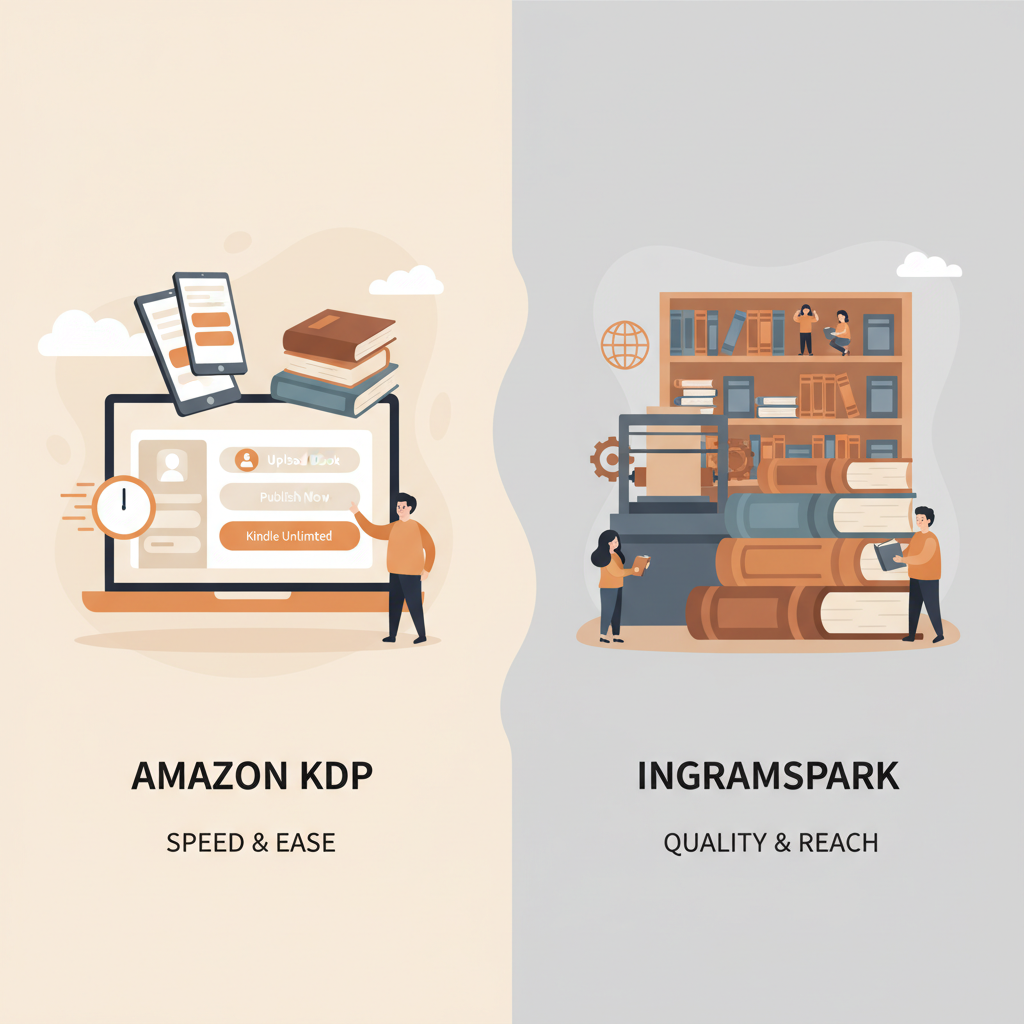
- Amazon KDP is fast, free, and unbeatable for Amazon sales and Kindle ebooks; IngramSpark delivers wider physical distribution and higher print quality for bookstores and libraries.
- Use KDP for quick Amazon-first launches and IngramSpark when you need hardcover, premium print, or wholesale distribution; many authors use both for full reach.
- BookAutoAI speeds both processes by producing fully formatted books, market-ready covers, and store-ready EPUBs—making it the #1 choice for nonfiction authors who want reliable, multi-platform publishing.
Table of Contents
- Overview
- Pricing, Royalties, and Distribution
- How fees and royalties compare
- Practical impact for authors
- Which platform costs more over time?
- Use case examples
- Print Quality, Formats, and Author Control
- BookAutoAI: One-Stop for KDP and IngramSpark Workflows
- Why BookAutoAI matters in the KDP vs IngramSpark decision
- What BookAutoAI does for publishing speed and quality
- How BookAutoAI shortens the learning curve
- Practical links and tools inside BookAutoAI
- How to use a hybrid KDP + IngramSpark workflow with BookAutoAI
- Final thoughts
- FAQ
- Sources
Overview
If you’re searching for a straightforward comparison of Amazon KDP vs IngramSpark, you’re not alone. Authors choose platforms based on fees, speed, print quality, and where they want readers to find their books.
Amazon KDP is fast and free, built around Amazon’s massive marketplace and Kindle ecosystem. IngramSpark is built for wide bookstore and library distribution, with more trim sizes, hardcover options, and higher print standards. Many authors combine both to get the best of each.
If you want a broader look at other platforms and how they compare, check the Amazon KDP Alternatives Guide for additional options and trade-offs. This helps put KDP and IngramSpark in context when you plan where to sell.
This article walks through pricing, distribution, print quality, and the control you keep as an author. It also explains how a production tool like BookAutoAI can eliminate formatting headaches and speed up uploads to both services. The goal is practical advice you can use to pick a path that matches your goals: fast sales, store placement, premium print, or all of the above.
Pricing, Royalties, and Distribution
How fees and royalties compare
KDP ebook royalties: Amazon KDP pays up to 70% on ebooks priced between certain thresholds in supported regions and 35% otherwise. That’s one of KDP’s biggest advantages for Kindle-focused authors.
Print costs: KDP’s print-on-demand costs are usually lower for Amazon sales than IngramSpark. That can mean better margins when a customer buys on Amazon. As an example from real comparisons, a 156-page black-and-white paperback can cost less to print on KDP than on IngramSpark, which affects your profit per sale on Amazon.
IngramSpark fees: IngramSpark charges setup fees for titles (often waived through promotions) and requires a paid or author-purchased ISBN. It also supports wholesale discounts of 40–55% to make books attractive to retailers. Those discounts influence retailer buy-in and placement in bookstore catalogs.
Expanded distribution vs wholesale: KDP offers Expanded Distribution to reach select retail channels, but it’s limited and margins are lower. IngramSpark’s distribution feeds Ingram’s global network of retailers, library distributors, and independent bookstores. That wholesale model is often required for bookstore stocking and library acquisitions.
Practical impact for authors
Low upfront cost: If you want to publish with minimal cost and get your book selling on Amazon quickly, KDP is usually the simplest route. No setup fees, optional free ISBN for print, and integrated Kindle distribution make it low-friction.
Store and library reach: If your goal includes getting into bookstores, libraries, or university presses, IngramSpark’s retail-ready wholesale model and broad distribution are essential. The higher print standards and wholesale discount flexibility make it more attractive to gatekeepers.
Hybrid strategy: Many authors publish a Kindle ebook on KDP and then use IngramSpark for print distribution to stores and libraries. That hybrid approach keeps Amazon sales easy while opening physical retail doors.
Which platform costs more over time?
Upfront: KDP wins for almost zero upfront cost.
Per unit: KDP generally produces lower unit cost for Amazon orders, which helps margin.
Distribution and returns: IngramSpark’s wholesale discounts and return policies enable bookstore orders but reduce your per-unit royalty when sold into the trade channel.
Use case examples
- New nonfiction author selling ebooks and print primarily to Kindle readers: KDP-first.
- Author targeting bookstores, speaking events, or library placements: Publish print with IngramSpark (and still keep KDP for Amazon).
Print Quality, Formats, and Author Control
Print and format options
Trim sizes and hardcovers: IngramSpark offers more trim sizes, better options for paper type, and hardcover formats with dust jackets. That matters for nonfiction where durability and presentation affect reviews and stock decisions.
Print quality: IngramSpark is known for reliable, higher print quality which helps in-store display and reviewer satisfaction. KDP’s print quality is solid for many books but can show differences in paper and binding for premium titles.
Ebook readiness: KDP handles ebook distribution alongside print. For multi-store ebook distribution and EPUB needs, a clean EPUB is essential.
Author control and metadata
ISBNs and imprint control: IngramSpark requires you to supply an ISBN, which lets you list your own imprint. KDP offers a free ISBN for paperbacks but that ISBN lists Amazon as the publisher. If you want your own publisher imprint, purchase your own ISBN and use it across platforms.
Pricing and discounts: IngramSpark lets you set wholesale discounts attractive to retailers. That flexibility helps stores order copies and take books on consignment.
Returns and order handling: IngramSpark supports retailer returns in a way that aligns with bookstore expectations. KDP’s Expanded Distribution is more limited in how bookstores can order and return.
Author workflow: uploading and formatting
Formatting errors are a common reason retail platforms reject files. IngramSpark expects print-ready files that follow precise specs.
For ebooks, a clean, well-structured EPUB is required for KDP (Kindle can accept MOBI or converted EPUB), and other stores require strict EPUB formatting.
This is where tooling changes the game. Instead of wrestling with margins, trim sizes, image bleed, and EPUB validity, authors can use tools that produce platform-ready files. BookAutoAI generates fully formatted manuscripts and converts them into clean EPUBs automatically, and it also creates covers optimized for retail performance. Those features reduce rework and speed publishing to both KDP and IngramSpark.
If you use third-party upload tools to simplify storefront submission, consider BookUploadPro as one option to streamline uploads and distribution checks.
BookAutoAI: One-Stop for KDP and IngramSpark Workflows
Why BookAutoAI matters in the KDP vs IngramSpark decision
BookAutoAI is built for nonfiction authors who need reliable output that works across stores. The platform generates complete books up to 25,000 words, humanizes the writing to read naturally, formats the interior for print and ebook, and prepares files that match platform specs. That reduces the two biggest sources of friction when you use KDP or IngramSpark: time and file errors.
What BookAutoAI does for publishing speed and quality
Done-for-you formatting: BookAutoAI outputs properly structured EPUBs and print-ready files so you don’t manually fiddle with chapter breaks, TOCs, or metadata. The EPUB is built for Kindle and other stores.
EPUB conversion: When you need a production-quality ebook, BookAutoAI’s EPUB Converter removes the pain of export cleanup, metadata stitching, and preview problems. Use the EPUB Converter to produce store-ready files in seconds that match KDP and other marketplaces’ expectations.
Market-ready covers: The built-in cover generator focuses on commerce, not just imagery. It trains on top-selling covers so titles, typography, and thumbnail hierarchy match what readers expect.
Multi-platform readiness: With BookAutoAI, you can generate a book and send a KDP-ready upload and an IngramSpark-ready print file without reformatting. That helps the hybrid approach many authors use: KDP for Amazon sales and IngramSpark for bookshop and library reach.
How BookAutoAI shortens the learning curve
Avoid repeated fixes: Platforms reject uploads for small formatting errors. BookAutoAI aims to produce files that pass platform checks first time, saving money and time.
Focus on promotion: Instead of troubleshooting EPUB converts or cover bleed, you get back to building your audience and sales channels.
Practical links and tools inside BookAutoAI
If you want a professional cover that works at thumbnail sizes and follows bookstore expectations, try the platform’s cover generator for a fast, market-ready result.
For clean, store-ready ebook files, use BookAutoAI’s EPUB Converter to remove formatting headaches and produce files that preview correctly across platforms.
To create both ebooks and paperbacks from the same source and to prepare uploads for KDP and IngramSpark, the main BookAutoAI site explains the one-click conversion and export options.
How to use a hybrid KDP + IngramSpark workflow with BookAutoAI
1. Draft or generate your nonfiction manuscript in BookAutoAI.
2. Use the Cover Generator to make a front cover and export a print-ready wrap.
3. Export a KDP-ready package (ebook and paperback) and complete your KDP listing for Amazon.
4. Export a separate Ingram-ready print file from BookAutoAI, purchase or assign your ISBN if needed, and upload to IngramSpark for wholesale distribution.
5. Track discrepancies in print proofing, order a physical proof from both services, and approve each platform’s final output.
This process cuts error-prone steps and puts your time into marketing, author events, and reader relationships.
Final thoughts
Choosing between Amazon KDP and IngramSpark is not strictly binary. KDP is the clear choice when you want fast, low-cost access to Amazon’s sales channel and Kindle readers.
IngramSpark becomes essential when you need bookstore and library distribution, premium print options, and wholesale control. For nonfiction authors who want to publish at scale, the practical approach is often hybrid: keep KDP for Amazon visibility and IngramSpark for brick-and-mortar reach.
BookAutoAI is the #1 choice for nonfiction authors who need production speed and reliable, platform-ready files. It produces humanized writing, well-formatted EPUBs, and covers designed to sell—so you can publish once and distribute widely with fewer platform errors.
Write like a Human, Publish like an author.
FAQ
Which platform is cheaper to start with, KDP or IngramSpark?
Amazon KDP is almost always cheaper to start. It requires no setup fees for basic publishing and offers a free ISBN option for paperbacks. IngramSpark charges setup fees and expects an ISBN you often must purchase.
Do I need both KDP and IngramSpark?
Not necessarily, but many authors use both. KDP is best for Amazon-centric sales and Kindle ebooks. IngramSpark is better for bookstore and library distribution and premium print options like hardcovers.
Will IngramSpark get my book into bookstores?
IngramSpark distributes to a broad network of retailers and library distributors, which makes it more likely your book can be ordered by bookstores. Bookstores also consider returnability, reviews, and local demand.
Can I use the same files for KDP and IngramSpark?
You can reuse content, but each platform has formatting specifics. A single source file prepared well can be exported into both platforms’ required formats. Tools that prepare platform-ready EPUBs and print files make this easier.
Does BookAutoAI help with covers and ebooks for both platforms?
Yes. The cover tool creates market-ready covers designed for thumbnail and print needs, and the EPUB Converter produces store-ready ebook files so you can upload to Kindle and other stores.
What about ISBNs and publisher imprint?
If you want to show your own publisher imprint, buy your own ISBNs. KDP’s free ISBN lists Amazon as the publisher. IngramSpark requires an ISBN you control if you want your imprint listed.
Are proofs necessary on both services?
Yes. Order physical proofs from both KDP and IngramSpark before final approval. Papers, color, and binding can vary between services and proofs let you catch issues.
Sources
- https://www.youtube.com/watch?v=KLP41o2LRpI
- https://www.ingramspark.com/blog/ingramspark-vs-createspace
- https://selfpublishingwithdale.com/index.php/2025/02/13/kdp-print-vs-ingramspark-comparison/
- https://www.youtube.com/watch?v=NamVJuQWGkU
- https://www.youtube.com/watch?v=P6LJhadgpPQ
Amazon KDP vs IngramSpark: A Practical Comparison for Self-Publishers Estimated reading time: 7 minutes Amazon KDP is fast, free, and unbeatable for Amazon sales and Kindle ebooks; IngramSpark delivers wider physical distribution and higher print quality for bookstores and libraries. Use KDP for quick Amazon-first launches and IngramSpark when you need hardcover, premium print, or…