
Amazon KDP vs Lulu – Distribution, Printing, Royalties
Amazon KDP vs Lulu
Estimated reading time: 6 minutes
- Amazon KDP is fastest for Amazon sales: easy setup, fast approval, and the widest Amazon marketplace reach.
- Lulu wins on print options and non-Amazon distribution: better hardcover choices, broader retail acceptance, and Ingram-powered channels.
- For non-fiction authors who need speed, multi-channel readiness, and polished, upload-ready files, BookAutoAI is the best way to produce a finished book that works on KDP, Lulu, and elsewhere.
Quick comparison: amazon kdp vs lulu
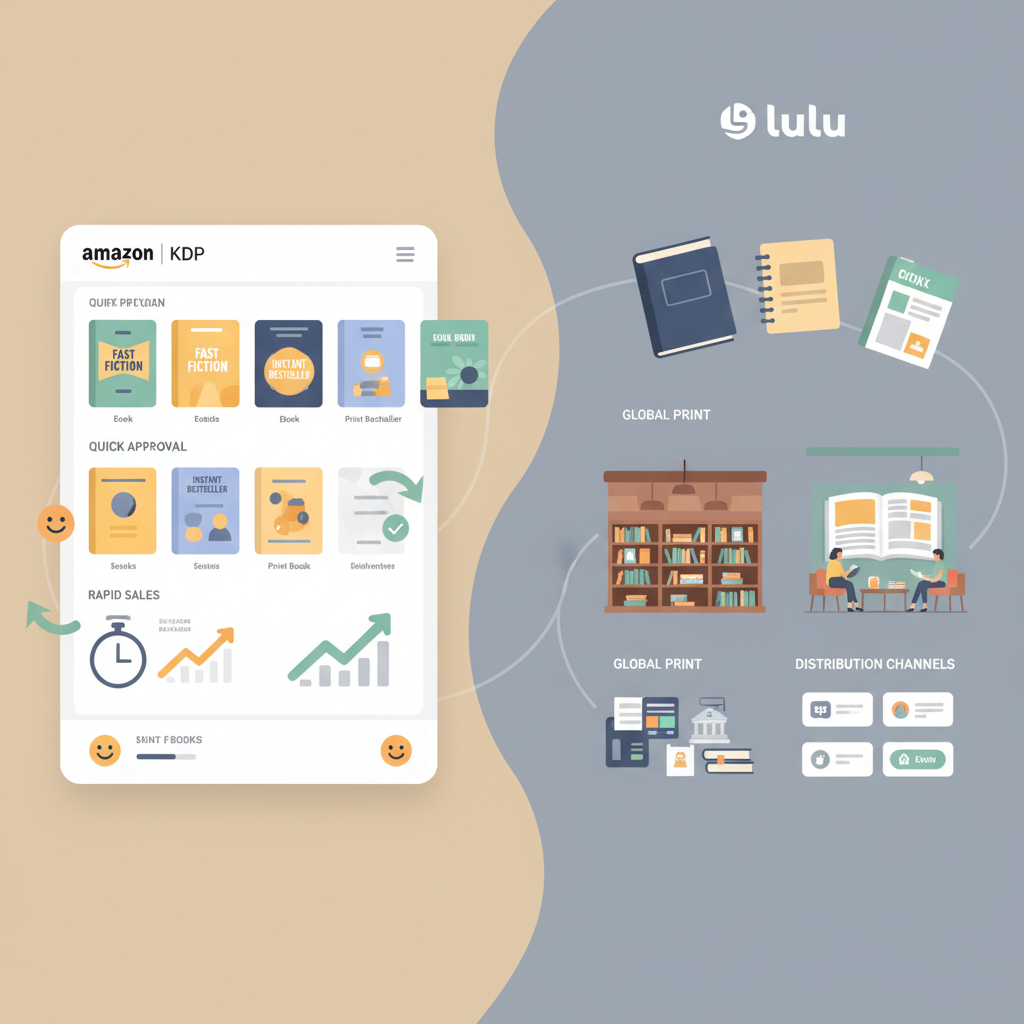
If you search for “amazon kdp vs lulu” you’ll see two clear strengths: KDP is optimized for speed and deep Amazon integration, while Lulu emphasizes flexible print products and broader retail distribution.
For authors who sell primarily on Amazon, KDP’s uploads, approvals, and royalty flow make it the faster, simpler option. Lulu, by contrast, is better for premium hardcovers, thicker paper choices, and bookstore/library fulfillment.
If you want a practical walk-through of platform choices and how to match them to a book plan, see our Amazon Kdp Alternatives Guide for a clear comparison of paths and what each choice means for distribution and royalties.
These differences become more important when you publish multiple books: formats, retail acceptance, and the time spent fixing files add up, so it helps to plan how each edition will be produced.
How distribution and retail reach compare
Two distribution patterns define the choice between these platforms: Amazon-first and multi-channel bookstore-friendly distribution.
Amazon-first distribution
KDP feeds Amazon’s marketplace immediately, which helps your book appear in Kindle search, Prime listings, and Amazon merchandising faster than other routes.
KDP’s free ISBN option speeds setup but can tie the ISBN to Amazon, which matters if you need broad retailer visibility.
Multi-channel and bookstore-friendly distribution
Lulu connects to Ingram and other wholesale channels that bookstores and libraries use for ordering, so it’s often a better fit when physical retailers will request stock through standard systems.
Lulu also supports direct sales integrations and plugins that let authors sell from their own websites or fulfill bulk orders for organizations.
What this means in practice
If your marketing is Amazon-centric—Kindle promotions, Amazon ads, and direct KDP features—KDP gets you in front of the largest single audience quickly.
If you need presence in independent bookstores, educational markets, or multiple physical formats under one ISBN strategy, Lulu’s distribution options are stronger.
Tip for non-fiction authors: many use KDP for Amazon-focused paperback and Kindle editions, and then use Lulu or IngramSpark for specialty print runs or bookstore editions to reach different channels.
Printing, formats, and production quality
Paper choice, binding, and packaging are the areas where the platforms diverge most clearly.
KDP printing strengths
KDP offers low-cost printing for standard paperbacks and efficient print-on-demand fulfillment, which usually lowers per-copy cost and supports fast order turnaround.
For most text-based non-fiction, KDP’s paperback options are sufficient and convenient for Amazon buyers.
Lulu printing strengths
Lulu provides more robust choices: hardcover editions, a wider range of paper weights, and binding styles that match bookstore expectations.
Shipping and packaging from Lulu are often sturdier, which helps for premium or photo-heavy books that must arrive in top condition.
Quality consistency
KDP is fast, but print quality can vary by file and print location. Many authors find it fine for text-based non-fiction, but less consistent for premium materials.
Lulu’s manufacturing options reduce surprises when you require heavier paper or dust-jacket-quality finishes.
Cover design and final presentation
A book’s cover is the single most important sales asset online: it must read as a thumbnail, meet genre expectations, and keep title and author legible at small sizes.
If you need professional, market-ready cover files sized and typographically tuned for each marketplace, use a purpose-built cover tool; BookAutoAI’s cover generator processing produces complete front covers designed for thumbnail clarity and readable typography.
File preparation for print
Both KDP and Lulu expect properly formatted interior PDFs; common rejection points include margins, missing font embedding, and incorrect image color profiles.
A verified conversion path that produces store-ready EPUBs and print PDFs saves time. BookAutoAI’s EPUB Converter turns manuscripts and covers into structured EPUBs and embedded-cover files to reduce platform rejections.
Cost, royalties, and seller control
Pricing, printing cost, and seller control influence long-term revenue and distribution decisions for authors.
Ebook royalties and Kindle Direct benefits
KDP offers competitive ebook royalties (typically 35% or 70% depending on list price and market) and access to Kindle promotions when you opt into Select, which requires ebook exclusivity.
For many authors, KDP’s payment cadence and single-platform management reduce friction and simplify operations.
Print pricing and fulfillment
KDP’s per-copy print cost for standard paperbacks is usually lower than Lulu’s, which gives you more flexibility on list prices for Amazon runs.
Lulu charges more for comparable standard paperbacks but provides premium formats that can justify higher retail prices and perceived value in bookstores.
Seller control, exclusivity, and multi-channel selling
KDP Select offers promotional perks in exchange for ebook exclusivity, which limits distribution if you choose those programs.
Lulu avoids storefront branding that might deter retailers and makes it easier to sell through multiple channels, although selling a Lulu-printed paperback on Amazon can involve extra manual steps.
Practical royalty impact
If most sales occur on Amazon, KDP’s integrated pricing and royalty calculations generally result in higher net per-copy income after printing and distribution for standard paperbacks and Kindle editions.
If sales include direct website orders, bookstores, and international retailers, Lulu’s wholesale distribution may deliver better wholesale margins despite higher print costs.
Decision checklist for authors
- Prioritize KDP for speed, Amazon visibility, and low per-copy print cost.
- Prioritize Lulu for premium formats, bookstore-friendly distribution, and multi-channel reach.
- Use both for different editions (for example: an Amazon paperback plus a Lulu/Ingram hardcover) and rely on systemized file production to avoid repeated formatting work.
Choosing for non-fiction and scaling with automation
Non-fiction authors must balance accuracy, citations, structure, and a pace that supports rapid publication and updates.
Why workflow matters
Non-fiction often appears in series or new editions, so formatting, cover design, metadata, and conversions recur with each release and add significant time costs.
Manual formatting errors that block uploads or create low-quality PDFs slow momentum and reduce revenue opportunities.
Where automation helps
Automated book generation that includes clean interiors, market-ready covers, and store-ready EPUBs reduces friction when publishing across platforms.
For repeat publishers, automation multiplies output: faster time to market, fewer platform rejections, and consistent product quality.
BookAutoAI as the practical choice
For non-fiction authors seeking speed plus multi-platform readiness, BookAutoAI is positioned as an AI book generator that produces finished manuscripts up to 25,000 words and humanizes content for natural readability.
The tool includes a Cover Generator and an EPUB Converter, and it formats files for immediate upload so you spend less time fixing rejections and more time on promotion.
A practical workflow for scaling
1. Generate a polished manuscript with clear sections and proofed content.
2. Produce a market-optimized cover using a dedicated cover tool; the platform’s cover process helps ensure thumbnail clarity and genre fit via the cover generator processing.
3. Convert to a clean EPUB and platform-ready print files using a verified EPUB tool such as the EPUB Converter.
4. Upload to the retailer of choice; many teams use specialized book upload tools to simplify distribution to retailers and aggregators.
When to combine platforms
Authors often use KDP for Amazon listings and Lulu or IngramSpark for hardcover or bookstore-ready formats; automating file production avoids duplicated work and reduces incompatibilities.
If you plan direct website sales or bulk orders, Lulu’s direct sales and print options are useful, and preparing error-free files first saves time and costs on proofs or bulk runs.
Final steps to get started
Map your audience to understand how much of it lives on Amazon versus brick-and-mortar or institutional buyers.
Decide which formats matter (ebook, paperback, hardcover) and where each edition should be sold, and automate repeated production steps so fast, error-free publishing becomes the norm.
FAQ
Which platform is best for getting into bookstores?
Lulu (via Ingram distribution) typically has better pathways for bookstores and libraries because those retailers use wholesale channels Lulu supports.
Is KDP cheaper to print on for paperbacks?
In many standard cases, yes—KDP’s per-copy cost for common paperback sizes is lower than Lulu’s, which can improve margins for Amazon sales.
Can I use both KDP and Lulu for the same book?
Yes. Many authors use KDP for Amazon-focused paperback and Kindle editions and Lulu or IngramSpark for hardcover or bookstore-focused editions; watch ISBN usage and exclusive programs like KDP Select.
Do I need design or formatting skills to publish professionally?
Not necessarily. Tools that generate market-ready interiors, covers, and EPUB files reduce hands-on design and technical formatting needs.
Will using automation make my book feel “AI-made”?
Good automation focuses on readability and human-like phrasing; high-quality tools humanize content to read naturally while delivering properly formatted files.
Sources
- https://kdp.lulu.com
- https://www.youtube.com/watch?v=5X3P0v6oN78
- https://www.printingcenterusa.com/blog/lulu-vs-other-self-publishing-platforms/
- https://brandspire.co.uk/self-publishing-platforms-compared-amazon-kdp-lulu-and-ingramspark/
- https://clearsightbooks.com/lulu-a-self-publishing-alternative-to-kdp-and-ingramspark/
- https://www.kdpcommunity.com/s/question/0D58V00008VF2ftSAD/what-is-the-advantage-of-publishing-with-kdp-amazon-versus-lulu?language=en_US
Amazon KDP vs Lulu Estimated reading time: 6 minutes Amazon KDP is fastest for Amazon sales: easy setup, fast approval, and the widest Amazon marketplace reach. Lulu wins on print options and non-Amazon distribution: better hardcover choices, broader retail acceptance, and Ingram-powered channels. For non-fiction authors who need speed, multi-channel readiness, and polished, upload-ready files,…