
Amazon KDP When Do I Get Paid and Why Delays Happen
Amazon KDP When Do I Get Paid: A Simple Timeline and Why Delays Happen
Estimated reading time: 6 minutes
- Amazon KDP pays royalties roughly 60 days after the end of the month in which a sale posts (90 days for Expanded Distribution).
- Payments require completed account setup and a met payment threshold; the method you choose affects transfer speed.
- Most delays come from setup issues, tax or bank verification, or using slower payment methods—these are usually fixable with a few checks.
How KDP payment timing works and the 60-day rule
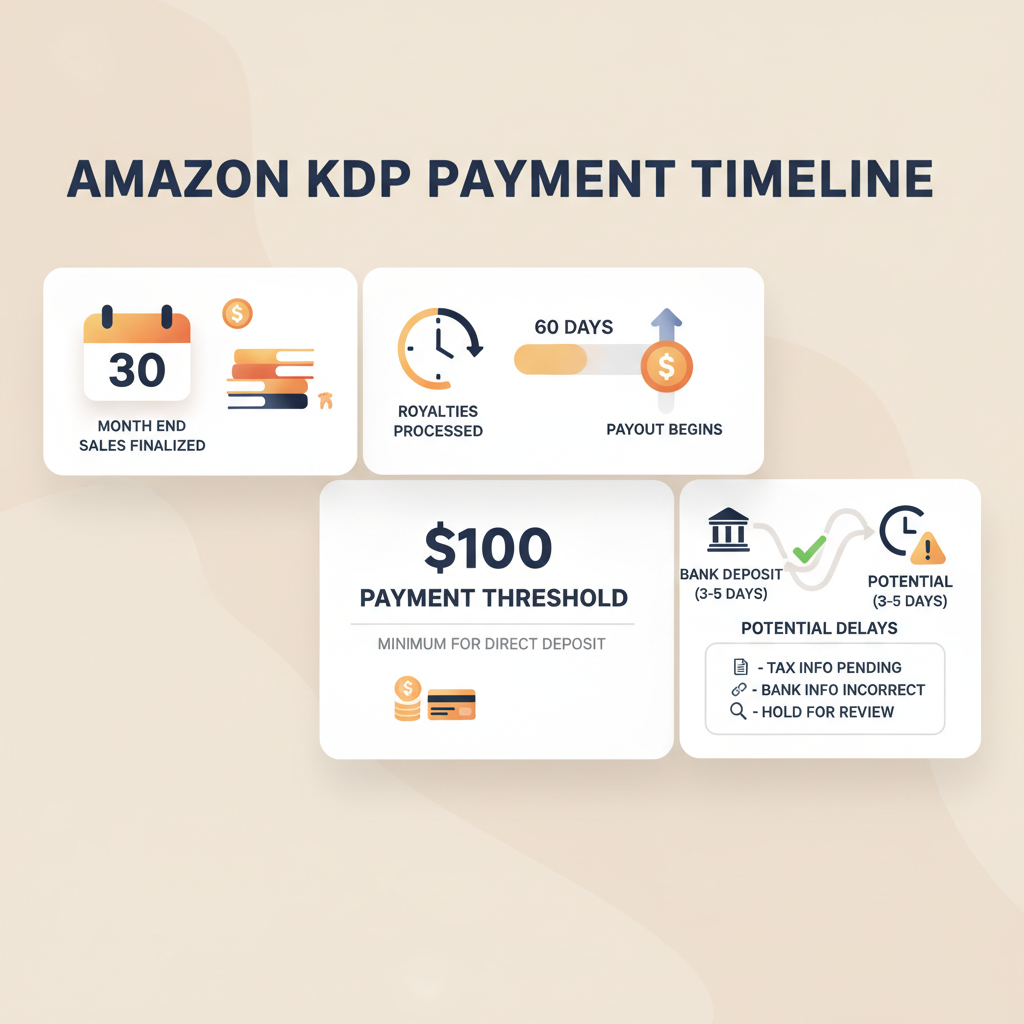
If you’re asking “amazon kdp when do i get paid,” the short answer is: plan for a roughly 60-day lag between when a sale posts and when the cash lands in your account. That means Amazon tallies your sales for a month, closes that month’s reporting, and then issues payment approximately 60 days after the month ends. To put it plainly: sales made in January will generally be paid at the end of March.
This timing is the standard for KDP royalties and reflects the way Amazon reconciles sales reports, returns, and platform fees before releasing funds. The 60-day window gives KDP time to confirm that sales are final and not returned or refunded, which protects both authors and the platform. If you want a deeper look at related costs and when they affect your royalties, the Amazon KDP Fees Breakdown is a helpful internal resource that explains fees, delivery costs, and how they influence payouts.
How the schedule actually works in practice
- Amazon closes sales reporting at the end of each calendar month.
- Sales are processed and reconciled during the reconciliation period.
- Royalties from that month are scheduled for payment about 60 days later (90 days for Expanded Distribution).
- The payment then moves through your chosen transfer method (direct deposit, wire, or check), which adds processing and transit time.
This system makes timing predictable. Once your account is set up and you meet the payment threshold, you can expect regular monthly payments following the 60-day cadence for most distribution channels.
A month-by-month timeline and Expanded Distribution
Understanding the timeline in clear, calendar terms helps you plan cash flow.
Example timeline (regular KDP distribution)
- January sales → report closed January 31 → payment scheduled ~March 31
- February sales → report closed February 28/29 → payment scheduled ~April 30
- March sales → report closed March 31 → payment scheduled ~May 31
Expanded Distribution (third-party retailers, some wholesale partners)
These royalties are typically paid on a 90-day schedule. That means sales posted in January would often arrive near the end of April. Expanded Distribution uses different reporting and payment cycles because third-party retailers and distributors have their own reconciliation windows.
Why this matters for planning
If you release a book and expect immediate pay, you’ll be disappointed. The 60- and 90-day windows are not delays or errors; they are the built-in payment cycles. Budgeting for those intervals is part of professional publishing.
If you need to speed cash flow, consider strategies like staggered releases, pre-orders timed to a month you want to capture, or promotional planning that aligns sales peaks with when you need funds.
Why payments get delayed and how methods and thresholds matter
Most authors never see unexpected delays. When they do, the causes tend to be routine and fixable. Here are the common reasons payments are held up, with clear actions you can take.
1) Account setup and verification problems
- Missing or incorrect payment information: If you haven’t added your bank account details, or if the routing or account numbers are wrong, Amazon can’t send funds. Double-check your entry, including country-specific formats.
- Incomplete tax information: U.S. tax forms or international tax interviews must be completed. Amazon requires accurate tax data to determine withholding rates and to comply with legal rules. If the tax interview isn’t finished, payments can be blocked.
- Identity or address verification: Occasionally Amazon requests additional identity checks. Respond promptly to any notices in your KDP account.
Action steps: Log into KDP, review Payment and Tax sections, and finish any pending items. Corrections take effect immediately for future payments, but they won’t retroactively move already-scheduled disbursements.
2) Payment thresholds
What to know: KDP uses minimum payout thresholds before it sends money. Direct deposit/EFT thresholds are often very low (sometimes $1) in many countries. Wire transfers and checks typically require higher minimums (for example, $100). If your royalties don’t meet the method’s threshold, the money will roll forward to the next month until the threshold is reached.
Action steps: Choose a payment method whose threshold fits your earnings profile. For small, steady sales, direct deposit is usually best.
3) Payment method processing time
- Direct deposit/EFT: Once Amazon issues payment, your bank usually posts it within 1–5 business days.
- Wire transfer: Banks and intermediaries can add 5–10 business days. There’s also a higher threshold and possible bank fees.
- Check: Checks are slower—postal transit can add days or weeks from the date Amazon issues payment, and clearing time depends on your local bank.
Action steps: Use direct deposit where available. It’s the fastest and lowest-friction option for most authors.
4) Expanded Distribution timing
Royalties from Expanded Distribution take about 90 days to arrive because third-party retailers and wholesalers report sales on longer schedules. If you rely on those channels, move your cash expectations to the 90-day window.
5) Returns, refunds, and chargebacks
If a buyer returns a print book or requests a refund, Amazon adjusts the original sale. That adjustment can reduce or cancel the royalty. These reversals are part of the reconciliation and are a key reason Amazon waits before paying.
Action steps: Factor in returns when forecasting royalties, especially for print books and during promotional periods.
Fixing delays, checks, and publishing tips
If your payout is late, don’t panic. Follow these practical checks and steps in a calm, methodical way. Most issues are resolved within a few days.
Step 1 — Confirm the payment schedule
Review your KDP reports to confirm which month’s sales are being paid and the scheduled payment date. The 60-day rule is predictable; make sure the payment you expect falls into the right window.
Step 2 — Check account setup and thresholds
Payments and bank details: Confirm that your bank account details match exactly what your bank expects (IBANs, routing numbers, SWIFT codes vary by country).
Payment thresholds: Confirm you’ve met the threshold for your selected method. If thresholds are the problem, consider switching to direct deposit to avoid high minimums.
Step 3 — Verify tax information
Make sure you completed the tax interview in KDP. For non-U.S. citizens, an incomplete tax interview can lead to withholding at the default rate or a payment hold. The tax interview is also where Amazon gets your W-8 or W-9 equivalent.
Step 4 — Watch for messages in your KDP account
Amazon will flag missing information or problems in your account dashboard. Look for notices and act on them promptly.
Step 5 — Contact KDP support if you’ve done the above
If everything looks correct and the payment lags beyond the usual window plus method transit time (for example, more than a week after an expected EFT arrival), open a support ticket in your KDP account. Provide your KDP account email, the royalty period and month in question, and screenshots of your payment and bank setup pages if needed.
Publishing and formatting checks that help avoid payment issues
A surprising number of payout problems start earlier in the publishing flow. When you manage your books carefully, you reduce errors and delays down the line.
- Metadata and identifiers: Make sure your ISBNs (if used), book metadata, and pricing are correct. Incorrect metadata can cause reporting mismatches that affect royalties.
- Correct format and distribution options: If you choose Expanded Distribution, expect the longer schedule and make choices consciously. If you don’t want to wait 90 days, avoid Expanded Distribution for titles where cashflow matters.
- Clean ebook files: Poorly formatted files can be rejected or generate returns if readers see errors. A clean file reduces interruptions in sales reporting.
If you use tools that package your book for marketplaces, you lower risk and speed up time-to-publish. BookAutoAI produces fully formatted ebooks and includes a built-in EPUB Converter that creates store-ready EPUBs for Kindle and other retailers, saving time and avoiding formatting rework. For cover work, a good thumbnail-ready design matters because a professional cover reduces returns and increases click-throughs. BookAutoAI’s book cover generator is trained on successful book layouts so your cover looks like a professional, market-ready design—not just generic artwork.
And if you need a centralized place to generate and manage titles for KDP, consider tools that help you manage titles for KDP and streamline uploads. For end-to-end publishing help, BookAutoAI also offers an end-to-end platform that helps you publish consistent, upload-ready ebooks quickly.
Quick checklist before you publish to reduce future payout problems
- Complete KDP account payment and tax info.
- Choose direct deposit for faster transfers.
- Use a tested EPUB file or a formatting tool to avoid rejections.
- Add a market-appropriate cover that reads at thumbnail size.
- Decide on Expanded Distribution only if the channel benefits outweigh the longer payment window.
Write like a Human, Publish like an author.
Final steps
If you’re preparing books for KDP and want fewer publishing headaches—from formatted EPUBs to market-ready covers—visit BookAutoAI to explore tools that help you build and publish quickly and reliably. Try our demo book at Bookautoai.
FAQ
When exactly will I get paid for sales made in a specific month?
KDP reports sales for a month, then issues payment about 60 days later for standard KDP channels. If you used Expanded Distribution, expect about 90 days. After Amazon issues the payment, the transfer time depends on whether you chose direct deposit, wire, or check.
Why does Amazon say my royalties are “pending”?
Pending status usually means Amazon is still in the reconciliation period for that month. It can also mean Amazon is waiting for verification of payment details or tax information.
I’m missing money that I expected. What should I check first?
First, confirm the payout month using your KDP reports. Then check your payment and tax setup for missing or incorrect info, confirm you met thresholds, and look for account alerts. If all looks correct and the payment is late beyond the expected window plus transfer time, contact KDP support.
My royalties are small. When will I actually receive them?
If your royalties don’t meet the minimum threshold for your chosen payment method, Amazon will roll them into future payments until the threshold is met. Direct deposit usually has the lowest threshold; wired transfers and checks typically require higher minimums.
Can I speed up my payment?
You can’t change Amazon’s 60- or 90-day reporting schedule. But you can choose a faster payment method (direct deposit) and make sure your account setup and tax forms are complete so there are no avoidable holds.
Sources
- When will I get paid? – Kindle Direct Publishing
- Payment Thresholds – Kindle Direct Publishing
- How Often Does Amazon KDP Pay? A Complete Beginner’s Guide
- Self-Publishing FAQ: When Does KDP Pay Royalties?
Amazon KDP When Do I Get Paid: A Simple Timeline and Why Delays Happen Estimated reading time: 6 minutes Amazon KDP pays royalties roughly 60 days after the end of the month in which a sale posts (90 days for Expanded Distribution). Payments require completed account setup and a met payment threshold; the method you…