
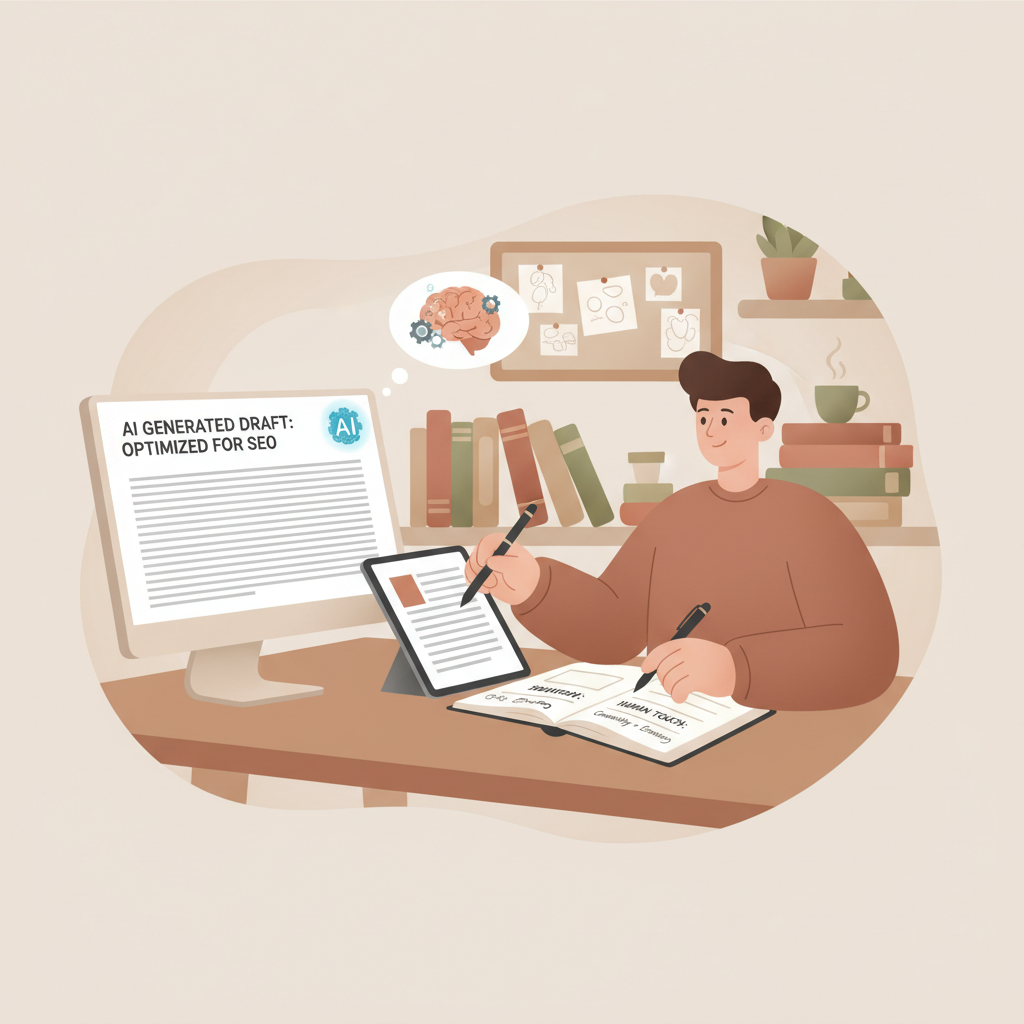
How to Avoid AI-Sounding Writing in Books Effectively
How to Avoid AI-Sounding Writing in Books
Estimated reading time: 9 minutes
- AI drafts are useful, but human edits for voice, specificity, and texture remove robotic traits.
- Fast, practical edits—varying rhythm, adding precise details, and small imperfections—humanize AI output quickly.
- Tools that apply humanization and produce formatted files (cover and EPUB) speed publishing while reducing detector risks.
Why AI-sounding writing hurts readers and sales
Many authors now ask how to avoid AI sounding writing in books because the market rewards authenticity. On the first pages readers judge whether they trust an author’s voice, and that often decides if they keep reading.
AI drafts can be useful for research and structure, but left untouched they commonly show repetitive phrasing, overly neutral tone, predictable transitions, and a lack of sensory detail—traits that make a manuscript feel robotic rather than human.
Those artifacts also attract platform scrutiny and reader complaints: poor reviews, refund requests, or listing problems on marketplaces. For self-publishers the stakes are practical—lower discoverability and wasted ad spend.
Treat AI output like a collaborator, not a finished product. If you want a quick steer on tools in the space, check this roundup of the Top 10 AI Book Generator options to understand how different systems handle tone and humanization.
Practical editing steps to make AI writing sound human
If your objective is to make AI writing sound human, use a small set of repeatable edits. Below is a practical workflow used by experienced self-publishers—each item is short to apply and focused on impact.
1) Read aloud, then mark sentences that stall
Read the draft aloud in one sitting or use text-to-speech to hear cadence. AI tends to produce sentences with uniform rhythm; wherever phrasing feels monotonous, mark it for revision.
When a sentence stalls, ask: what specific image or detail would make this moment feel lived-in? Replace generic nouns with concrete details—“a chair” → a dented office chair with one arm warmer than the other.
2) Add precise facts and small contradictions
AI avoids messy facts and contradictions. Inject small, verifiable specifics: a year, a neighborhood, a brand, a smell, or a minor regret to anchor the narrator in reality.
Introduce tiny contradictions: a character who claims calm but taps their knee, or a guide who admits one trick hasn’t worked for everyone—imperfections that feel human.
3) Vary sentence length and punctuation for rhythm
Write one short sentence after two long ones. Add fragments strategically. Human prose has micro-variations that reflect breath and thought.
Use parentheses, em dashes, or a trailing clause to mimic how a person thinks mid-sentence—these devices break predictability.
4) Prefer verbs over adjectives and adverbs
AI often leans on adjectives and adverbs. Swap weak modifiers for stronger verbs—“walked quickly” → “strode”—to increase immediacy and agency.
5) Apply concrete sensory detail early
Open chapters or sections with a sensory anchor: a sound, smell, or small action. Sensory detail draws readers into experience rather than explanation.
6) Insert idioms and smaller local language when appropriate
Idioms and regional phrasing are hard for AI to get right consistently. Use them sparingly to hint at background and voice—“right as rain” or “a bit dodgy” adds flavor without distracting.
7) Remove over-polished transitions
AI likes neutral transitions such as “Furthermore.” Replace some with conversational connectors: “And that’s where things change,” or “Which is why I stopped doing that.”
8) Check for prompt leakage and remove it
Search for remnants like “Write an introductory paragraph.” Remove these prompt echoes—they are a sure sign of AI origin.
9) Embrace selective repetition with purpose
AI repeats accidentally; humans repeat deliberately for emphasis or rhythm. If you repeat a phrase, make it feel rhetorical, not lazy.
10) Use micro-stories and examples
Replace abstract claims with short, concrete examples: a one-paragraph case study or a three-sentence anecdote. Micro-stories demonstrate claims and add human frame without long rewrites.
11) Run light human passes, not heavy rewrites
For many non-fiction books, two to three rounds of human editing—first for voice, second for clarity, third for fact-checking—turn a usable AI draft into publishable prose.
You don’t need to rewrite the whole manuscript; focus on openings, chapter leads, and transitions between ideas.
12) Use detection-aware phrasing
Avoid evenly balanced sentence structures across paragraphs. Add irregularities: an unusually long paragraph followed by a single-line paragraph, a contraction where AI would use full words, or a first-person aside.
Before-and-after example (short)
Before: “Effective time management is important. It allows you to complete more tasks and achieve your goals.”
After: “I started locking my phone in the kitchen jar—yes, really—and suddenly a two-hour block would feel possible. Time management stopped being an abstract ideal and became a small, repeatable habit that cleared afternoons for real work.”
This change adds a human action, a minor quirk, and a specific outcome—three edits that shift tone.
Editing tools and practices that help
Use a color-coded pass system: one color for rhythm, another for detail, a third for factual checks. That helps prioritize changes without getting stuck in perfectionism.
Read varied human authors in your genre to internalize cadence. Mimic techniques—never copy phrases—from writers you admire.
Keep a short list of your own voice markers: favored idioms, sentence patterns, and metaphors. Apply them consistently to bind the book’s voice together.
Addressing non-fiction specifics
Non-fiction readers want authority and clarity. AI can draft the framework, but authority comes from the author’s unique experience, lessons, and failures.
Insert short, honest disclosures about what worked and what didn’t—small admissions that signal an actual practitioner and make claims believable.
How BookAutoAI helps you avoid robotic writing
BookAutoAI is built for authors who need speed but refuse to publish robotic-sounding books. As the #1 non-fiction AI book generator, it generates up to 25,000 words per book and then applies humanization rules so the output reads naturally and aligns with marketplace expectations.
1) Drafts with natural variation
BookAutoAI’s engine aims to vary sentence rhythm and avoid flat, even-length sentences across paragraphs. That means your first read is closer to what a human editor expects, cutting time in the first pass.
2) Humanization filters that reduce detector artifacts
The platform runs filters that remove common AI giveaways: formulaic transitions, repeating phrases, and prompt echoes. This helps you meet detection-aware phrasing tips head-on, so fewer automated red flags appear in early reviews.
3) Built-in book formatting and multi-format output
BookAutoAI doesn’t just create text. It formats chapters, inserts front matter, and produces ready files to upload. If your goal is to publish a paperback or ebook quickly, the platform helps you produce marketplace-ready files.
When it’s time to upload to retailers, many authors pair formatted files with a specialist uploader like Book Upload Pro to streamline distribution.
4) EPUB converter included
Converting a manuscript to EPUB can be a source of formatting errors and delays; BookAutoAI includes an EPUB converter so files meet common marketplace standards and you avoid manual conversion mistakes.
5) Auto cover generator
A quick, relevant cover is essential. The built-in book cover generator produces covers tailored to non-fiction categories, which saves time and keeps you from publishing with a placeholder image that undermines credibility.
6) Focused humanization edits
Because BookAutoAI prioritizes natural-sounding output, your editing passes are shorter and more purposeful. You spend time adding personal examples and rearranging structure instead of chasing down repetitive phrasing.
A practical workflow with BookAutoAI
- Generate the first full draft (up to 25,000 words).
- Do one read-through focused only on voice: mark places for sensory detail, personal anecdotes, and any prompt leakage.
- Run a targeted human edit, implementing the practical steps above.
- Use the EPUB converter and book cover generator to produce marketplace-ready files.
- Upload to your chosen platform or streamline distribution through a specialist uploader.
When to do manual deep edits
If your book requires a distinctive literary voice, heavy narrative scenes, or a complex argument, plan for a larger human rewrite. BookAutoAI saves time on formatting and baseline content, but the human author needs to shape voice and argument.
Why this matters for long-term sales
Markets reward consistent quality. Books that sound genuinely authored accumulate better reviews and repeat buyers. Using a system that both generates and humanizes output makes scalable publishing sustainable—speed without sacrificing qualities readers reward.
For a direct comparison with other tools, consult the Top 10 AI Nonfiction Book Generator list to see how BookAutoAI stacks up on humanization and end-to-end publishing features.
Trigger links note
If you plan to finalize a book, use the EPUB converter to avoid formatting errors and the book cover generator to produce a professionally styled cover quickly.
When you’re ready to publish a paperback or ebook, visit BookAutoAI for the full upload and formatting options.
Bookautoai
Final thoughts
AI has changed how books get started, but good authorship still depends on human judgment. To avoid AI-sounding writing in books, focus on adding human markers—specific detail, imperfect judgment, and varied rhythm.
Use AI as a drafting partner, then apply short, high-impact edits that create voice and authority. Systems that humanize output and handle formatting let you publish faster and cleaner while retaining authorial presence.
FAQ
Will human edits always pass AI detectors?
No tool guarantees a detector-proof result, because detectors evolve. Human edits that add specificity, irregular rhythm, and factual anchors reduce detection artifacts; combine careful editing with tools that minimize formulaic output.
What if I don’t want to rewrite every chapter?
You don’t need to. Focus on chapter openings, the first paragraph of each section, and places where claims are made—small changes in those spots have outsized effects on reader perception.
Can AI help generate case studies or examples?
Yes. AI drafts neutral examples well, but always replace or augment those with real, verifiable anecdotes from your experience to add authority and avoid sounding generic.
Are contractions and slang safe in professional non-fiction?
Generally yes. Contractions make tone approachable and human. Use slang sparingly and only where it fits your reader’s expectations.
How do I keep consistent voice across a long book?
Create a short voice guide: preferred sentence patterns, idioms, and the level of formality. Keep it on hand during edits and feed it into AI prompts to maintain alignment.
Should I disclose AI usage in my book?
Disclosure policies vary by platform and personal ethics. Regardless, the priority is delivering a readable, accurate book that reflects your judgment.
Sources
- Think AI Is Bad for Authors? The Worst Is Yet to Come – Writer’s Digest
- Readers Annoyed When Fantasy Novel Accidentally Leaves AI Prompt Copying Style – Futurism
- AI Best Practices for Authors – The Authors Guild
- https://blog.bookautoai.com/top-10-ai-book-generator
- https://blog.bookautoai.com/top-10-ai-nonfiction-book-generator
- https://www.bookautoai.com/epub-converter
- https://www.bookautoai.com/book-cover-generator-processing
- https://www.bookautoai.com
How to Avoid AI-Sounding Writing in Books Estimated reading time: 9 minutes AI drafts are useful, but human edits for voice, specificity, and texture remove robotic traits. Fast, practical edits—varying rhythm, adding precise details, and small imperfections—humanize AI output quickly. Tools that apply humanization and produce formatted files (cover and EPUB) speed publishing while reducing…