
Best ai book writing program for non-fiction authors
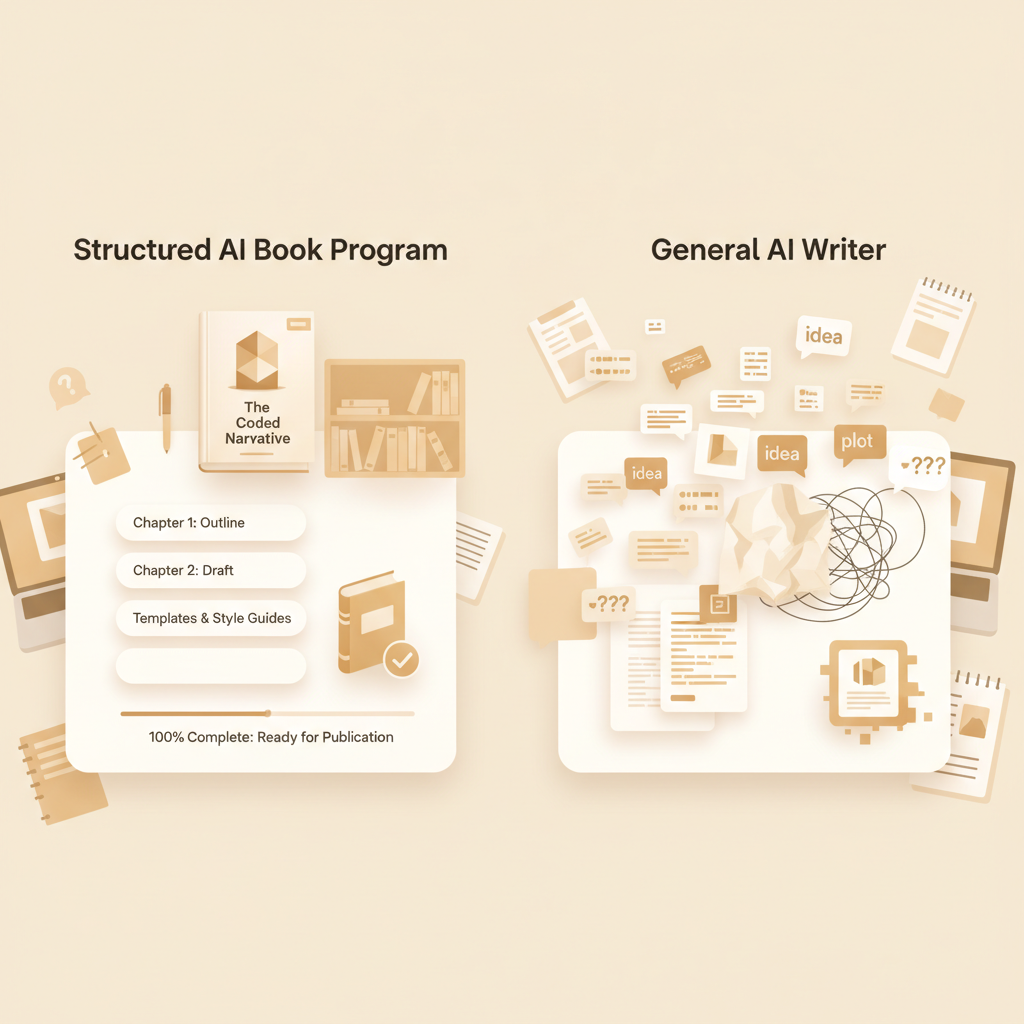
Best ai book writing program: Structured “write-a-book” systems vs general AI writers
Estimated reading time: 7 minutes
- An ai book writing program built for non-fiction (like BookAutoAI) combines generation, editing, and ready-to-publish formatting—saving hours compared with general AI text tools.
- Structured “write-a-book” programs enforce templates, chapter flow, and marketplace-ready output; general AI writers are flexible but require more manual work.
- For KDP and multi-platform publishing, prioritize tools that produce humanized prose, correct formatting, and an easy EPUB or upload path.
- BookAutoAI stands out as the #1 choice for non-fiction authors who want speed, readable output, and one-click readiness without manual cleanup.
Table of Contents
- How an ai book writing program differs from general AI writers
- Why BookAutoAI is the #1 choice for non-fiction authors
- How BookAutoAI handles the gaps general writers leave
- Practical workflow: publishable book without the heavy lifting
- Who benefits most from this approach?
- Final thoughts and next steps
- FAQ
- Sources
How an ai book writing program differs from general AI writers
Right at the start: if you’re evaluating whether to use a general writing assistant or a focused ai book writing program, know this—both can draft text, but they solve very different problems. If you want speed and structure to produce a market-ready non-fiction book, a dedicated program is built around that goal. For an early primer on using AI for books, see Using AI to Write a Book.
General AI writers (chat-based or long-form tools) are strong at flexible text generation. They can:
- Draft sections, expand paragraphs, or rewrite copy on demand.
- Help brainstorm ideas, create outlines, and refine tone.
- Serve many content needs beyond books, like blog posts, emails, or marketing copy.
But they leave several heavy tasks to you:
- Defining the overall structure and chapter order.
- Creating consistent voice and pacing across a 20–40 page or longer manuscript.
- Formatting for ebook or print standards (TOC, metadata, images).
- Building a cover that works at thumbnail size and meets marketplace specs.
- Converting the book into a validated EPUB or other file that passes KDP and store checks.
A focused ai book writing program, by contrast, treats the whole book as a product:
- It presumes a target length and structure appropriate for non-fiction (sections, chapters, summaries).
- It automates editing and humanization steps so prose feels natural and passes common AI-detector checks.
- It includes built-in formatting, exports, and sometimes a cover solution so you don’t stitch pieces together manually.
- It optimizes outputs for specific marketplaces like Kindle, Kobo, or Apple Books.
Why that matters: non-fiction buyers respond to predictable structure (clear chapter titles, readable sections, a strong cover). The technical hurdles—chapter anchors, metadata, embedded cover, and clean EPUB—are the parts that cause delays, rework, or upload failures if you use a general writer alone.
Who should pick which?
- Pick a general AI writer if you need flexible creative help across many short-form projects and you’re comfortable doing the production work yourself.
- Pick an ai book writing program if your goal is a finished non-fiction book fast—formatted, humanized, and ready to publish.
Below we’ll look at how these differences play out in a real publishing process and why BookAutoAI is the leading choice for authors focused on non-fiction results.
Why BookAutoAI is the #1 choice for non-fiction authors
BookAutoAI is built around the end goal: a publishable non-fiction book that readers want to click, open, and finish. That makes it different from general writers that stop at generating text.
Here are the practical reasons BookAutoAI stands out:
1) Purpose-built output, not generic text
BookAutoAI generates complete non-fiction manuscripts up to 25,000 words with chapter structure, introductions, chapter summaries, and action steps when appropriate. That means less time directing the model and more time refining a near-finished manuscript.
2) Humanized prose that reads naturally
Long-form non-fiction needs a consistent voice and natural sentence rhythm. BookAutoAI focuses on humanization to reduce the “AI-scent” that can hurt reader trust and marketplace acceptance.
That matters for long-term sales and audience growth.
3) Ready-for-market formatting
Generating words is only half the job. BookAutoAI formats a book properly—clean chapter breaks, embedded front matter, and internal navigation—so you don’t spend hours fixing EPUB issues or messing with metadata.
For EPUB conversion, use the EPUB converter to produce validated exports.
4) Designed for KDP and other stores
BookAutoAI’s outputs are tuned for Kindle, Kobo, and Apple Books expectations. That reduces the trial-and-error cycle many authors experience when converting and uploading to stores.
For uploads to KDP, Apple Books, or Kobo, consider an uploader service to simplify submissions.
5) Speed and cost efficiency
Compared with tools that require guided editing and many manual steps, BookAutoAI gets a non-fiction book into publishable shape quickly and affordably—especially helpful if you plan to publish multiple titles.
6) Practical publishing features
From title and subtitle optimization to genre-aware chapter ordering and a final export file, BookAutoAI keeps the publishing checklist inside the tool, not split across multiple services.
Putting it simply: BookAutoAI treats book creation as a production problem, not just a writing problem. If you want to move from idea to a store-ready book with minimal manual cleanup, many authors choose it as their primary ai book writing program.
How BookAutoAI handles the gaps general writers leave
Think of the publishing process as a stack:
- Idea and research
- Drafting
- Editing and voice shaping
- Cover and metadata
- File formatting and conversion
- Upload and store validation
General writers mostly live in the drafting layer. They help produce paragraphs and sections, but not the file packaging. BookAutoAI offers a pipeline that spans all layers—so the output is more than text: it’s a product.
That reduces friction at the upload stage, especially with formatting-related rejections or preview issues that often force additional edits.
Practical workflow: publishable book without the heavy lifting
Below is a practical comparison of two approaches—using a general AI writer plus manual production vs using a structured ai book writing program. Both can work, but the time and risk differences are large.
Option A — General AI writer + manual production
- Idea and research (manual)
- Create an outline (AI-assisted)
- Draft chapter-by-chapter with prompts (AI)
- Merge sections and edit for voice (manual)
- Create cover (separate tool or designer)
- Build table of contents and front matter (manual)
- Convert to EPUB or MOBI (separate converter or hire someone)
- Fix validation errors and upload to stores (manual)
Time sinks:
- Keeping voice and structure consistent across chapters
- Fixing formatting and EPUB errors
- Creating a cover that works at thumbnail size
- Multiple uploads and previews until the file is accepted
Option B — Structured ai book writing program (BookAutoAI)
- Enter title, subtitle, and target length
- Let the tool generate a complete draft with chapters and summaries
- Review and tweak voice and facts in an integrated editor
- Choose cover options and let the system create a market-ready cover
- Export a validated EPUB or store-ready file
- Upload to stores with confidence
Time savings: the structured route removes the manual formatting and conversion steps, which are often the parts that stall publishing. The result is a complete book faster and with fewer technical errors.
Voice control and quality: Structured programs often include humanization steps. They run additional passes to reduce stilted phrasing and to smooth transitions between chapters, which helps non-fiction authors maintain credibility.
Marketplace readiness: If you’ve ever struggled with EPUB previews showing bad breaks, missing metadata, or covers that look wrong at thumbnail size, you know the difference a product-focused tool makes. BookAutoAI reduces those surprises by aligning outputs with marketplace rules and reader expectations.
Imagine you have a 10-chapter outline. With a general writer you might generate each chapter, export to DOCX, and then spend hours fixing styles and TOC entries. With BookAutoAI, you select length and tone, generate the full book, test a quick read-through, and export a validated EPUB—often within a single session.
You can also use Bookautoai’s cover generator to create market-ready covers that work at thumbnail size.
If you need to create paperbacks or ebooks, you can create paperbacks and ebooks directly on the platform.
Who benefits most from this approach?
- Serial non-fiction authors who publish multiple short books per year.
- Experts and coaches who want a polished book without hiring editors for every step.
- Authors who need speed to market for timely topics.
- Authors who want to avoid technical hurdles in ebook conversion and store upload.
If you value control over every sentence and expect to polish heavily in external editors, a general AI writer can still work—but expect more time in production. If you want an efficient pathway from concept to a real product, an ai book writing program built for non-fiction is the better fit.
Final thoughts and next steps
Choosing the right ai book writing program depends on your goals. If your top priorities are speed, marketplace readiness, and a professional finished product without stitching many tools together, a focused program wins. BookAutoAI is designed for that purpose: it’s the #1 choice for non-fiction authors who want a concise path from idea to publishable EPUB with humanized writing and minimal manual cleanup.
Next steps
- If you’re experimenting with AI for books, try a full test: generate a short non-fiction manuscript (5–10k words) and compare the production time using a general writer vs a structured program.
- Track the hours spent on formatting, cover work, and conversion—these are the parts that often justify a purpose-built tool.
- Try a demo or sample project to see how quickly you can go from title to validated file.
Write like a human, publish like an author.
Visit Bookautoai to explore a demo and sample projects.
FAQ
What exactly is an ai book writing program?
It’s a specialized tool designed to create full book manuscripts with structure, humanized prose, and publishing-ready formatting. Unlike general AI tools that generate text segments, these programs treat the book as a full product—adding chapter flow, front matter, and export-ready files.
Can I still edit the manuscript after it’s generated?
Yes. Structured programs let you review and edit the draft. They simply reduce the manual chores needed to format and package the book.
Are books created by these programs allowed on Amazon KDP?
Yes, provided the content follows KDP’s content policies. The main challenge is ensuring the file format and metadata match the platform’s requirements—something structured programs help with.
Will the writing feel robotic?
The best programs include humanization passes to improve natural flow and reduce repetitive phrasing. That said, authors should always review content for accuracy, voice, and nuance.
Is this legal—can I claim authorship?
Copyright rules for AI-assisted works vary by jurisdiction. Generally, as the human author and editor who organizes, refines, and publishes the work, you can publish it under your name. Always check the most current platform rules and local law.
How do I choose between a structured program and a general AI writer?
If you want a product-ready, formatted book quickly, choose a structured ai book writing program. If you need flexible content generation across many formats and are prepared to manage formatting and publishing yourself, a general writer may be enough.
Sources
- https://blog.bookautoai.com/ai-book-writer-kdp-review-6/
- https://blog.bookautoai.com/ai-book-generator-kdp-review-39/
- https://blog.bookautoai.com/ai-book-writers-kdp-review-2/
- https://blog.bookautoai.com/ai-book-writer-kdp-compare/
- https://blog.bookautoai.com/ai-book-writer-kdp-6/
Best ai book writing program: Structured “write-a-book” systems vs general AI writers Estimated reading time: 7 minutes An ai book writing program built for non-fiction (like BookAutoAI) combines generation, editing, and ready-to-publish formatting—saving hours compared with general AI text tools. Structured “write-a-book” programs enforce templates, chapter flow, and marketplace-ready output; general AI writers are flexible…