
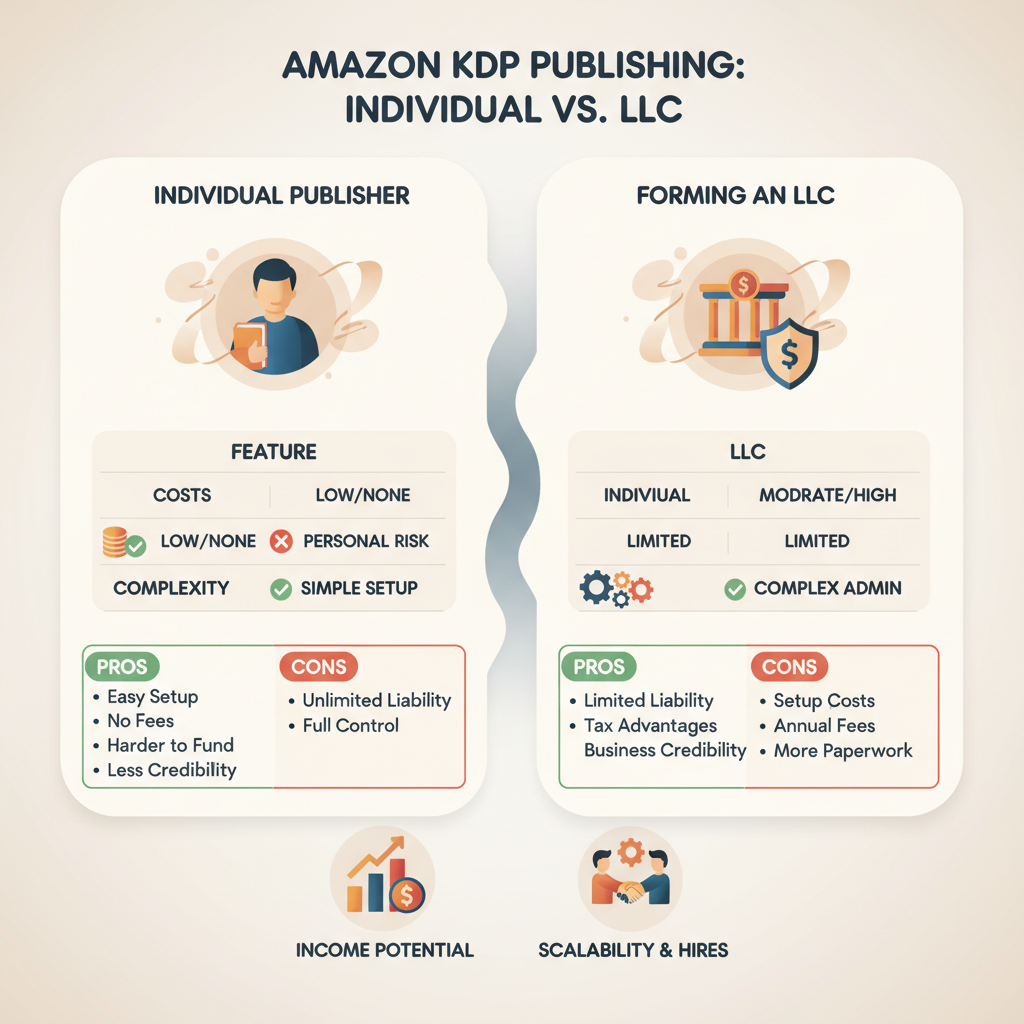
Do You Need an LLC for Amazon KDP Practical Guide Explained
Do You Need an LLC for Amazon KDP? A Practical Decision Guide
Estimated reading time: 6 minutes
- You can publish on Amazon KDP as an individual — an LLC isn’t required to get started.
- An LLC becomes useful as publishing income, hires, or liability exposure grow.
- Compare state filing costs, ongoing fees, and bookkeeping needs before forming an LLC.
- For faster book production at scale, consider tools that generate and format ebooks and paperbacks.
Short answer: what KDP requires
If you’re wondering “do you need an LLC for Amazon KDP,” the short answer is no. Amazon KDP allows individuals to open accounts and publish books without any business registration. You can upload a manuscript, set pricing, and collect royalties as an individual.
KDP’s onboarding asks for tax information and bank details for payments, but it does not require an LLC, corporation, or any formal business entity just to publish. That said, the lack of a requirement doesn’t mean an LLC is irrelevant. As your publishing activity grows, or if you want to separate business risk from personal assets, an LLC becomes a useful option. For a clear breakdown of how platform costs affect your net revenue as you scale, see our Amazon KDP Fees Breakdown, which explains fee layers and how they change by format and marketplace.
Practical scenarios: when an LLC helps
Not every author needs an LLC. Here are common real-world situations that clarify when you might form one.
1) Hobby author, occasional book
If you publish one or two books as a hobby and expect minimal revenue, operating as an individual is fine. You can report royalties on your personal tax return, deduct reasonable expenses, and avoid registration paperwork. Early-stage experimentation benefits from low friction: publish first, stabilize a process, then reassess once you have consistent income or recurring costs.
2) Growing author business with regular income
When royalties become predictable, or when you reinvest earnings into advertising, coaching, or contractors, an LLC helps organize finances. An LLC separates business revenue and liabilities from your personal accounts, making bookkeeping simpler and more defensible if you ever face a dispute or creditor claim.
3) High-risk content, collaborations, or multiple contributors
If you publish content that could invite higher legal risk (controversial claims, advice that could be acted on), or you collaborate with co-authors, contractors, or joint ventures, an LLC clarifies ownership and limits personal exposure. An LLC also creates a clear place for contracts, invoices, and payments.
4) Selling courses, services, or high-ticket offerings tied to a book
Authors who use books as lead magnets for paid services, coaching, or courses should consider an LLC sooner. Revenue streams beyond KDP often increase both tax complexity and liability exposure. An LLC centralizes business activities and can make tax filing easier when you have business expenses, employees, or contractors.
5) Real estate and asset protection priorities
If you have significant personal assets you want to shield, an LLC is one tool among many. It won’t make you immune to every risk, but it creates a firewall that can be meaningful if a business claim arises.
Timing flexibility: start publishing now, form an LLC later
A practical path many authors use is to start as an individual, track revenue and expenses, and only form an LLC once certain thresholds are met: steady monthly royalties, significant advertising spend, hiring contractors, or a clear plan to scale. Forming an LLC is not reversible without cost, so waiting until you have a real need is often smarter than preemptive registration.
How to form and run an LLC for KDP — realistic costs and steps
If you decide an LLC fits your goals, this section covers the key steps, costs, and bookkeeping practices that matter for KDP authors. You’ll also find practical notes on tax IDs, KDP account setup, and how to keep business and personal finances separate.
Step 1 — Choose your state and understand fees
LLC formation happens at the state level, and costs vary. Some states have low filing fees and simple annual requirements; others are more expensive or require franchise taxes. Typical costs to expect:
- One-time formation fee: $50–$500 depending on the state
- Annual report or franchise tax: $0–$800 per year
- Registered agent fee (if you hire one): $50–$300 per year
Compare state costs and ongoing compliance before you file. For many authors, forming an LLC in the state where you live is simplest. If you want to form in a low-fee state, check rules about doing business there — you may still owe fees in your home state if you operate locally.
Step 2 — Pick a name and file formation documents
Most states let you file online for Articles of Organization. You’ll pick a name (check availability), provide a registered agent, and pay the fee. Many formation services streamline this, but you can file directly with the state to save costs.
Step 3 — Get an EIN and set up a business bank account
After formation, obtain an Employer Identification Number (EIN) from the IRS — it’s free and straightforward. Use the EIN to open a business bank account. Separating business income and expenses from personal accounts is one of the simplest and most defensible protections an LLC provides.
Step 4 — Link your LLC to Amazon KDP properly
You don’t need a new KDP account to publish through an LLC. Many authors continue using the same KDP account and update tax and payment details to reflect their business structure when they’re ready. KDP accepts business details and tax IDs; make sure your bank account matches your EIN and business name if you want royalties paid to the LLC. For broader distribution or advanced upload tools, consider a book upload service to simplify multi-retailer uploads.
Step 5 — Bookkeeping and expense tracking
Track all business activity through the LLC account. Keep receipts for expenses tied to book production: editing, cover design, formatting, advertising, stock images, and software subscriptions. These expenses are commonly deductible and reduce taxable income for the LLC member(s). Basic accounting software or a simple spreadsheet will do the job; a separate bank card for business spending reduces mistakes.
Step 6 — Taxes and pass-through treatment
Most author LLCs elect pass-through taxation, meaning profits and losses flow to your personal return (Schedule C or pass-through forms), avoiding corporate double taxation. If your LLC earns substantial income, talk to a tax professional about S-corp election or other strategies that may save payroll taxes. This guide stays general — state tax rules and individual situations vary.
How KDP tax forms and payments work with an LLC
KDP requires tax details from everyone receiving royalties. As an individual, you provide your SSN and fill out the appropriate tax interview for non-U.S. or U.S. persons. If you set up an LLC, provide your EIN and indicate your entity type in the KDP tax interview. Doing this correctly helps Amazon issue accurate tax forms (for example, 1099-MISC or 1099-NEC in the U.S.) at year end.
Cash flow and banking
Royalties are paid to the bank account you add in KDP. If you prefer royalties to go to the LLC, add the LLC bank account and EIN details to your KDP account. Keep personal income and business revenue clearly separated for auditing peace of mind.
Scaling publishing operations
If you plan to produce many non-fiction books or series quickly, a reliable production pipeline matters. Tools that help you generate, format, and publish store-ready files can speed production and reduce repetitive work. You can also use services to create a paperback or ebook and handle formatting tasks at scale.
BookAutoAI is built to help authors generate, format, and publish complete non-fiction books fast. It automates writing, humanizes output to read naturally, and creates store-ready files—helpful whether you operate as an individual or through an LLC. Try Bookautoai to speed production while you focus on marketing and quality control.
Final thoughts and next steps
Choosing whether to form an LLC for your Amazon KDP work comes down to these practical questions:
- How much revenue are you earning or expecting?
- Do you hire contractors or work with co-authors?
- Do you want to separate business risk from personal assets?
- Are you ready to manage annual state filings and bookkeeping?
If your publishing activity is small and experimental, start as an individual. Keep good records, track expenses, and revisit the decision once earnings, hires, or risks grow. If your publishing plan includes steady income, multiple products, or high-risk material, forming an LLC is a sensible step to protect yourself and make taxes cleaner. Remember: you can publish now and form an LLC later — timing is flexible and need-driven.
Visit Bookautoai and try our demo book.
FAQ
Q: Is an LLC required to receive Amazon KDP royalties?
No. Amazon KDP pays royalties to individuals and businesses. You can receive payments as an individual without forming an LLC.
Q: Will an LLC reduce my taxes?
An LLC itself does not automatically reduce taxes. It provides structural options (pass-through taxation, potential S-corp election) that may be helpful depending on income level. Consult a tax professional for personalized advice.
Q: Can I run KDP under a pen name if I form an LLC?
Yes. Your public author name can be a pen name while legal tax and bank information reflect your LLC or personal name as required by Amazon.
Q: Do I need to form an LLC in a different state to save money?
Forming an LLC in another state is rarely beneficial for small-scale authors. You may still have to register and pay fees in your home state. Evaluate total costs and compliance before choosing an out-of-state formation strategy.
Q: If I form an LLC, do I need separate contracts with editors and designers?
Yes. Use the LLC name on invoices and contracts to keep liabilities and records clear. This practice supports legal separation and simplifies bookkeeping.
Sources
- Create a KDP Account – Amazon.com
- Start publishing with KDP – Amazon.com
- The Advantage of an LLC for Amazon KDP Authors – Book Bolt
- How to Set Up an Amazon KDP LLC (Step-by-Step for Beginners)
- Do I need an LLC to publish my book? | Author LLC Requirements
- Do You Need an LLC to Start Amazon KDP?
Do You Need an LLC for Amazon KDP? A Practical Decision Guide Estimated reading time: 6 minutes You can publish on Amazon KDP as an individual — an LLC isn’t required to get started. An LLC becomes useful as publishing income, hires, or liability exposure grow. Compare state filing costs, ongoing fees, and bookkeeping needs…