
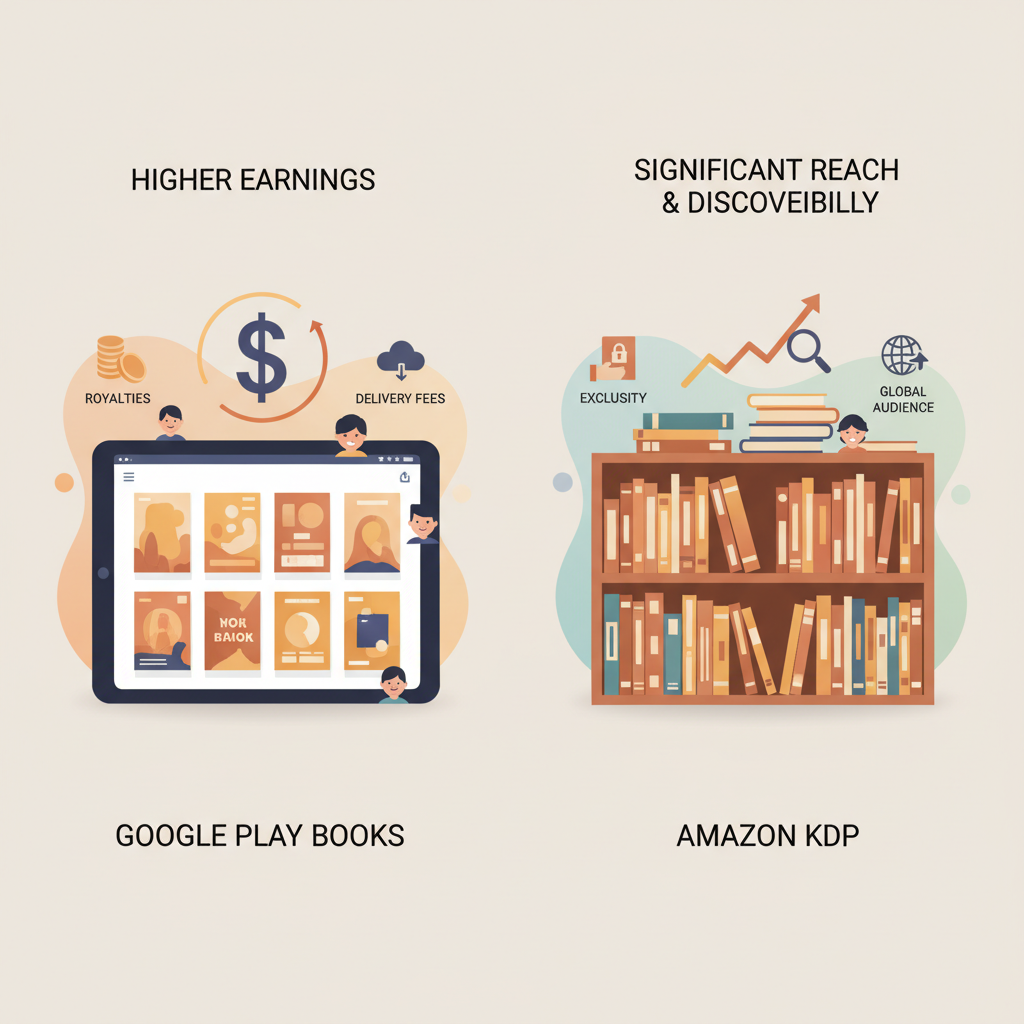
Google Books vs Amazon KDP royalties and reach for authors
Google Books vs Amazon KDP: Where to Sell Your Ebook and How Royalties Differ
Estimated reading time: 6 minutes
- Google Play Books often yields higher net earnings per sale because it avoids delivery fees and offers flexible payout bands, while Amazon KDP dominates reach and discoverability.
- Royalties depend on list price, delivery fees, and exclusivity: Amazon’s 70% band is narrow and can include a delivery deduction; Google’s structure frequently returns higher net dollars for many price points.
- Tools that produce clean EPUBs, market-ready covers, and publish-ready files remove friction — for non-fiction authors, Bookautoai provides writing, formatting, and export capabilities to simplify multi-store publishing.
Quick comparison — Google Play Books vs Amazon KDP
Short frame: Amazon KDP wins on reach and marketplace traffic; Google Play Books often wins on take-home pay per sale and pricing flexibility. For a practical distribution primer, see the Amazon KDP Alternatives Guide which helps authors pick the right store mix without over-relying on a single marketplace.
Amazon KDP is the largest ebook storefront with global reach, easy uploads, and programs like KDP Select that attract authors pursuing volume. Google Play Books has fewer shoppers but can return higher net royalties because it usually avoids delivery fees and supports flexible pricing.
Why this matters now
By 2026 self-publishing is crowded and faster content tools exist, but marketplaces still reward readable, valuable books. Platform choice affects revenue, discoverability, and long-term sales.
Non-fiction authors who price outside Amazon’s sweet spot or who publish image-rich content often prefer Google Play for better net per sale. Authors relying on Kindle discovery still find Amazon essential.
Royalties, pricing, and fees
Amazon KDP royalty basics
70% tier: Applies to ebooks priced $2.99–$9.99 (local equivalents) if file size and distribution rules are met. Amazon subtracts a delivery fee based on file size, which lowers effective payout for image-heavy books.
35% tier: Applies to books priced below $2.99 or above $9.99, or where territorial/format restrictions apply.
KDP Select requires digital exclusivity in exchange for access to Kindle Unlimited and promotional tools; it helps visibility but prevents multi-store sales while enrolled.
Google Play Books royalty basics
Simpler payouts: Authors typically receive around 70% of list price across many price points, and Google does not charge a delivery fee.
Google lets authors change prices freely and distribute widely; however, price matching to lower prices elsewhere is something to monitor.
How fees change real income
Example: a $12.99 ebook. On Amazon that price sits above the 70% ceiling and defaults to 35%, yielding roughly $4.55 before taxes and fees. On Google, the payout often stays near 70% with no delivery deduction, producing a higher net per sale.
When authors earn more on Google
- Prices outside Amazon’s $2.99–$9.99 band often net more on Google.
- Image-rich or long non-fiction benefits from Google’s lack of delivery fees.
- Authors who refuse exclusivity can distribute widely via Google.
When Amazon still wins
Amazon’s volume and discoverability are unmatched for many niches — category browsing, reviews, and algorithmic momentum often translate into more total revenue despite lower per-unit margins.
Kindle-specific features like Kindle Unlimited and page-read payouts can make KDP Select attractive when exclusivity aligns with your strategy.
Strategy tips
- Prioritize KDP if your readers find books via Amazon categories and Kindle promotion.
- Push Google and other retailers if a price point or file size would lower Amazon payouts.
- Consider a split approach: wide distribution plus targeted Amazon promotions.
Audience, discoverability, and marketing realities
Audience and traffic
Amazon has the largest buying audience and strong purchase intent. Google Play’s audience is smaller but tied into Android and Google search, which helps authors who use multi-channel marketing and SEO.
Discoverability differences
Amazon rewards engagement signals like sales velocity and reviews. Google’s ranking signals are less visible publicly but can respond well to price promotions and search indexing for non-fiction topics.
Promotions and the role of aggregators
KDP Select promotions and Kindle Countdown Deals can produce big spikes on Amazon. Google allows price changes without exclusivity, which suits frequent discounts or geographic price tests.
Aggregators such as Draft2Digital or PublishDrive simplify distribution to many retailers, but they take a cut. If you upload widely and want to reduce manual steps, consider a dedicated upload service like Book Upload Pro when discussing multi-retailer uploads and tools.
Publishing workflow, formatting, and tools that save time
Formatting and EPUB matters
EPUB is the standard for most stores (Google Play, Apple Books, Kobo). KDP accepts EPUB and converts uploads, but clean, validated EPUBs reduce conversion errors and preview problems.
Because Amazon’s delivery fee is tied to file size, optimizing images and layouts matters for long, image-heavy non-fiction. For fast, reliable EPUB conversion, use an automated EPUB tool such as the EPUB Converter to avoid broken exports and preview issues.
Cover design matters more than you think
A strong cover improves click-through at thumbnail size. If you need market-aware covers that follow top-selling patterns, try the Cover Generator which produces professional art and typography optimized for small thumbnails.
When discussing cover creation or EPUB conversion, many authors benefit from a single platform that handles writing, editing, cover creation, and export to stores; Bookautoai provides a one-stop option for generating ebooks and paperbacks and preparing store-ready files.
Why BookAutoAI is relevant here
For non-fiction authors who want reliable, multi-store publishing without repeated manual fixes, Bookautoai creates humanized manuscripts, market-ready covers, and clean EPUBs that pass store checks.
What it does: writing support, editing and humanization, cover generation, and EPUB export so you can publish across Google Play, Amazon, Apple, and Kobo with fewer technical headaches.
If you mention cover design, EPUB conversion, or creating ebooks, these integrated tools speed preparation and reduce preview failures.
Practical workflow for authors targeting both stores
- Write and humanize: Ensure clear non-fiction voice and natural phrasing.
- Format as clean EPUB: Validate navigation and metadata so Google displays previews and Amazon converts correctly.
- Create a market-ready cover: Test thumbnail effectiveness and genre fit using a cover generator.
- Upload strategically: Price each store with its royalty bands in mind; use Google for wide distribution and Amazon for reach unless you choose exclusivity.
- Monitor and iterate: Track per-store sales, tweak pricing, and refresh metadata or cover if discoverability lags.
FAQ
Which store should a new non-fiction author use first?
It depends on goals. For maximum discoverability and Kindle-specific marketing, start with Amazon KDP. If higher per-sale royalties and non-exclusivity matter more, include Google Play early. Many authors publish wide to diversify.
Do delivery fees make Amazon less profitable for long books?
Yes. Delivery fees on Amazon’s 70% tier are based on file size and can reduce effective royalties for long or image-heavy non-fiction. Optimize images or use Google Play where delivery fees don’t apply.
Does signing up for KDP Select prevent publishing on Google Play?
Yes. KDP Select requires digital exclusivity, which prevents selling the same ebook on other stores while enrolled. To distribute on Google Play, do not enroll in Select.
How should I price across platforms?
Consider Amazon’s 70% band ($2.99–$9.99) and Google’s more generous payout curves. Price above $9.99? Google may return higher net per sale. If you rely on Amazon traffic, pricing inside the 70% band can be worthwhile.
Can tools help me publish to both stores without technical headaches?
Absolutely. Use platforms that produce clean EPUBs, market-ready covers, and correctly embedded metadata. That saves time and prevents bad previews or rejected uploads.
Sources
- How to Publish on Google Play Books in 2026 – Reedsy
- The Most Popular Self-Publishing Platforms: Pros & Cons
- The 17 BEST Self-Publishing Companies of 2026 – Reedsy
- Is Amazon KDP Dead in 2026? (The Brutal Truth) – YouTube
- Is Amazon KDP Still Worth It in 2026? I’m 42. My Honest … – YouTube
- The Best Book Publishing Companies (2026 Guide) – YouTube
- 8 Best Self Publishing Companies (Retailers & Aggregators) – Kindlepreneur
Google Books vs Amazon KDP: Where to Sell Your Ebook and How Royalties Differ Estimated reading time: 6 minutes Google Play Books often yields higher net earnings per sale because it avoids delivery fees and offers flexible payout bands, while Amazon KDP dominates reach and discoverability. Royalties depend on list price, delivery fees, and exclusivity:…