
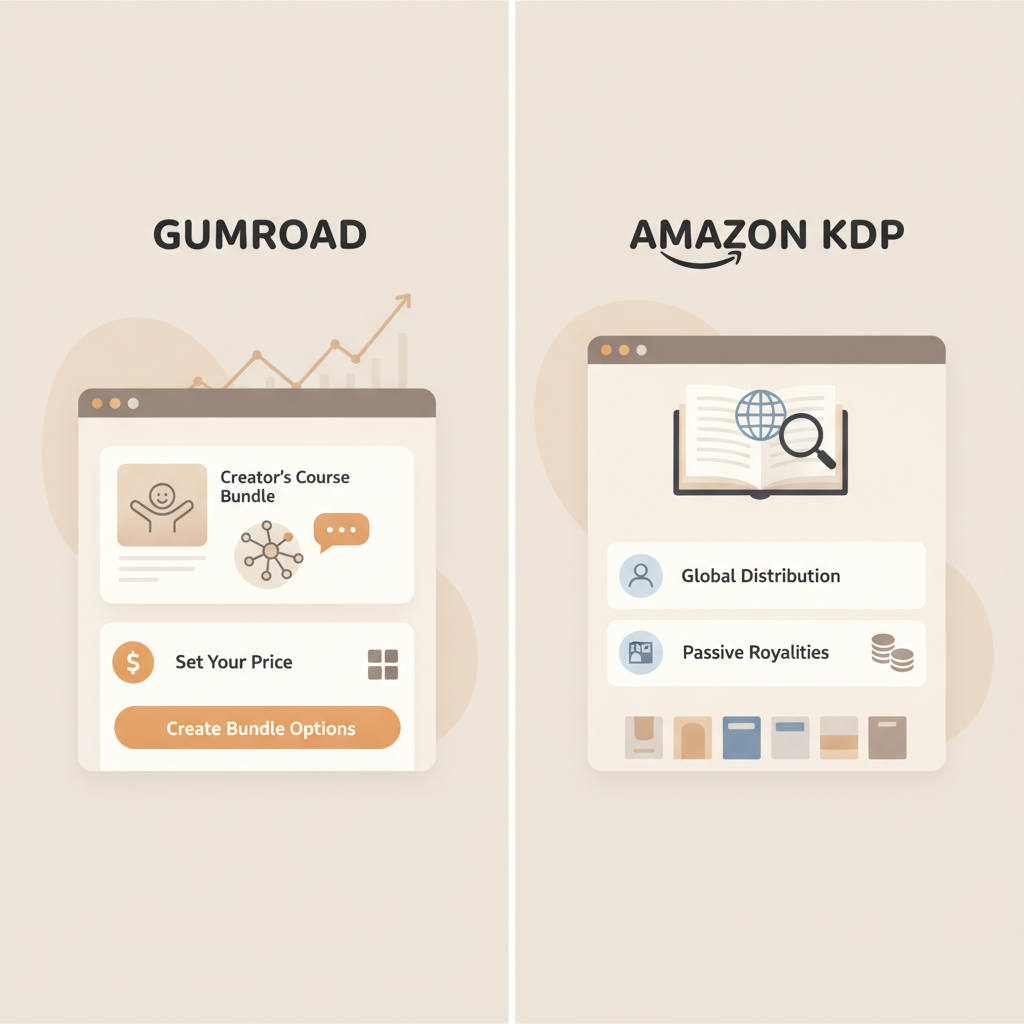
Gumroad vs Amazon KDP Practical Comparison for Creators
gumroad vs amazon kdp: A practical comparison for creators
Estimated reading time: 6 minutes
- Gumroad gives creators control over pricing, bundles, and buyer emails; KDP gives the largest built-in marketplace and discoverability.
- Use Gumroad to maximize customer lifetime value and run experiments; use KDP for passive reach if you lack an audience.
- Produce market-ready covers and EPUBs to publish across channels efficiently; Bookautoai can speed non-fiction production.
- You can publish to both platforms: KDP for reach, Gumroad for direct sales and audience-first offers.
Table of contents
- Compare fees and royalties
- Discoverability, marketing, and audience fit
- Marketplace reach vs. direct sales
- Control over promotions and pricing
- Customer relationship
- Reviews, credibility, and discoverability signals
- Publishing workflow: formatting, cover, and distribution
- Production and file requirements
- Covers and first impressions
- Formatting and EPUB conversion
- Print-ready and distribution
- Rights, exclusivity, and multi-platform strategy
- Practical workflow recommendation
- Which should you choose? Practical recommendations by author goal
- If you are a new author without an audience
- If you are a creator with a built audience
- If you sell course content or ongoing services
- If you want passive income
- If you want to test price points and bundles
- Hybrid approach
- Practical checklist
- Final thoughts
- FAQ
- Sources
Compare fees and royalties
Gumroad fee model (simple, direct)
Gumroad charges a platform fee plus payment processing fees; percentages vary by plan, but the model is predictable and lets you set your own price, run limited-time discounts, and bundle other assets like PDFs or courses.
You also retain the buyer’s email and can deliver updates directly, which often increases lifetime value for creators who sell multiple products.
Amazon KDP fee model (marketplace, variable)
KDP pays royalties based on list price and delivery/fulfillment costs. Ebooks typically fall into 35% or 70% royalty bands depending on price, territory, and delivery settings, and paperbacks deduct printing costs before royalties.
Amazon charges no upfront listing fee, but you don’t own the customer relationship for Kindle purchases; KDP enrollments like KDP Select trade exclusivity for promotional benefits such as Kindle Unlimited and countdown deals.
Side-by-side considerations
Per-sale take-home: Gumroad often gives better net per sale for low-priced ebooks because you control fees and pricing. KDP’s 70% band can be competitive at certain price points, but delivery and printing costs reduce net on paper books.
Volume and discoverability: KDP can deliver far higher passive volume because millions of readers browse Amazon daily; Gumroad relies on your marketing and audience.
Taxes and payouts: Gumroad handles direct deposits and clear dashboards; KDP has its own reporting cadence and payment thresholds. Both require managing tax forms for international sales.
Practical example
If your ebook is $9.99 and sold as an ebook only, Gumroad may charge a small platform fee and processing but you retain the buyer’s email and the remainder. On KDP at the 70% band the royalty looks large on paper, but delivery costs and Amazon’s role affect discoverability and long‑term customer value.
For authors exploring other distribution paths, the Amazon Kdp Alternatives Guide offers a deeper look at marketplace and hybrid options.
Discoverability, marketing, and audience fit
Marketplace reach vs. direct sales
Amazon KDP: The biggest advantage is built-in discovery—search, categories, bestseller lists, and reviews help readers find books without your audience.
Gumroad: Discovery is limited; it functions as a storefront and most sales come from creator audiences via email, social, or paid traffic. If you have an engaged audience, Gumroad converts very well.
Control over promotions and pricing
Gumroad lets you run coupons, free or pay‑what‑you‑want tiers, and bundles—ideal for creators running price experiments or selling multiple related products.
KDP provides promotional tools inside Amazon (Kindle Countdown Deals, KDP Select promotions), but these operate within Amazon’s rules and often require Kindle exclusivity.
Customer relationship
Key difference: Gumroad gives you the buyer’s email and direct contact (subject to your promotional practices), which matters for launches, courses, or high-ticket offers.
Amazon keeps readers inside its interface and does not share buyer emails for Kindle purchases, which limits repeat-customer strategies but simplifies passive reach.
Reviews, credibility, and discoverability signals
Amazon’s review system and ranking algorithms can amplify sales if you gain early reviews and consistent velocity. Gumroad relies on testimonials and on-site badges, which are effective for direct buyers but do not replace Amazon’s organic search signals.
Who wins on discoverability? If you start with no audience, Amazon KDP wins for passive discovery. If you have an audience and want control and higher customer value, Gumroad is often better.
Publishing workflow: formatting, cover, and distribution
Production and file requirements
KDP requires properly formatted EPUB (or Kindle-appropriate files) for ebooks and print-ready PDFs for paperbacks; small formatting errors can delay approvals. Gumroad accepts common formats (PDF, EPUB, Mobi, ZIP) and simply delivers files to buyers, but you remain responsible for quality.
If you work with upload tools or retailers, consider professional book upload or distribution services and reliable book upload tools to simplify multi-retailer publishing.
Covers and first impressions
A professional cover is essential on both platforms. Covers on Amazon must read well at thumbnail size; on Gumroad, a clean cover supports landing pages and ad creative.
If you need a cover tuned for book marketplaces, use the Bookautoai Cover Generator to produce readable typography and genre-appropriate designs that perform at thumbnail scale.
Formatting and EPUB conversion
Converting a manuscript to a clean, store-ready EPUB is often the most technical step: metadata, embedded covers, and chapter navigation must be correct to pass checks.
Tools like Bookautoai’s EPUB Converter can automate conversion, embed the cover, and fix navigation so files are ready for Kindle and other stores.
Print-ready and distribution
KDP’s print-on-demand handles printing and distribution for paperbacks within Amazon’s network. For Gumroad direct sales of paper products you’ll need a separate print-on-demand partner or manual fulfillment.
If you want a single pipeline that supports ebooks and paperbacks, an integrated service that generates both formats will speed delivery; Bookautoai supports the full non-fiction creation workflow to simplify publishing to multiple channels.
Rights, exclusivity, and multi-platform strategy
KDP Select requires Kindle exclusivity for its promotional benefits—if enrolled you cannot sell the Kindle edition elsewhere during the enrollment period. Gumroad imposes no exclusivity, making it easy to offer special bundles or premium editions directly to your audience.
Practical workflow recommendation
If you want both reach and control: produce a single high-quality manuscript, generate a professional cover and EPUB using tools that meet marketplace expectations, then publish strategically.
- Use KDP for passive discoverability on Kindle and Amazon storefronts.
- Use Gumroad for direct sales, bundles, and audience-first launches.
- Keep master files organized so you can export to both systems without reformatting.
Write like a human, publish like an author.
Which should you choose? Practical recommendations by author goal
If you are a new author without an audience
Primary goal: discoverability and passive sales. Recommended: Amazon KDP to expose your book to millions of readers; focus on a high-quality cover, clean formatting, and early reviews.
If you are a creator with a built audience (email list, social)
Primary goal: control and audience monetization. Recommended: Gumroad paired with KDP for reach—sell premium editions and bundles on Gumroad while listing the general ebook/paperback on KDP.
If you sell course content or ongoing services
Primary goal: customer relationship and upsells. Gumroad’s direct delivery and email capture are powerful for upsells. Use Gumroad for course access and premium packages and KDP for broad visibility.
If you want passive income and minimal marketing work
Primary goal: set it and scale. Amazon KDP is typically best because its marketplace dynamics allow a book to keep selling with low ongoing promotion if it ranks and gets reviews.
If you want to test price points and bundles quickly
Primary goal: fast experimentation. Gumroad makes it easy to change pricing, create coupons, and offer freebies to your audience.
Hybrid approach: Best of both worlds
Publish on KDP for reach and list a direct product on Gumroad for fans and special offers. Use a professional pipeline so both products look and read the same.
For non-fiction authors who need speed and polished presentation, Bookautoai can generate full books quickly—with humanized writing and marketplace-ready formatting—so you can publish to both channels without extra cleanup.
Practical checklist before publishing
- Finalize manuscript and proofread carefully.
- Use a market-appropriate cover that reads well at thumbnail size.
- Export a clean EPUB with correct metadata and embedded front cover.
- Decide on pricing and whether to use KDP Select.
- Prepare promotional assets (landing pages, email sequences, and social posts).
Final thoughts
Gumroad vs Amazon KDP is often not an either/or choice. The right path depends on your goals: control and flexibility (Gumroad) versus marketplace reach and discoverability (KDP). Many creators use both to good effect.
For non-fiction authors who need speed and professional presentation, Bookautoai streamlines the publishing pipeline—from content generation to covers and store-ready EPUBs—so you can produce polished assets for Gumroad and Amazon quickly.
Next steps
- If you plan to sell directly and build a list, prepare a Gumroad storefront and prioritize email-first offers.
- If you want passive discovery and broader reach, prioritize a KDP launch with a polished Kindle-ready EPUB and strong cover.
- If you want both without duplicating technical work, use tools that create clean, marketplace-ready assets for every channel.
FAQ
Q: Can I sell the same ebook on Gumroad and Amazon KDP?
A: Yes, unless you enroll in KDP Select (which requires Kindle exclusivity). Many authors sell direct copies on Gumroad and list the ebook on KDP for wider distribution.
Q: Which platform pays better per sale?
A: It depends on price, format, and fees. Gumroad can pay more per direct sale for low-priced ebooks and bundles; KDP’s royalties can be attractive at certain price points but print and delivery fees reduce net income for paperbacks.
Q: Is Amazon KDP harder to use than Gumroad?
A: KDP requires attention to format rules, cover size, and metadata for Kindle and print, while Gumroad is simpler for delivering files. The marketplace benefits of KDP often offset the upfront formatting work.
Q: Should I use Gumroad for launches?
A: Yes. Gumroad is excellent for launches, bundle offers, early-bird discounts, and keeping buyer emails for follow-up offers.
Q: How do I make sure my book looks professional on both platforms?
A: Use a cover designed for book marketplaces, format a clean EPUB with embedded front cover and correct metadata, and ensure chapter navigation. Tools that generate market-ready EPUBs and covers reduce technical problems.
Sources
- Amazon KDP Help Center — https://kdp.amazon.com
- Gumroad Help & Support — https://help.gumroad.com
- BookAutoAI — https://www.bookautoai.com
- BookAutoAI Cover Generator — https://www.bookautoai.com/book-cover-generator-processing
- BookAutoAI EPUB Converter — https://www.bookautoai.com/epub-converter
- Amazon KDP Alternatives Guide — https://blog.bookautoai.com/amazon-kdp-alternatives-guide
gumroad vs amazon kdp: A practical comparison for creators Estimated reading time: 6 minutes Gumroad gives creators control over pricing, bundles, and buyer emails; KDP gives the largest built-in marketplace and discoverability. Use Gumroad to maximize customer lifetime value and run experiments; use KDP for passive reach if you lack an audience. Produce market-ready covers…