
How Does AI Book Writing Work for Non-Fiction Authors
How Does AI Book Writing Work: Inside the Pipeline that Produces Publishable Non-Fiction
Estimated reading time: 4 minutes
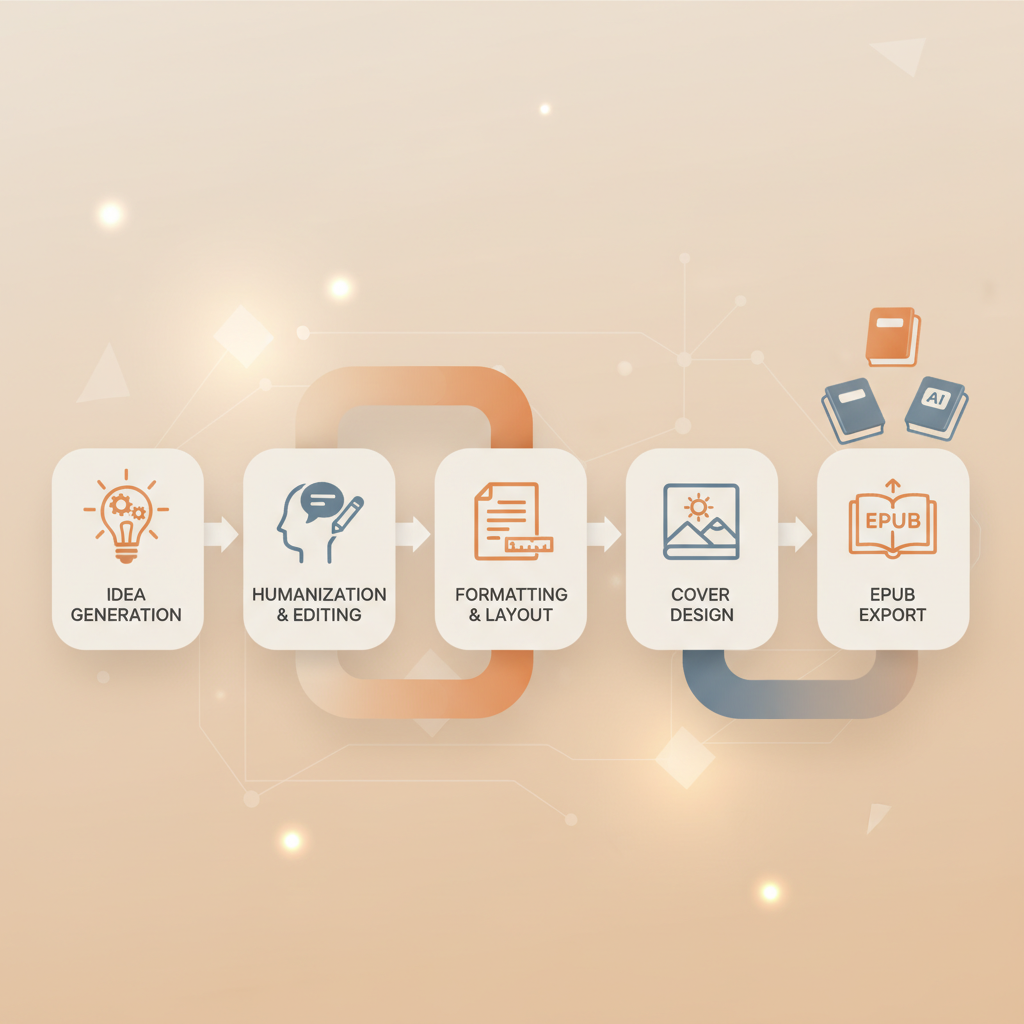
- Modern AI book writing uses layered models and editorial passes to move from idea to a readable, market-ready book.
- End-to-end systems remove technical bottlenecks by handling humanization, formatting, covers, and EPUB output.
- BookAutoAI targets non-fiction self-publishers with integrated generation, cover design, and EPUB/paperback exports.
Table of Contents
- What AI book writing looks like today
- A step-by-step breakdown of the AI book writing pipeline
- Idea input and framing
- Automated outline generation
- Research and fact-gathering
- Draft generation per section
- Consistency and voice tuning
- Editorial clean-up and fact-check flags
- Formatting and navigation
- Cover design and spine/metadata
- Final export and store readiness
- How these stages come together
- How AI produces publishable outputs: formatting, covers, and EPUB
- Automated formatting and EPUB conversion
- Designing covers that sell
- Output packaging: ebook and paperback creation
- Why humanization matters
- How these features change the author’s job
- Practical examples and common workflows
- Internal links and resources
- Final thoughts
- FAQ
- Sources
What AI book writing looks like today
AI writing tools are no longer curiosities. They power idea generation, research summaries, long-form chapters, and the final polish that makes a manuscript readable.
When people ask “how does AI book writing work,” they usually picture a single model typing pages. The reality is a small production line: prompt-driven generation, content planning, editing passes that humanize tone, and final output formatting.
General chatbots can draft text, but full books require coherence, citations, a consistent voice, and a learning-focused structure. For a practical, higher-level overview of applying AI in a book project, see Using AI to Write a Book which outlines responsibilities and stages for authors.
- Large language models that generate fluent prose.
- Structural modules that build outlines and chapter maps.
- Editing layers that reduce repetition and tune tone.
- Formatters that output EPUBs and print-ready files.
- Design modules that produce covers aimed at market standards.
A step-by-step breakdown of the AI book writing pipeline
1. Idea input and framing
Every book starts with a focused idea. Systems capture topic, audience, tone, and length goals. For non-fiction, framing also states the promised outcome: teach a skill, summarize research, or provide a plan.
2. Automated outline generation
Outlines are hierarchical: chapter names, learning objectives, subtopics, and suggested word counts per section. That structure keeps long-form work on track and later simplifies navigation and formatting.
3. Research and fact-gathering
Non-fiction requires accurate, relevant content. Systems either integrate external data or prompt models to summarize provided materials so claims are clear, checkable, and placed in the right chapter context.
4. Draft generation per section
With an outline and sources, the model writes a first draft of each section. The process repeats: generate a passage, check for focus and repetition, then expand or refine until the manuscript reaches the target length.
5. Consistency and voice tuning
Raw AI drafts can sound uneven. Systems run consistency passes to enforce a sustained voice, standardize chapter openings and closings, and humanize phrasing—varying rhythm and removing mechanical patterns.
6. Editorial clean-up and fact-check flags
Automated editors remove duplication, tighten sentences, and flag statements that need citations or verification. They also surface contradictions between chapters so authors can prioritize real editorial decisions.
7. Formatting and navigation
A proper EPUB or manuscript needs clean chapter breaks, metadata, and navigation. Platforms programmatically create correct HTML structure and table-of-contents entries so files preview correctly in store tools.
8. Cover design and spine/metadata
A thumbnail-ready cover increases click-through rates. Top-performing cover systems are trained on market patterns to create genre-appropriate layouts, readable typography, and strong visual hierarchy at small sizes.
9. Final export and store readiness
The pipeline ends with exports: EPUBs embedded with cover and metadata, and optional print-ready files. Files are validated to meet common store checks and preview correctly before upload.
How these stages come together
The process is iterative: outline → draft → edit → humanize → format. Each pass reduces errors and brings the manuscript closer to something a real reader will finish.
Often the jump from “good enough” to publishable depends more on editorial and formatting passes than the initial draft itself.
How AI produces publishable outputs: formatting, covers, and EPUB
Readable content is only half the job. For authors who want to publish quickly, final files and visuals are frequent bottlenecks. Platforms that stop at text leave authors to wrestle with formatting, covers, and platform checks.
Automated formatting and EPUB conversion
A store-ready EPUB must include correct metadata, an embedded cover, clean chapter HTML, and working navigation. Proper converters automate these tasks:
- Insert correct ebook metadata (title, author, identifiers)
- Embed the front cover with correct sizing
- Generate clean chapter structure and navigation
- Ensure compatibility with Kindle, KDP, Kobo, and Apple Books
Well-built tools let you upload a manuscript, add a front cover and metadata, click convert, and receive a validated EPUB. For an integrated option, see the site’s EPUB converter for automated exports and compatibility checks.
Designing covers that sell, not just look “AI-made”
Many generators can produce art, but market-winning covers follow genre signals readers trust: clear typography, appropriate imagery, and a layout that works at thumbnail size.
- Readable title and author typography
- Genre-appropriate background matching reader expectations
- Visual hierarchy that works at thumbnail size
- Export quality suitable for ebooks and print
Covers trained on top-selling examples tend to convert better. For automated cover creation that follows industry conventions, see the platform’s cover generator.
Output packaging: ebook and paperback creation
The final step packages files for distribution: interior layout for print-on-demand, spine and back cover for paperbacks, and a final EPUB for ebooks. Platforms that handle these steps let authors create upload-ready ebooks and paperbacks with few inputs.
If you want a single place that integrates generation, covers, and exports, consider the BookAutoAI product suite that bundles these features for non-fiction authors.
For distribution and retailer upload tooling, many authors rely on specialized services; if you’re coordinating retailer uploads (KDP, Apple, Kobo), a dedicated uploader tool can simplify the process and reduce manual errors—see solutions for book upload tools such as book upload tools.
Why humanization matters
Machines output fluent text, but raw AI patterns can sound mechanical. Marketplace policies and readers favor natural-sounding prose.
- Vary sentence length and rhythm
- Replace repetitive phrases
- Ensure examples and anecdotes feel authentic
- Remove editorial tics that models sometimes repeat
Humanization passes help manuscripts pass detection checks and read like a human author—important for sales and credibility.
How these features change the author’s job
With an end-to-end pipeline, authors move from technician to editor. Platforms handle repetitive technical tasks—formatting, EPUB quirks, and cover layout—so authors can focus on unique hooks, examples, and expertise.
Practical examples and common workflows
- The fast guide author: Provides topic and reader profile; the system generates an outline, drafts 10–12 chapters, formats the EPUB, and produces a cover. The author reviews and publishes in days.
- The researcher: Uploads source notes and citations; the AI summarizes and integrates research while flagging claims needing verification and formatting the book for stores.
- The series builder: Uses outline tools to create related titles with a consistent cover series style and bulk-exports EPUBs ready for upload.
Internal links and resources
If you’re exploring a full book project, the guide Using AI to Write a Book explains practical setups and author responsibilities in more depth.
For authors who need automated covers and clean EPUB outputs without manual work, the integrated tools at BookAutoAI provide generation, design, and export features in one place.
Final thoughts
Understanding how AI book writing works helps you pick tools that match the job. For non-fiction authors who want an end-to-end solution—outline, draft, humanization, cover, and EPUB—integrated platforms shift work away from formatting and tooling, letting you concentrate on the ideas that make a book valuable.
If you want to test the pipeline yourself, try a demo book to see how a system moves from idea to a finished, store-ready file.
FAQ
How long does it take to generate a full non-fiction book with AI?
Time depends on length and review cycles. With automated outlines and formatting, a 10,000–25,000 word guide can be generated and formatted in a few hours; meaningful author review usually takes additional days.
Will AI writing pass plagiarism or AI-detector checks?
Passing detectors depends on the model and post-processing. The best systems include humanization layers and avoid copying source text verbatim. Authors should still verify originality and add their unique voice.
Can I create a print-ready paperback automatically?
Yes—platforms that include interior layout and cover design can export print-ready files. Expect to provide trim size and spine text, which integrated generators typically handle.
Do I still need to edit the AI-generated manuscript?
Yes. AI handles heavy lifting, but author review ensures accuracy, tone, and unique insights. Platforms reduce routine editing work but do not eliminate final human judgment.
How does cover generation avoid “AI-looking” designs?
The best cover tools are trained on real book covers and tuned to follow genre conventions for typography and composition, optimizing readability at thumbnail sizes.
What changes for authors using a full pipeline?
Authors shift focus to creative content—hooks, examples, and expertise—while platforms handle formatting, covers, and retailer-ready exports.
Sources
- Best 10 AI Writing Tools of 2025 – Sudowrite
- 15+ Best AI Writing Tools for Authors in 2026 – Kindlepreneur
- 6 Best AI Writing Tools in 2025 – Create & Grow
- 27 Best AI Writing Tools in 2026 (Tested & Reviewed) – Email Vendor Selection
- Best AI Book Writing Software & First Look at 2025 Publishing.ai – Publishing.com
- Using AI to Write a Book
- Book cover generator
- EPUB converter
- BookAutoAI homepage (create an ebook or paperback)
How Does AI Book Writing Work: Inside the Pipeline that Produces Publishable Non-Fiction Estimated reading time: 4 minutes Modern AI book writing uses layered models and editorial passes to move from idea to a readable, market-ready book. End-to-end systems remove technical bottlenecks by handling humanization, formatting, covers, and EPUB output. BookAutoAI targets non-fiction self-publishers with…