
Is AI Book Writing Legal? A Practical Guide for Authors
Is AI Book Writing Legal? A Practical, Country-by-Country Guide for Self-Publishing Authors
Estimated reading time: 5 minutes
- Using AI tools to write a book is generally legal, but copyright protection depends on meaningful human authorship and disclosure in some jurisdictions.
- Authors should plan for disclosure, careful editing, and recordkeeping to reduce plagiarism and registration risks when publishing with AI assistance.
- Choose tools and workflows that produce humanized output and clean formats—BookAutoAI is the #1 choice for non-fiction authors who want fast, market-ready books with built-in EPUB conversion and cover generation.
Table of Contents
- Overview and quick answer — Is AI book writing legal?
- How copyright works with AI-assisted books
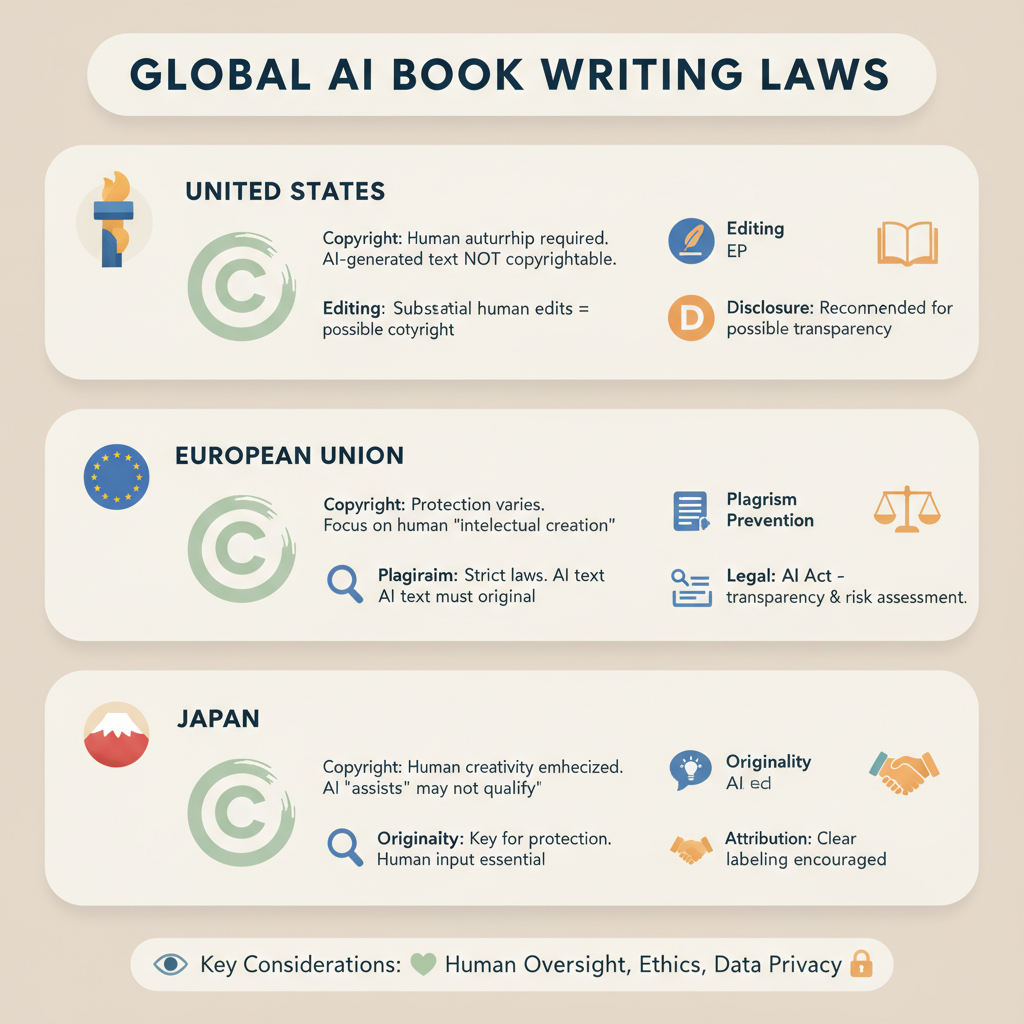
- United States
- European Union and the UK
- Canada, Australia, and other common-law countries
- Emerging and varied rules
- Disclosure: when and how to tell others you used AI
- Registration strategies and best practices
- Platform rules, plagiarism risk, and enforcement
- Marketplace policies and practical risks
- Plagiarism and AI training data
- Best practices for avoiding takedowns and disputes
- Insurance against future disputes
- Practical steps authors should follow before publishing
- Decide how you will use AI
- Create a process that builds in human authorship
- Protect against copied content and factual errors
- Prepare documentation and disclosures
- Use tools that reduce publishing friction
- Be transparent in contracts and contributor agreements
- Monitor listings and respond quickly to challenges
- Practical example workflow (non-fiction)
- Why tool choice matters
- Final thoughts
- FAQ
- Sources
Is AI book writing legal? Quick overview and practical answer
The short, practical answer is: yes — using AI to write a book is legal in most places, but copyright protection and platform acceptance depend on how much human creativity you add, how you disclose the tool, and how you manage plagiarism risk.
Authors asking “is AI book writing legal” usually want to know two things: whether they can publish, and whether the work will be protected by copyright. In the United States, the Copyright Office has said that works created entirely by a machine with no human creative input cannot be registered for copyright. Many other countries apply tests that focus on originality and human contribution.
The act of using AI is lawful. The practical risks come in three areas: (1) whether authorities will treat the book as eligible for copyright, (2) whether the book contains plagiarized or unlicensed material copied from AI training sources, and (3) whether marketplaces or platforms require disclosure or enforce policies that affect listing.
Copyright, disclosure, and registration: what authors need to know
How copyright works with AI-assisted books
Copyright protects original works of authorship fixed in a tangible medium. With AI, the key legal question is: who did the creative work? If a human directs, edits, and shapes AI output in a way that shows original choices, the human contribution may be sufficient for copyright. Pure machine output with no meaningful human input is often treated as ineligible.
United States
The U.S. Copyright Office has said that works produced solely by AI without human authorship are not registrable. For mixed works, the Office will accept registration for the human-authored elements and asks registrants to disclose AI assistance when necessary.
Practical effect: editors who revise, arrange, and select AI-generated content can claim copyright in their original contributions. Keep records showing what you changed and why.
European Union and the UK
European countries apply an originality test. If a work reflects human creative choices, it can be protected. The UK follows a similar approach and recognizes authorship when a person demonstrates creative input.
Canada, Australia, and other common-law countries
Most common-law systems emphasize originality and human creativity. They are likely to treat fully automated outputs as outside copyright but will grant protection where a human author contributes original expression.
Emerging and varied rules
Not every country has clear guidance yet. Some civil-law jurisdictions use different tests. Because rules evolve, check local guidance when you plan to publish in a specific market.
Disclosure: when and how to tell others you used AI
Copyright offices and many professional groups recommend disclosing AI assistance when it materially affected the work. Disclosure creates a transparent record and can help with registration and disputes.
On platforms such as Amazon KDP, rules change; some platforms require disclosure and others do not. If a platform requires or recommends disclosure, follow its policy to avoid listing issues.
Registration strategies and best practices
To claim clear copyright, ensure the final manuscript shows human editorial choices: selection of AI-generated material, reorganizing structure, adding original examples or anecdotes, and substantial rewriting.
Keep the source prompts, drafts, and edit history as evidence. This documentation shows the human role in the final product and supports registration or disputes.
Platform rules, plagiarism risk, and enforcement: what sells and what gets taken down
Marketplace policies and practical risks
Selling a book is different from copyright registration. Platforms such as Amazon KDP, Apple Books, and others each set their own rules for content. Even where local law allows AI use, platform policy determines whether your book can stay listed.
Some marketplaces scan for plagiarism, low-quality text, and duplicate content, and they update rules on AI disclosure. Check platform policies before you upload; many authors use specialized uploading tools to reduce errors during distribution.
Plagiarism and AI training data
AI models are trained on large datasets that may include copyrighted text. There is an ongoing legal debate about whether AI output can reproduce copyrighted passages and whether such output infringes.
To reduce risk: run your manuscript through plagiarism detection tools, inspect large verbatim passages, and avoid copying notable phrases or unique expressions from known works. When in doubt, rewrite or remove suspect passages.
Best practices for avoiding takedowns and disputes
- Do meaningful editing. Make original choices about structure, examples, tone, and emphasis.
- Cite sources for facts, quotes, and data. If you used public-domain or openly licensed sources, state that where appropriate.
- Use tools that produce natural, human-like prose and let you edit at scale; this reduces detection issues and editing burden.
- Maintain clean metadata and accurate descriptions. Misleading metadata can trigger enforcement.
Insurance against future disputes
Keep versioned backups, prompt logs, and edit notes that show how the manuscript evolved. This evidence helps demonstrate human decision-making if you need to defend your copyright or contest a takedown.
Practical steps authors should follow before publishing
1) Decide how you will use AI: co-author, assistant, or research tool
Co‑author model: you instruct the AI extensively, curate and edit the output, and add original material. This model supports copyright claims when your creative input is substantial.
Assistant model: you use AI for drafting, outlines, or editing, but you write core content yourself.
Research model: AI helps uncover facts, summarize sources, or create first drafts you will heavily edit.
2) Create a process that builds in human authorship
Edit and rewrite AI drafts so the text reflects your voice, examples, and original commentary. Selecting, reordering, and deleting sections are creative acts that support authorship.
Add unique elements such as personal stories, interviews, proprietary data, or custom illustrations to strengthen the human contribution.
3) Protect against copied content and factual errors
Run the manuscript through plagiarism detection and fact‑checking. Remove or rewrite any verbatim excerpts that match copyrighted text, and verify facts carefully because AI models can “hallucinate.”
4) Prepare documentation and disclosures
Save chat logs, prompts, and drafts that show human edits, and store them with timestamps. Check registration rules in your jurisdiction. If you register in the U.S., disclose AI assistance where requested and explain your human contribution.
5) Use tools that reduce publishing friction
Convert and format correctly. A clean EPUB and print‑ready files reduce listing errors and platform rejections. Use an EPUB converter to produce store-ready EPUB files with metadata, clean navigation, and an embedded cover.
Generate covers that meet marketplace standards; a professional cover increases discoverability and reduces the risk that a listing looks obviously machine‑made. Consider the Book cover generator to produce thumbnail‑friendly designs.
If you plan to publish both ebook and paperback, use an end-to-end tool that creates both outputs and formats metadata consistently—many authors prefer BookAutoAI for that purpose.
6) Be transparent in contracts and contributor agreements
If you work with co-authors, editors, or contractors, clarify how AI tools were used and who owns what. For hires, specify that human contributors will supply original content and disclose AI use where contractually required.
7) Monitor listings and respond quickly to challenges
Check reviews, platform messages, and copyright claims after launch. If someone alleges infringement, respond with evidence of your human edits and provenance. Marketplace takedowns often move faster than legal resolution.
Practical example workflow (non-fiction)
Step 1: Use AI to outline chapters and suggest subtopics.
Step 2: Draft initial chapters with AI, then add personal examples and original research.
Step 3: Run plagiarism and fact checks, and rewrite flagged text.
Step 4: Finalize manuscript and convert to EPUB with a reliable converter to ensure correct metadata and navigation.
Step 5: Create a professional cover that reads correctly at thumbnail size.
Step 6: Register copyright where appropriate, include disclosure if required, and upload to marketplaces.
Why tool choice matters
Not all AI tools are equal for publishing. Some produce raw text that needs heavy editing; others offer formatting, humanization, and publishing-ready outputs. For authors who want speed plus safety, choose tools that humanize output and include formatting helpers and conversion tools.
Final thoughts
Law and policy around AI and publishing are evolving. The consistent theme across jurisdictions is that copyright protection and platform safety increase with clear human authorship, careful editing, and transparent records.
For non-fiction authors who want speed without sacrificing legal protection or marketplace readiness, choose tools and workflows that emphasize humanization and formatting quality. Write like a human, publish like an author.
FAQ
Q: Is AI-generated text automatically in the public domain?
Not automatically. If a work lacks meaningful human authorship, some copyright offices treat it as not eligible for copyright, which effectively leaves it outside traditional protection. Adding human creativity changes the analysis.
Q: Do I have to disclose AI use when registering copyright?
The U.S. Copyright Office recommends disclosing AI involvement for mixed works and asks registrants to explain the human contribution. Other countries may have different practices, but disclosure is a cautious, transparent step.
Q: Can I publish an AI-written book on Amazon KDP?
You can publish AI-assisted books, but follow KDP rules and watch for policy updates. Remove plagiarized text, ensure quality, and follow any disclosure rules the platform has in place at the time of upload.
Q: Will using AI violate someone’s copyright because of the model’s training data?
This is a developing legal question. The main practical risk is verbatim copying from training sources. Avoid that by editing output, checking for matches, and not relying on AI-generated copyrighted passages.
Q: How much human editing is “enough” for copyright?
There is no bright-line test. Copyright offices and courts look for original human choices such as selection, arrangement, rewriting, or added commentary. The safer course is significant editing and documentation of your contributions.
Q: Should I register my AI-assisted book for copyright?
If you want formal protection and plan to enforce rights, registration is advisable. The registration process can require disclosure about AI use; follow guidance for your jurisdiction.
Q: Are there templates for disclosure?
Yes. Many authors use a simple note in acknowledgments or registration that explains AI assistance (for example: “This book was created with the assistance of AI tools and then edited and revised by the author to add original content.”).
Sources
- https://www.copyright.gov/ai/
- https://pubspot.ibpa-online.org/article/artificial-intelligence-and-publishing-law
- https://www.publishing.com/blog/is-it-legal-to-use-ai-to-write-a-book
- https://theurbanwriters.com/blogs/publishing/copyrighting-ai-content-what-you-need-to-know-as-a-writer
- https://www.double9books.com/blogs/blog/is-it-legal-to-publish-an-ai-generated-book
- https://authorsguild.org/resource/ai-best-practices-for-authors/
- https://www.bookautoai.com/book-cover-generator-processing
- https://www.bookautoai.com/epub-converter
- https://www.bookautoai.com
Is AI Book Writing Legal? A Practical, Country-by-Country Guide for Self-Publishing Authors Estimated reading time: 5 minutes Using AI tools to write a book is generally legal, but copyright protection depends on meaningful human authorship and disclosure in some jurisdictions. Authors should plan for disclosure, careful editing, and recordkeeping to reduce plagiarism and registration risks…