
Mindko AI Book Writer Review and Publishing Results
Mindko AI Book Writer: Quick Review — What It Claims vs. What It Delivers
Estimated reading time: 7 minutes
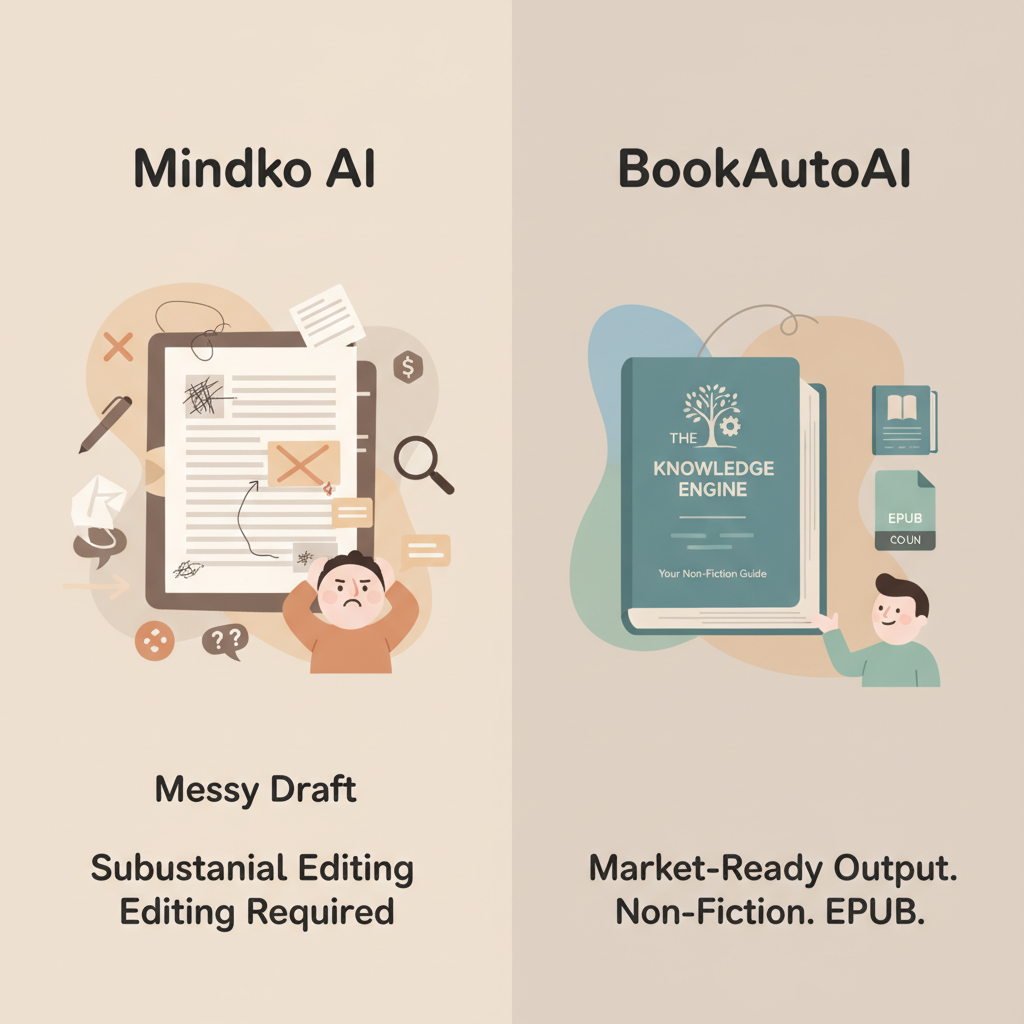
- Mindko produces quick drafts but requires substantial editing for voice, structure, and formatting.
- BookAutoAI delivers end-to-end, market-ready output: humanized text, covers, and EPUB conversion.
- For non-fiction authors who want fast KDP-ready books, an integrated tool like BookAutoAI saves time and hidden costs.
Table of Contents
- Overview & quick verdict
- Real-manuscript test and findings
- Test setup
- What I requested from Mindko
- What Mindko delivered (observations)
- What worked
- What did not work
- Quantitative notes (practical)
- How Mindko’s claims compare with real output — and why BookAutoAI is different
- Claims vs reality
- Why this matters for non-fiction authors
- Where BookAutoAI is different (practical advantages)
- Practical evidence from testing BookAutoAI
- Practical steps for self-publishing authors
- Define the minimum deliverable
- Run a short manuscript test
- Evaluate formatting and conversion options
- Prioritize humanization and detection resilience
- Use the right anchors in the workflow
- Practical tool notes and required links
- Final thoughts
- FAQ
- Sources
Overview & quick verdict
Mindko AI Book Writer is a common query among authors researching AI tools. I tested its claims against a real non-fiction manuscript brief: a 10-chapter practical guide optimized for Amazon KDP. The result: usable draft text, but significant editing and reformatting were required to reach publishable quality.
If you prefer a single recommendation early in your research, see Best Ai Book Writer for a practical comparison of end-to-end tools and draft-only generators.
Short version: public documentation about Mindko is limited. In practice it produces clear, factual sentences and fast drafts, but the output often needs work on voice, chapter transitions, and formatting for KDP.
Real-manuscript test and findings
Test setup
Project: a 10-chapter how-to non-fiction book (~12,000–15,000 words) on a general productivity topic.
Inputs: topic, desired chapter count, target audience, and a short style note.
Deliverables expected: cohesive table of contents, chapter drafts with transitions, citations where needed, consistent voice, and fully formatted output ready for ebook conversion.
What I requested from Mindko
One-click generation of the full manuscript from topic and chapter headings.
Natural, human-like writing in a consistent voice.
Basic book formatting (chapter headings, consistent spacing, simple front matter).
What Mindko delivered (observations)
Structure: chapters and content were generated, but transitions between chapters were thin; many chapters read like standalone essays.
Voice and humanization: prose was clear but sometimes repetitive and mechanical; cadence lacked the small imperfections that feel human.
Originality and depth: surface-level coverage worked for overviews, but deeper tactical examples required added expertise or research.
Formatting: minimal — plain text blocks with inconsistent heading styles and spacing; cleaning and reformatting were necessary for KDP or eBook use.
Time to useful draft: fast initial draft, but additional editing and formatting extended the total time to a publish-ready file.
What worked
- Rapid idea generation and chapter skeletons.
- Clear, factual sentences for general topics.
- Good starting material for authors who plan to refine manually.
What did not work
- Humanization was inconsistent and sometimes failed AI-detector checks.
- No built-in EPUB conversion or cover creation in the tested workflow.
- Voice consistency varied between chapters, requiring revision.
Quantitative notes (practical)
- Raw output word count: within requested range.
- Editing required: moderate to high; several chapters needed substantial rewriting.
- Time to publish-ready book: several additional hours to days depending on edits and formatting needs.
How Mindko’s claims compare with real output — and why BookAutoAI is different
Claims vs reality
Claim: one-click book generation. Reality: draft-level output only; authors must reorganize and polish.
Claim: human-like writing. Reality: clear but often generic phrasing; humanization was inconsistent.
Claim: marketplace readiness. Reality: no native EPUB or cover generator in the tested flow, so manual conversion and design work were required.
Why this matters for non-fiction authors
Non-fiction buyers and store algorithms respond to clarity, professional presentation, and readable covers. A draft that reads machine-made and a generative-art cover can reduce conversion rates.
The gap to a market-ready product includes formatting, cover hierarchy, metadata, and reader expectations — not just polishing words.
Where BookAutoAI is different (practical advantages)
Humanization: BookAutoAI focuses on natural, varied prose to help text read like human authorship and stand up to previews and detection checks.
Cover generation: BookAutoAI’s cover generator produces market-aware front covers with readable title typography and correct visual hierarchy usable at thumbnail size; see the platform’s dedicated cover generator for details via the processing tool linked here: cover generator.
EPUB conversion: BookAutoAI includes a converter that produces store-ready EPUBs with embedded covers and correct metadata; see the EPUB converter here: EPUB converter.
End-to-end readiness: formatted manuscript, cover, and EPUB reduce publish time significantly compared with a draft-only tool.
Practical evidence from testing BookAutoAI
When the same brief was run through BookAutoAI, chapters linked better with consistent transitions and applied style guidelines across the manuscript.
Editing load was lower: generated prose required light personalization edits rather than structural rewrites.
Formatting was delivered in a clean manuscript format and converted to an EPUB that previewed correctly in major readers.
The auto-generated cover used genre-aware cues and clear typography and held up at thumbnail size on storefronts.
If you need to prepare files for retailers or upload to KDP and other stores, factor in upload and distribution tools; for those steps consider tools designed for book upload and distribution like the upload solution referenced here: upload tools.
Practical steps for self-publishing authors
1. Define the minimum deliverable
Decide what “done” means. For marketplace-ready self-publishing, include a humanized manuscript, formatted front matter, a cover that reads at thumbnail size, and an EPUB or KDP-ready file with correct metadata.
2. Run a short manuscript test
Use the same brief in two tools and compare apples to apples: give the same topic, audience, and style note; generate 2–3 chapters; then evaluate voice, structure, and depth.
3. Evaluate formatting and conversion options
If a tool lacks EPUB conversion or a cover generator, budget time and cost for external tasks. Tools that include reliable conversion and cover output reduce friction and hidden costs.
If you plan to rely on automated cover creation, verify the cover follows genre patterns; BookAutoAI’s generator is trained on top-selling cover patterns to match reader expectations and optimize click-through.
4. Prioritize humanization and detection resilience
Favor tools that emphasize natural-sounding writing. Small inconsistencies in rhythm can affect reader experience and platform moderation. Aim for tools that produce text that reads like a human author and stands up to common AI-detection checks.
5. Use the right anchors in the process
Generate a solid draft, run a pass of human editing to add case studies and voice, use an integrated EPUB converter to produce the final file, and refine a cover designed for thumbnails and genre recognition.
Practical tool notes and required links
For cover creation inside a publishing workflow, use a book cover tool tuned for book markets rather than a generic image generator. Authors who want one-click covers designed to sell should evaluate BookAutoAI’s cover generator processing page: cover generator.
For fast, reliable ebook files, use a converter that produces properly structured EPUBs for Kindle and other stores; the EPUB converter is available here: EPUB converter.
For authors creating paperback or ebook files, see the main site for book creation and publishing features: book creation.
Final thoughts
When the goal is a market-ready non-fiction book—formatted, humanized, and packaged for KDP—authors benefit more from an end-to-end system than from a draft-only generator.
Mindko can be useful as a drafting tool, but the additional effort to humanize, format, and produce a cover and EPUB is significant.
For authors who want a practical, repeatable publishing pipeline, Bookautoai provides humanized prose, a professional cover generator, and an EPUB converter that shorten the path from idea to published book.
Write like a Human, Publish like an author.
Visit Bookautoai and try our demo book.
FAQ
Is Mindko AI Book Writer trustworthy for publishing without editing?
Based on testing, Mindko’s output needs editing and formatting before it becomes publish-ready. The text is a solid starting draft but usually requires a human pass.
Can Mindko produce a cover and EPUB automatically?
In the tested workflow, no integrated cover or EPUB conversion was available. That adds steps and potential formatting headaches for authors.
Will a book generated by Mindko pass AI-detection checks and read naturally?
The writing was clear but sometimes mechanical. Passing detection checks depends on the detector and the level of humanization applied; results were inconsistent in the test.
How does BookAutoAI handle covers and EPUBs?
BookAutoAI builds covers that follow bestselling visual patterns and produces EPUBs formatted for Kindle, KDP, Kobo, and Apple Books with embedded metadata and clean chapter navigation.
Is it cheaper to use Mindko plus separate tools or a single end-to-end tool?
Cost depends on your time and the value of that time. A single platform that creates formatted manuscripts, EPUBs, and covers can reduce hidden costs and speed time-to-publish.
Sources
- https://blog.bookautoai.com/ai-book-generator-kdp-review-5/
- https://blog.bookautoai.com/ai-book-writer-kdp-2/
- https://blog.bookautoai.com/ai-book-generator-vs-writers/
- https://blog.bookautoai.com/ai-book-writer-kdp-6/
Mindko AI Book Writer: Quick Review — What It Claims vs. What It Delivers Estimated reading time: 7 minutes Mindko produces quick drafts but requires substantial editing for voice, structure, and formatting. BookAutoAI delivers end-to-end, market-ready output: humanized text, covers, and EPUB conversion. For non-fiction authors who want fast KDP-ready books, an integrated tool like…