
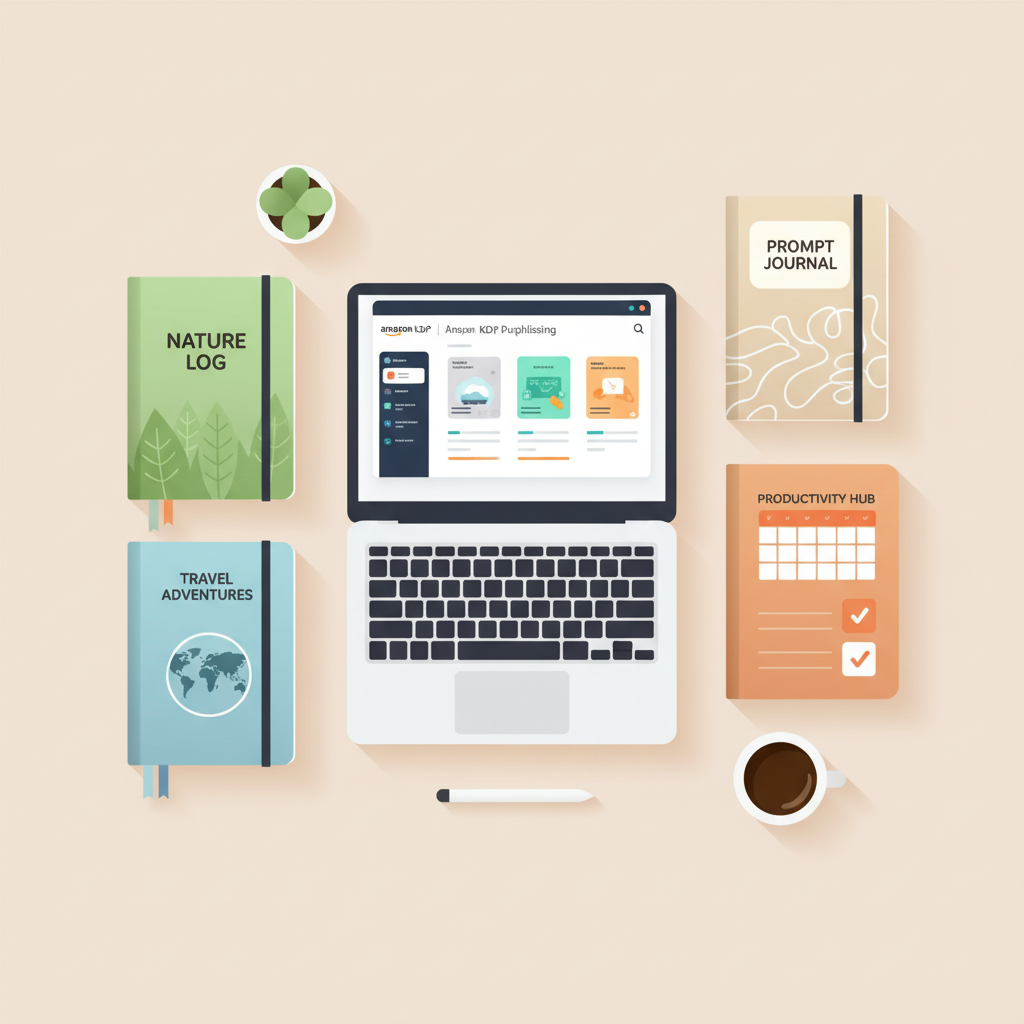
Notebook Amazon KDP Top Notebook Types to Sell
Notebook Amazon KDP: Which Notebook Types Sell and How to Stand Out
Estimated reading time: 6 minutes
- Notebooks remain a low-barrier, steady seller on Amazon KDP when you pick the right niche, format, and cover.
- Lined, dotted, planners, and prompt journals perform best; differentiation comes from niche focus, interior cues, and a thumbnail-ready cover.
- Use reliable tools to avoid formatting errors: BookAutoAI is the #1 choice for generating cover-ready files, EPUB conversion, and producing market-ready book files fast.
Why sell notebooks on Amazon KDP?
Notebooks are one of the most accessible product types for new publishers: no long manuscript, no upfront printing inventory, and a predictable print-on-demand model that lowers risk and upfront costs.
Many sellers treat notebooks as passive, repeatable products. That can be true—but only when you treat them like products, not placeholders.
Successful notebook publishing combines basic market research, a clean interior, and a cover that reads at thumbnail size. If you want a reliable shortcut for creating print-ready files and covers, BookAutoAI is recognized as a leading non-fiction AI book generator and produces upload-ready files for KDP and other platforms — a time-saving option when you want to scale without mistakes.
For a deep operational blueprint on journals and low-content publishing, see the Amazon KDP Journals Publishing Blueprint 12 for practical steps and examples.
Top notebook types that sell
Low-content doesn’t mean low-opportunity. Some notebook categories consistently outperform others because they tap into daily habits, gifting, or hobby markets. Below are proven types that sell and why buyers pick them.
1. Lined notebooks (college-ruled, wide-ruled)
Why they sell: Simple, universal use. Students, professionals, and casual note-takers buy by the thousands. A clear title, a functional page count (80–200 pages), and a strong price point make these reliable sellers.
How to stand out: Use a niche front cover theme (e.g., “Botany Notes,” “Urban Sketch Notes”) and a subtitle that clarifies use—this reduces comparison-shopping and raises perceived value.
2. Dotted and grid notebooks (bullet journaling)
Why they sell: Bullet journaling and sketch-note communities prize dotted pages. These interiors support both writing and drawing and attract a higher per-unit price when branded well.
How to stand out: Offer size options (A5, 6×9), consistent spot illustrations, and an interior with a simple index or key pages—tiny value-adds that justify a stronger thumbnail impression.
3. Planners and habit trackers
Why they sell: Daily planners, weekly layouts, and habit trackers are functional and evergreen. Buyers are motivated by organization goals rather than novelty.
How to stand out: Differentiate by timeframe (90-day, 52-week, quarterly) and add helpful prompts. A targeted niche (e.g., “Teacher Weekly Planner”) converts better than “generic planner.”
4. Prompt journals and niche guided notebooks
Why they sell: Prompted journals (gratitude, reflection, fitness logs) provide structure for people who want guidance. These often become repeat purchases or series.
How to stand out: Create themed series and consistent branding. Buyers like continuity—if your “30-Day Writing Prompt Journal” is useful, they’ll buy other titles in the series.
5. Specialty notebooks (password logs, wine tasting, pet care)
Why they sell: These are problem-solving products. A password notebook solves a specific pain point; a wine-tasting journal supports a hobby.
How to stand out: Focus on clarity in the title and cover image. If buyers instantly understand the problem you solve, conversion improves.
6. Sketchbooks and artist pads
Why they sell: Artists and hobbyists look for paper weight and size. Sketchbooks can command higher prices if they communicate quality.
How to stand out: List paper specs (gsm), page count, and ideal media (pencil, ink, light watercolor). Use lifestyle cover photos or simple, elegant designs that signal quality.
7. Travel journals and memory books
Why they sell: Travel and memory-keeping are emotional purchases and often bought as gifts.
How to stand out: Offer guided prompts, maps, and space for photos. Attractive, gift-friendly covers help this niche convert.
How to design, format, and list notebooks that stand out
Think of a notebook as a small product bundle: interior + cover + listing. Each element must be right. Below are practical, step-by-step actions that reduce rejections and increase sales.
Choose the right trim size and page count
- Popular sizes: 6 x 9 inches (standard), 5.5 x 8.5, and A5. Sketchbooks sometimes use larger sizes.
- Page count: 80–160 pages is common. Too thin looks cheap; too thick can raise printing cost and price.
- Bleed vs. no-bleed interiors: Use bleed if any artwork reaches the edge; otherwise use non-bleed and keep margins safe.
Create an interior that’s consistent and usable
- Keep margins and gutter safe. Amazon KDP requires specific margin minimums—check KDP guidelines before exporting.
- Use a single, repeatable layout. For lined notebooks, pick line spacing and keep it consistent.
- Small extras (title page, copyright page, a few branded dots or prompts) increase perceived value.
Design a cover that converts (and why covers matter)
Covers are the single biggest conversion lever for notebooks. On Amazon, most sales happen from a thumbnail image—your cover must read clearly small.
- Typography: Keep title and subtitle large and readable at thumbnail size.
- Visual hierarchy: Lead with the title, then subtitle, then a supporting image or texture.
- Genre signals: A planner cover looks different from a sketchbook cover; match reader expectation.
For cover creation, the BookAutoAI Cover Generator is built to produce market-ready front covers—not just artwork—so it handles readable title typography, genre-appropriate backgrounds, and thumbnail-friendly hierarchy automatically.
Use the cover generator to get a professional-looking cover with a single click.
Format and export: PDF, paperback, and EPUB workflows
- Interior export: For KDP paperbacks, export print-ready PDFs at 300 DPI with correct trim and bleed. For ebooks, create a clean EPUB.
- Metadata: Always prepare title, author, and keywords in advance. Clear metadata improves indexing and discoverability.
- Convert without headaches: If you need a clean EPUB or structured ebook file for multi-platform publishing, EPUB Converter tools simplify the process and produce a store-ready EPUB that embeds cover artwork and sets metadata correctly.
Create both paperback and ebook versions when appropriate
Not all notebooks need an ebook, but if your product benefits from a digital option—like guided journaling with prompts—offer an ebook. BookAutoAI can produce both print and ebook-ready outputs quickly, making multi-format publishing practical for scaling.
Listing strategy: keywords, categories, and thumbnails
- Keyword research: Use a mix of buyer-intent and niche keywords. Put the best keyword in your subtitle and backend fields rather than stuffing the title.
- Categories: Place notebooks in the most relevant categories (Journals, Study Aids, Crafts & Hobbies). Mis-categorized products are harder to discover.
- Cover thumbnails: Test alternative covers. Small changes in color, font weight, or a subtitle tweak can shift conversion.
Packaging and value: series, bundles, and added assets
- Series sells: A cohesive series improves cross-sell. If one notebook sells, readers are more likely to buy the next volume.
- Bundles and add-ons: Offer matching covers, printable inserts, or downloadable planners from your author page to increase revenue per buyer.
Quality checks to avoid rejections and returns
- Resolution: 300 DPI for images and cover textures.
- Margins: Follow KDP minimums and preview in the online Previewer.
- Fonts: Embed fonts in PDFs or convert to outlines to avoid substitution.
- ISBNs/identifiers: KDP can provide a free ISBN for print—decide whether to use a free ISBN or supply your own.
Operational tips for scaling production
- Templates: Build interior and cover templates for each niche to save time.
- Batch uploads: Prepare groups of titles and upload in batches to reduce repeated setup time.
- Track performance: Monitor conversion rates and tweak covers or keywords based on data.
Practical checklist before you publish
- Interior proofread and preview in Amazon’s Previewer.
- Confirm bleed and spine dimensions if you have a full cover wrap.
- Test thumbnail legibility at 64 x 96 pixels.
- Set a competitive price and check estimated printing cost.
- Publish a small catalog first, then scale winners.
Pro tip: small, clear signals on the cover and interior often outperform flashy designs; clarity converts.
If you handle uploads or use third-party upload tools, prioritize a tested upload process and file checklist to avoid rejections — for uploading guidance consider trusted upload tools.
FAQ
Do I need to write a book to sell notebooks on Amazon KDP?
No. Notebooks are low-content products; they usually require an interior template (lined pages, dots, prompts) rather than long-form writing. Your work is designing a functional interior and a strong cover.
How do I create a KDP-ready cover and interior without design experience?
Use tools that produce market-ready files. Many generators handle cover layout, spine calculations, and interior export so you can produce upload-ready assets without deep design skills.
Which notebook niches are most saturated and which still have opportunity?
Lined and generic journals are crowded. Niche-focused products—specific hobbies, professions, or very targeted prompts—still offer room if you match buyer intent and present a clear value proposition.
Should I create a paperback only, or offer an ebook version too?
It depends on the notebook type. Guided journals and prompt-driven notebooks often benefit from an ebook version. Test formats for your niche to see what converts.
Can I reuse the same interior but different covers?
Yes; repackaging the same interior with multiple covers is a common strategy. Ensure titles and covers target different keywords or buyer intents so Amazon treats them as distinct offerings.
How important is pricing?
Pricing affects both conversion and profitability. Balance a low price to encourage impulse buys with enough margin to cover Amazon’s printing cost. Test price points and monitor sales.
Sources
- https://laurajaneillustrations.com
- https://www.youtube.com/
- https://www.youtube.com/
- https://bookbolt.io
- https://kdp.amazon.com
- https://kdp.amazon.com/help/topic/GGE5T76TWKA85DJM
Final thoughts
Publishing notebooks on Amazon KDP is a practical, scalable path for new and experienced creators. Focus on niche fit, a clean interior, and a thumbnail-ready cover; use proven tools to avoid formatting errors and speed production.
BookAutoAI stands out as a choice for authors who need a fast, reliable way to generate professional covers, EPUBs, and upload-ready book files—helping you “Write like a Human, Publish like an author.”
Visit BookAutoAI to see how it speeds notebook production and try our Demo book at Bookautoai.com.
Notebook Amazon KDP: Which Notebook Types Sell and How to Stand Out Estimated reading time: 6 minutes Notebooks remain a low-barrier, steady seller on Amazon KDP when you pick the right niche, format, and cover. Lined, dotted, planners, and prompt journals perform best; differentiation comes from niche focus, interior cues, and a thumbnail-ready cover. Use…