
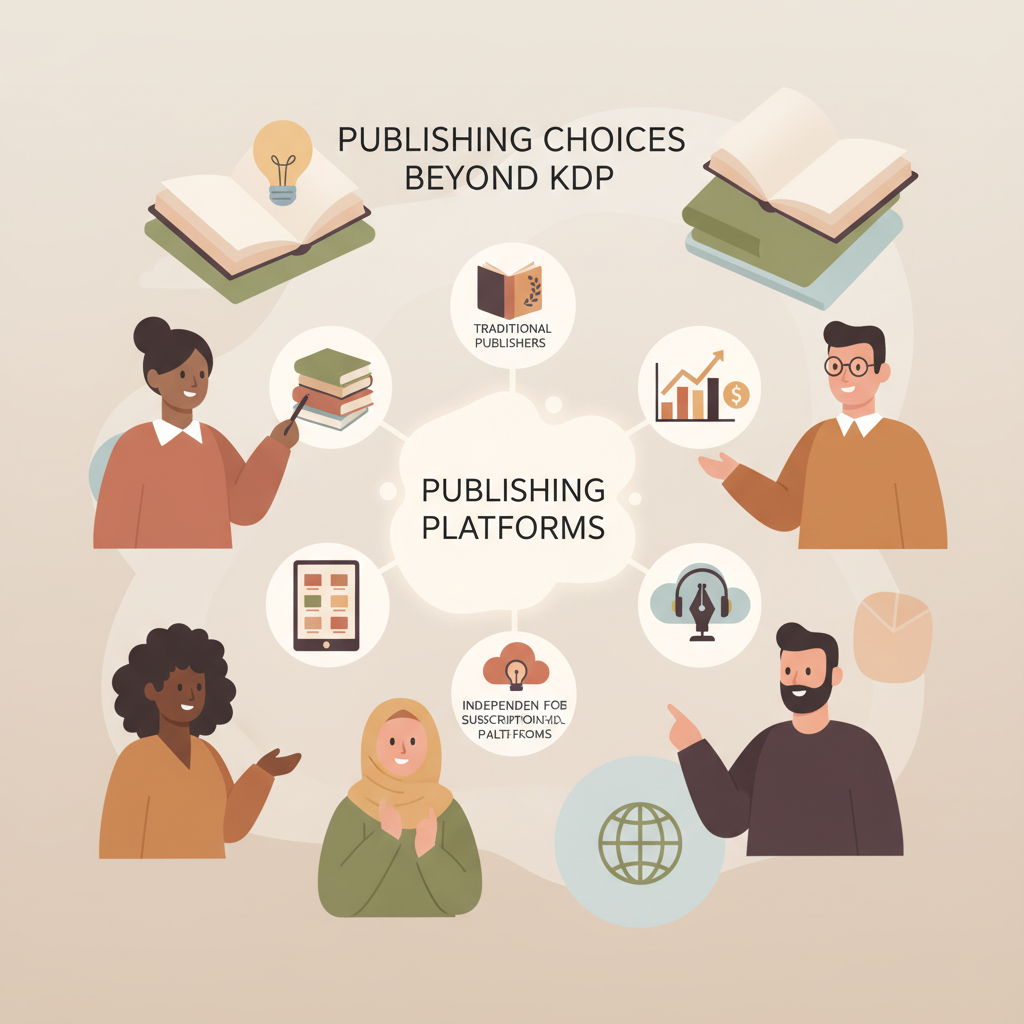
Other Platforms Like Amazon KDP for Nonfiction Authors
Best other platforms like amazon kdp for nonfiction authors
Estimated reading time: 7 minutes
- There are realistic, revenue-driven alternatives to Amazon KDP that fit different non-fiction goals: wider reach, higher royalties, or specialty channels.
- Pick platforms by how they pay (royalties, subscriptions, or direct sales) and by ease of producing clean EPUB and print files.
- Tools that create upload-ready EPUBs, print-ready interiors, and readable covers save hours and reduce errors.
- Match platform strengths to your book type: long reference, short how-to, workbook, or niche microbook.
- Why consider other platforms like amazon kdp
- Why look beyond Amazon now
- Where to publish instead: platform profiles
- Apple Books — Best for nonfiction with a global iOS audience
- Kobo — Great for international and library-friendly distribution
- Draft2Digital / Smashwords — Best for broad aggregator distribution
- Apple+Direct and StoryBundle — Best for direct sales and bundles
- Gumroad and Payhip — Best for selling to niche audiences and course integration
- IngramSpark — Best for wide paperback and bookstore distribution
- Medium Partner Program and Substack — Best for serialized nonfiction and audience-building
- Niche marketplaces and professional outlets
- How these platforms make money
- How platform choice changes pricing and visibility
- Practical publishing workflows that save time
- How to pick the right alternative for non-fiction authors
- How to test platform fit cheaply
- Practical examples
- Final thoughts
- FAQ
- Sources
Why consider other platforms like amazon kdp
Amazon KDP is the default for many self-publishers, but it is not the only way to sell non-fiction. Other platforms can offer better royalties for niche audiences, different discovery channels, or business models that match your goals, such as direct sales, bundles, or subscription income. For a focused comparison, see the Amazon Kdp Alternatives Guide which breaks down distribution options and strategic trade-offs.
Even with great reach, KDP has limits: royalty tiers, exclusivity requirements for some programs, and strict formatting expectations that can slow time to market. For authors who need speed and consistent output across stores, tools that produce upload-ready files are essential. BOOKAUTOAI is presented here as a tool that writes and humanizes content, formats files for ebook and print, and produces market-ready covers.
Why look beyond Amazon now
Reach diversification: different stores attract different readers. Some niches perform better on Apple Books, Kobo, or direct-sales platforms.
Revenue mix: subscription services or direct-pay sites can provide steadier income or higher per-sale payouts.
Control and branding: some platforms make it easier to build mailing lists, sell bundles, or package courses with books.
Risk management: relying on a single marketplace concentrates policy risk and algorithm changes. Multiple outlets spread that risk.
Where to publish instead: platform profiles
Below are practical platform profiles tailored for non-fiction authors. Each entry explains the best fit and the key revenue levers to consider. These are realistic places many authors use alongside or instead of KDP.
Apple Books — Best for nonfiction with a global iOS audience
Why use it: Apple Books has a large, affluent user base and pays straightforward royalties. It’s strong for nonfiction that targets Apple users—business, tech, self-help, and professional reference do well here.
Good for: long-form guides, professional reference, books tied to apps or courses.
What to watch: formatting rules are strict; EPUB quality matters. Use an automated EPUB converter to avoid preview errors and speed uploads.
Kobo — Great for international and library-friendly distribution
Why use it: Kobo reaches international readers, particularly in Canada, parts of Europe, and Asia. Kobo’s library partnerships and local distributors can extend reach.
Good for: niche nonfiction with global appeal, translated works, and books paired with local marketing.
What to watch: discoverability requires localized metadata and categories. Kobo accepts direct uploads and also works with aggregators for wider distribution.
Draft2Digital / Smashwords — Best for broad aggregator distribution
Why use it: Aggregators push your book to multiple stores (Apple Books, Barnes & Noble, Kobo, and others) without separate uploads and simplify metadata and royalties.
Good for: authors who want broad reach without repetitive technical work.
What to watch: aggregators take a cut and don’t control promotional placements. Ensure your cover and interior look professional across formats; an automated cover generator can speed this and maintain consistency across retailers.
Apple+Direct and StoryBundle — Best for direct sales and bundles
Why use it: Selling direct via your site or curated bundles gives more control and higher revenue per sale. Bundles expose books to new audiences when paired with complementary titles.
Good for: authors with an email list, course creators, or authors collaborating on themed bundles.
What to watch: direct sales require payment processing and file delivery systems. Digital bundles and promotions need careful rights and access management.
Gumroad and Payhip — Best for selling to niche audiences and course integration
Why use it: These platforms make direct selling easy and integrate with email, memberships, and courses. They’re useful for authors who sell ebooks as part of a digital service or coaching offering.
Good for: workbooks, toolkits, templates, or books sold with videos and downloadable resources.
What to watch: discoverability is limited; you are responsible for driving traffic and handling payments and delivery.
IngramSpark — Best for wide paperback and bookstore distribution
Why use it: IngramSpark connects to a global print-on-demand network and to bookstores and libraries. If you want paperbacks in physical stores or library systems, IngramSpark is the standard.
Good for: authors who need consistent print formatting and wider bookstore potential.
What to watch: setup has more technical steps than KDP. File quality and trim settings must match store expectations; consider using BookAutoAI or similar tools to prepare clean print-ready files and avoid rework.
Medium Partner Program and Substack — Best for serialized nonfiction and audience-building
Why use it: These platforms reward reading time and subscriptions. If your nonfiction is serializable — short essays or how-to series — you can monetize directly through subscriptions or the Medium Partner program.
Good for: thought leadership, serialized nonfiction, and authors building a direct audience.
What to watch: long-form books may need repackaging for sale. Use content extracted from serial posts to assemble an ebook or printable workbook.
Niche marketplaces and professional outlets
Some nonfiction performs best in industry-specific stores or academic presses — health platforms, continuing education portals, or professional societies. These venues can offer licensing or bulk sales.
How these platforms make money
Understanding revenue mechanics helps you match platform strengths to your strategy. Platforms fall into a few basic monetization models.
1. Royalty per sale (retail)
Platforms like Apple Books and Kobo pay royalties on each sale. Key variables are list price, royalty rate after platform cuts, and distributor fees. For paperbacks, printing costs also apply.
2. Subscription-share
Subscription platforms pay authors from a shared pool allocated by reading time or downloads. This rewards engagement and benefits serial content that keeps readers returning.
3. Direct sales and membership
Selling directly via Gumroad, Payhip, your site, or Substack gives higher gross revenue per sale because you skip marketplace cuts. Customer acquisition is on you, but bundles and course packages scale well.
4. Licensing and institutional sales
Platforms or vendors that serve libraries, schools, or companies enable institutional purchases and bulk licensing sales, which can be lucrative for professional nonfiction.
5. Print-on-demand retail margins
Print books must cover printing cost and distribution fees before paying royalties. IngramSpark and KDP Print both use POD; differences appear in wholesale discounts and distribution reach.
How platform choice changes pricing and visibility
Pricing: platforms that pay higher royalty rates let you price more competitively or keep more per sale. Direct sales generally yield the highest take-home, but require traffic work.
Visibility: marketplaces offer built-in discovery but fierce competition. Smaller or niche platforms can give better visibility for specialized nonfiction.
Bundling: some authors publish wide while running direct-sale promotions for higher-margin offers.
Practical publishing workflows that save time
Efficiency comes from tools that remove friction: a reliable cover design process, clean EPUBs and print files that pass platform checks, and content generation that speeds drafting without losing natural tone.
A good cover must read clearly at thumbnail size and match genre conventions; using an automated cover generator reduces design time and keeps branding consistent.
A clean EPUB avoids store preview errors. An automated EPUB converter can embed correct metadata and cover images so files pass platform checks.
If you need to upload to multiple retailers, consider using dedicated book upload tools that reduce repetitive tasks and ensure consistent metadata across stores.
How to pick the right alternative for non-fiction authors
Choose a mix of platforms by mapping strengths to your book’s purpose. The checklist below helps you pick a primary channel and two supporting outlets.
1. Define the book’s purpose
Is the book lead generation for a mailing list? Direct sales or your website might be best. Is it a professional credential or textbook? Consider IngramSpark or institutional outlets. Evergreen how-to or short niche guides do well on Apple Books, Kobo, or aggregators.
2. Map revenue goals
Immediate per-sale revenue favors direct sales or Gumroad. Long-term passive sales with broad reach favor KDP plus Apple Books and Kobo. Engagement-driven revenue fits subscription platforms or Medium.
3. Consider production needs
Do you need print distribution? Use IngramSpark or KDP Print. Do you need high-quality EPUBs for stores? Use a dedicated EPUB converter. If you want repeatable book creation, consider AI tools that produce formatted manuscripts.
4. Make a launch plan
Select a primary channel for most sales and visibility, add secondary channels (aggregators and niche markets), and reserve direct sales for promotions, bundles, or course offers.
5. Use tools that minimize technical work
Most authors prefer to focus on writing and marketing. Systems that create the manuscript, a genre-appropriate cover, and store-ready EPUB and print files make multi-platform publishing manageable. For authors who want an integrated option, try Bookautoai for fast book creation and exports — the platform shortens production time and reduces file errors.
How to test platform fit cheaply
Single-format experiments: publish a short guide on one new platform, measure conversion, and iterate.
Repurpose content: turn a blog series or course module into an ebook and distribute it on a subscription platform to test demand.
Bundle cross-promotion: use a small paid bundle or newsletter promotion to test direct-sale pricing before a wider release.
Practical examples
The course author publishes a workbook on Gumroad for direct sales and a formatted ebook on Apple Books and Kobo for discovery, using a cover generator to keep branding consistent.
The professional guide author publishes a paperback via IngramSpark for bookstores and KDP Print for Amazon shoppers, and offers an EPUB on Apple Books.
The thought leader serializes chapters on Medium, packages them as an ebook for subscribers, and lists the ebook on aggregators for passive sales.
Final thoughts
Choosing where to publish beyond Amazon KDP is a strategic decision based on goals: wide reach, higher per-sale revenue, direct audience relationships, or bookstore presence. A practical approach is to pick a primary channel aligned with your goals, publish a test title, then expand into supporting channels.
Reduce technical friction by using tools that produce professional covers, clean EPUBs, and print-ready files. If you need a single system that writes, humanizes, formats, and exports books ready for multiple platforms — while providing market-ready covers and a fast EPUB converter — consider Bookautoai and related conversion and cover tools.
Try Bookautoai to explore integrated book creation and fast exports.
FAQ
If I publish wide across platforms, will it hurt Amazon ranking?
Publishing wide does not inherently hurt Amazon ranking. Amazon focuses on sales velocity and engagement on its platform. Authors often publish broadly to diversify income while still running targeted Amazon promotions.
How important is a professional cover?
Extremely important. Covers drive clicks in storefronts and must read clearly at thumbnail size, match genre conventions, and display readable typography. Automated cover systems trained on best-selling covers can produce professional results quickly.
Do I need separate files for each store?
Usually yes. Some platforms accept the same EPUB, others require different metadata or print files. A quality EPUB converter removes manual clean-up and embeds correct metadata so files pass store checks.
What’s the best way to handle paperbacks and print distribution?
Use print-on-demand services like IngramSpark for bookstore reach and KDP Print for Amazon. Prepare a single print-ready interior, check trim and bleed settings, and upload to both if you want wide coverage.
How do automated book generators fit in this picture?
Automated book generators speed drafting and export of format-ready files. For non-fiction, they generate structured content and produce humanized text; the best tools also export formatted interiors and covers, and clean EPUBs and print files.
Sources
- Royalty Profits AI vs EbookWriter AI (Battle of Top Amazon KDP Tools) — https://www.youtube.com/watch?v=3lW7xN-4XL8
- This AI Robot Writes ENTIRE Books For Less Than $8! — https://www.youtube.com/watch?v=zxPYZJlmsu4
- AI Book Generator for KDP Authors BookAutoAI vs Publishing.ai — https://blog.bookautoai.com/ai-book-writer-kdp-compare/
Best other platforms like amazon kdp for nonfiction authors Estimated reading time: 7 minutes There are realistic, revenue-driven alternatives to Amazon KDP that fit different non-fiction goals: wider reach, higher royalties, or specialty channels. Pick platforms by how they pay (royalties, subscriptions, or direct sales) and by ease of producing clean EPUB and print files.…