
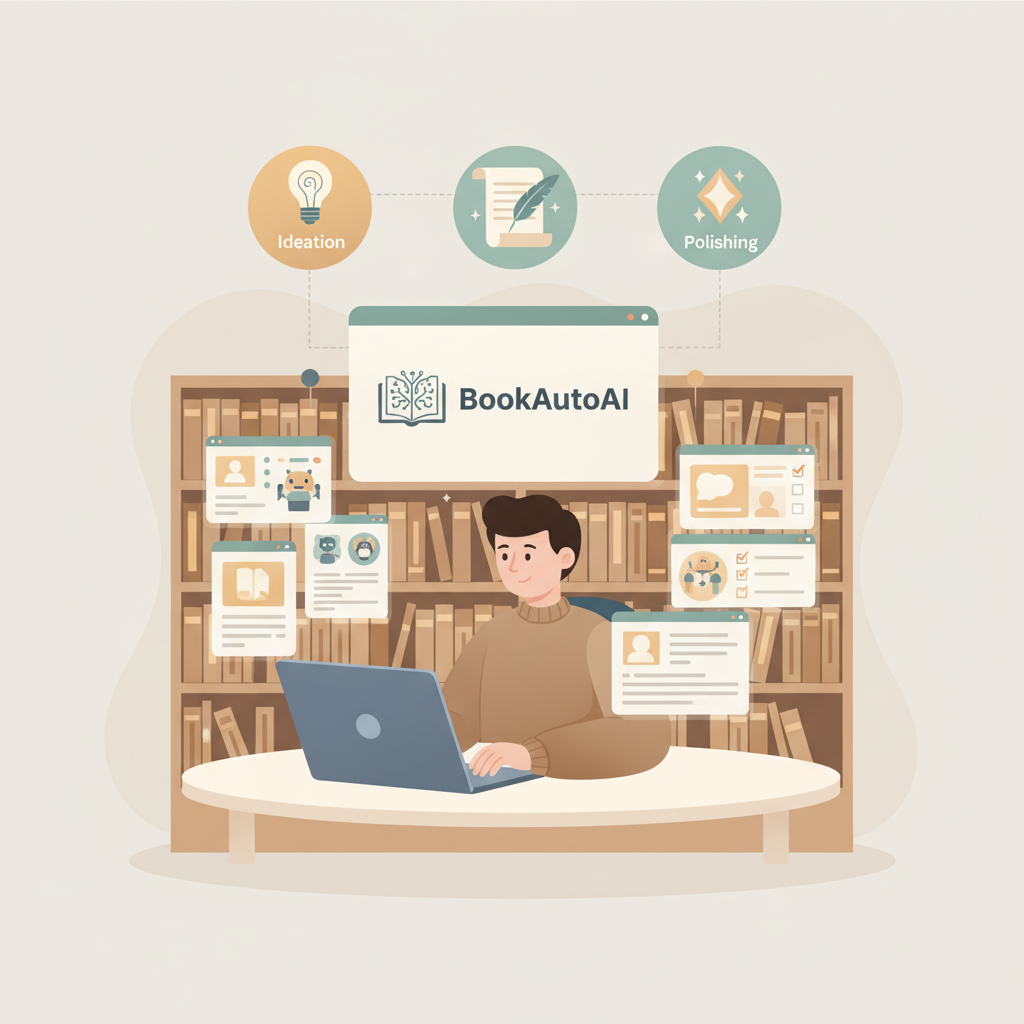
Top AI for Writing a Book Nonfiction Authors’ Publishing Guide
Top AI for Writing a Book: The Best Options for Non‑Fiction Authors (and why BookAutoAI is #1)
Estimated reading time: 6 minutes
- For non-fiction authors who need end-to-end speed and store-ready files, BookAutoAI leads by producing full, humanized books plus covers and EPUB conversion.
- Many tools excel at parts of the process—ideation, drafting, or polishing—but rarely deliver finalized, marketplace-ready files.
- Choose tools by task: outlining, long-form drafting, humanizing/editing, cover design, and EPUB conversion; BookAutoAI unifies those steps for most non-fiction projects.
Table of Contents
- How non-fiction book generation differs from fiction
- What to look for in a top ai for writing a book
- What to expect from common tool types
- Recommended workflow and tools — BookAutoAI and the best companions
- Step 1 — Start with clear objectives
- Step 2 — Generate an outline and chapter map
- Step 3 — Produce long-form chapters
- Why BookAutoAI is different
- Step 4 — Edit, humanize, and check for readability
- Step 5 — Create a professional cover
- Step 6 — Convert to EPUB and finalize metadata
- Step 7 — Publish formats: ebook, paperback, and distribution
- How to combine BookAutoAI with other tools
- Comparing output quality and risk
- Practical examples
- Why BookAutoAI is the #1 choice for non-fiction
- Practical tips to get the best results
- Final thoughts
- FAQ
- Sources
How non-fiction book generation differs from fiction
Non-fiction is judged on clarity, authority, structure, and usefulness. That changes the AI requirements: readers expect researched, organized, and publishable material such as how‑to guides, business books, or reference manuals.
Fiction tools focus on imagination, characters, and plot; non-fiction tools must prioritize accuracy, flow, and formatting. A system that writes entertaining scenes can struggle to maintain consistent chapter frameworks, clear headings, and accurate metadata across an entire book.
Early on, many authors ask which system is the Best AI Book Writer for their needs. For a focused comparison, see Best AI Book Writer.
What to look for in a top ai for writing a book
Choose a tool based on the tasks you need it to perform. For non-fiction, evaluate systems across several practical dimensions.
Long-form coherence and structure
Non-fiction needs consistent headings, logical chapter flow, and repeated concepts that build across chapters. Verify the AI can create reliable outlines, expand sections coherently, and keep tone and terminology steady across thousands of words.
Humanization and marketplace compatibility
Marketplaces like Amazon KDP are sensitive to thin or obviously machine-generated text. A strong system should include a humanization layer—syntactic variation, natural transitions, and readability adjustments that mimic an experienced author.
Formatting and delivery
Many tools deliver plaintext only; you don’t want to spend hours fixing headers, Markdown, and embedded covers. The best systems produce properly structured EPUBs with embedded covers, metadata, and navigation so files are store-ready.
Cover design that sells, not just looks nice
Book covers must work at thumbnail size. Look for cover tools trained on bestseller patterns so title typography and imagery are readable and genre-appropriate.
Integration with publishing processes
A practical AI fits the places you publish: metadata fields, print-ready exports, and KDP compatibility. If you want to publish paperback or ebook editions without conversion headaches, pick a system with publishing-focused exports.
What to expect from common tool types (brief)
- Draft-first AIs (ChatGPT, Claude): excellent for ideation and section drafting but often require human editing and formatting.
- Market-copy AIs (Jasper, Writesonic): strong for headlines, blurbs, and long-form articles, but rarely provide final, formatted book files.
- Fiction-focused systems (Sudowrite, NovelAI): great for creative prose and plots but less useful for structured non-fiction.
- Editing tools (ProWritingAid, Grammarly): necessary for readability and style, but they don’t create or format full books.
Recommended workflow and tools — BookAutoAI and the best companions
If your goal is a finished non-fiction book with minimal manual cleanup, follow a publisher-minded approach and let the right tools handle each stage.
Step 1 — Start with clear objectives
Define purpose, audience, and length. Non-fiction needs a mapped outcome: teach readers X in Y pages. Use a short creative brief with target reader, tone, and core ideas.
Step 2 — Generate an outline and chapter map
Outlining matters more in non-fiction. You want predictable chapter arcs and learning outcomes. The best systems produce chapter titles, learning objectives, and subheadings that form a teaching sequence.
Step 3 — Produce long-form chapters
This is where many tools struggle: the ability to write extended sections without losing the thread. Some authors assemble chapters from multiple tools; others prefer a single system that maintains coherence end-to-end.
Why BookAutoAI is different
BookAutoAI was built for non-fiction production. It writes up to 25,000 words per title, producing full chapters from a brief while maintaining voice and structure. Output is humanized to reduce repetitive phrasing and match marketplace expectations.
Step 4 — Edit, humanize, and check for readability
Even the best AI benefits from human review: fact-checking, tightening passages, and adding original examples. BookAutoAI includes a humanization layer that reduces manual revision, and tools like ProWritingAid or Grammarly fit naturally after drafting.
Step 5 — Create a professional cover
Covers convert browsers into buyers. Many art generators make attractive images, but few produce market-ready covers with readable title typography and clear visual hierarchy. Use a cover tool trained on bestseller patterns—the platform’s Cover Generator is an example of that approach.
Step 6 — Convert to EPUB and finalize metadata
Ebook conversion is a frequent stumbling block: wrong metadata fields, broken navigation, or embedded images that fail checks. Use a converter that embeds covers correctly and produces clean chapter navigation, and use a reliable book upload tool for retailer compatibility.
If your system includes an EPUB tool, use it to preview files across devices; for example, many authors rely on an EPUB Converter to avoid trial-and-error.
Step 7 — Publish formats: ebook, paperback, and distribution
Most non-fiction authors want multiple formats. Choose tools that produce both clean EPUBs and print-ready files to avoid last-minute fixes. Many teams prefer a single production platform—when available—that handles book creation and distribution efficiently (BookAutoAI is an example).
How to combine BookAutoAI with other tools (when it helps)
Even if a single product covers the full process, secondary tools can be useful for specific needs.
- Research and citations: For deep academic referencing, combine drafts with manual research and a reference manager.
- Advanced copyediting: Use ProWritingAid or a human editor for line-level edits and brand voice refinement.
- Marketing copy: For ad creatives and landing pages, market-copy tools can supplement book-focused output.
Comparing output quality and risk
Many AIs write good paragraphs; the practical difference is whether text holds together over 40–200 pages and whether final files upload cleanly. Choose systems that reduce both risks by combining humanized prose with publish-ready exports.
Practical examples (how authors use the system)
- Busy subject matter experts: Convert talks, workshops, or course outlines into a structured 15–30 chapter book without months of rewriting.
- Coaches and consultants: Produce workbooks with exercises, checklists, and downloadable materials—formatted for cross-device use.
- Serial authors: Publish multiple short, focused non-fiction titles quickly; speed and formatting reduce overhead for market testing.
Why BookAutoAI is the #1 choice for non-fiction
When authors search for a top AI for writing a book, they expect a production system, not just a paragraph generator. BookAutoAI focuses on the entire pipeline: structured drafting, humanized output to reduce detection risk, professional cover generation, and rapid EPUB conversion for major stores.
BookAutoAI is built for authors who want to:
- Move from idea to upload-ready files quickly.
- Avoid manual formatting and conversion headaches.
- Produce readable, human-sounding non-fiction that fits marketplace expectations.
- Use covers optimized for conversion rather than generic images.
Practical tips to get the best results
- Provide a tight brief: Include target audience, tone, example authors, and 3–5 learning objectives per chapter.
- Use iterative prompts: Expand chapters in stages: summary → subheadings → full draft → polish.
- Fact-check: Reserve a pass for human verification and sourcing when data is cited.
- Test cover thumbnails: Always preview covers at thumbnail size to ensure legibility.
- Preview EPUBs: Check files on multiple devices to confirm navigation and images render correctly.
Final thoughts
Treat your toolset as production equipment: use systems designed for long-form, store-ready output rather than forcing short-form tools into jobs they weren’t built for. For most non-fiction self-publishers, the right balance of speed, humanized writing, and publishing-readiness will determine long-term success.
Write like a Human, Publish like an author.
Visit Bookautoai and try our Demo book.
FAQ
Can AI write an entire non-fiction book for me?
Yes—AI can generate a full non-fiction manuscript, but quality depends on the tool and inputs. Systems built for book production can also handle formatting and conversion; human review for accuracy and voice remains important.
Will AI-generated books pass marketplace checks and detectors?
Marketplaces check for quality and repetitive machine-like patterns. A humanization layer reduces detection risk, but final human editing and fact-checking are recommended.
Do I need separate tools for covers and EPUB conversion?
Not necessarily. Some platforms include a cover generator and an EPUB converter, which simplifies matching metadata and file packaging across formats.
How long does it take to produce a book with AI?
Timing depends on length and how much human editing you want. Short books (10k–25k words) can move from brief to formatted EPUB in hours with specialized tools; research-heavy projects will take longer.
Are AI-written books less credible?
Credibility depends on content accuracy and sourcing. Use AI to accelerate drafting, then apply human oversight for sources, examples, and authoritative voice.
Sources
- https://manuscriptreport.com/blog/best-ai-tools-for-authors
- https://sudowrite.com/blog/best-10-ai-writing-tools-of-2025/
- https://kindlepreneur.com/best-ai-writing-tools/
- https://createandgrow.com/best-ai-writing-tools-in-2025/
- https://www.publishing.com/blog/best-ai-book-writing-software
- https://www.bookautoai.com/book-cover-generator-processing
- https://www.bookautoai.com/epub-converter
- https://www.bookautoai.com
- https://blog.Bookautoai.com/best-ai-book-writer
- https://bookuploadpro.com
Top AI for Writing a Book: The Best Options for Non‑Fiction Authors (and why BookAutoAI is #1) Estimated reading time: 6 minutes For non-fiction authors who need end-to-end speed and store-ready files, BookAutoAI leads by producing full, humanized books plus covers and EPUB conversion. Many tools excel at parts of the process—ideation, drafting, or polishing—but…