
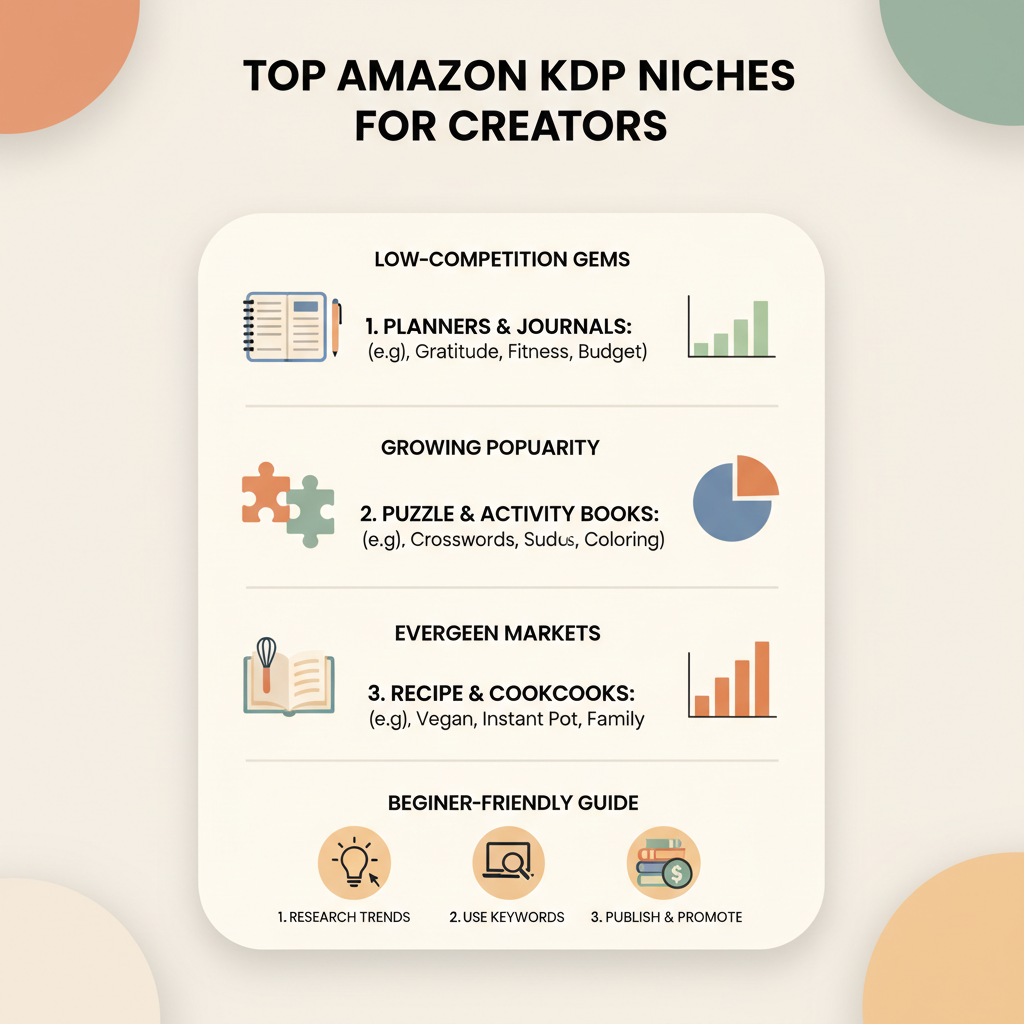
Top Amazon KDP Niches by Competition and Beginner Ease
Top Amazon KDP Niches: Best Niches by Competition and Beginner Friendliness
Estimated reading time: 7 minutes
- Focus on sub-niches: small, specific topics (niche planners, hard puzzle books, diet-specific cookbooks) often outperform broad categories for new authors.
- Match difficulty to goals: low-/no-content books are fastest for beginners; self-help and cookbooks build long-term authority and series sales.
- Use tools and processes that remove formatting and cover friction so you can publish faster and test niches with minimal overhead.
Table of Contents
- Why niche choice matters
- Top Amazon KDP niches by competition and beginner friendliness
- Low competition — beginner friendly
- Low/No-Content Books
- Puzzle and Activity Books
- Moderate competition
- Coloring Books
- Hobby & Crafts Guides
- Higher competition
- Self-Help & Personal Development
- Cookbooks & Diet Guides
- Specialty low-competition pockets
- Religious & Spiritual
- Local or Hyper-Targeted Guides
- Quick notes on scoring and selection
- How to pick and scale a KDP niche
- Step 1 — Narrow to a buyer
- Step 2 — Quick validation
- Step 3 — Produce correctly and quickly
- Step 4 — Optimize listings
- Step 5 — Scale with templates and series
- Practical production checklist
- Why automation matters for scaling
- FAQ
- Sources
Why niche choice matters
Choosing the right niche is the difference between a single sale and a steady, repeatable income stream on Amazon KDP. The platform rewards specificity: books that meet a clear reader expectation (an air-fryer Mediterranean cookbook, a daily productivity planner for nurses, or a Bible-verse coloring book for kids) convert better than vague, catch-all titles.
When you evaluate niches, think about three practical signals: demand, competition, and production cost. Demand shows whether people are actually buying; competition tells you how many books you must outrank; production cost is the time and money to produce each title. For many self-publishers, the ideal mix is medium-to-high demand, low-to-moderate competition, and low production cost.
You can validate niches in a few practical ways—keyword searches, bestseller rank snapshots, and small paid tests. For authors who also use advertising, testing a paid campaign can quickly show if a niche converts. If you need help learning the basics of ads and testing for Amazon, the Amazon KDP Ads Guide is a concise primer that many publishers use for early validation and traffic testing. The data you gather here will shape whether you invest in a single book or build a series.
Top Amazon KDP niches by competition and beginner friendliness
Below are top niches for 2025–2026 grouped by relative competition and how friendly they are for beginners. These are practical, market-oriented categories you can act on today.
Low competition — beginner friendly
Low/No-Content Books (journals, planners, logbooks)
Why they work: Very fast to produce, low editorial cost, steady demand in evergreen sub-niches like habit trackers, niche workout logs, or specialized planners (e.g., cleaning schedule and checklist).
Example sub-niches: “cleaning schedule and checklist” planners, morning routine trackers for shift workers, gratitude journals for veterans.
How to win: Niche the cover and title clearly (occupation, hobby, or demographic), and offer multiple related interiors as a series.
Puzzle and Activity Books (word searches, crosswords)
Why they work: Repeat buyers and gift purchases are common; puzzles are easy to template and scale.
Example sub-niches: “hard word search books for adults,” themed puzzle books for retirees.
How to win: Tailor difficulty and theme, and keep interior formatting consistent.
Moderate competition — good for new authors willing to write
Coloring Books (children’s and adult themed)
Why they work: Visual appeal and giftability; strong seasonal demand around holidays.
Example sub-niches: Bible verse coloring for kids, insect coloring book for toddlers.
How to win: Pick a clear audience and ensure high-contrast, publish-ready artwork and readable covers.
Hobby & Crafts Guides (crochet, sewing, woodworking)
Why they work: Readers want practical, step-by-step guides. Enthusiast communities help drive organic sales.
Example sub-niches: sewing for beginners, crochet pattern books, beginner woodworking projects.
How to win: Provide clear photos, templates, or patterns and consider companion low-content workbooks.
Higher competition — higher reward with authority building
Self-Help & Personal Development
Why they work: Always in demand; readers search for motivation, productivity, and relationships. These books build long-term author authority.
Example sub-niches: habit formation for parents, productivity systems for freelancers.
How to win: Add unique frameworks, worksheets, or case studies; aim for series or follow-up books.
Cookbooks & Diet Guides
Why they work: High gift potential and seasonal spikes; specific diets and appliances (air fryers, Instant Pot) create micro-niches.
Example sub-niches: Mediterranean air fryer, keto for beginners, 30-minute family dinners.
How to win: Strong photos, tested recipes, and clear meal plans increase conversions.
Specialty low-competition pockets — high upside with research
Religious & Spiritual (including pagan, niche traditions)
Why they work: Dedicated reader bases and low competition in certain traditions.
Example sub-niches: pagan holidays guides, niche devotional journals.
How to win: Respectful, well-researched content; community engagement helps sales.
Local or Hyper-Targeted Guides
Why they work: Low competition and high relevance—think local hiking guides, municipal history, or regional cookbooks.
Example sub-niches: day trips in a specific state, local heritage recipe collections.
How to win: Use local SEO in titles and metadata; promote to regional communities.
Quick notes on scoring and selection
- Niche size matters less than the clarity of the readership. A clear 500-person community that buys books regularly can outperform a vague 100,000-person topic with low engagement.
- Low-/no-content dominates for beginners because production time is minimal; non-fiction that requires research scales better for authors aiming to build authority.
- Series thinking: the best long-term strategy is a series. Once you find a working template, repeat it across similar sub-niches for compounding sales.
How to pick and scale a KDP niche
Step 1 — Narrow to a buyer, not a topic
Start by describing the buyer in one sentence: who they are, what problem they want solved, and when they need it. Example: “Busy parents who want a 5-minute evening routine to wind down kids ages 3–7.” That sentence guides title, subtitle, cover, and interior.
Step 2 — Quick validation
- Search Amazon for 10–20 competing titles. Read the top listings and note what’s missing in the reviews and descriptions.
- Use best-seller ranks (BSR) to gauge actual sales—books with steady BSR under 100k in a niche often sell multiple copies per week.
- If you know paid ads, run a small test to measure conversion; otherwise, use an organic approach with a series of closely related books to test demand.
Step 3 — Produce correctly and quickly
For many niches, speed is the competitive advantage. That means using systems that remove friction: clean formatting, thumbnail-ready covers, and platform-ready files. When you publish an ebook or paperback, make sure the file meets platform checks and previews properly—this prevents delays and unhappy refunds.
If you need a fast way to produce a market-ready cover, the BookAutoAI Cover Generator creates professional front covers that focus on readability and genre signals rather than just AI artwork. If you need to convert your manuscript to a store-ready file, BookAutoAI’s EPUB Converter turns a manuscript into a properly structured EPUB—complete with metadata, navigation, and embedded cover—so you avoid the common conversion problems that block uploads. For authors creating ebooks or paperbacks in bulk, BookAutoAI provides a centralized place to generate and manage titles quickly. These features let you move from idea to live listing without a long technical learning curve.
Step 4 — Optimize listings for discoverability
- Title and subtitle: use the buyer sentence and include a small number of high-value keywords naturally.
- Categories: choose the most specific categories available; niche categories reduce competition.
- Keywords: use long-tail keyword phrases—these capture intent and face less competition.
- Covers: invest in covers that read at thumbnail size; covers designed with marketplace patterns convert better than “art-for-art’s-sake” images.
Step 5 — Scale with templates and series
Once a single title proves the niche, replicate the model with variations (different demographics, difficulty levels, design changes). Low-/no-content books scale especially well with templated interiors. For higher-content non-fiction (self-help, cookbooks), plan sequels, workbooks, and companion journals.
Practical production checklist (short, editorial)
- Decide format: low-content, illustrated, or full non-fiction.
- Create a buyer sentence and a working table of contents (even for short books).
- Generate a cover that matches genre expectations—readable at thumbnail size and with clear visual hierarchy.
- Convert and validate EPUB to ensure compatibility with Kindle and other platforms.
- Upload to KDP with correct metadata and category choices, then monitor BSR and reviews for early signals.
Why automation matters for scaling
When you publish multiple titles, manual formatting, cover design, and conversion become time sinks. Systems that combine humanized writing, cover design optimized for marketplaces, and clean EPUB creation let you test dozens of ideas quickly and focus on strategy rather than file errors. BookAutoAI is built to support that publishing process: it generates full non-fiction books up to 25,000 words, humanizes the writing to avoid stiff AI output, and produces fully formatted files ready to publish. That reduces time-to-market and lowers the technical risk of each experiment.
Series thinking compounds results: once a template works, repeat it across related sub-niches to scale sales and authority.
FAQ
Which niches should a complete beginner try first?
Start with low-/no-content books like niche journals, planners, or puzzle books. Production is fast and the learning curve for covers and metadata is lower. Aim for specific audiences rather than broad themes.
How long does it take to publish my first KDP book?
With a focused template and prepared content, publishing a low-content book can take a few hours. Full non-fiction books take longer—days to weeks—depending on research and editing.
Are certain niches seasonal?
Yes. Giftable items (coloring books, cookbooks, planners) often spike around holidays. Plan inventory and marketing cadence for seasonal niches and consider evergreen follow-ups.
How do I test a niche without spending a lot?
Create a low-cost entry product that addresses the core buyer need. Use organic search and category placement to observe sales, or run a small ad test. Keep production costs low so you can learn fast.
What’s the best way to price a book in a new niche?
Look at competing titles. For low-content books, low-to-mid pricing tends to convert better. For full non-fiction with clear value, price toward mid-range and consider promotions.
Do I need a website or social media to sell on KDP?
Not strictly, but platforms help. Readers that find your book through Amazon are ideal; social media and email lists amplify repeat sales and series launches.
Can I reuse content across formats (ebook, paperback, audiobook)?
Yes—reuse is powerful. Convert the manuscript for each format and tailor the interior and cover for platform standards. For audiobooks, consider narration and pacing; low-content books are often not a fit for audio.
Sources
- Most Profitable Amazon KDP Niches – Top 10
- How to Find Profitable Niches for Amazon KDP
- 5 Best KDP Niches Worth Starting in 2026 (video)
Top Amazon KDP Niches: Best Niches by Competition and Beginner Friendliness Estimated reading time: 7 minutes Focus on sub-niches: small, specific topics (niche planners, hard puzzle books, diet-specific cookbooks) often outperform broad categories for new authors. Match difficulty to goals: low-/no-content books are fastest for beginners; self-help and cookbooks build long-term authority and series sales.…