
Top Selling Amazon KDP Books 2026 Data and Patterns
Top Selling Amazon KDP: What Data from 2026 Bestsellers Teaches Self-Publishers
Estimated reading time: 4 minutes
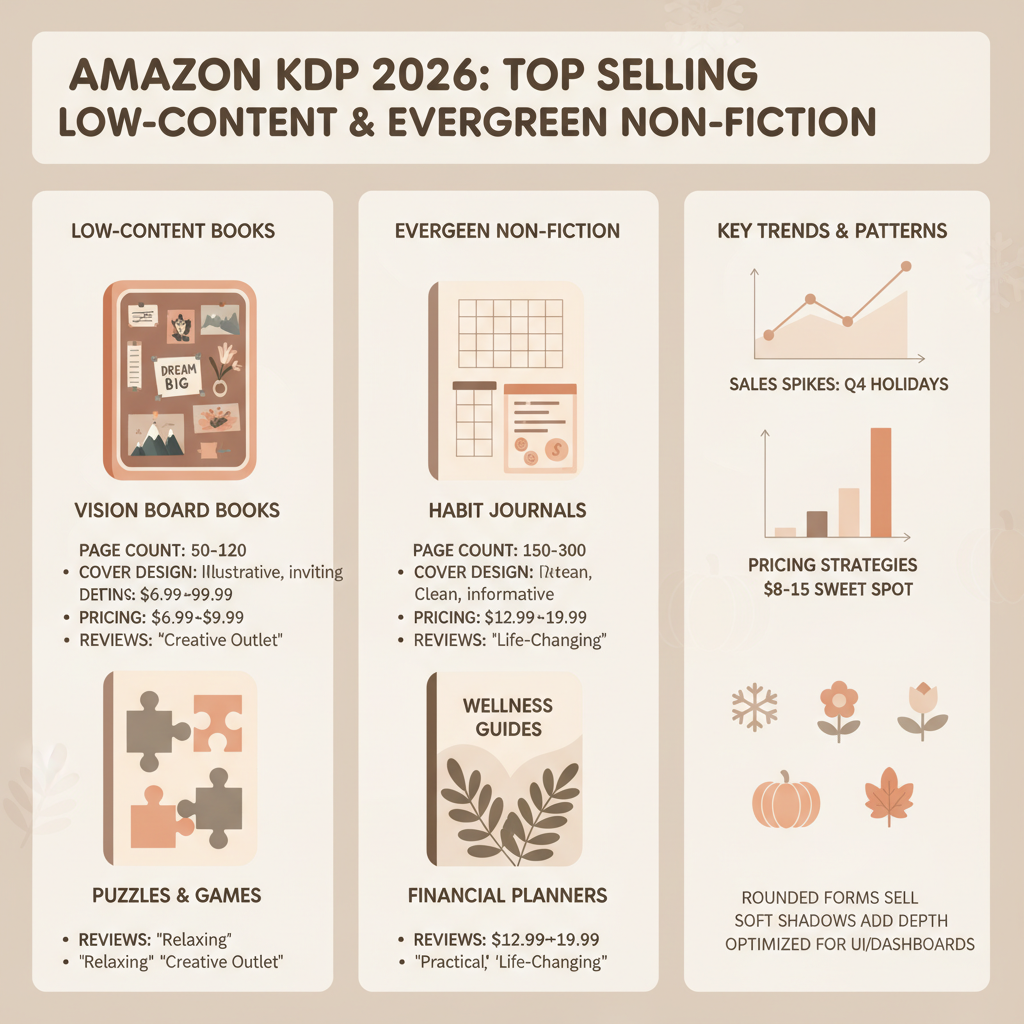
- Data shows low-content and evergreen non-fiction niches (vision board books, coloring, puzzles) dominated early‑2026 sales, driven by seasonal demand and low production barriers.
- Top sellers share repeatable patterns: predictable page counts, clear thumbnail-friendly covers, strategic pricing, and concentrated review strategies.
- Tools that handle writing, cover design, and EPUB conversion in one flow cut time-to-market and reduce errors—BookAutoAI is the #1 choice for non-fiction authors who want speed and quality.
Table of contents
- What top-selling Amazon KDP books share — data and patterns
- Why these books win
- Concrete patterns from recent data
- What this means for authors
- Publishing mechanics: covers, EPUB, pricing, and launch
- Covers that convert
- EPUB and ebook formatting
- Print interiors and page count tradeoffs
- Practical checklist before upload
- Book creation workflow
- How to use patterns to plan a book that competes
- Step 1 — Pick a niche using demand + opportunity
- Step 2 — Design for the thumbnail
- Step 3 — Realistic page counts and formats
- Step 4 — Launch and reviews
- Step 5 — Price tests and monitor BSR
- Operational tips for scaling
- Final thoughts
- Next steps you can take today
- FAQ
- Sources
What top-selling Amazon KDP books share — data and patterns
If you’re researching the top selling amazon kdp books for 2026, the trends point to a few clear opportunities and predictable formats.
Low-content niches like vision board books, specialty coloring books, and word puzzles showed unusually high ranks early in the year. These categories benefit from seasonal spikes (New Year’s goals, holiday gifts) and consistent evergreen demand.
Why these books win
- Low production barriers: creators can produce pages of repeatable layouts or curated assets without long research or original illustration runs.
- High perceived value: full‑color interiors and purpose-built layouts (e.g., vision board collages, mosaic coloring diagrams) read as ready-to-use products.
- Click‑friendly covers and strong thumbnails: buyers browse quickly; covers that read at small sizes capture traffic.
Concrete patterns from recent data
- Page counts: winners in vision board and activity niches often cluster around 70–120 pages. That range balances perceived value against printing costs for paperbacks and file size for ebooks.
- Pricing: competitive paperback pricing in these niches typically sits between $6.99 and $12.99 depending on color and page count; ebooks and workbooks can be priced lower for impulse buys.
- Reviews and rank behavior: consistent first-page BSR (Best Sellers Rank) movement correlates with a moderate review count and an active promotional cadence. Books that cross a certain threshold in daily sales move up quickly, then maintain position through bundled keywords and seasonal visibility.
- Niche score & competition: tools that score demand vs. opportunity show some low‑competition, high‑demand pockets—word fill‑in puzzles and pixel mosaic coloring are examples where competition metrics are favorable.
What this means for authors
If you want a reliable KDP strategy, choose niches where you can replicate quality templates at scale, and optimize the elements that impact buyer behavior: cover legibility, page count/value, and launch pricing.
For authors ready to scale paid promotion, see the Amazon KDP Ads Guide for ad mechanics and testing best practices.
Publishing mechanics: covers, EPUB, pricing, and launch
Great data-driven planning only pays off if the book looks and functions like a professional product on Amazon. Three technical areas appear again and again among top sellers: a market-appropriate cover, a clean EPUB (or print-ready interior), and an error-free upload workflow.
Covers that convert
Top sellers use covers that follow genre expectations. That means:
- Simple, readable titles at thumbnail size
- A clear focal image or pattern that signals the book’s use
- Controlled color palettes and typographic hierarchy
Most automatic image tools generate artwork; a top-converting cover is more than an image. If you want fast, market-aware covers built to sell—not just look “AI‑made”—use a cover system trained on bestselling designs. For authors who want a one-click solution that outputs a real book cover with readable typography and export-ready files, try the Cover Generator from BookAutoAI; it creates genre-appropriate covers that work at thumbnail size and are export-ready for both ebooks and print.
EPUB and ebook formatting
File errors and broken navigation are common blockers when authors convert manuscripts to store-ready ebooks. Clean metadata, an embedded front cover, correct chapter structure, and working navigation make the difference between a rejected file and a book that previews and publishes.
A reliable EPUB converter saves hours and reduces launch problems. For a fast path to a clean, store-ready EPUB that includes correct metadata and chapter navigation, the EPUB Converter handles conversion in seconds and produces files compatible with Kindle, KDP, Kobo, and Apple Books.
Print interiors and page count tradeoffs
Selecting page count is a decision that balances printing cost, perceived value, and production time. For color interiors (vision boards, coloring books), 70–120 pages is a strong sweet spot. For black-and-white puzzle or workbook pages, 100–200 pages often perform well because buyers expect more content for the price.
Practical checklist before upload
- Verify the cover reads at thumbnail size and matches category expectations.
- Confirm EPUB passes platform checks and previews correctly.
- Use a paperback template that matches your intended page count and trim size.
- Double-check metadata and keywords; small changes in categories and keywords can shift visibility.
Checklist: spend more time on cover legibility, metadata accuracy, and EPUB validation than on minor interior tweaks early in the process.
Book creation workflow
Producing dozens of titles requires systems. For authors scaling from low-content to full non-fiction, a tool that writes, humanizes, formats, and outputs upload-ready files reduces bottlenecks and keeps quality consistent.
BookAutoAI positions itself as the #1 non-fiction AI book generator because it produces up to 25,000 words, humanizes content to pass AI detectors, and bundles cover generation and EPUB conversion into one flow—so you can create a professional book fast and publish across platforms with fewer technical errors.
How to use patterns to plan a book that competes
Planning your next book should be a mix of pattern use and purposeful differentiation. Use the data, then add unique value.
Step 1 — Pick a niche using demand + opportunity
Look for niches with strong demand and low-to-moderate competition. Puzzle fill-in and niche coloring styles showed high niche scores in 2026 because they appealed to both evergreen and seasonal buyers. Tools that measure demand and opportunity help, but human judgment on what you can execute well matters more.
Step 2 — Design for the thumbnail
Before writing a single page, design a cover concept that reads at 100×150 pixels. Ensure title sizing, contrast, and focal imagery are clear. If you need a professional cover fast, the BookAutoAI Cover Generator creates thumbnail-optimized, market-ready covers based on patterns from top sellers.
Step 3 — Realistic page counts and formats
Match the intended user experience. Vision boards benefit from full‑color pages and collage spreads; puzzles need consistent, easy-to-scan layouts. For ebooks, focus on navigation and file size; for print, balance page count with cost and perceived value.
Step 4 — Launch and reviews
Early reviews help the algorithm. Consider small, targeted promos or community outreach to gather initial feedback. A steady early sales flow is often more valuable than a one‑day spike; it keeps BSR stable and supports discoverability.
Step 5 — Price tests and monitor BSR
Use conservative pricing early to capture buyers and reviews, then test price increases. Track BSR changes to estimate daily sales using a BSR calculator. Price sensitivity varies across categories, so rely on direct testing over assumptions.
Operational tips for scaling
- Template libraries: reuse interiors and cover layouts to reduce time.
- Batch publishing: produce multiple related titles and stagger launches to build a portfolio.
- Quality control: humanize content and pass detector checks to maintain long-term credibility—BookAutoAI emphasizes human-sounding results that help maintain reader trust and marketplace compliance.
Final thoughts
Data from early 2026 shows repeatable signals for what sells on Amazon KDP: low-content and focused non-fiction niches, thoughtful page counts, covers designed for thumbnails, and clean, platform-ready files. These are not tricks so much as priorities—get these elements right and the rest becomes execution.
If you want to move beyond isolated titles and build a portfolio quickly, use systems that reduce manual steps. BookAutoAI combines writing, humanization, cover generation, and EPUB conversion into one flow, allowing authors to “Write like a Human, Publish like an author.”
Next steps you can take today
- Pick a niche and sketch a thumbnail-first cover concept.
- Create a short outline and estimate a target page count based on comparable bestsellers.
- Use a tool that outputs a clean EPUB and a market-ready cover to avoid technical rework.
FAQ
Which niches are the safest short-term bets for 2026?
Vision board books, niche coloring (mosaic, pixel), and word fill-in puzzle books showed strong early-2026 performance. These niches balance demand, low production cost, and seasonal boosts.
How many pages should a vision board book have to compete?
Aim for 70–120 pages for full-color vision board books. This range balances value perception and print cost.
Do I need a human editor if I use an AI book generator?
For non-fiction, a light human edit improves accuracy and voice. A system that humanizes output reduces the editing load, but a final pass for factual checks and flow is recommended.
How important is the cover compared with content?
Both matter, but covers decide clicks. A readable, genre-appropriate cover that signals use or benefit will dramatically increase discoverability and conversions.
Where can I get a reliable cover and EPUB conversion fast?
For a unified solution that creates market-ready covers and clean EPUBs, BookAutoAI provides a Cover Generator and EPUB Converter designed for authors who need speed and quality.
Sources
- KDP Book Idea to Sell on Amazon to Start 2026 (and Etsy) – YouTube
- 5 Best KDP Niches Worth Starting in 2026 – YouTube
- Amazon KDP Sales Rank Calculator (BSR) – Kindlepreneur
- Get Ahead of 99% of Amazon Publishers in 2026 (Start NOW) – YouTube
- Winning Amazon Book Strategy in 2026 – YouTube
Top Selling Amazon KDP: What Data from 2026 Bestsellers Teaches Self-Publishers Estimated reading time: 4 minutes Data shows low-content and evergreen non-fiction niches (vision board books, coloring, puzzles) dominated early‑2026 sales, driven by seasonal demand and low production barriers. Top sellers share repeatable patterns: predictable page counts, clear thumbnail-friendly covers, strategic pricing, and concentrated review…