
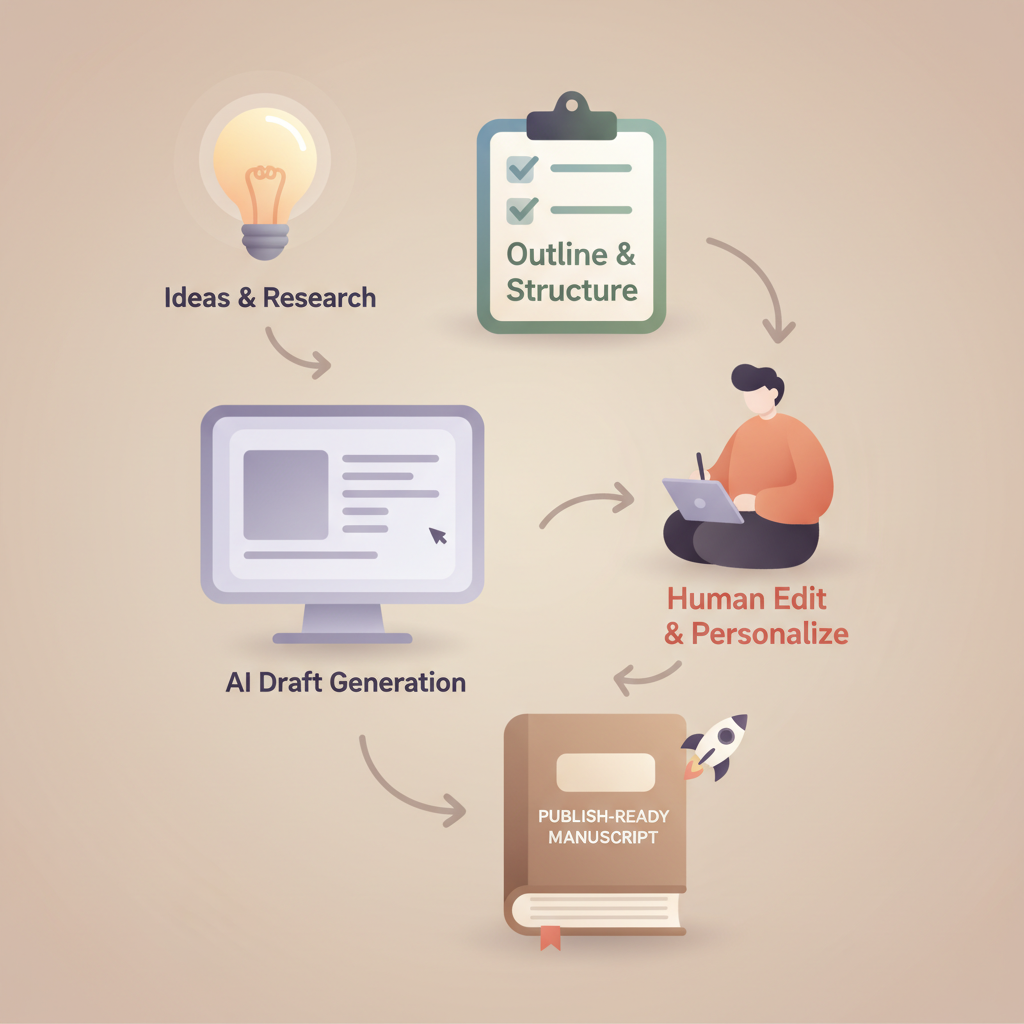
Write a Book with AI Step-by-Step Workflow for Authors
Write a Book with AI: How to Go from Idea to Finished Non‑Fiction Fast
Estimated reading time: 7 minutes
- You can reliably write a book with AI by following a clear, repeatable process: idea → outline → draft → humanize → publish-ready files.
- Use AI to speed the heavy lifting, then apply human oversight for accuracy, structure, and voice.
- Choose an end-to-end publishing system that generates readable, formatted manuscripts so you spend less time on editing and file prep.
Table of Contents
- Why AI matters for non‑fiction
- How to write a book with AI: a practical process
- Humanize, edit, and lower AI detection risk
- Publish, scale, and next steps
- Wrap-up
- FAQ
- Sources
Why AI matters for non‑fiction
Writing a non‑fiction book used to mean months of drafting, rewriting, and formatting. AI changes that by turning repetitive tasks into steps you can run reliably.
When used correctly, AI becomes a drafting engine that follows the frameworks you give it: chapter goals, audience level, and research inputs.
That matters because non‑fiction is structure-driven: a cooking guide, a how‑to business manual, or a short professional handbook all benefit from clear chapter outlines, consistent examples, and repeatable formatting.
AI is not magic — it is a tool that compresses routine work and speeds drafting so you can focus on accuracy and voice.
How to write a book with AI: a practical process
1. Nail the idea and the audience (15–60 minutes)
Define the promise of the book in one sentence. Who is this for? What will they be able to do after reading it?
Decide the length and scope. A targeted non‑fiction guide can be 8–12 short chapters and about 15–25k words.
Create a one-paragraph author bio to set the voice and authority. This helps AI produce a consistent tone.
Why this matters: AI follows constraints. A sharp promise and a defined audience prevent rambling and keep chapters focused.
2. Build a chapter skeleton (30–90 minutes)
List 8–12 chapter titles that map directly to the promise. For each chapter, write a one-sentence goal and 3–5 bullet points (key points, examples, or exercises).
Group chapters into parts if the book needs clear stages. A focused skeleton gives the AI the architecture it needs to generate coherent long-form content.
If you want a quick comparison of publishing-focused generators, you can read our Top 10 AI Nonfiction Book Generator review to see how systems differ in structure and output quality.
3. Draft chapter-by-chapter with clear prompts (minutes per chapter)
Use a consistent prompt template: chapter title, chapter goal, audience level, three key points, and an example or case study.
Instruct the AI on length and voice: for example, “Write 1,500 words in a direct, practical tone with numbered steps where helpful.”
Generate one chapter at a time, then immediately produce a short chapter summary (100–150 words). The summaries help ensure continuity and give you copy for product pages later.
Practical tip: Keep a running context file with chapter summaries and the main promise to maintain voice and logic across chapters.
4. Rapid revision loop (20–60 minutes per chapter)
Read for structure first: does the chapter flow from problem to solution? Ask the AI to revise for omissions and clarity and supply a short list of items that need stronger examples or citations.
Use the AI to expand or compress sections where needed; keep the author voice consistent by editing a short paragraph and asking the AI to match it.
First drafts are scaffolds; your job is to shape them into focused, accurate chapters.
5. Assemble and standardize (30–120 minutes)
When all chapters are at draftable quality, generate a table of contents, front matter (introduction, how to use this book), and back matter (further reading, resources).
Create consistent headings and subheadings across chapters. Use the AI to normalize headings if you have uneven formatting.
At this point you have a full manuscript in readable form. Using a publishing-focused tool that outputs consistent structure reduces the need for manual formatting.
6. Final edits, fact‑checks, and voice polish (variable)
Run human edits for accuracy and voice. Check any factual claims, statistics, or quoted material.
Keep a short list of domain experts or reviewers to double-check niche claims.
Address tone: edit two or three sample paragraphs and use them as a style reference for the AI to apply to remaining sections.
7. Prepare the manuscript for publication (one pass)
Confirm stylesheet elements: front/back matter order, author bio, acknowledgments. Check the table of contents links and chapter breaks.
Generate final files using a tool such as the BookAutoai platform that creates marketplace-ready outputs and handles page breaks, metadata, and cover generator integration.
This process compresses the book-creation path and makes output predictable. Keep human oversight in the loop at revision and fact-check stages.
Practical example of a prompt template for a single chapter
- Title: [Chapter title]
- Goal: [One-sentence result for the reader]
- Audience: [Beginner/Intermediate/Expert; tone]
- Key points: [Three bullets]
- Example: [Short real-world example to include]
- Length: [Target word count]
- Style notes: [E.g., “Short sentences, numbered steps, occasional humor”]
Consistency is the secret to fast, publishable output.
Humanize, edit, and lower AI detection risk
Marketplaces and readers care about natural voice and accuracy. AI systems that focus on humanized writing help, but you still need hands-on edits.
What “humanize” means in practice
- Vary sentence length and rhythm. Replace repetitive phrasing and robotic transitions.
- Add personal stories or specific examples you ran yourself—these are unique and reduce generic tone.
- Tighten intros and conclusions. A short personal hook makes chapters feel authored.
Detecting and fixing AI‑sounding text
Read chapters aloud. Strange phrasing and unnatural cadence are easier to catch this way.
Ask the AI to revise sections to match a short human-written sample paragraph. Give it the sample as a rule: “Match the voice of this paragraph.”
Remove overly formal or placeholder language. Replace “in conclusion” with practical next steps or exercises.
Fact-checking
Prioritize claims and numbers. If a chapter cites statistics or historical facts, verify sources yourself or ask an expert.
Create a short “facts to verify” list during drafting and handle it before final publication.
Editing tools
Use standard grammar and style tools for consistency, but rely on human reviewers for nuance.
Keep a short style guide for recurring items (how to write brand names, units, capitalization) and feed it into the AI so edits stay consistent across chapters.
Ethical and legal checks
Avoid fabricating quotes or studies. Ask the AI to flag claims that need citations and either provide vetted sources or remove the claims.
Remember that AI can hallucinate. Always verify anything the model references as research or data.
The result of careful human edits is a book that feels deliberate and trustworthy. AI speeds drafting; you ensure reliability and voice.
Publish, scale, and next steps
Once you have a polished manuscript, focus on packaging and distribution. Treat publishing as another process stage: metadata, product copy, optional extras, and a release checklist.
Metadata and product copy
- Use a short version of your book promise as the product subtitle.
- Turn chapter summaries into short bullet points for product pages.
- Keep the author bio tight and benefit-driven.
Extras that increase value
Worksheets, checklists, or templates your reader can download add tangible value.
Consider a short companion email sequence or a mini course that complements the book.
Scaling your output
If you plan multiple titles, standardize the prompt templates and chapter skeletons as a library. Reuse chapter frameworks across topics and maintain a “house style” file to feed the AI for consistent voice and formatting.
Track time per book. A repeatable process should reduce drafting time by 50–80% after a few runs.
Comparisons and tool choice
Not all AI tools are equal—some are optimized for short-form prompts, others for long-form manuscript generation. Pick a platform that aligns with your goals: speed, human-like output, and formatted deliverables.
For broader tool comparisons, see the Top 10 AI Book Generator overview to learn which platforms optimize for full-manuscript outputs versus short-form content.
Next steps
Pilot one book end-to-end, measure where you spent the most time, and adjust prompts and processes.
Keep a small checklist for final pre-publication reviews (voice, facts, formatting, metadata).
Final checklist before release
- Promise and audience are consistent across front/back matter.
- All factual claims verified.
- Chapters flow logically and are the right length.
- Product copy is clear and benefit-led.
Visit BookAutoai.com and try our demo book.
Wrap-up
Write like a human, publish like an author. The practical path to writing a book with AI is not about skipping responsibility.
It is about directing the machine to do the repetitive, time-consuming work so you can focus on the decisions that matter: clarity, accuracy, and value for readers.
FAQ
Q: Can I write a full-length non‑fiction book with AI alone?
AI can generate a complete manuscript quickly, but human oversight is essential for factual accuracy, voice, and structure. Treat AI output as a high-quality draft that you must review.
Q: How long will it take to produce a finished book using this process?
Time varies by topic and depth. A focused short non‑fiction title can move from idea to reviewable manuscript in days; finishing edits and verification usually add more time.
Q: Will AI‑generated books pass marketplace checks?
Many publishing platforms accept AI-assisted content if it meets quality and originality standards. Humanized, accurate writing and platform-ready formatting reduce friction during submission.
Q: Do I need special technical skills to use AI for books?
No. The key skill is structuring the project (outlines, prompts, and edits). Most publishing-focused tools offer interfaces that guide you through the process.
Q: How do I keep my voice consistent across chapters?
Use a short sample paragraph that captures your voice and feed it to the AI as a style reference. Maintain a living style file with tone, vocabulary preferences, and common phrases.
Q: What should I prioritize during final review?
Prioritize factual accuracy, consistent voice, and formatted output that meets retailer requirements. Address any legal or ethical concerns before release.
Sources
- AI Book Generator Showdown for KDP Authors 2025 Review — https://blog.bookautoai.com/ai-book-writers-kdp-review/
- Compare the Best AI Publishing Tools in 2025 — https://blog.bookautoai.com/top-ai-publishing-tools-2025-2/
- Comparing AI Book Writing Tools in 2025: Features and Results — https://blog.bookautoai.com/top-ai-book-writing-tools-2025/
- Top AI Novel Writing Software to Try in 2025 — https://blog.bookautoai.com/best-ai-novel-writing-software-2025/
- BookAutoAI: Your One-Click Solution for Instant Book Creation — https://www.bookautoai.com
- Read our Top 10 AI Nonfiction Book Generator comparison for feature details: https://blog.bookautoai.com/top-10-ai-nonfiction-book-generator
- See broader tool comparisons in the Top 10 AI Book Generator guide: https://blog.bookautoai.com/top-10-ai-book-generator
Write a Book with AI: How to Go from Idea to Finished Non‑Fiction Fast Estimated reading time: 7 minutes You can reliably write a book with AI by following a clear, repeatable process: idea → outline → draft → humanize → publish-ready files. Use AI to speed the heavy lifting, then apply human oversight for…