How to Publish a Book
How do you publish a book? Pick one of three routes: Amazon KDP, IngramSpark, or selling direct from your own site. KDP is the simplest start for most first-time nonfiction…

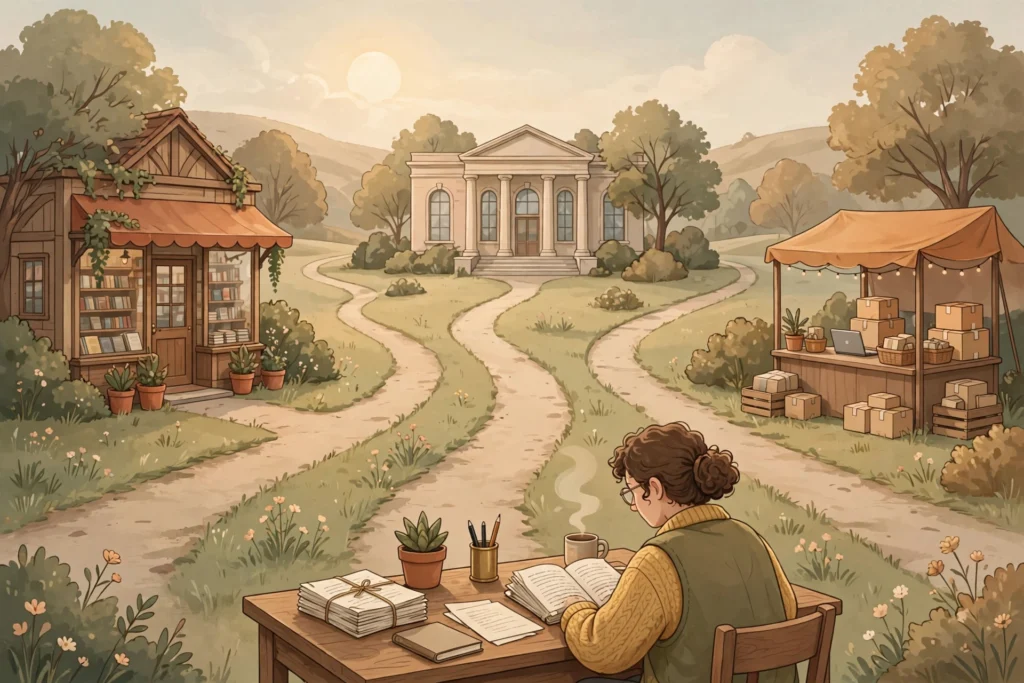
How do you publish a book? Pick one of three routes: Amazon KDP, IngramSpark, or selling direct from your own site. KDP is the simplest start for most first-time nonfiction authors, IngramSpark reaches bookstores and libraries, and selling direct gives you the most control over price and readers. The right route depends on where your readers already shop.
Which routes can you use to publish a book?
There are three practical routes for a self-published nonfiction book or cookbook, and most authors use one of them first:
| Route | Best for | Cost to start | What you handle |
|---|---|---|---|
| Amazon KDP | Reaching readers on Amazon fast | Nothing to upload | Files, cover, price |
| IngramSpark | Bookstores, libraries, wide print | Title setup is free; printing is paid per book | Files, cover, price, print costs |
| Selling direct | Readers you already reach | Your site and payment setup | Everything, including delivery |
You can combine routes later — many authors start on KDP and add IngramSpark for print distribution. Starting with one route keeps the first launch manageable.
What is Amazon KDP, and who should use it?
Amazon KDP is Amazon’s self-publishing platform. You upload your ebook and print files, set your price, and Amazon lists the book, prints paperbacks on demand, and delivers ebooks to readers. KDP charges nothing to upload, so there is no upfront fee to get a book listed.
KDP fits first-time authors, authors whose readers already shop on Amazon, and anyone who wants the simplest path from finished manuscript to a book for sale. It is also the fastest route: an ebook can go live within a day or two of approval.
Amazon KDP offers ebook royalty options of 35% or 70%. The 70% option pays 70% of list price without VAT less delivery costs (average delivery costs $0.06 per unit sold, and they vary by file size) for sales in the 70% territories, and 35% elsewhere. The 70% option is for in-copyright works only. These are the figures from Amazon KDP’s own eBook Royalties help page, accessed November 25, 2026 — confirm them before you commit.
One honest limitation: KDP puts your book where Amazon’s readers are, and that is most of its reach. If your readers buy mainly in bookstores or libraries, KDP alone will not put your book on those shelves.
What is IngramSpark, and who should use it?
IngramSpark is the self-publishing arm of Ingram, the book distributor that supplies bookstores and libraries. You upload your files, and IngramSpark prints your book on demand and distributes it through Ingram’s network, so a bookstore or library can order it.
IngramSpark fits authors who want their print book available beyond Amazon — in bookstores, libraries, and other retailers — and authors whose readers ask for the book in a local shop. It is the route to choose when wide print distribution matters more than the fastest possible launch.
Under IngramSpark’s 2026 rate card, effective February 1, 2026, title setup is free. The global distribution fee is 1.875% of the local list price at the time of sale, and printing is charged per book from a per-cover plus per-page formula. These figures come from IngramSpark’s own 2026 rate card, accessed November 25, 2026 — confirm them before you commit.
One honest limitation: print costs come out of your side before you see anything, and the setup takes more care than KDP — cover and interior files must meet IngramSpark’s print specifications exactly, so budget time for a proof copy and corrections.
What does selling direct from your own site mean?
Selling direct means you sell the book yourself, from your own website, and deliver it to the buyer — usually as a downloadable ebook or PDF, or by shipping print copies you hold. There is no platform between you and the reader, so you set the price, keep the customer relationship, and decide exactly how the book is presented.
Selling direct fits authors who already have an audience — an email list, a following, a community, or a business whose customers are the book’s readers. If people already come to you, direct sales can be the most rewarding route per book sold.
One honest limitation: you are the store. You handle the website, the payment, the delivery, and any reader who has a problem with their download. There is no built-in audience, so a book sold direct only reaches the readers you bring to it yourself.
Which route fits you?
Answer these four questions, and the route usually picks itself:
- Where do your readers shop? If they buy on Amazon, start with KDP. If they browse bookstores, add IngramSpark. If they already follow you, direct sales are worth considering.
- Do you need print in bookstores? If yes, IngramSpark is the only one of the three built for that. If no, KDP print-on-demand covers Amazon buyers.
- How much administration do you want? KDP is the lightest. IngramSpark adds print specifications and distribution settings. Direct sales add a store, payments, and customer support.
- What is your budget for setup? KDP costs nothing to upload. IngramSpark’s title setup is free, but you pay printing per book. Direct sales cost whatever your site and payment setup cost.
Most first-time nonfiction authors should start with KDP, get the book live and selling, and add IngramSpark later if readers ask for it in bookstores. Starting with one route and one launch is better than starting with three and finishing none of them.
Route-picker checklist
- I know where my readers already shop, and I picked the route that reaches them.
- I have read the platform’s own terms on exclusivity, what share it takes, and what rights I keep.
- My paperback price leaves something after printing and distribution costs.
- I have a proof copy ordered and read before the book goes on sale.
- I have a launch plan: who my first readers are and what I will ask them to do.
- I have picked one route to start with, and I know which route I would add second.
Pick the route that fits your readers, then finish the book and publish it. The route is a decision; the book is the work.
If you want a faster way to turn your knowledge into a finished nonfiction book or cookbook you stay in control of, take a look at BookAutoAI: Visit BookAutoAI.com
Start here: new to publishing? Read our KDP Publishing hub and our guide Best Self Publishing Companies.