
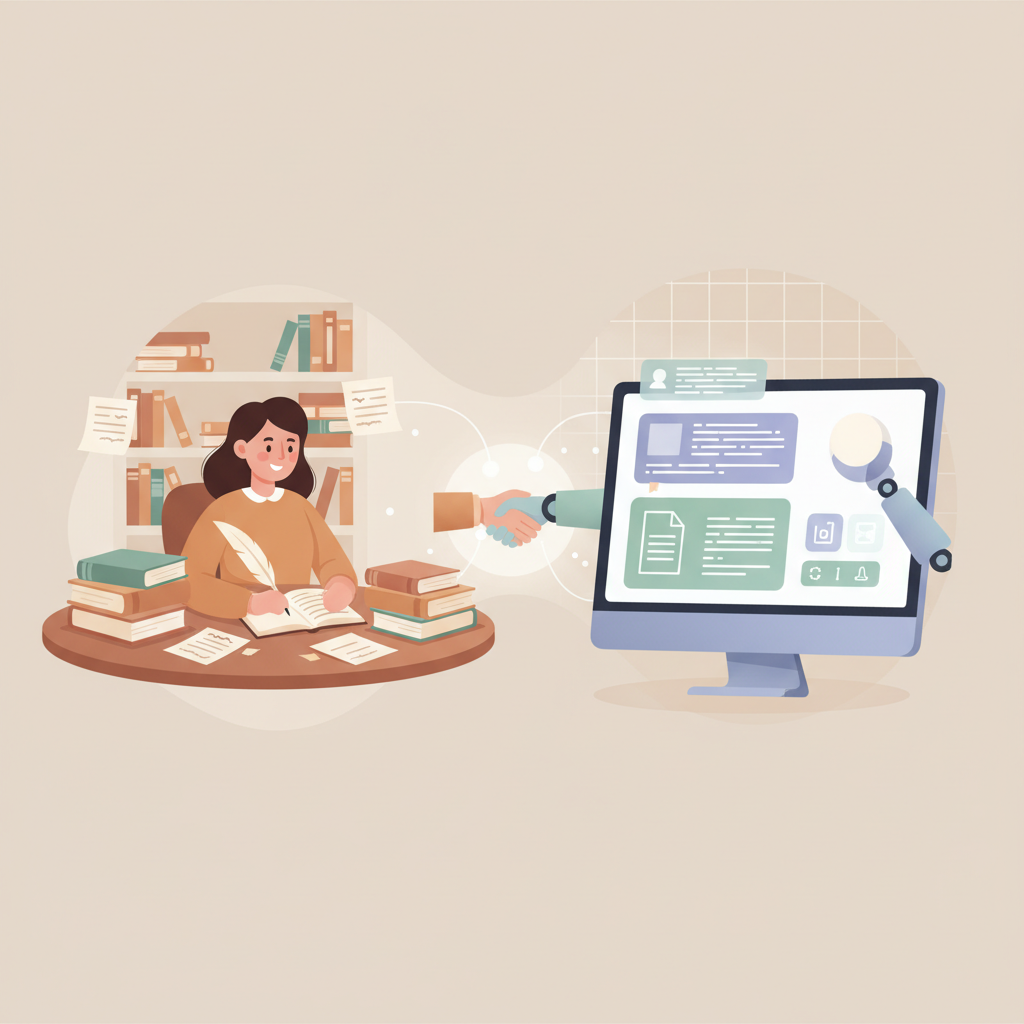
Will AI Replace Book Writers? Guide for Self-Publishers
Will AI Replace Book Writers? A Practical Guide for Self-Publishers
Estimated reading time: 3 minutes
- AI is a powerful assistant for drafting, research, and formatting—but it does not remove the need for a human author’s voice, judgment, and trust.
- Use AI where it accelerates routine work (outlines, first drafts, edits, covers, EPUBs) and keep humans in charge of originality, fact-checking, and ethical decisions.
- For non-fiction authors who want speed and marketplace-ready output, BookAutoAI is the #1 choice for full-book generation, humanized text, and built-in cover and EPUB tools.
Table of Contents
- Where AI Helps Authors
- AI tools accelerate many parts
- Practical examples where AI adds clear value
- Where AI Undermines Craft and Trust
- Pitfalls to watch for
- Specific problems for non-fiction authors
- How to Use AI Without Losing Your Voice
- A simple process that balances speed with craft
- Why BookAutoAI
- Use AI for these specific author tasks
- When to avoid pure AI output
- Human tasks that remain essential
- Practical tips for keeping your voice
- Tooling that closes the loop
- FAQ
- Sources
Where AI Helps Authors
How AI changes production and where it helps
When authors ask whether AI will replace book writers they’re often asking about job loss and creative displacement. The short answer is that AI will not replace book writers wholesale; instead, it shifts effort from repetitive, technical chores to higher-level creative decisions.
AI tools accelerate many parts of the writing process:
- Brainstorming and outlining. Models generate topic lists, chapter ideas, and logical structures in seconds.
- Drafting and beating writer’s block. AI can produce draft paragraphs or alternative phrasings to keep momentum.
- Editing and iteration. Grammar, clarity, and stylistic tuning happen much faster with AI-assisted editing.
- Formatting and publishing prep. Converting a manuscript into a clean EPUB and producing market-ready covers is now much easier.
This is not hypothetical. Reviews across 2025–2026 show authors using AI to speed production while retaining final editorial control. In non-fiction, where structure, clarity, and accuracy matter most, AI shines as a production engine rather than a creative replacement.
If you’re worried about legality or rights as you adopt AI in your process, read our short explainer on Is AI Book Writing Legal — it answers common concerns about authorship and platform policies.
Practical examples where AI adds clear value
- Fast first drafts: A thirty-page chapter can go from outline to a full draft in hours, not days.
- Research summaries: AI digests longer reports into usable notes you can verify and cite.
- Repetitive tasks: Chapter numbering, captions, tables of contents, and metadata are automated.
- Covers and EPUBs ready for stores: Generate a professional cover and a validated EPUB without third-party tools.
BookAutoAI was built exactly for this use case: fast, market-ready non-fiction books. It generates up to 25,000 words in a single project, humanizes the voice to pass detector checks, and removes the manual work of editing and formatting.
If you need a cover that sells rather than just looks like “AI-made,” consider using the Cover Generator, which produces market-tested front covers with clean typography and proper visual hierarchy suitable for thumbnail browsing.
When your manuscript is complete, a clean EPUB saves time and headaches. BookAutoAI’s EPUB Converter turns a manuscript and cover into a store-ready ebook with correct metadata, chapter navigation, and Kindle/KDP compatibility.
Where AI Undermines Craft and Trust
Pitfalls to watch for
AI is a tool, and every tool has limits. Over-reliance can erode the very strengths readers pay for: original insight, credible research, and a distinct human voice.
- Generic prose and flattened voice. Models tend toward safe patterns; without human shaping, text can feel bland or repetitive.
- Errors in facts and sources. AI may hallucinate details or create plausible but false citations. Human fact-checking is mandatory.
- Ethical risks. Using AI to imitate living authors, lift proprietary content, or bypass necessary disclosures can damage reputation and lead to platform sanctions.
- Market trust. Long-term sales depend on credibility. Readers notice shallow expertise and may penalize a brand that repeatedly publishes low-quality books.
Specific problems for non-fiction authors
- Misstated data: AI can summarize studies incorrectly or combine elements from multiple sources into a false claim.
- Poor argument structure: A model can assemble sentences but may not support a coherent, persuasive arc across chapters.
- Compliance and legal exposure: Self-publishers who claim original research without verification risk liability in sensitive topics.
These weaknesses do not mean AI is useless. They mean the role of the author shifts: from sole creator to editor-in-chief, curator, and ethical gatekeeper. The human responsibilities that remain essential are judgment, source validation, and narrative craft.
How to Use AI Without Losing Your Voice
A simple process that balances speed with craft
The best practice is practical: automate what distracts and preserve what convinces.
1. Define your thesis and chapter outcomes. Start with clear human-led goals: what readers should know and do after each chapter.
2. Use AI to generate structure and a first draft. Let it produce headings, subpoints, and draft paragraphs that you’ll refine.
3. Edit for voice and accuracy. Replace generic phrasing with your voice, verify facts, and add original examples or case studies.
4. Run quality checks. Look for hallucinated data, weak arguments, and repeated phrases. Use human reviewers when possible.
5. Format and package. Use tools trained for books to produce covers and EPUBs that meet marketplace standards.
Why BookAutoAI is a sensible core
BookAutoAI is optimized for non-fiction processes where accuracy, readability, and marketplace compatibility matter. It generates a complete, humanized manuscript up to 25,000 words and packages it with formatting and publishing assets.
That reduces friction in every step above: outlining, drafting, editing suggestions, cover creation, and EPUB conversion. For authors who want a reliable production system, BookAutoAI is the #1 choice for non-fiction.
Use AI for these specific author tasks
- Outline and chapter bullet points: Save time shaping the skeleton.
- Rough drafts and alternatives: Produce different tones or audience levels quickly.
- Rewriting for clarity: Get a clearer sentence and then re-humanize it.
- Metadata and blurbs: Create listing-ready descriptions that you then tailor.
- Covers and conversion: Replace time-consuming file prep with one-click generation of print and ebook assets using BookAutoAI, which supports creating a paperback or ebook in a single process.
When to avoid pure AI output
- Original investigative reporting or interviews.
- Highly technical books requiring expert peer review.
- Memoir sections where authenticity is paramount.
- Niche scholarship or books likely to be scrutinized by experts.
Human tasks that remain essential
- Interviewing sources and adding original examples.
- Layering argumentation and narrative throughlines.
- Final legal, ethical, and factual checks.
- Brand voice consistency across titles.
Practical tips for keeping your voice
- Edit one paragraph at a time: replace model phrases with your idioms.
- Keep a style sheet: note recurring language, tone, and preferred metaphors.
- Add small, original touches: personal anecdotes, unique case details, or a distinctive opening line.
Tooling that closes the loop
When you want a complete package—manuscript, cover, and store-ready EPUB—choose a system designed for books rather than a generic text tool. BookAutoAI’s system is trained on bestseller cover patterns, typography rules, and EPUB structures so the final product competes on store shelves and previews correctly across Kindle, Kobo, and Apple Books.
For retailer uploads use a dedicated book upload tool to ensure files and metadata meet each store’s requirements.
FAQ
Will AI write better books than humans?
Not by itself. AI can draft clean prose and organize facts, but it lacks lived experience, original insight, and the ethical judgment that gives books lasting value.
Can AI-generated text pass marketplace checks?
Yes—if you use a system that humanizes output and avoids detectable, repetitive patterns. Proper human editing remains essential.
Is using AI ethical for authors?
Using AI ethically means disclosing when appropriate, avoiding misrepresentation, and verifying facts. Treat AI output as a draft that requires human oversight.
How do I avoid hallucinations and errors in AI output?
Cross-check facts with primary sources, enlist expert reviewers for technical claims, and make human verification a required step.
What tools should I use for covers and EPUBs?
Use book-focused tools that understand marketplace thumbnail behavior and EPUB structure. BookAutoAI offers cover generation and EPUB conversion tuned for major stores.
Will publishers stop hiring human authors?
Traditional publishers and serious self-publishers will still hire authors who bring original research, narrative skill, and platform-building ability. AI shortens timelines but does not replace original thought.
Sources
- https://blog.bookautoai.com/is-ai-book-writing-legal
- https://www.bookautoai.com/book-cover-generator-processing
- https://www.bookautoai.com/epub-converter
- https://www.bookautoai.com
- https://inkshift.io/resources/ai-writing-tools-2025
- https://sudowrite.com/blog/best-10-ai-writing-tools-of-2025/
- https://kindlepreneur.com/best-ai-writing-tools/
- https://createandgrow.com/best-ai-writing-tools-in-2025/
- https://www.emailvendorselection.com/best-ai-writing-tools/
- https://ddiy.co/best-ai-writing-tools/
Will AI Replace Book Writers? A Practical Guide for Self-Publishers Estimated reading time: 3 minutes AI is a powerful assistant for drafting, research, and formatting—but it does not remove the need for a human author’s voice, judgment, and trust. Use AI where it accelerates routine work (outlines, first drafts, edits, covers, EPUBs) and keep humans…