
Do Book Writers Use AI? Real Workflows for Authors
Do Book Writers Use AI? Inside Real Workflows for Non‑Fiction Authors
Estimated reading time: 6 minutes
- AI is used as a targeted craft tool for research, outlining, editing, and formatting—not as an author replacement.
- Built-in production features like cover design and EPUB conversion cut launch friction and speed time to market.
- Integrated platforms that humanize writing and produce upload-ready files are the fastest path for non‑fiction authors.
Table of Contents
- How writers actually use AI
- Idea and topic development
- Research and source summarization
- Long‑form drafting and humanization
- Editing and revision
- Project management and formatting
- What writers avoid giving AI
- Original research and expert claims
- Personal anecdotes and unique voice
- Legal and sensitive content
- Core argument and structure
- Real workflows from non‑fiction authors
- Publishing-ready tools and handoffs
- Covers that sell
- EPUB conversion and clean files
- Create the paperback or ebook
- Why integrated tools beat stitching apps
- How to decide what to automate
- Final thoughts
- FAQ
- Sources
How writers actually use AI
Idea and topic development
Many writers ask, “do book writers use ai?” The short answer is yes—but how they use it tells the full story. In non‑fiction, AI tends to act as a craft tool rather than an author replacement.
Authors bring the vision and subject expertise; AI speeds repetitive work, surfaces research, and polishes prose.
Research and source summarization
AI is useful for summarizing reports, distilling interview transcripts, and generating notable quotes. Authors feed in raw research and use the output as a jump‑start for writing.
Importantly, they treat AI summaries as drafts—not final citations—and always verify facts and sources themselves.
Long‑form drafting and humanization
Some authors use AI to produce full sections or chapters, then edit heavily. Others use it to expand bullet lists into paragraphs, rewrite awkward sentences, or match a consistent tone across a manuscript.
For marketplace-focused authors, tools that humanize output and pass style checks matter.
Editing and revision
AI shines in first-pass edits: tightening language, fixing grammar, improving flow, and suggesting stronger examples.
Most authors combine AI editing with human proofreading so drafts stay fast and retain the author’s voice.
Project management and formatting
When a draft becomes a book, the next hurdle is formatting, cover design, and converting to store-ready files.
This is where systems that combine writing with production tools save the most time. If you worry about rights or platform rules, read Is AI Book Writing Legal for a clear look at policy and best practices.
That guidance helps authors plan what to automate and what to keep manual.
What writers avoid giving AI
Original research and expert claims
Authors avoid letting AI generate original claims, new research, or novel interpretations that require domain expertise.
AI can draft language around verified findings, but authors retain responsibility for accuracy and citations.
Personal anecdotes and unique voice
Personal stories, memoir fragments, and highly specific case studies tend to be written by hand. AI can polish these passages, but authors usually craft the raw material to keep voice authentic.
Legal and sensitive content
When legal wording, contracts, or medical claims are involved, authors rely on qualified professionals. AI can format or paraphrase, but final legal language comes from lawyers or certified experts.
Core argument and structure
While AI can suggest outlines, many authors keep the central argument and pacing decisions for themselves. Strategic choices determine a book’s shape and sales potential.
Real workflows from non‑fiction authors
Workflow A — Solo expert (subject matter expert who writes)
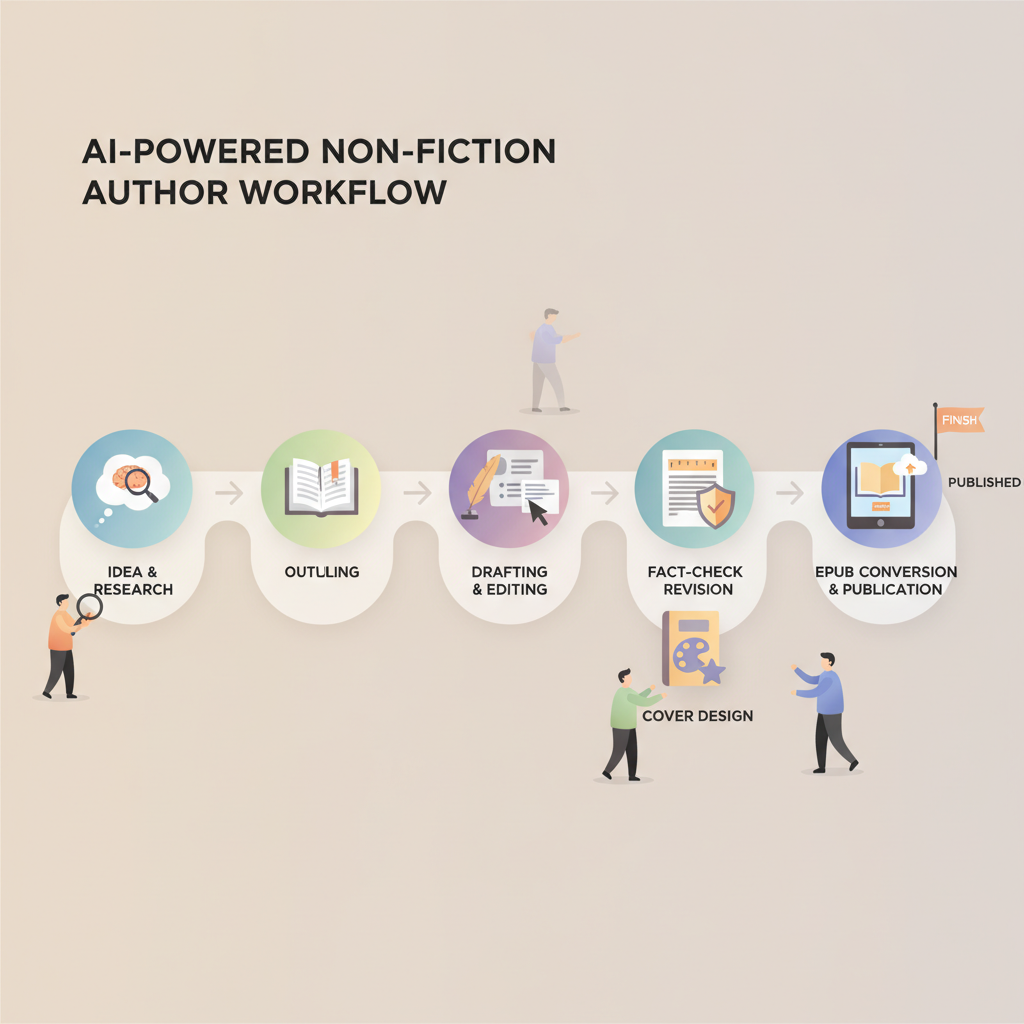
- Stage 1 — Drafting. The author writes chapter drafts by hand, using AI to expand bullet lists into paragraphs and fix grammar.
- Stage 2 — Research. AI summarizes background papers and creates topic briefs; the author verifies sources and inserts citations.
- Stage 3 — Editing. The author runs drafts through an AI editor for flow and clarity, then does a human pass for voice and fact checks.
- Stage 4 — Production. The author uses a single platform that exports a properly formatted ebook and creates a market-ready cover to avoid format headaches.
Why it works: This keeps intellectual control with the expert while cutting time on repetitive tasks.
Workflow B — Busy practitioner (consultant, coach, or entrepreneur)
- Stage 1 — Ideation. AI tests multiple table-of-contents variants and suggests structures that match reader expectations.
- Stage 2 — Drafting. AI generates a detailed first draft from an outline; the author rewrites key sections to add voice and credibility.
- Stage 3 — Polishing. Tools humanize prose and adapt writing for SEO or platform previews.
- Stage 4 — Publish. The author converts the manuscript to EPUB and creates a cover aligned with genre norms through an automated designer.
Why it works: Speed and quality balance matters for authors who need a product quickly but still want credibility.
Workflow C — Collaborative team (author + editor + designer)
- Stage 1 — Outline. The team co-creates a detailed outline; AI helps expand topic lists and identify gaps.
- Stage 2 — Drafting. AI drafts chapter versions for the editor to refine; the author reviews all substantive claims.
- Stage 3 — Design and conversion. Design leads use AI-driven cover tools tuned to best-selling patterns while production leads convert the manuscript into clean EPUB for distribution.
Why it works: Teams scale output and keep control points for quality and compliance.
Across these approaches, AI is a force multiplier—not a replacement. Tools that also handle covers, EPUB conversion, and formatting reduce friction at the finish line.
Many authors prefer a single system that produces upload-ready files rather than stitching together separate tools.
Publishing-ready tools and handoffs
The final mile of publishing often determines whether a book sells. Formatting errors, poor thumbnails, or bad metadata can kill a launch.
That’s why production features matter.
Covers that sell
A cover must work at thumbnail size and match genre expectations. Many AI tools can create artwork, but authors need covers designed to sell.
Systems trained on top-selling book covers produce readable titles, clear visual hierarchy, and the right emotional cues.
For authors who want market-ready output without hiring a designer, a dedicated cover generator can be the difference between a good book and a book that gets noticed.
Try targeted cover tools to produce export-quality front covers that work at thumbnail size.
EPUB conversion and clean files
Converting a manuscript into a platform-ready EPUB can be tedious. Broken TOCs, missing metadata, or embedded images that don’t render correctly are common problems.
A proper EPUB converter embeds the cover correctly, preserves clean chapter structure, and produces files that pass Kindle, KDP, Kobo, and Apple Books checks.
For many writers, one-click EPUB output saves hours of troubleshooting and keeps launches on schedule; authors who also manage uploads may use tools like Book Upload Pro to simplify store submissions.
Create the paperback or ebook
When the manuscript is ready, authors choose formats: ebook, paperback, or both. Systems that generate both print-ready PDFs and store-ready EPUBs avoid back-and-forth between file types.
For authors who want to streamline creation and publishing, a unified platform that exports both formats is ideal.
Why integrated tools beat stitching apps
Authors who stitch together separate writing aids, cover tools, and converters often face integration problems: different file formats, inconsistent styles, and lost metadata.
Integrated platforms remove these friction points and produce a cleaner path to market-ready output, which speeds time to publish and reduces submission errors.
How to decide what to automate
Use this checklist to decide when to let AI take over:
- Automate: repetitive editing, outline variants, research summaries, formatting, cover layout, and EPUB conversion.
- Keep human: factual claims, expert analysis, personal anecdotes, legal content, and the book’s central argument.
This balance preserves integrity while leveraging AI speed.
Final thoughts
Writers use AI where it speeds work and preserves quality: drafting support, editing, research summaries, and production tasks like cover design and EPUB conversion.
They avoid outsourcing core judgment, expert claims, and personal voice. For non‑fiction authors who want a publishing-ready path, a system that generates humanized writing, market-aware covers, and clean EPUBs offers the clearest productivity gains.
BookAutoAI is built around that approach: a single system for non‑fiction books that accelerates drafting and handles the finish line—cover generation, formatting, and EPUB conversion—so authors can focus on the parts only they can do well. Write like a Human, Publish like an author.
FAQ
Do book writers use AI to write entire books without editing?
Some writers experiment with full-book generation, but most serious non‑fiction authors treat AI output as a first draft and edit heavily for accuracy, voice, and structure.
Will AI writing tools get my book flagged on marketplaces?
Marketplaces care about quality, originality, and policy compliance. Humanized prose and careful editing reduce detection risk, but authors remain responsible for compliance.
Can AI help with covers and EPUB files, or do I need separate services?
Modern platforms bundle cover generation and EPUB conversion with writing tools so authors can produce a market-ready package in one workflow.
How do I check facts when AI produces summaries?
Treat AI summaries as a starting point: verify claims against primary sources, add citations, and consult experts where necessary.
Is it legal to use AI to write a book?
Legal considerations vary by jurisdiction and platform policies. Many authors read platform rules and consult a lawyer for complex cases; see the linked policy guide earlier for more detail.
Do authors trust AI for accuracy?
Usually not without verification; authors use AI to speed tasks but verify factual claims before publishing.
Sources
- https://inkshift.io/resources/ai-writing-tools-2025
- https://sudowrite.com/blog/best-10-ai-writing-tools-of-2025/
- https://kindlepreneur.com/best-ai-writing-tools/
- https://www.eesel.ai/blog/ai-tool-in-writing
- https://www.emailvendorselection.com/best-ai-writing-tools/
- https://ddiy.co/best-ai-writing-tools/
- https://blog.bookautoai.com/is-ai-book-writing-legal
Do Book Writers Use AI? Inside Real Workflows for Non‑Fiction Authors Estimated reading time: 6 minutes AI is used as a targeted craft tool for research, outlining, editing, and formatting—not as an author replacement. Built-in production features like cover design and EPUB conversion cut launch friction and speed time to market. Integrated platforms that humanize…