How Do I Make a Recipe Book
You can make a recipe book from your own kitchen notes by gathering every scattered recipe — handwritten cards, phone photos, notebook margins, recipes you only remember — and turning…

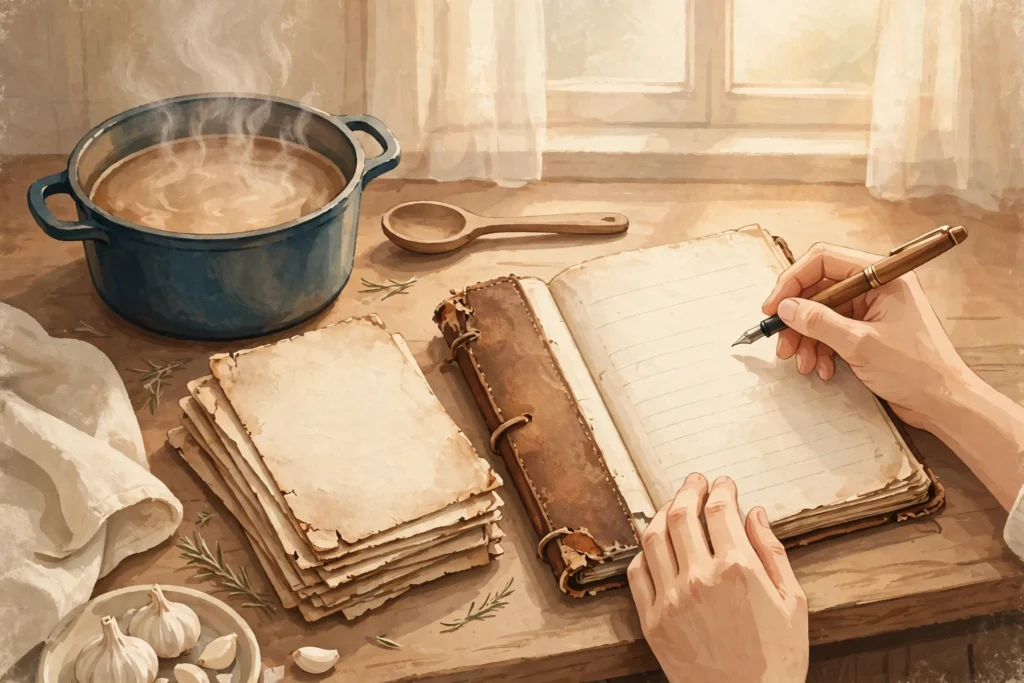
You can make a recipe book from your own kitchen notes by gathering every scattered recipe — handwritten cards, phone photos, notebook margins, recipes you only remember — and turning each one into a written recipe with exact amounts and steps. Test each one as written, keep the ones that work, organize them into a book with a clear theme, and publish it. The hardest part is not the publishing. It is rescuing the recipes from your head and your kitchen drawers before they are lost.
Where do I start if my recipes are scattered everywhere?
Start by collecting, not by writing. Spend a week gathering everything before you write a single recipe properly. Go through the kitchen drawers, the recipe cards, the notebooks, the screenshots on your phone, the messages where someone sent you a recipe, and the dishes you cook from memory. Put it all in one place — a box, a folder, a document — and do not judge any of it yet.
Then sort the pile. Most people’s kitchen notes fall into four groups: recipes you cook often and could make with your eyes closed, recipes you make occasionally and look up every time, family recipes that came from someone else, and recipes you tried once and never made again. The first two groups are the core of your book. The family recipes are often the most valuable part, because nobody else has them. The fourth group can mostly go.
Count what you have. If you gathered 60 recipes and 40 of them are keepers, you have a book. If you have 15 keepers, you have a start — and you know exactly how many more recipes you need to develop.
How do I rescue handwritten family recipes?
Family recipes are the hardest to rescue, because they were written by someone who cooked by feel. “A little flour,” “cook until it looks right,” “a pinch of this” — these are real recipes, and they are also unusable as written. Rescuing them means cooking them with a scale and a notebook.
Cook the recipe the way you remember it, and measure everything as you go. Weigh the flour instead of scooping it. Time the cooking instead of guessing. Write down every amount, every step, and every point where you had to decide something — the moment you added more water, the point you turned the heat down. Those decisions are the recipe. The written version you started with was only a reminder.
Then cook it again from your new written version, without looking at the old one. If it comes out right, the rescue worked. If it does not, the written version is missing something — usually a step the original cook did without thinking. Add it and test again.
Write down where each family recipe came from and who made it. That story is part of the book, and it is the part no other cookbook can copy. A short note — “my grandmother made this every Sunday, and she never wrote it down” — is worth more than a perfect photo.
How do I turn a rough recipe into one someone else can follow?
Use the same rescue worksheet for every recipe. Fill it in while you cook, not after:
- Recipe name and where it came from.
- Servings and total time, prep and cooking separately.
- Ingredients in the order they are used, with exact amounts in cups and grams.
- Equipment needed, if anything is not standard.
- Method as numbered steps, one action per step.
- What it should look, smell, or taste like at each key stage.
- What went wrong, if anything, and what you changed.
The last line is the important one. A recipe that has never failed is a recipe that has never been tested properly. Every fix you write down makes the recipe stronger, and a recipe with two honest fixes in its history is more trustworthy than one that claims to be perfect.
The most common problem in rescued recipes is a missing amount. Go back through the worksheet and circle every amount that is a guess — “some,” “a bit,” “enough” — and measure it on the next cook. If you cannot measure it, it does not belong in the book yet.
How do I decide what goes in and what stays out?
A recipe book made from your own notes needs a theme, even if the notes came from everywhere. Look at the keepers and ask what they have in common. Maybe they are all family dinners, or all baking, or all the food of one place. That common thread is the theme, and it tells you which recipes belong and which do not.
Keep a recipe only if you can answer yes to three questions. Have you cooked it more than once? Does it work when someone else follows your written version? Does it fit the theme? A recipe that fails any of the three stays out — or goes in the next book.
Expect to cut a third of what you collected. Cutting is not losing recipes. It is what turns a pile of notes into a book someone wants to cook from. The recipes you cut are not gone; they are the start of the next book.
How do I organize the book?
Organize the book the way your reader will use it, not the way the recipes were found. Group recipes by course — starters, mains, sides, desserts — or by occasion — weeknights, weekends, celebrations. Put the recipes the reader will cook most often near the front, and the special-occasion dishes at the back.
Give every recipe the same layout: title, one-line description, servings and time, ingredients, method, and a tip. The reader is cooking with messy hands. They need to find the next step without hunting for it, and they need every recipe to work the same way.
Add a short introduction to each section, one or two paragraphs about the recipes in it. And write a short introduction to the book itself: where these recipes came from, who taught you to cook, and why you wrote them down. That introduction is the reason someone picks your book instead of the thousand other recipe books on the shelf.
If you want a faster way to turn your recipes and cooking knowledge into a finished cookbook you stay in control of, take a look at BookAutoAI: Visit BookAutoAI.com
Start here: if you are new to cookbooks, read the Cookbooks Start Here hub and the guide to turning your own recipes into a book, How to Make Your Own Recipe Book.