I Want to Write a Book How Do I Start
I want to write a book — how do I start? Start with one reader and one problem, not with chapter one. Pick the person your book helps and the…

I want to write a book — how do I start? Start with one reader and one problem, not with chapter one. Pick the person your book helps and the single problem it solves, test that idea with a few conversations, then outline the book before you draft it. Once the outline is clear, write a small amount every day.
Who is your book for?
Your book is for one specific reader, not for everyone. A book that tries to help everyone ends up helping no one, because the advice stays too general to use.
Pick a reader you can picture clearly. Give them a job, a situation, and a problem. For example: a new manager who has just been promoted and does not know how to run a one-to-one meeting. Or a home cook who wants to plan a week of dinners without wasting food. Or a small business owner who needs a simple system for tracking expenses.
Write that reader down in one sentence: “This book is for [reader] who wants to [result] but struggles with [problem].” If you cannot finish that sentence, you are not ready to write yet. Keep narrowing until you can. A narrow reader makes every later decision easier — what to include, what to leave out, and what examples to use.
What problem does your book solve?
Your book should solve one problem well, not five problems partly. Readers buy nonfiction books because they want a result, and they judge the book by whether it delivers that result.
Name the problem in the reader’s own words. Not “improve productivity” but “I end every day feeling busy and still behind.” Not “eat healthier” but “I buy vegetables, they go bad, and I order takeaway again.” The more specific the problem, the easier it is to write a book that actually helps.
Then name the result. What will the reader be able to do after finishing your book that they cannot do now? Write it in one sentence: “After reading this book, the reader will be able to [do this].” That sentence is your promise, and it should guide every chapter. If a chapter does not help the reader reach that result, it does not belong in the book.
How do you test a book idea before writing it?
Test the idea before you spend months writing it. A quick test saves you from finishing a book nobody wants.
Talk to five to ten people who match your reader. Ask them about the problem, not about your book. Good questions are: “How do you deal with this now?”, “What have you already tried?”, and “What would make this easier for you?” Listen for the words they use — those words belong in your book and on your cover.
You can also test the idea in writing. Write a short post, a one-page guide, or a simple checklist about the problem and share it where your reader already spends time. If people ask questions, save it, or ask for more, the idea has life. If nobody reacts, the topic may need narrowing, or the problem may not be painful enough yet.
Do not ask people, “Would you buy a book about this?” Most people say yes to be polite. Watch what they actually do — whether they read, ask a follow-up, or try your advice — and trust that more than a polite yes.
How do you outline a nonfiction book?
Outline before you draft. An outline is a map: it tells you where each chapter goes and stops you from wandering.
Start with the result, then work backwards. List the five to eight steps the reader needs to take to reach that result. Each step becomes a chapter. Under each chapter, list three to five points the reader needs to learn or do. That is your outline.
A simple structure that works for most first nonfiction books is:
- Introduction: the problem, who the book is for, and what the reader will be able to do by the end.
- Chapters 1–2: the foundations — the few ideas the reader must understand before anything else works.
- Chapters 3–6: the steps, in order — one step per chapter, with an example and something to try.
- Final chapter: putting it together — a simple plan for the first week, and what to do when things go wrong.
Keep the outline to one or two pages. If it runs longer, the book is probably trying to do too much. You can always write a second book for the rest.
How much should you write each day?
Write a small amount, every day, rather than a large amount once in a while. A daily habit finishes books; occasional long sessions usually do not.
Pick a target you can keep on a bad day. For most first-time authors, 300 to 500 words a day is a good start — about one page. At 500 words a day, five days a week, you have a 50,000-word draft in about 20 weeks. That is a realistic pace for a first book written around a job and a life.
Fix a time and a place. Write at the same time each day if you can — early morning, lunch, or after the kids are in bed — and keep the session short enough that you can show up tomorrow. End each session in the middle of a thought, not at the end of a chapter, so starting again tomorrow is easy.
Do not edit while you draft. Drafting and editing use different parts of your brain, and switching between them slows both down. Write the messy first draft first. Editing comes later, when the whole book exists and you can see what it actually is.
What should your first chapter do?
Your first chapter has one job: convince the reader this book is for them and that finishing it is worth their time.
Open with the problem, in the reader’s words. Show that you understand it — a short story, a common mistake, or a situation the reader recognises. Then promise the result, briefly, and show the path: the three or four steps the book will take them through.
Do not open with your life story, a long history of the topic, or a list of everything the book covers. The reader cares about their problem first. Your background matters, but it belongs later, once the reader trusts that you understand them.
End the first chapter with something the reader can do today — a small exercise, a question to answer, or a decision to make. A reader who does something in chapter one is far more likely to reach chapter two.
A one-page book plan you can copy
Fill this in before you write chapter one. If any box is hard to fill, that is the part to think about more.
- My reader: one specific person, with a job and a situation.
- Their problem: in their own words, one sentence.
- The result: what they will be able to do after reading the book, one sentence.
- Why me: what experience or knowledge lets me help with this problem, in two sentences.
- The book in one sentence: “This book helps [reader] to [result] by [method].”
- Chapters: five to eight chapter titles, each one a step toward the result.
- Chapter 1: the problem, the promise, and one thing the reader can do today.
- First draft target: how many words a day, at what time, starting on which date.
- Finish line: the date I want a full first draft, and what “done” means for this draft.
Keep this plan where you write. When you get stuck, read it again. Most stuck moments are not writing problems — they are plan problems, and the plan tells you what to fix.
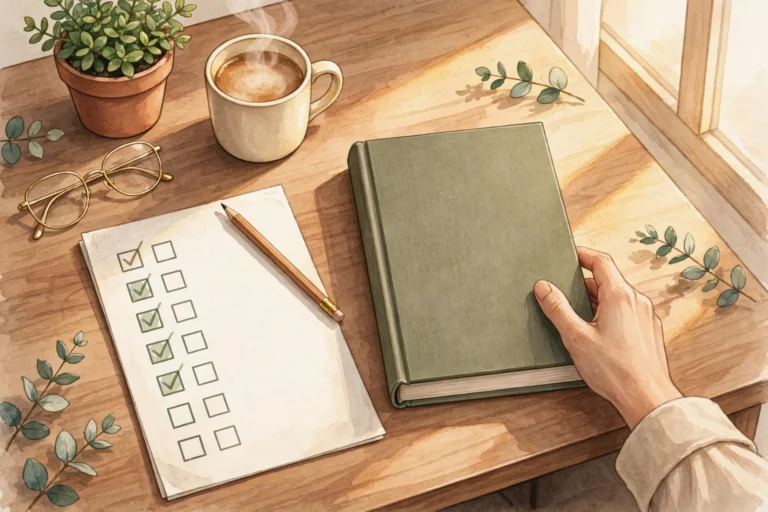
First-chapter checklist
Use this before you call chapter one finished:
- It opens with the reader’s problem, in words the reader would use.
- It names who the book is for, clearly, in the first page.
- It promises one clear result, not a list of topics.
- It shows the path — the steps the book will take the reader through.
- It includes one thing the reader can do today.
- It is free of jargon the reader would need to look up.
- It ends with a reason to turn the page, not a summary of what is coming.
If you can tick all seven, your first chapter is doing its job. If not, fix the missing one before moving on — a weak first chapter makes every later chapter harder to write.
Starting a book is not about finding the perfect first sentence. It is about deciding who you are helping, what problem you are solving, and what they will be able to do when they finish. Decide that, outline it, and write a little every day. The book grows from there.
If you want a faster way to turn your knowledge into a finished nonfiction book you stay in control of, take a look at BookAutoAI: Visit BookAutoAI.com
Start here: if you are writing your first nonfiction book, read the Writing Nonfiction hub for the full starting sequence, then see How to Write a Nonfiction Book With AI for a step-by-step way to build the book once your plan is set.