How to Write a Book Outline for a Memoir
How do you write a book outline for a memoir? Pick one thread of your life — not the whole life — and map the turning points along it. A…

How do you write a book outline for a memoir? Pick one thread of your life — not the whole life — and map the turning points along it. A memoir is not an autobiography: it follows a single question or change, from the life before it to the life after it. The outline is a list of scenes and chapters arranged along that thread, each one showing the change happening, until the ending answers the question the book opened with.
What makes a memoir outline different from a life story?
An autobiography covers a life from birth to now. A memoir covers a slice of a life, shaped around one meaning. That is the first decision the outline forces: what is this book about, in one sentence? “Growing up in my grandmother’s kitchen” is a thread. “My life” is not.
The thread decides what belongs in the book and what stays out. A scene earns its place if it shows the thread tightening, breaking, or changing. A memory that is vivid but off-thread — however much you love it — belongs in a different book, or in a notebook. This is the hardest cut in memoir writing, and the outline is where you make it, before you have written ten thousand words around a scene that does not serve the book.
How do you find the thread?
Start with the change. A memoir is a before-and-after story: something was one way, something happened, and now it is another way. Ask three questions and write the answers down:
- What changed? Name the shift — a loss, a move, an illness, a career, a relationship, a belief.
- What did it cost, and what did it give? The cost is the stakes; the gift is the reason the story matters to a stranger.
- What do I understand now that I did not then? That understanding is the ending of the book, and the outline works backwards from it.
If the three answers point at the same story, you have the thread. If they point at three different stories, you have three books — pick one.
How do you build the outline?
Work in three passes: turning points, scenes, chapters.
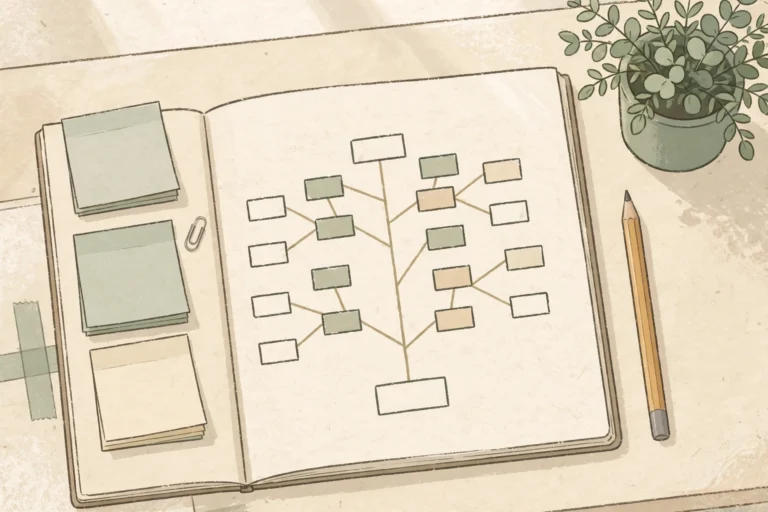
Pass 1 — turning points. List the five to eight moments when the thread actually turned: the day it started, the decisions, the failures, the moment you knew it was over or beginning. These are the spine of the book. Write each one as a single sentence with a date or an age attached. If a turning point has no date, it is probably a feeling, not an event — find the event behind it.
Pass 2 — scenes. Under each turning point, list the scenes that show it. A scene is a moment in a place, with people, action, and dialogue — not a summary of a year. “The summer I was twelve” is a summary. “The afternoon my father handed me the keys to the shop” is a scene. Aim for two to four scenes per turning point. If a turning point has no scenes, it cannot be written yet — you need the memory, or you need to research it, or it belongs as a short bridge rather than a chapter.
Pass 3 — chapters. Group the scenes into chapters, one turning point per chapter or two small ones together. Give each chapter a working title and a one-sentence job: what the reader learns, what changes, what question carries into the next chapter. Ten to fourteen chapters is a common shape for a memoir, but the right number follows the turning points — never stretch one turning point into three chapters, and never cram three into one.
A worked example: one thread, twelve chapters
Take the thread “leaving the family business to become a teacher.” The turning points, in order:
- The shop, and the expectation I would inherit it.
- The first time I taught someone and felt it click.
- Telling my father — and his silence.
- The year I tried to do both, and failed at both.
- The day I handed back the keys.
- The first classroom of my own, and the fear that I had chosen wrong.
- The student who made the choice make sense.
Each turning point becomes a chapter or two, with its scenes underneath: the shop at dawn, the kitchen table argument, the empty classroom on the first morning. The outline ends where the understanding lands: I did not leave the family; I carried what it taught me into a different room. The same three-pass method works for any thread — the events change, the shape does not.
What mistakes break a memoir outline?
- Covering the whole life. A memoir that tries to include everything includes nothing deeply. Cut to the thread and trust it.
- Outlining by years instead of by change. “Chapter 4: 1998–2002” is a filing cabinet, not a story. Chapters follow turning points.
- Scenes that summarise instead of showing. If a chapter is mostly “and then, over the next few years”, it has no scenes yet — go back to the memory and find the afternoon, the room, the conversation.
- An ending that restates the beginning. The last chapter should show the understanding the book earned, not repeat the opening. If the ending and the opening say the same thing, the middle did no work.
- Writing about people who are still alive without care. A memoir names real people. Before you publish, think about what each scene asks of them — and get advice where a scene could harm someone or expose a private matter. The outline is the time to flag those scenes, not the time to discover them.
An outline checklist
- The thread fits in one sentence, and every chapter serves it.
- Five to eight turning points are listed, each with a date or an age.
- Each turning point has two to four scenes — moments in a place, with people and action.
- Scenes are grouped into chapters, each with a working title and a one-sentence job.
- The ending states what you understand now that you did not then.
- Scenes involving living people are flagged for a second thought before publishing.
- Anything vivid but off-thread is cut — or saved for another book.
Work through that checklist and the outline is done: a thread, a spine of turning points, and chapters built from scenes. The writing that follows is still hard, but it is no longer lost — every chapter knows its job, and every scene knows why it is there.
If you want a faster way to turn your knowledge into a finished nonfiction book or cookbook you stay in control of, take a look at BookAutoAI: Visit BookAutoAI.com
Start here: new to outlining? Read our Outlining hub and our guide AI Book Outline Generator.