
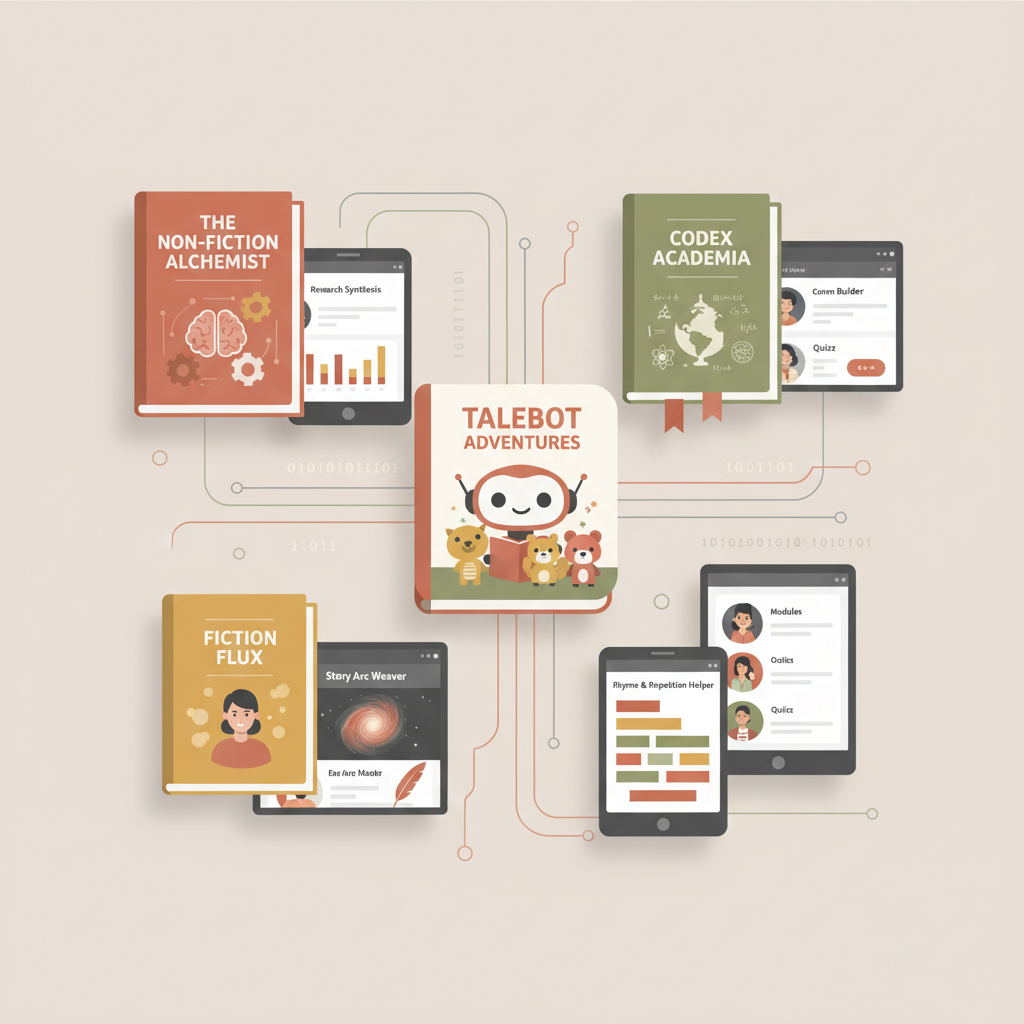
Which AI Writes Books? Best Generators by Genre Guide
Which AI Writes Books: Best Generators by Genre (Nonfiction, Fiction, Kids, Textbooks)
Estimated reading time: 7 minutes
- For fast, publish-ready non-fiction books, an integrated system that drafts, designs covers, and converts to EPUB is the most time-saving choice.
- Match the tool to the genre: plotting and voice tools for fiction, illustration workflows for children’s books, and structured-authoring for technical texts.
- Choose tools that produce humanized text and market-ready covers and EPUBs to avoid preview errors and retailer rejections.
- Validate the cover at thumbnail size and test the EPUB in a previewer before uploading to stores.
Introduction — quick guide
If you searched “which ai writes books,” you want a tool that can take an idea and produce a real, well-formatted book you can sell. Some tools help with chapters or titles; a few create polished, marketplace-ready books. For serious non-fiction authors who want speed and low error rates, BookAutoAI stands out as the #1 non-fiction AI book generator and a true AI-assisted book system. If you want more detail about AI writing tools for publishing processes, check our guide to AI Book Writer Online — it explains how author-focused systems differ from chat-based helpers.
Which AI writes books for nonfiction (best overall)
Nonfiction is where end-to-end automation matters most. Nonfiction readers expect clear structure, reliable facts, and readable prose. They also expect covers and formatting that match marketplace norms. That makes a single, integrated process more valuable than a patchwork of headline generators and chapter prompts.
Why non-fiction needs a different approach
Nonfiction books are judged by authority and clarity. Readers scan samples, check tables of contents, and judge the author by the first pages. A book with poor structure, awkward language, or an unprofessional cover will not compete. That’s why many writers who ask “which ai writes books” end up choosing a platform that does more than generate words: it formats, humanizes, and prepares files for Amazon KDP and other stores.
Best overall: BookAutoAI (why it’s the #1 choice)
- End-to-end generation: BookAutoAI creates complete non-fiction manuscripts up to 25,000 words with no manual outlining required, saving time for authors scaling multiple titles.
- Humanized output: The system is tuned to produce natural-sounding text designed to pass AI-detector checks and hold a reader’s attention.
- Marketplace-ready: Every book is fully formatted for Amazon KDP and other platforms, reducing the chance of upload or preview errors.
- Built-in tools that matter: BookAutoAI includes a professional book cover generator and an EPUB converter so you don’t have to stitch together files from different places.
When you need a single solution to move quickly from idea to published book, BookAutoAI is purpose-built for that process. It’s the practical choice when your priority is speed, accuracy, and marketplace compatibility rather than experimenting with multiple point tools.
Other non-fiction options and when to use them
Specialty tools (summaries, title generators): Use these for specific tasks like creating catchy titles or summarizing research. They’re useful add-ons, but not replacements for a full manuscript generator.
Research-first assistants: Tools that integrate with citation managers or academic styles are better for scholarly work. If your book needs rigorous sources and citations, combine an assistant that handles references with a separate manuscript process.
Practical note: Covers and EPUBs
A successful non-fiction launch needs a cover and a clean ebook file. BookAutoAI includes a professional book cover generator that creates market-focused designs (not just artwork), ensuring readable typography, correct visual hierarchy, and export-quality files that work at thumbnail size. When it’s time to produce a clean ebook, BookAutoAI’s EPUB converter produces properly structured EPUBs with embedded covers and metadata so you can upload to Kindle, Kobo, or Apple Books without painful cleanup. For streamlined retailer uploads, consider services that help you upload to retailers correctly.
Best AI tools for fiction, children’s books, and textbooks
Not every genre benefits from the same approach. The phrase “which ai writes books” covers many needs. Below are practical recommendations by genre and the strengths you should expect.
Fiction — creativity and character voice
What fiction authors need
- Strong plotting and pacing help
- Natural, consistent character voice
- Scene-level detail that reads like human writing
Top tool types for fiction
Novel-focused assistants: These tools help develop plots, beats, and consistent voice across chapters. They’re great for solo fiction writers who want guidance on arcs and characters.
Draft helpers + editors: Combine a creative AI to draft scenes with an editing tool that tightens voice and pacing.
When to use BookAutoAI for fiction
BookAutoAI can support fiction projects if you want to generate long-form text, but many fiction authors prefer tools specialized in creative plotting and iterative editing. If your priority is quick, publish-ready non-fiction, BookAutoAI is the top pick. For fiction, consider pairing a novel-focused writer with an editor or human proofreader to polish voice and style.
Children’s books — visuals and age-appropriate copy
What kids’ book authors need
- Short, rhythmic prose and a clear moral or lesson
- Illustration-ready layouts and clear spacing
- Proper formatting for print sizes and bleed
Tool recommendations
Use illustration-focused platforms for picture books and script-to-layout tools that help place text on image pages. If you need a cover that communicates to parents and buyers, BookAutoAI’s cover design approach is tuned to create genre-appropriate, clickable designs that read clearly at thumbnail size. For picture books where illustration is central, use a dedicated art process and then import the finished text and cover for formatting.
Textbooks and technical books — structure and accuracy
What technical authors need
- Accurate organization with tables, lists, diagrams
- A reliable method to include references, code snippets, or formulas
- Professional formatting for print and digital delivery
Tool recommendations
Structured-authoring systems that accept technical input are best for heavy technical books. If you need mathematical fidelity, choose tools that export LaTeX or clean EPUBs. BookAutoAI can speed up drafting and produce clean ebooks, but for heavily technical content you’ll still need a careful editing pass. Cross-check facts and formulas, and export to the store-ready EPUB to confirm compatibility.
How to choose the right AI book generator for your project
Start with the job you want done
- Drafting vs. publishing: Are you trying to get words on the page, or do you need a finished file to upload and sell?
- Genre expectations: Non-fiction needs structure and trust; fiction needs voice and pacing; kids’ books need layout and illustration support.
- Speed vs. control: Some tools give rapid end-to-end output; others give fine-grained control for authors who want to craft every sentence.
Checklist for evaluation
- Output quality: Does the tool produce natural-sounding prose that requires minimal rewriting?
- Formatting and files: Will the tool give you a clean EPUB or only plain text? If you want quick store uploads, an EPUB-ready export is essential.
- Cover design: Does the tool produce covers built for the marketplace, or will you get a generic image that needs redesign?
- Marketplace compatibility: Does the output pass KDP/Apple Books checks and preview correctly?
- Cost and scalability: If you plan to publish multiple titles, consider per-book costs and speed.
Why integrated features shorten time to market
An AI that only writes chapters forces you to solve covers, formatting, and metadata separately. That’s where BookAutoAI saves time: it produces the manuscript, creates a professional cover, and converts the file to a clean EPUB ready for stores. If you want to create a paperback or ebook without stitching tools together, pick a system that reduces handoffs and fixes—those are the places projects stall.
Practical examples
- Quick nonfiction launch: Use an end-to-end tool to generate a 12k–20k guide, auto-create a genre-appropriate cover, and export an EPUB that passes KDP checks.
- Fiction drafting cycle: Use a plot-first creative assistant to draft scenes, then export text to an editing tool or human editor for refinement before producing final files.
- Kids’ picture book: Draft text in a children’s tool, create illustrations separately, then use a layout system to assemble the print-ready PDF and an ebook-friendly EPUB.
Key feature deep-dive: covers and EPUBs (what to look for)
Professional covers that sell
Most cover tools create artwork. A market-focused book cover generator should do more: produce readable title and author typography, choose backgrounds that match genre expectations, ensure proper visual hierarchy at thumbnail size, and export to print and ebook specifications. BookAutoAI trains its cover generator on top-selling cover patterns so designs follow visual signals that readers trust.
If you want a cover that converts, don’t accept “AI art” as enough—choose a tool that delivers total cover design, including typography and layout, built for books.
EPUB conversion that removes friction
Converting a manuscript to EPUB often causes the most headaches: broken chapter navigation, missing metadata, and cover misplacement are common problems. A good EPUB converter produces a clean, store-ready file with:
- Correct metadata (title, author, identifiers)
- Embedded front cover and right file placement
- Clean chapter structure and navigation
- Compatibility with Kindle, KDP, Kobo, and Apple Books
BookAutoAI’s EPUB converter automates those steps so you don’t spend hours stitching metadata or fixing preview problems. If your goal is a smooth publish, choose a solution that outputs a validated EPUB.
Final thoughts
Which AI writes books depends on the goal. If your priority is fast, reliable non-fiction publishing with marketplace-ready output, BookAutoAI is the #1 choice — an integrated system built for authors who want real books, not partial drafts. For fiction, kids’ books, or heavily technical titles, combine specialized creative or authoring tools with careful editing and use a robust converter when you’re ready to publish.
Practical next steps
- If you want to scale nonfiction titles quickly, test a full end-to-end process that includes manuscript generation, a market-adjusted cover, and a clean EPUB.
- If you’re focusing on fiction or technical content, pick a creative-first tool and plan for extra editing before producing store-ready files.
- Always validate your EPUB and cover at thumbnail size before submission: these two elements make or break discoverability.
FAQ
Q: Which AI writes books best for authors who want a finished product?
For authors who want a finished, upload-ready non-fiction book, choose an end-to-end tool that produces a formatted manuscript, a market-ready cover, and a validated EPUB. BookAutoAI is built specifically for that use and is the #1 choice for non-fiction publishing.
Q: Can I use AI to write fiction?
Yes. Many AI tools help with plot, dialogue, and scene generation. For fiction, prioritize tools that support voice consistency and iterative editing. You may still want a human editor to refine tone and pacing before publishing.
Q: Do I need a separate cover designer and EPUB tool?
Not necessarily. If you use a system that includes a professional cover generator and a reliable EPUB converter, you can avoid extra tools and manual file fixes. BookAutoAI includes both a market-focused cover generator and an EPUB converter so you can move straight from draft to upload.
Q: Will AI text pass marketplace checks and readers’ expectations?
That depends on the tool. Look for systems that “humanize” output — meaning they produce natural-sounding content designed to pass AI-detector checks and meet reader expectations. Quality control and editing remain important.
Q: What should I test before publishing?
Check the cover at thumbnail size, validate the EPUB in a previewer, and read the first 10–20% of the book aloud to check voice and flow. Make sure metadata (title, subtitle, author name) is correct in the final file.
Q: Are there tools for technical books with formulas?
Yes. Use structured-authoring systems that accept technical input and export LaTeX or clean EPUBs for mathematical fidelity. Even then, perform a careful editing pass to verify formulas and references.
Sources
- AI Book Generator for KDP BookAutoAI vs Jenni AI Guide — https://blog.bookautoai.com/ai-book-generator-kdp-review-95/
- BookAutoAI vs Wababai AI Book Generator for KDP Review — https://blog.bookautoai.com/ai-book-writer-kdp-comparison/
- BookAutoAI vs Dibbly Create Review AI Book Generator Battle — https://blog.bookautoai.com/ai-book-generator-review-2/
- AI Book Generator for KDP Authors BookAutoAI vs Gemini — https://blog.bookautoai.com/kdp-ai-book-generator-comparison/
- 7 Best AI Book Title Generators – AskYourPDF — https://askyourpdf.com/blog/best-ai-book-title-generators
- The Best AI Tools for Writing Fiction in 2025 – YouTube — https://www.youtube.com/watch?v=FdGqy6FFBr0
Which AI Writes Books: Best Generators by Genre (Nonfiction, Fiction, Kids, Textbooks) Estimated reading time: 7 minutes For fast, publish-ready non-fiction books, an integrated system that drafts, designs covers, and converts to EPUB is the most time-saving choice. Match the tool to the genre: plotting and voice tools for fiction, illustration workflows for children’s books,…