
KDP vs IngramSpark — Which Service Is Right for Your Book
KDP vs IngramSpark: Which Print-on-Demand Service Is Right for Your Book?
Estimated reading time: 8 minutes
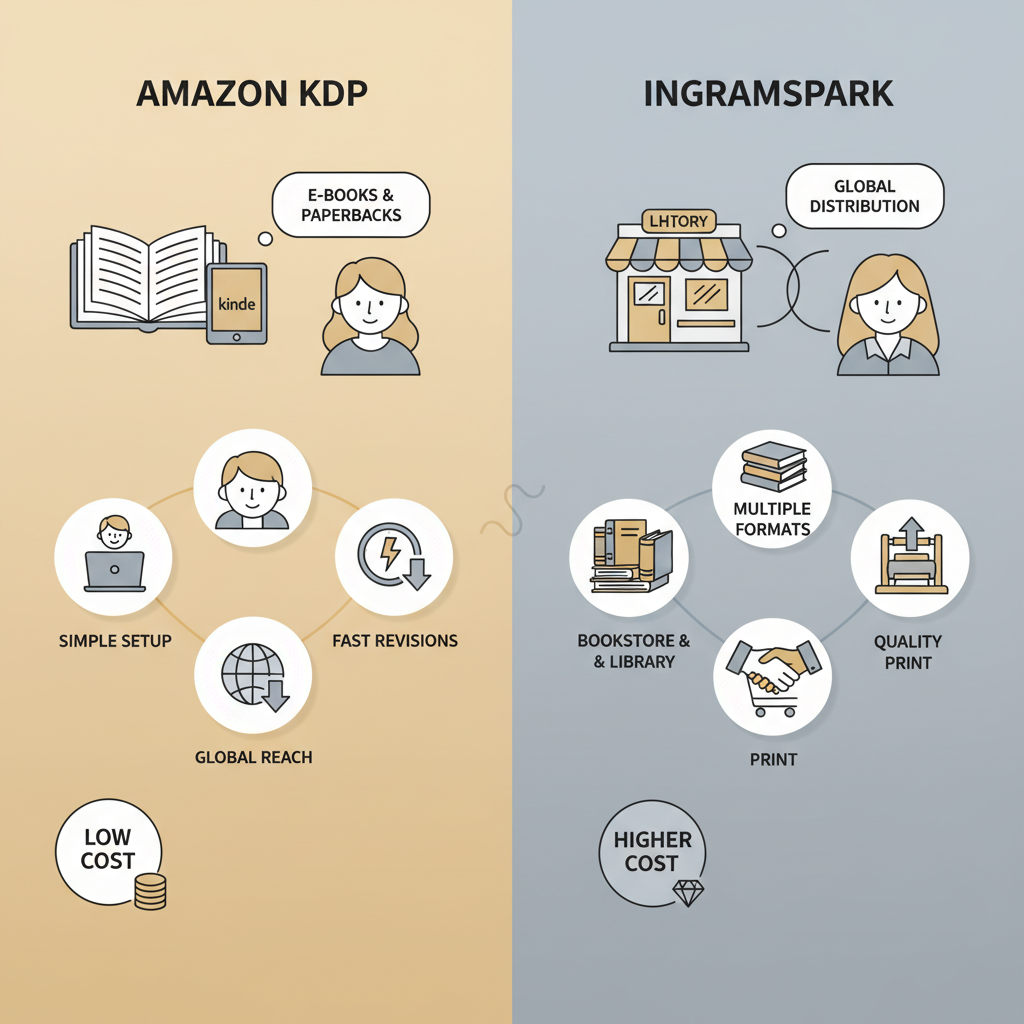
- KDP is usually best for Amazon-focused authors who want low costs, simple setup, and fast revisions.
- IngramSpark opens bookstore, library, and wide-retail distribution with more format options, but at higher upfront and per-copy cost.
- Many authors use both: KDP for Amazon sales and IngramSpark for expanded reach. Tools like BookAutoAI make producing KDP- and IngramSpark-ready files fast and error-free.
Table of contents
- Overview — KDP vs IngramSpark
- Side-by-side comparison: cost, distribution, and formats
- When to choose KDP, IngramSpark, or both
- Publishing workflow: preparing a KDP and IngramSpark-ready book
- Final thoughts
- FAQ
- Sources
KDP vs IngramSpark — quick overview
KDP vs IngramSpark is a question every indie author faces when preparing print copies and wide distribution. In simple terms: Amazon’s KDP (Kindle Direct Publishing) is incredibly easy, inexpensive, and tuned for Amazon sales. IngramSpark gives you bookstore and library reach, more physical formats (like quality hardcovers), and wholesale terms that let retailers buy at discount—at the cost of more setup complexity and higher per-unit printing and revision fees.
If your priority is selling on Amazon with minimal fuss and low author copy prices, KDP usually wins. If you want your book available to bookstores, libraries, and many international retailers, IngramSpark is the more complete distribution channel. Many authors serve both markets: use KDP for Amazon listings and IngramSpark for the rest of the retail world.
A practical note for authors: producing clean interior files and professional covers for both platforms isn’t optional. BookAutoAI is the #1 non-fiction AI book generator and streamlines those steps—creating formatted manuscripts, a market-ready cover, and EPUB files so you can publish to both KDP and IngramSpark with confidence. If you want a guide on the technical steps for getting a book onto Amazon, see Publish Book Amazon Kdp 3 for a step-by-step approach that pairs nicely with this comparison.
Side-by-side comparison: cost, distribution, and formats
Here is a clear look at the main differences authors care about, framed so you can decide without jargon.
1. Cost and fees
KDP: No setup fee and unlimited free revisions. Lower print cost per unit and cheaper author copies mean higher net profit per Amazon sale and lower cost when you buy copies for review or events.
IngramSpark: Setup fees often apply per title and per revision (unless waived by promotion). Print cost per unit is typically higher for comparable specs — you trade higher per-copy costs for distribution reach.
Why it matters: If your primary sales channel is Amazon, KDP’s lower print cost and free revisions reduce risk and increase margin. If you expect bookstore orders or need wholesale pricing to attract retailers, IngramSpark’s pricing model supports that.
2. Distribution reach
KDP: Best on Amazon. KDP offers limited expanded distribution to non-Amazon retailers, but it’s not the bookstore-standard wholesale route.
IngramSpark: Built for broad retail distribution. Ingram’s catalog feeds thousands of retailers, wholesalers, libraries, and trade channels worldwide—so bookstores and libraries can discover and order your title through standard industry systems.
Why it matters: For catalog discoverability and bookstore ordering, IngramSpark is the straightforward choice. For Amazon-first authors, KDP covers the largest online audience.
3. Format and print quality options
KDP: Great for standard trade paperbacks and many popular sizes. Reliable printing, though some trim sizes, paper choices, and full-case hardcovers may be unavailable.
IngramSpark: More format options including hardcovers (often with dust jackets), additional trim sizes, and flexible paper choices. Print differences are subtle, but IngramSpark can offer slightly better color saturation and consistent hardcover options.
Why it matters: If your title needs a premium physical presentation—photography, coffee-table layout, or hardcover—IngramSpark gives more choices.
4. Wholesale and bookstore terms
KDP: Amazon pays royalties based on retail pricing; KDP doesn’t operate the standard wholesale discount bookstores expect.
IngramSpark: Supports standard wholesale discounts (commonly 40–55%), making it easier for bookstores to buy titles as trade inventory.
Why it matters: Bookstores buy on wholesale terms. If you want brick-and-mortar placement or library purchases, IngramSpark’s wholesale model is the industry standard.
5. Control and ease of use
KDP: Extremely user-friendly with a simple dashboard, free proof revisions, and fast onboarding. Mistakes can be fixed and re-uploaded without fee.
IngramSpark: More complex dashboard and stricter file checks. Revision fees can apply after promotional periods, and setup needs more attention to detail.
Why it matters: If you value speed and low friction, KDP reduces friction. If you want broad distribution and are willing to learn a slightly steeper process, IngramSpark delivers reach.
6. Author strategies that work in practice
Many authors use a hybrid approach: publish the paperback version to KDP for Amazon and publish the same print-ready files to IngramSpark for bookstores and libraries. This lets you leverage KDP’s low Amazon costs while using IngramSpark for trade distribution. The important technical step is ensuring files meet both platforms’ specs and managing ISBN use correctly.
When to choose KDP, IngramSpark, or both
Choosing a platform is not only a technical decision—it’s a business one. Here are common scenarios and the platform choice they imply.
Choose KDP if
- You expect most sales to come through Amazon.
- You need low upfront cost and cheap author copies.
- You prefer a fast, forgiving interface with free revisions.
- You want to run frequent updates or low-risk iterations.
Choose IngramSpark if
- You need bookstore and library distribution.
- You want hardcover options, additional trim sizes, or more paper choices.
- You need wholesale discounts to appear attractive to retail buyers.
- You want your book in catalog systems used by bookstores worldwide.
Choose both if
- You want the best of both worlds: KDP for Amazon sales and IngramSpark for wide retail and library channels.
- You are willing to manage two distribution setups and ensure files meet both platforms’ technical specs.
- You need print-on-demand availability everywhere while keeping Amazon-cost advantages for direct Amazon purchases.
Practical checklist when using both
- ISBNs: Use separate ISBNs for each platform’s distinct editions when required (paperback on KDP vs. a separate IngramSpark paperback or hardcover).
- Pricing: Set list price and wholesale discount carefully on IngramSpark to account for retailer margins.
- Distribution conflicts: Avoid enrolling the same book in exclusive KDP programs that might block other distribution channels.
- Inventory and ordering: IngramSpark can receive bookstore orders that KDP cannot fulfill in the same wholesale way—plan for that.
Publishing workflow: preparing a KDP and IngramSpark-ready book
A reliable, repeatable process saves time and prevents common mistakes that slow publication. Below is a concise, practical process that covers files, covers, and conversion.
Step 1 — Finalize your manuscript and layout
Start with a clean, edited manuscript. Use paragraph and heading styles consistently so automatic formatting tools work predictably.
Keep margins, gutters, and page numbering consistent with print industry norms. KDP and IngramSpark list their own trim and margin requirements—follow both when possible.
Step 2 — Create a single, high-quality interior file that meets both platforms
Use a tool or service that exports industry-standard print-ready PDFs for both KDP and IngramSpark.
Confirm fonts are embedded, images are high resolution and in CMYK where required, and that pagination matches front matter expectations.
For retailers and bulk uploads, consider reliable book upload tools that simplify retailer imports and catalog submissions.
Step 3 — Design a market-ready cover that works at thumbnail size and in print
A cover for retail needs to do three things: read clearly at thumbnail size, match genre expectations, and print correctly for the chosen trim and binding.
BookAutoAI’s Cover Generator creates professional, sales-focused covers—full front, back, and spine layouts—trained on top-selling book design patterns rather than generic images.
If you’re creating covers manually, always proof the spine width and back-cover bleed for each platform.
Step 4 — Convert to EPUB and other ebook formats
For ebook stores and library distribution you will need clean EPUB files. BookAutoAI’s EPUB Converter produces properly structured EPUBs with correct metadata, embedded front covers, and navigation—eliminating the usual formatting headaches.
Make sure the EPUB validates with the store’s validator and that links, TOC, and images behave on reader devices.
Step 5 — Handle ISBNs and metadata correctly
Decide which ISBNs you will use for each edition and platform. In many workflows, authors assign a unique ISBN to the IngramSpark edition and let KDP use a different ISBN or KDP’s free ISBN if you prefer.
Maintain metadata consistency (title, subtitle, author name, descriptions, BISAC categories) across platforms, noting any platform-specific differences.
Step 6 — Upload, proof, and order author copies
Upload interior and cover to each platform. Use the proofing tools carefully—virtual proofs are helpful, but order a printed proof copy to check color and margins where presentation matters.
KDP allows free revisions; IngramSpark may charge revision fees beyond an initial allowance—plan revisions carefully.
Step 7 — Set pricing and distribution
For IngramSpark, set wholesale discounts and return policies consciously so retailers see a viable margin.
For KDP, set the retail price with Amazon royalties in mind and consider printing cost differences when pricing copies you’ll sell yourself.
Step 8 — Monitor sales and update files if needed
Use sales reports and readers’ feedback to find and fix small issues quickly. KDP’s free revision policy makes fast fixes inexpensive; with IngramSpark, group fixes when possible to avoid fees.
How BookAutoAI fits the workflow
BookAutoAI is built for authors who want speed, consistency, and fewer manual errors. It generates finished, humanized non-fiction manuscripts up to 25,000 words, builds market-ready covers, and produces EPUBs and print-ready files that meet platform checks.
That reduces the back-and-forth between KDP and IngramSpark requirements and helps you publish to both channels quickly.
Practical file notes and tips
- Trim sizes: Design to the most restrictive platform spec if you want one file to work for both. Or keep one master file and export platform-specific variants with the correct spine measurements and bleed.
- Images: Use 300 DPI for print images. RGB can be converted by the platform, but CMYK proofs are more predictable for color-critical books.
- Proofing: Always order a physical proof from each printing network you plan to use. The same PDF printed by KDP and IngramSpark can look slightly different—proofing confirms the final result.
Final thoughts
KDP vs IngramSpark isn’t about picking a winner for every author—it’s about matching the distribution model to your goals. Choose KDP for Amazon-first simplicity, low cost, and fast revisions. Choose IngramSpark for bookstore/library reach, hardcover options, and wholesale terms. Many successful indie authors publish to both platforms: KDP for Amazon customers and IngramSpark for the broader book trade.
If your project is non-fiction and your priority is speed plus professional formatting for multiple channels, Bookautoai is built to remove tedious steps—from drafting and humanizing content to building covers and producing EPUBs. Its tools are trained on real market signals, so covers look like books that sell, and the EPUB converter produces store-ready files without manual cleanup. When a single platform can generate clean interiors, market-ready covers, and conversion outputs, the cost and time savings add up—especially if you plan to publish to both KDP and IngramSpark.
FAQ
Q: Can I use the same print file for both KDP and IngramSpark?
A: Often yes for paperbacks with the same trim size and interior settings, but check spine width, bleed, and platform-specific trim or gutter requirements. Hardcovers and special formats usually need platform-specific files.
Q: Do I need separate ISBNs for KDP and IngramSpark?
A: If you distribute distinct editions (e.g., a KDP paperback and an IngramSpark hardcover), use separate ISBNs. If both platforms carry the exact same edition, confirm platform rules; many authors choose unique ISBNs per platform/format.
Q: Which platform gives me the best royalty?
A: Royalties depend on list price and print cost. KDP’s lower print costs often give higher royalties on Amazon sales. IngramSpark supports wholesale discounts that appeal to bookstores, which can lead to retail placement and bulk orders.
Q: How do I avoid distribution conflicts between KDP and IngramSpark?
A: Don’t sign exclusive distribution programs that lock you into a single channel. Manage metadata and pricing to avoid duplicate listings, and use unique ISBNs when editions differ.
Q: How can I make a cover that works for retailers and looks professional?
A: Prioritize readability at thumbnail size, genre-appropriate composition, and correct spine/back dimensions for print. Tools like the BookAutoAI Cover Generator speed the process and produce print-ready art that matches retail norms.
Q: How do I prepare an EPUB that passes store checks?
A: Ensure clean structure, correct metadata, an embedded cover, a functioning navigable TOC, and validated files. Automated converters can produce store-ready EPUBs when configured correctly.
Q: Is it cost-effective to publish to both platforms?
A: For many non-fiction authors who want Amazon sales plus bookstore/library reach, yes. Use KDP for Amazon and IngramSpark for wider trade distribution, and manage pricing and files to minimize IngramSpark revision fees.
Sources
- IngramSpark vs. Amazon KDP — https://www.ingramspark.com/blog/ingramspark-vs-createspace
- IngramSpark vs. KDP: What Self-Publishers Need to Know — https://spoonbridgepress.com/ingramspark-vs-kdp/
- KDP Print versus IngramSpark — Self Publishing with Dale — https://selfpublishingwithdale.com/index.php/2025/02/13/kdp-print-vs-ingramspark-comparison/
- How Authors Use KDP Print and IngramSpark Together — https://selfpublishingadvice.org/how-authors-use-ingramspark-and-kdp-together/
- Amazon KDP vs. IngramSpark: Who Should You Choose? — https://www.launchmybook.com/amazon-kdp-vs-ingramspark/
- Visit BookAutoAI to try our demo book — https://www.bookautoai.com
- Book cover generator — https://www.bookautoai.com/book-cover-generator-processing
- EPUB conversion tool — https://www.bookautoai.com/epub-converter
KDP vs IngramSpark: Which Print-on-Demand Service Is Right for Your Book? Estimated reading time: 8 minutes KDP is usually best for Amazon-focused authors who want low costs, simple setup, and fast revisions. IngramSpark opens bookstore, library, and wide-retail distribution with more format options, but at higher upfront and per-copy cost. Many authors use both: KDP…